
Coronaviridae is a family of enveloped, positive-strand RNA viruses which infect amphibians, birds, and mammals. The group includes the subfamilies Letovirinae and Orthocoronavirinae; the members of the latter are known as coronaviruses.
The viral genome is 26–32 kilobases in length. The particles are typically decorated with large (~20 nm), club- or petal-shaped surface projections (the “peplomers” or “spikes”), which in electron micrographs of spherical particles create an image reminiscent of the solar corona.
Virology

Replication cycle of a coronavirus.
The 5′ and 3′ ends of the genome have a cap and poly(A) tract, respectively. The viral envelope, obtained by budding through membranes of the endoplasmic reticulum (ER) or Golgi apparatus, invariably contains two virus-specified (glyco)protein species, S and M. Glycoprotein S comprises the large surface projections, while M is a triple-spanning transmembrane protein. Toroviruses and a select subset of coronaviruses (in particular the members of subgroup A in the genus Betacoronavirus) possess, in addition to the peplomers composed of S, a second type of surface projections composed of the hemagglutinin-esterase protein. Another important structural protein is the phosphoprotein N, which is responsible for the helical symmetry of the nucleocapsid that encloses the genomic RNA.
Genetic recombination can occur when at least two viral genomes are present in the same infected host cell. RNA recombination appears to be a major driving force in coronavirus evolution. Recombination can determine genetic variability within a CoV species, the capability of a CoV species to jump from one host to another and, infrequently, the emergence of a novel CoV. The exact mechanism of recombination in CoVs is not known, but likely involves template switching during genome replication.
Taxonomy
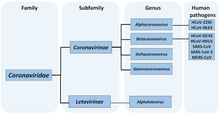
Taxonomy of family Coronaviridae with species pathogenic to humans.

Illustration of a coronavirus
The family Coronaviridae is organized in 2 sub-families, 5 genera, 26 sub-genera, and 46 species. Additional species are pending or tentative.
- Coronaviridae
- Orthocoronavirinae
- Letovirinae
- Alphaletovirus
- Milecovirus
- Microhyla letovirus 1
- Milecovirus
- Alphaletovirus
Coronavirus is the common name for Coronaviridae and Orthocoronavirinae, also called Coronavirinae. Coronaviruses cause diseases in mammals and birds. In humans, the viruses cause respiratory infections, including the common cold, which are typically mild, though rarer forms such as SARS (including the one causing COVID-19) and MERS can be lethal. Symptoms vary in other species: in chickens, they cause an upper respiratory disease, while in cows and pigs coronaviruses cause diarrhea. Other than for SARS-CoV-2, there no vaccines or antiviral drugs to prevent or treat human coronavirus infections. They are enveloped viruses with a positive-sense single-stranded RNA genome and a nucleocapsid of helical symmetry. The genome size of coronaviruses ranges from approximately 26 to 32 kilobases, among the largest for an RNA virus (second only to a 41-kb nidovirus recently discovered in planaria).
- Orthocoronavirinae
- Alphacoronavirus
- Colacovirus
- Bat coronavirus CDPHE15
- Decacovirus
- Bat coronavirus HKU10
- Rhinolophus ferrumequinum alphacoronavirus HuB-2013
- Duvinacovirus
- Human coronavirus 229E
- Luchacovirus
- Lucheng Rn rat coronavirus
- Minacovirus
- Mink coronavirus 1
- Minunacovirus
- Miniopterus bat coronavirus 1
- Miniopterus bat coronavirus HKU8
- Myotacovirus
- Myotis ricketti alphacoronavirus Sax-2011
- Nyctacovirus
- Nyctalus velutinus alphacoronavirus SC-2013
- Pipistrellus kuhlii coronavirus 3398
- Pedacovirus
- Porcine epidemic diarrhea virus
- Scotophilus bat coronavirus 512
- Rhinacovirus
- Rhinolophus bat coronavirus HKU2
- Setracovirus
- Human coronavirus NL63
- NL63-related bat coronavirus strain BtKYNL63-9b
- Soracovirus
- Sorex araneus coronavirus T14
- Sunacovirus
- Suncus murinus coronavirus X74
- Tegacovirus
- Alphacoronavirus 1 – type species
- Colacovirus
- Betacoronavirus
- Embecovirus
- Betacoronavirus 1
- Human coronavirus OC43
- China Rattus coronavirus HKU24
- Human coronavirus HKU1
- Murine coronavirus – type species
- Myodes coronavirus 2JL14
- Betacoronavirus 1
- Hibecovirus
- Bat Hp-betacoronavirus Zhejiang2013
- Merbecovirus
- Hedgehog coronavirus 1
- Middle East respiratory syndrome-related coronavirus (MERS-CoV)
- Pipistrellus bat coronavirus HKU5
- Tylonycteris bat coronavirus HKU4
- Nobecovirus
- Eidolon bat coronavirus C704
- Rousettus bat coronavirus GCCDC1
- Rousettus bat coronavirus HKU9
- Sarbecovirus
- Severe acute respiratory syndrome-related coronavirus
- Severe acute respiratory syndrome coronavirus (SARS-CoV)
- Severe acute respiratory syndrome coronavirus 2 (SARS-CoV-2, cause of COVID-19)
- Severe acute respiratory syndrome-related coronavirus
- Embecovirus
- Gammacoronavirus
- Brangacovirus
- Goose coronavirus CB17
- Cegacovirus
- Beluga whale coronavirus SW1
- Igacovirus
- Avian coronavirus – type species
- Avian coronavirus 9203
- Duck coronavirus 2714
- Brangacovirus
- Deltacoronavirus
- Andecovirus
- Wigeon coronavirus HKU20
- Buldecovirus
- Bulbul coronavirus HKU11 – type species
- Common moorhen coronavirus HKU21
- Coronavirus HKU15
- Munia coronavirus HKU13
- White-eye coronavirus HKU16
- Herdecovirus
- Night heron coronavirus HKU19
- Andecovirus
- Alphacoronavirus