
The impeachment process against Richard Nixon began in the United States House of Representatives on October 30, 1973, following the series of high-level resignations and firings widely called the “Saturday Night Massacre” during the course of the Watergate scandal.
The House Committee on the Judiciary set up an impeachment inquiry staff and began investigations into possible impeachable offenses by Richard Nixon, the 37th president of the United States. The process was formally initiated on February 6, 1974, when the House granted the Judiciary Committee authority to investigate whether sufficient grounds existed to impeach Nixon of high crimes and misdemeanors under Article II, Section 4, of the United States Constitution. This investigation was undertaken one year after the United States Senate established the Select Committee on Presidential Campaign Activities to investigate the 1972 break-in at the Democratic National Committee headquarters at the Watergate office complex in Washington, D.C., and the Republican Nixon administration’s attempted cover-up of its involvement; during those hearings the scope of the scandal became apparent and the existence of the Nixon White House tapes was revealed.
Following an April 1974 subpoena from the Judiciary Committee, edited transcripts of 42 taped White House conversations relevant to the Watergate cover-up were finally made public by Nixon. However, the committee pressed for the audio tapes themselves, and subsequently issued subpoenas for additional tapes, all of which Nixon had refused. That same month, Nixon also refused to comply with a subpoena from special prosecutor Leon Jaworski for 64 Watergate-related tapes. Ultimately, on July 24, 1974, the United States Supreme Court issued a unanimous decision against Nixon, which ordered him to comply.
On May 9, 1974, formal hearings in the impeachment inquiry of Nixon began, culminating July 27–30, 1974, when members of the Democratic-led Judiciary Committee eventually approved three articles of impeachment. The articles charged Nixon with: 1) obstruction of justice in attempting to impede the investigation of the Watergate break-in, protect those responsible, and conceal the existence of other illegal activities; 2) abuse of power by using the office of the presidency on multiple occasions, dating back to the first year of his administration (1969), to unlawfully use federal agencies, such as the Internal Revenue Service and the Federal Bureau of Investigation, as well as establishing a covert White House special investigative unit, to violate the constitutional rights of citizens and interfere with lawful investigations; and 3) contempt of Congress by refusing to comply with congressional subpoenas. These articles were reported to the House of Representatives for final action, with 7 of the committee’s 17 Republicans joining all 21 of its Democrats in voting in favor of one or more of the articles. Two other articles were debated in committee but were rejected. Based on the strength of the evidence presented and the bipartisan support for the articles in committee, House leaders of both political parties concluded that Nixon’s impeachment by the full House was a certainty if it reached the House floor for a final vote, and that his conviction in a Senate trial was a distinct possibility.
On August 5, 1974, Nixon released a transcript of one of the additional conversations to the public, known as the “smoking gun” tape, which made clear his complicity in the Watergate cover-up. This disclosure destroyed Nixon politically. His most loyal defenders in Congress announced they would vote to impeach and convict Nixon for obstructing justice. Republican congressional leaders met with Nixon and told him that his impeachment and removal were all but certain. Thereupon, Nixon gave up the struggle to remain in office, resigning the presidency on August 9, 1974, before the full House could vote on the articles of impeachment. Although arrangements for a final House vote along with a Senate trial were being made at the time, further formal action was rendered unnecessary by his resignation, so the House brought the impeachment process against him to an official close two weeks later.
Nixon was the first U.S. president in over a century, since Andrew Johnson in 1868, to be the subject of formal impeachment proceedings in the House of Representatives. Two of Nixon’s successors have undergone similar proceedings, and both, like Johnson, were impeached but then acquitted at the consequent Senate trial. Thus, while Nixon himself was not impeached, the impeachment process against him is so far the only one to cause a president’s departure from office.
Background
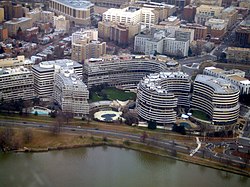
The Watergate scandal began with the June 17, 1972, break-in at the Democratic National Committee headquarters at the Watergate Office Building in Washington, D.C., and the Nixon administration’s attempted cover-up of its involvement. In January 1973, the same month in which President Nixon began his second term, the burglars each went on trial separately before U.S. District Judge John Sirica; all pleaded or were found guilty. That February, the United States Senate voted to create a special investigative committee to look into the scandal. The resultant Senate Watergate hearings, led by Sam Ervin, commenced in May 1973. Broadcast “gavel-to-gavel” nationwide by PBS and (alternately) by the three U.S. commercial networks—ABC, CBS and NBC, the hearings aroused and held great public interest through that summer. Senators heard testimony that the president had approved plans to cover up administration involvement with the Watergate break-in, and learned of the existence of a voice-activated taping system in the Oval Office.
Separately, on May 25, 1973, Attorney General Elliot Richardson appointed Archibald Cox as special prosecutor for the federal investigation into possible Nixon administration ties to the Watergate burglary. When the existence of tape recorded White House conversations became known in July of that year, both Cox and the Senate Watergate Committee asked Judge Sirica to issue a subpoena for several “relevant and important” recordings and documents. The president, who denied prior knowledge of the Watergate burglary or participating in its cover-up, which he claimed to have been unaware of until earlier in 1973, refused to comply with the subpoenas, citing executive privilege and national security concerns. During an address to the nation on Watergate the following month, Nixon justified his refusal:
This principle of confidentiality of presidential conversations is at stake in the question of these tapes. I must and I shall oppose any efforts to destroy this principle, which is so vital to the conduct of this great office.
Nixon’s adamant refusal to comply with the subpoenas for the tapes sparked a constitutional crisis between the White House and Congress and the special prosecutor. On August 9, the Senate committee filed suit in federal district court to force President Nixon to make the subpoenaed tapes available. Hoping to avoid making a ruling, the Court asked the parties to negotiate an out of court solution; their effort to find an acceptable compromise failed however, largely due to Nixon’s intransigence. Nevertheless, Nixon soon began contemplating ways to accommodate Cox, the Senate Watergate committee, and Sirica after two polls showed that public opinion was solidly against him: 61 percent of those responding to a Gallup Poll said the president should release the subpoenaed tapes to the court; 54 percent of those responding to a Harris Poll said Congress would be justified in beginning impeachment proceedings against the president if he refused to obey a court order directing him to turn over the tapes.
In a 5–2 ruling on October 12, a U.S. court of appeals upheld Sirica’s subpoena. Weakened by the decision, the president, together with Chief of Staff Alexander Haig and Press Secretary Ron Ziegler, moved forward with a proposed compromise: the White House would prepare transcripts of the tapes, Senator John C. Stennis, a Democrat, and chairman of the Senate Armed Services Committee, would be asked to listen to the tapes himself and make a comparison between the transcripts and the tapes. His authenticated version would be submitted to the court. The White House also wanted to empower Stennis to paraphrase language that in its original form would, in his judgment, be embarrassing to the President, and wanted an assurance from Cox that no other tapes would be subpoenaed by his office. The administration’s explanation was that Stennis would be sensitive to matters of national security contained within. However, as Stennis was hard-of-hearing and on heavy doses of medication since being mugged and shot earlier in the year, it is believed that the president did not want the tapes entered into the public record verbatim, because they contained recordings of him and others using coarse language and racial slurs, and making possibly incriminating statements. When the plan was presented to him, Cox categorically rejected it.
Afterward, on October 20, after being directed by the White House to make no further attempts to obtain tapes, notes or memoranda of presidential conversations, Cox held a news conference to state that he would continue pressing in court for the tapes, even if it meant asking that Nixon be held in contempt if the White House refused to turn them over. Nixon thereupon ordered that Cox be fired, precipitating the immediate departures of Attorney General Richardson and Deputy Attorney General William Ruckelshaus in what became known as the “Saturday Night Massacre.”
Early calls for impeachment
During the opening months of the 93rd Congress, multiple resolutions calling for a presidential impeachment inquiry were introduced in the House and referred to its Judiciary Committee. The committee began an examination of the charges under its general investigative authority. In February 1973, the House approved a resolution providing additional investigative authority that did not specifically mention impeachment.
The first resolution to directly call for President Nixon’s impeachment was introduced on July 31, 1973, by Robert Drinan. His resolution, which did not contain specific charges, was made in response to Nixon’s clandestine authorization of the bombing of Cambodia, as well as his actions relative to the growing Watergate scandal. The resolution was effectively ignored by leaders of both parties. House Majority Leader Tip O’Neill later said,
Morally, Drinan had a good case. But politically, he damn near blew it. For if Drinan’s resolution had come up for a vote at the time he filed it, it would have been overwhelmingly defeated—by something like 400 to 20. After that, with most of the members already on record as having voted once against impeachment, it would have been extremely difficult to get them to change their minds later on.
By September 1973, there was a sense that Nixon had regained some political strength, the American public had become burned out by the Watergate hearings, and Congress was not willing to undertake impeachment absent some major revelation from the White House tapes or some egregious new presidential action against the investigation. There was, nonetheless, a public appetite for information about impeachment, piqued by the legal maneuvering over the tapes. Accordingly, the Judiciary Committee prepared a 718-page book on the topic. Published in October 1973, it traces the origin of the impeachment power, cites all the instances in which that power had previously been used by Congress and gives a detailed description of Andrew Johnson’s 1868 Senate impeachment trial.
Preparation for impeachment inquiry
Initiating the inquiry

Demonstrators in Washington, D.C., demanding that Congress impeach President Nixon, following the “Saturday Night Massacre”
The October 20 “Saturday Night Massacre” rapidly became a public relations disaster for Nixon. Shortly after the White House announced the firing and the resignations, NBC News anchor John Chancellor interrupted the network’s prime time programming with a dire message: “The country tonight is in the midst of what may be the most serious constitutional crisis in its history.” The next day, The New York Times declared: “The nation is in the hands of a president overcome with dictatorial misconceptions of his constitutional authority.” The White House and congressional offices were deluged with a record shattering 450,000 telegrams, most demanding Nixon’s impeachment; hundreds of demonstrators gathered outside the White House, loudly demanding the same.
Nixon’s firing of Archibald Cox triggered an uproar in Congress as well. Beginning on October 23, outraged House Democrats introduced 22 separate impeachment-related resolutions, variously calling for impeachment or an impeachment investigation or (at least) a new special prosecutor. Additionally, Nixon was the subject of several resolutions that either sought to censure him or that called for him to resign. Speaker of the House Carl Albert referred the various resolutions to the Judiciary Committee.
Further, Nixon’s actions were widely criticized by Republican congressional leaders, who demanded “full and complete disclosure” to investigators of all subpoenaed Watergate materials as well as the appointment of a new special prosecutor. That same day, Nixon agreed to turn the subpoenaed tapes over to Judge Sirica. The president also reversed course on his decision to abolish the office of the special prosecutor, which he had done when he fired Cox. One week later, Leon Jaworski was appointed to the post by the acting attorney general, Robert Bork.
Speaker Albert, who at the time was first in the presidential line of succession, following the resignation of Vice President Spiro Agnew on October 10, cautioned the committee against taking impulsive or ill-considered action on impeachment; he also called on Congress to take swift action on the nomination of Gerald Ford to fill the vice presidential vacancy. During the vacancy, Albert came under increasing pressure from various liberal House Democrats, such as Bella Abzug, to do the opposite. By using his political power to delay Ford’s confirmation as vice president and expedite Nixon’s impeachment and removal from office, Albert would become acting president and the Democratic Party would assume control of the executive branch without having to win an election. He rejected that course of action, however, though he did develop a 19-page contingency plan for a presidential transition, just in case. Importantly, Rodino told the committee that the Ford nomination would not be held “hostage” until the impeachment inquiry was completed.
The Judiciary Committee voted on October 30, to begin consideration of possible impeachment of President Nixon by a 21–17 party-line vote, with all the committee’s Democrats voting yes and all Republicans voting no, and took up the matter in earnest that December, upon completing the Ford confirmation hearings. The committee was led by Peter W. Rodino, who, until assuming its chairmanship in January 1973, had kept a low profile in Congress. Now front and center in the political limelight, he told a reporter: “If fate had been looking for one of the powerhouses of Congress, it wouldn’t have picked me.” Those wishing to expedite the impeachment were critical of the slowness of running the process through the Judiciary Committee and of Rodino’s leadership abilities. But Albert, who thought Rodino and his committee had done a fair and thorough job during the Ford hearings, was content to let the committee handle the process.
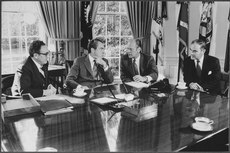
Secretary of State Kissinger, President Nixon, vice-presidential nominee Ford, and White House Chief of Staff Haig in the Oval Office, October 1973
On November 4, 1973, Senator Edward Brooke became the first congressional Republican to publicly urge President Nixon to resign. That same week, several newspapers, including The Atlanta Journal, The Denver Post, The Detroit News, and The New York Times, published editorials also urging him to resign. Time magazine, in its first editorial in 50 years of publication, did so as well, declaring that the president “has irredeemably lost his moral authority” to govern effectively, and that Nixon “and the nation have passed a tragic point of no return.” Later in November, the ACLU, which two months earlier had become the first national organization to publicly call for the president’s impeachment and removal, released a 56‐page handbook detailing “17 things citizens could do to bring about the impeachment of President Nixon.”
With momentum on impeachment quickly building in Congress, Nixon held a live one-hour televised press conference on November 17 to defend himself. In addition to Watergate-related matters, the president addressed a variety of topics, including the nation’s energy crisis and his personal finances. In response to a question concerning allegations of fraud on his tax returns, he stated categorically: “People have got to know whether or not their president is a crook. Well, I am not a crook.”
Over the next two months, as the impeachment investigations began, there was speculation in Washington that Nixon might resign. Despite several attempts to do so, Nixon had not been able to put Watergate behind him, and the momentum of events was against him. In the climate of anxiety and skepticism engendered by the Watergate scandal, the president’s health and morale, as well as the motives behind his words and actions became the subject of much speculation. Rumors persisted that he was in poor mental and physical shape, and the White House became ultra-sensitive to any assessment of the president’s public behavior that might cast doubt on his ability to govern.
Assembling investigation staff
Meanwhile, to ensure a “fair and principled inquiry” by keeping the impeachment process out of the hands of overzealous liberals, Rodino, with the support of the committee’s ranking minority member Edward Hutchinson, decided to hire an independent lead special counsel for the inquiry whom the committee would oversee. John Doar, formerly a civil rights attorney in the Kennedy and Johnson administrations, was hired for the position in December 1973. A registered Republican, he shared with Rodino a view that the Senate hearings had gone overboard with leaked revelations and witnesses compelled to testify under immunity grants; they were determined to do things in a more thorough and objective process. He also shared Rodino’s view that the process would be as even-handed as possible, and was given the freedom to hire his own inquiry staff, separate from that handling regular Committee business.
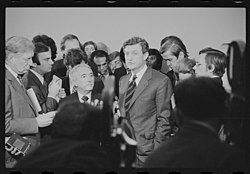
Judiciary Committee Chairman Rodino (center-left) and Special Counsel Doar speaking with reporters, January 24, 1974
While assembling his team, Doar began meticulously reviewing the Watergate grand jury testimony, Senate Watergate committee files and the earlier-released taped White House conversations. He supervised a staff which in due course grew to 100 people, including some 43 attorneys, of whom four were black and two were women, plus scores of researchers, clerks, typists, and other support personnel, who all worked long, sometimes tedious hours.
The attorneys hired were nearly all recent (1968 or after) law school graduates. Among them was Bill Weld, who would go on to become the governor of Massachusetts. He worked on researching case law regarding what constituted grounds for presidential impeachment, and whether impoundment of appropriated funds was an impeachable offense. Another staff member was Hillary Rodham, not yet married to Bill Clinton, who would go on to become first lady of the United States, U.S. Senator, and U.S. Secretary of State. She helped research procedures of impeachment, and like Weld, the historical grounds and standards for impeachment. She also worked on a task force led by Evan A. Davis, that gathered and organized the facts pertaining to the Watergate break-in and cover-up by: reading through earlier Senate Watergate Committee testimony; examining the various documents and tape recordings released by Nixon in April 1974; and interviewing witnesses.
Albert E. Jenner Jr., who had previously served as assistant counsel to the Warren Commission investigating the assassination of President Kennedy, was named in January 1974 as senior counsel on the inquiry staff for the Republican minority on the Judiciary Committee, and Sam Garrison, who previously had been staff counsel and legislative liaison to Vice President Agnew, was named deputy counsel. Additionally, Nixon shuffled his legal team, and in January 1974, James D. St. Clair, a Boston lawyer, supplanted Charles Wright as the president’s lead attorney. At its height his legal team employed 15 lawyers. St. Clair’s defense was centered around the notion that while Nixon had made a number of statements that looked bad, he had committed no crimes. He also stated on numerous occasions during the proceedings, in explanation of his role: “I don’t represent Mr. Nixon personally. I represent him in his capacity as president.”
As the Judiciary Committee prepared to begin a formal impeachment inquiry, the president tried once more to contain the situation. At the conclusion of his 1974 State of the Union Address on January 30, Nixon asked for an expeditious resolution to any impeachment proceedings against him, so the government could function fully effectively again. He told Congress directly that “one year of Watergate is enough” and asserted that he had no “intention whatever” of resigning.
Inquiry staff investigation
| Watergate scandal |
|---|
|
| Events |
| People |