Facebook, Inc., is an American technology conglomerate based in Menlo Park, California. It was founded by Mark Zuckerberg, along with his fellow roommates and students at Harvard College, who were Eduardo Saverin, Andrew McCollum, Dustin Moskovitz and Chris Hughes, originally as TheFacebook.com—today’s Facebook, a popular global social networking service. It is one of the world’s most valuable companies. It is considered one of the Big Five companies in U.S. information technology, with Google, Apple, Microsoft and Amazon.
Facebook offers other products and services beyond its social networking platform, including Facebook Messenger, Facebook Watch, and Facebook Portal. It also has acquired Instagram, WhatsApp, Oculus, Giphy and Mapillary, and has a 9.9% stake in Jio Platforms.
History
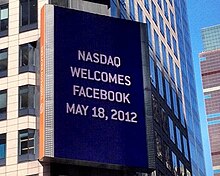
Billboard on the Thomson Reuters building welcomes Facebook to NASDAQ, 2012
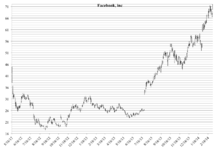
Chart of Facebook’s stock
Facebook filed for an initial public offering (IPO) on February 1, 2012. The preliminary prospectus stated that the company sought to raise $5 billion, that the company had 845 million active monthly users, and that its website featured 2.7 billion daily likes and comments. After the IPO, Zuckerberg would retain a 22% ownership share in Facebook and would own 57% of the voting shares.
Underwriters valued the shares at $38 each, pricing the company at $104 billion, the largest valuation to date for a newly public company. On May 16, one day before the IPO, Fathaok announced it would sell 25% more shares than originally planned due to high demand. The IPO raised $16 billion, making it the third largest in U.S. history (just ahead of AT&T Wireless and behind only General Motors and Visa). The stock price left the company with a higher market capitalization than all but a few U.S. corporations—surpassing heavyweights such as Amazon, McDonald’s, Disney, and Kraft Foods—and made Zuckerberg’s stock worth $19 billion. The New York Times stated that the offering overcame questions about Facebook’s difficulties in attracting advertisers to transform the company into a “must-own stock”. Jimmy Lee of JPMorgan Chase described it as “the next great blue-chip”. Writers at TechCrunch, on the other hand, expressed skepticism, stating, “That’s a big multiple to live up to, and Facebook will likely need to add bold new revenue streams to justify the mammoth valuation”.
Trading in the stock, which began on May 18, was delayed that day due to technical problems with the NASDAQ exchange. The stock struggled to stay above the IPO price for most of the day, forcing underwriters to buy back shares to support the price. At closing bell, shares were valued at $38.23, only $0.23 above the IPO price and down $3.82 from the opening bell value. The opening was widely described by the financial press as a disappointment. The stock nonetheless set a new record for trading volume of an IPO. On May 25, 2012, the stock ended its first full week of trading at $31.91, a 16.5% decline.
On May 22, 2012, regulators from Wall Street’s Financial Industry Regulatory Authority announced that they had begun to investigate whether banks underwriting Facebook had improperly shared information only with select clients rather than the general public. Massachusetts Secretary of State William Galvin subpoenaed Morgan Stanley over the same issue. The allegations sparked “fury” among some investors and led to the immediate filing of several lawsuits, one of them a class action suit claiming more than $2.5 billion in losses due to the IPO. Bloomberg estimated that retail investors may have lost approximately $630 million on Facebook stock since its debut.
Standard & Poor’s added Facebook, Inc. to its S&P 500 index on December 21, 2013.
On May 2, 2014, Zuckerberg announced that the company would be changing its internal motto from “Move fast and break things” to “Move fast with stable infrastructure”. The earlier motto had been described as Zuckerberg’s “prime directive to his developers and team” in a 2009 interview in Business Insider, in which he also said, “Unless you are breaking stuff, you are not moving fast enough.”
In May 2019, Facebook founded Libra Networks, reportedly to develop their own stablecoin cryptocurrency. In recent developments it has been reported that Libra is being supported by financial companies like Visa, Mastercard, PayPal and Uber. The consortium of companies is expected to pool in $10 million each to fund the launch of the cryptocurrency coin named Libra. Depending on when it receives approval from the Swiss Financial Market Supervisory authority to operate as a payments service, the Libra Association plans to launch a limited format cryptocurrency in 2021.
Mergers and acquisitions
Throughout its existence, Facebook has acquired multiple companies (often identified as talent acquisitions).
One of its first major acquisitions was in April 2012, when it acquired Instagram for approximately US$1 billion in cash and stock.
In October 2013, Facebook acquired Onavo, an Israeli mobile web analytics company.
In February 2014, Facebook announced it would buy mobile messaging company WhatsApp for US$19 billion in cash and stock. Later that year, Facebook bought Oculus VR for $2.3 billion in stock and cash, which released its first consumer virtual reality headset in 2016.
In late July 2019, the company announced it was under antitrust investigation by the Federal Trade Commission.
In late November 2019, Facebook announced the acquisition of game developer Beat Games, responsible for developing one of the year’s most popular VR titles, Beat Saber.
In April 2020, Facebook announced a $5.7 billion deal with the Indian multinational conglomerate Reliance Industries to purchase approximately 10 percent of Jio Platforms, Reliance’s digital media and services entity.
In May 2020, Facebook announced they had acquired Giphy for a reported cash price of $400 million. It will be integrated with the Instagram team.
Facebook announced in November 2020 that they planned to purchase the customer-service platform and chatbot specialist startup Kustomer to promote companies to use their platform for business. It has been reported that Kustomer valued at slightly over $1 billion.
Lobbying
In 2020, Facebook spent $19.7m on lobbying, hiring 79 lobbyists. In 2019, it had spent $16.7m on lobbying and had a team of 71 lobbyists, up from $12.6m and 51 lobbyists in 2018.
Lawsuits
 |
This section needs expansion. You can help by adding to it. (December 2020)
|
Facebook has been involved in multiple lawsuits since its founding.
In March 2020, The Office of the Australian Information Commissioner (OAIC) has sued Facebook Inc., for significant and persistent infringements of the rule on privacy involving the Cambridge Analytica fiasco. Every violation of the Privacy Act is subject to a theoretical cumulative liability of $1.7 million. The OAIC estimated that a total of 311,127 Australians had been exposed.
On December 8, 2020, the Federal Trade Commission, along with 46 US states (excluding Alabama, Georgia, South Carolina, and South Dakota), the District of Columbia and the territory of Guam, launched Federal Trade Commission v. Facebook as an antitrust lawsuit against Facebook. The lawsuit concerns Facebook’s acquisition of two competitors – Instagram and WhatsApp – and the ensuing monopolistic situation. FTC alleges that Facebook holds monopolistic power in the US social networking market and seeks to force the company to divest from Instagram and WhatsApp to break up the conglomerate. William Kovacic, a former chairman of the Federal Trade Commission, argued the case will be difficult to win as it would require the government to create a counterfactual argument of an internet where the Facebook-WhatsApp-Instagram entity did not exist, and prove that harmed competition or consumers.
Structure
Management
Facebook’s key management consists of:
- Mark Zuckerberg, Chairman and Chief Executive Officer
- Sheryl Sandberg, Chief Operating Officer
- Mike Schroepfer, Chief Technology Officer
- David Wehner, Chief Financial Officer
- Chris Cox, Chief Product Officer
As of December 2020, Facebook has 58,604 employees, an increase of 30.4% year-over-year.
Board of directors
In April 2019, Facebook nominated Peggy Alford to be added as a board member during the May 2019 AGM. If this happens, she will become the first African-American woman to serve in this board, and the second African-American ever to do so. As of April 2019, Facebook’s board consists of the following directors;
- Mark Zuckerberg (Chairman, Founder and CEO)
- Sheryl Sandberg (Executive Director and COO)
- Peggy Alford (Non-Executive Director, Executive Vice President, Global Sales, PayPal)
- Marc Andreessen (Non-Executive Director, Co-Founder and General Partner, Andreessen Horowitz)
- Drew Houston (Non-Executive Director, Chairman and CEO, Dropbox)
- Nancy Killefer (Non-Executive Director, Senior Partner, McKinsey & Company)
- Robert M. Kimmitt (Non-Executive Director, Senior International Counsel, WilmerHale)
- Peter Thiel (Non-Executive Director, Co-Founder and Former CEO, PayPal, Founder and President, Clarium Capital)
- Tracey Travis (Non-Executive Director, Executive Vice President, Chief Financial Officer, Estée Lauder Companies)
Company governance
Early Facebook investor and former Zuckerberg mentor Roger McNamee described Facebook as having “the most centralized decision-making structure I have ever encountered in a large company.” Nathan Schneider, a professor of media studies at the University of Colorado Boulder argued for transforming Facebook into a platform cooperative owned and governed by the users.
Facebook cofounder Chris Hughes has stated that CEO Mark Zuckerberg has too much power, that the company is now a monopoly, and that, as a result, it should be split into multiple smaller companies. In an op-ed in The New York Times, Hughes said hewas concerned that Zuckerberg had surrounded himself with a team that didn’t challenge him, and that it’s the U.S. government’s job to hold him accountable and curb his “unchecked power.” He also said that “Mark’s power is unprecedented and unamerican.” Several U.S. politicians agree with Hughes. European Union Commissioner for Competition Margrethe Vestager stated that splitting Facebook should be done only as “a remedy of the very last resort”, and that it would not solve Facebook’s underlying problems.
Revenue
| Year | Revenue | Growth |
|---|---|---|
| 2004 | $0.4 | — |
| 2005 | $9 | 2150% |
| 2006 | $48 | 433% |
| 2007 | $153 | 219% |
| 2008 | $280 | 83% |
| 2009 | $775 | 177% |
| 2010 | $2,000 | 158% |
| 2011 | $3,711 | 86% |
| 2012 | $5,089 | 37% |
| 2013 | $7,872 | 55% |
| 2014 | $12,466 | 58% |
| 2015 | $17,928 | 44% |
| 2016 | $27,638 | 54% |
| 2017 | $40,653 | 47% |
| 2018 | $55,838 | 38% |
| 2019 | $70,697 | 27% |
| 2020 | $85,965 | 22% |
Facebook ranked No. 76 in the 2018 Fortune 500 list of the largest United States corporations by revenue. Most comes from advertising. One analysis of 2017 data determined that the company earned US$20.21 per user from advertising.
Number of advertisers
In February 2015, Facebook announced it had reached two million active advertisers, with most of the gain coming from small businesses. An active advertiser is one that has advertised on the Facebook platform in the last 28 days. In March 2016, Facebook announced it had reached three million active advertisers with more than 70% from outside the US. Prices for advertising follow a variable pricing model based on ad auction bids, potential engagement levels of the advertisement itself. Similar to other online advertising platforms like Google and Twitter, targeting of advertisements is one of the chief merits of advertising vs. traditional mass advertising modes like television and print. Marketing on Facebook is employed through two methods based on the viewing habits, likes and shares, and purchasing data of the audience, namely targeted audiences and “look alike” audiences.
Tax affairs
The US IRS challenged the valuation Facebook used when it transferred IP from the US to Facebook Ireland in 2010 (which Facebook Ireland then revalued higher before charging out), as it was building its double Irish tax structure. The case is ongoing and Facebook faces a potential fine of $3–5bn.
The US Tax Cuts and Jobs Act of 2017 changed Facebook’s global tax calculations. Facebook Ireland is subject to the US GILTI tax of 10.5% on global intangible profits (i.e. Irish profits). On the basis that Facebook Ireland is paying some tax, the effective minimum US tax for Facebook Ireland will be circa 11%. In contrast, Facebook Inc. would incur a special IP tax rate of 13.125% (the FDII rate) if its Irish business relocated to the US. Tax relief in the US (21% vs. Irish at the GILTI rate) and accelerated capital expensing, would make this effective US rate around 12%.
The insignificance of the US/Irish tax difference was demonstrated when Facebook moved 1.5bn non-EU accounts to the US to limit exposure to GDPR.
Facilities
Offices
Users outside of the US and Canada contract with Facebook’s Irish subsidiary, Facebook Ireland Limited, allowing Facebook to avoid US taxes for all users in Europe, Africa and South America. Facebook is making use of the Double Irish arrangement which allows it to pay 2–3% corporation tax on all international revenue. Users in the Asia-Pacific contract with Facebook’s Singaporean subsidiary, Facebook Singapore Pte. Ltd.
In 2010, Facebook opened an office in Hyderabad ,India, which houses online advertising and developer support teams and provides support to users and advertisers. In India, Facebook is registered as Facebook India Online Services Pvt Ltd. It also has support centers in Dublin, Ireland, Singapore, and Austin, Texas.
In 2017, Facebook opened an office in the Fitzrovia area of London. In 2018 it opened offices in Cambridge, Massachusetts, initially home to its “Connectivity Lab”, a group focused on bringing Internet access to those who did not have it. That year, Facebook also opened its main Asia-Pacific headquarters at Marina One in Singapore.
-
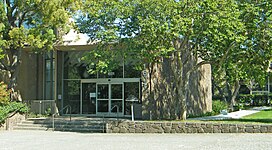
Entrance to Facebook’s previous headquarters in the Stanford Research Park, Palo Alto, California
-

Entrance to Facebook headquarters complex in Menlo Park, California
-

Inside the Facebook headquarters in 2014
Data centres
As of 2019 Facebook operated 16 data centres. It committed to purchase 100% renewable energy and to reduce its greenhouse gas emissions 75% by 2020. Its data center technologies include Fabric Aggregator, a distributed network system that accommodates larger regions and varied traffic patterns.