
Gurjar or Gujjar (also transliterated as Gujar, Gurjara and Gujjer ) is an ethnic agricultural and pastoral community of India, Pakistan, and Afghanistan. Although traditionally they have been involved in agriculture (most famously, dairy and livestock farming), Gurjars are a large heterogeneous group that is internally differentiated in terms of culture, religion, occupation, and socio-economic status. The historical role of Gurjars has been quite diverse in society, at one end they have founded kingdom, districts, cities, towns, and villages, and at the other end, they are also nomads with no land of their own.
The pivotal point in the history of Gurjar identity is often traced back to the emergence of a Gurjara kingdom in present-day Rajasthan during medieval times (around 570 CE). It is believed that the Gurjars migrated to different parts of the Indian Subcontinent from the Gurjara kingdom. Previously, it was believed that the Gurjars had migrated earlier on from Central Asia as well, however, this view is generally considered to be speculative. Historical references speak of Gurjara warriors and commoners in North India in the 7th century CE, and mention several Gurjara kingdoms and dynasties. The Gurjaras started fading way from the forefront of history after 10th century CE. Thereafter, several Gurjar chieftains and upstart warriors are mentioned in history, who were rather petty rulers in contrast to their predecessors. The modern forms “Gurjar” and “Gujjar” were quite common during the Mughalera, and documents dating from the period mention Gurjars as a “turbulent” people. The Indian states of Gujarat and Rajasthan were known as Gurjaradesa and Gurjaratra for centuries prior to the arrival of the British power. The Gujrat and Gujranwala districts of Pakistani Punjab have also been associated with Gujjars from as early as the 8th century CE, when there existed a Gurjara kingdom in the same area. The Saharanpur district of Uttar Pradesh was also known as Gujarat previously, due to the presence of many Gujjar zamindars, or land holding farmer class, in the area.
Gurjars are linguistically and religiously diverse. Although they are able to speak the language of the region and country where they live, Gurjars have their own language, known as Gujari. They variously follow Hinduism, Islam, and Sikhism. The Hindu Gurjars are mostly found in Indian states of Rajasthan, Haryana, Madhya Pradesh, Punjab Plains and Maharashtra. Muslim Gujjars are mostly found in Punjab, Pakistan where they make up 20% of the population, mainly concentrated in Northern Punjabi cities of Gujranwala, Gujrat, Gujar Khan, Jehlum and Lahore, Afghanistan and Indian Himalayan regions such as Jammu & Kashmir, Himachal Pradesh and Garhwal and Kumaon divisions of Uttarakhand.
The Gurjars are classified as Other Backward Class (OBC) in some of India’s States and UTs; in Jammu and Kashmir and some parts of Himachal Pradesh they are categorised as a Scheduled Tribe.
Contents
- Etymology
- History
- Origin
- Medieval period
- British rule
- Culture
- Afghanistan
- India
- Haryana
- Rajasthan
- Madhya Pradesh
- Maharashtra
- Gujarat
- Himachal Pradesh
- Jammu and Kashmir
- Uttarakhand – Van Gurjars
- Pakistan
- See also
- References
- Bibliography
- Further reading
- External links
Etymology
The word Gurjar represents a modern caste group in India, Pakistan, and Afghanistan, locally referred to as jati, zaat, qaum or biradari The history of the word Gurjar can be confidently traced back to an ancient ethnic and tribal identity called Gurjara, which became prominent after the collapse of Gupta Empire. A literal or definitive meaning of the word Gurjara is not available in any of the historical references. The oldest reference to the word Gurjara is found in the book called Harshacharita (Harsha’s Deeds), a biography of king Harshavardhana written around 630 CE. Banabhatta, the author of Harshacharita, mentions that Harsha’s father Prabhakravardhana (560-580 CE) was “a constant threat to the sleep of Gurjara”—apparently a reference to the Gurjara king or kingdom. Inscriptions from a collateral branch of Gurjaras, known as Gurjaras of Lata, claim that their family was ruling Bharakucha (Bharuch) as early as 450 CE from their capital at Nandipuri. Based on these early dates, it has been proposed by some authors that Gurjara identity might have been present in India as early as the 3rd century CE, but it became prominent only after the fall of Guptas.
It has been suggested by several historians that Gurjara was initially the name of a tribe or clan which later evolved into a geographical and ethnic identity following the establishment of a janapada (tribal kingdom) called ‘Gurjara’. This understanding has introduced an element of ambiguity regarding ancient royal designations containing the word ‘gurjara’ such as ‘gurjaraeshvara‘ or ‘gurjararaja‘, as now its debatable whether the kings bearing these epithets were tribal or ethnic Gurjaras.
History
Origin
Historians and anthropologists differ on the issue of Gurjar origin. According to one view, the ancient ancestors of Gurjars came from central Asia via Georgia from near the Caspian Sea; that Sea’s alternate name of the Bahr-e-Khizar caused the tribe to be known as Khizar, Guzar, Gujur, Gurjara, or Gujjar. According to this view, between 1 BCE and 1 CE, the ancient ancestors of Gurjars came in multiple waves of migration and they were initially accorded status as high-caste warriors in the Hindu fold in the North-Western regions (modern Rajasthan and Gujarat). Aydogdy Kurbanovstates that some Gurjars, along with people from northwestern India, merged with the Hephthalites to become the Rajput clan.
According to scholars such as Baij Nath Puri, the Mount Abu (ancient Arbuda Mountain) region of present-day Rajasthan had been an abode of the Gurjars during the medieval period. The association of the Gurjars with the mountain is noticed in many inscriptions and epigraphs including Tilakamanjari of Dhanpala. These Gurjars migrated from the Arbuda mountain region and as early as in the 6th century A.D., they set up one or more principalities in Rajasthan and Gujarat. The whole or a larger part of Rajasthan and Gujarat had been long known as Gurjaratra (country ruled or protected by the Gurjars) or Gurjarabhumi (land of the Gurjars) for centuries prior to the Mughal period.
In Sanskrit texts, the ethnonym has sometimes been interpreted as “destroyer of the enemy”: gur meaning “enemy” and ujjar meaning “destroyer”).
In its survey of The People of India, the Anthropological Survey of India(AnSI) – a government-sponsored organisation – noted that
The Gurjars/Gujjars were no doubt a remarkable people spread from Kashmir to Gujarat and Maharashtra, who gave an identity to Gujarat, established kingdoms, entered the Rajput groups as the dominant lineage of Badgujar, and survive today as a pastoral and a tribal group with both Hindu and Muslim segments.
Irawati Karve, the Indologist and historian, believed that the Gurjars position in society and the caste system generally varied from one linguistic area of India to another. In Maharashtra, Karve thought that they were probably absorbed by the Rajputs and Marathas but retained some of their distinct identity. She based her theories on analysis of clan names and tradition, noting that while most Rajputs claim their origins to lie in the mythological Chandravansh or Suryavansh dynasties, at least two of the communities in the region claimed instead to be descended from the Agnivansh.
A 2009 study conducted by Tribal Research and Cultural Foundation, under the supervision of Gurjar scholar Javaid Rahi, claimed that the word “Gojar” has a Central Asian Turkic origin, written in romanized Turkish as Göçer. The study claimed that according to the new research, the Gurjar race “remained one of the most vibrant identity of Central Asia in BC era and later ruled over many princely states in northern India for hundred of years.”
Medieval period
Many Gurjars were converted to Islam at various times, dating back to Mahmud of Ghazni’s raid in Gujarat in 1026. Gurjars of Awadh and Meerut date their conversion to Tamerlane, when he sacked Delhi and forcibly converted them. By 1525, when Babur invaded India, he saw that the Gurjars of northern Punjab were already Muslims. Until the 1700s, conversions continued under Aurangzeb, who converted the Gurjars of Himachal Pradesh by force. Pathans and Balochis drove Gujar converts out of their land, forcing them into vagrancy.
British rule
- Gurjars during the 19th century
-

Image depicting a scene of combat between a Gurjar and a British soldier during the 1824 Gurjar rebellion in Saharanpur district
-

Gurjar zamindar from Saharanpur, 1868
-

Two Gurjar men and a woman in Delhi, c. 1859-1869
-

Gurjar zamindars from Rajputana
-

Gurjar man, 1868
In the 18th century, several Gurjar chieftains and small kings were in power. During the reign of Rohilla Nawab Najib-ul-Daula, Rao Dargahi Singh Bhati, the Gurjar chieftain of Dadri possessed 133 villages at a fixed revenue of Rs. 29,000. A fort in Parikshitgarh in Meerut district, also known as Qila Parikishatgarh, is ascribed to a Gurjar king Nain Singh Nagar.
During the revolt of 1857, the Gurjars of Chundrowli rose against the British, under the leadership of Damar Ram. The Gurjars of Shunkuri village, numbering around three thousand, joined the rebel sepoys. According to British records, the Gurjars plundered gunpowder and ammunition from the British and their allies. In Delhi, the Metcalfe House was sacked by Gurjar villagers from whom the land was taken to erect the building. The British records claim that the Gurjars carried out several robberies. Twenty Gurjars were reported to have been beheaded by Rao Tula Ram for committing dacoities in July 1857. In September 1857, the British were able to enlist the support of many Gurjars at Meerut. The colonial authors always used the code word “turbulent” for the castes who were generally hostile to British rule. They cited proverbs that appear to evaluate the caste in an unfavorable light. A British administrator, William Crooke, described that Gurjars seriously impeded the operations of the British Army before Delhi. Reporter Meena Radhakrishna believe that the British classified the Gurjars along with others as “criminal tribes” because of their active participation in the revolt of 1857, and also because, they considered these tribes to be prone to criminality in the absence of legitimate means of livelihood.
Culture
Afghanistan
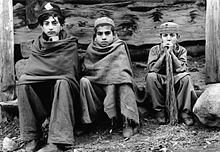
Gurjar children in Afghanistan, 1984
Small pockets of Gurjars are found in Afghanistan’s northeastern region, particularly in and around the Nuristan province.
India
Today, the Gurjars are classified under the Other Backward Class category in some states in India.However, in Jammu and Kashmir and parts of Himachal Pradesh, they are designated as a Scheduled Tribe under the Indian government’s reservation program of positive discrimination. Hindu Gurjars were assimilated into several varnas.
Haryana
The Gurjar community in Haryana has set elaborate guidelines for solemnizing marriages and holding other functions. In a mahapanchayat(“the great panchayat”), the Gurjar community decided that those who sought dowry would be excommunicated from the society.
Rajasthan

Fairs of Shri Devnarayan Bhagwanare organized two times in a year at Demali, Maalasheri, Asind and Jodhpuriya

Statue of Sri Sawai Bhoj Bagaravat, one of the 24 Gurjar brothers collectively known as Bagaravats, at Dev Dham Jodhpuriya temple.
Songs pertaining to Krishna and Gurjars were documented in Gurjar-inhabited areas during the British Raj, the connection being that Nand Mihir, the foster-father of Krishna, is claimed to be a Gurjar. Radha, the consort of Krishna, was also a Gurjar.
The Rajasthani Gurjars worship the Sun God, Devnarayan (an avatar of Vishnu), Shiva and Bhavani.
In Rajasthan, some members of the Gurjar community resorted to violent protests over the issue of reservationin 2006 and 2007. During the 2003 election to the Rajasthan assembly, the Bharatiya Janata Party (BJP) promised them ST status.However, the party failed to keep its promise after coming to the power, resulting in protests by the Gurjars in September 2006.
In May 2007, during violent protests over the reservation issue, members of the Gurjar community clashed with the police. Subsequently, the Gurjars protested violently, under various groups including the Gurjar Sangarsh Samiti, Gurjar Mahasabha and the Gurjar Action Committee. The protestors blocked roads and set fire to two police stations and some vehicles. Presently, the Gurjars in Rajasthan are classified as Other Backward Classes.
On 5 June 2007, Gurjars rioted over their desire to be added to the central list of tribes who are given preference in India government job selection as well as placement in the schools sponsored by the states of India. This preference is given under a system designed to help India’s poor and disadvantaged citizens. However, other tribes on the list oppose this request as it would make it harder to obtain the few positions already set aside.
In December 2007, the Akhil Bhartiya Gurjar Mahasabha (“All-India Gurjar Council”) stated that the community would boycott BJP, which is in power in Rajasthan. But now in 2009 all Gurjars were supporting BJP so that they can be politically benefitted. Kirori Singh Bainsla fought and lost at BJP ticket. In early 2000s (decade), the Gurjar community in Dang region of Rajasthan was also in news for the falling sex ratio, unavailability of brides, and the resulting polyandry.
Madhya Pradesh
As of 2007, the Gurjars in Madhya Pradesh are classified as Other Backward Classes.
Maharashtra
Dode Gujars and Dore Gujars are listed as Other Backward Classes in Maharashtra.
Gujarat
The State took it’s name from the Gujara, the land of the Gujjars, who ruled the area during the 700’s and 800’s.
Gurjars are one of the 6 main carpenter (Suthar) castes of Gujarat, and are believed to be of Central Asian descent. They are listed among the Other Backward Classes of Gujarat.
The Kutch Gurjar Kshatriya (also known as Mistri) and Gurjar Kshatriya Kadiaare minority communities of Gujarat which are listed among the Other Backward Classes of Gujarat.
A few scholars believe that the Leva Kunbis (or Kambis) of Gujarat, a section of the Patidars, are possibly of Gurjar origin. However, several others state that the Patidars are Kurmis or Kunbis (Kanbis); Gurjars are included in the OBC list in Gujarat but Patidars are not.
The Gurjars are a subtype of Kumhar and Prajapati community of Gujarat and are listed among the Other Backward Classes of Gujarat.
Gurjars of North Gujarat, along with those of Western Rajasthan and Punjab, worship Sitala and Bhavani.
Himachal Pradesh
As of 2001, the Gurjars in parts of Himachal Pradesh were classified as a Scheduled Tribe.
Jammu and Kashmir
Gujjars, Bakerwals tribes of Jammu and Kashmir were declared Scheduled Tribe (ST) in 1991. In the Indian Union Territory of Jammu and Kashmir, the concentration of Gurjars is observed in all but largely found in Rajouri, Poonch, Reasi, Kishtwar district and, followed by, Anantnag, Udhampur and Doda districts. It is believed that Gurjars migrated to Jammu and Kashmir from Gujarat (via Rajasthan) and Hazara district of Khyber Pakhtunkhwa.
As of 2011, the Gurjars and the Bakarwals in Jammu and Kashmir were classified as Scheduled Tribes constitute 12% of the total population of Jammu and Kashmir but Gujjars / Bakerwal claim that they constitute more than 20%, as when the Census held in, 2001 and 2011, more than 50% of their population is in upper reaches of Himalaya in connection with by annual tribal migrations and accordingly seek special census of tribal.According to 2011 Census of India, Gurjar is the most populous scheduled tribe in J&K, having a population of 1493299 . Around 99.3 percent population of Gurjar and Bakarwal in J&K follow Islam.
The Gurjars of Jammu and Kashmir in 2007 demanded to treat this tribal community as a linguistic minority in the State and provide constitutional safeguards to their language Gojri. They also impressed upon the state government to take up the matter with Delhi for inclusion of Gojri in the list of official languages of India.
In 2002, some Gurjars and Bakarwals in J&K demanded a separate state (Gujaristan) for Gurjar and Bakarwal communities, under the banner of All India Gurjar Parishad.
Uttarakhand – Van Gurjars
The Van Gurjars (“forest Gurjars”) are found in the Shivalik Hills area of Uttarakhand. The Van Gurjars follow Islam, and they have their own clans, similar to the Hindu gotras. They are a pastoral semi-nomadic community, practising transhumance. In the winter season, the Van Gurjars migrate with herds of semi-wild water buffalo to the Shivalik Hills at the foot of the Himalayas, and in summer, they migrate to alpine pastures higher up the Himalayas. The Gurjar’s sell milk to local peoples as their primary source of income. They treat their animals with great care and do not eat them nor sell them for meat.
The Van Gurjars have had conflicts with forest authorities, who prohibited human and livestock populations inside reserved parks. However, India’s Forest Rights Act of 2006 granted rights to “traditional forest dwellers” to the lands they’ve relied on for generations. The conflict between local forest officials who claim rights over the newly created parks, and the thousand year nomadic traditions of the Van Gurjars has been ongoing.
Pakistan
Gujjars are a major tribe in Pakistan and compromise as much as twenty percent of the country’s population. Several cities in Punjab, Pakistan are named after them including Gujranwala, Gujar Khan and Gujrat. Due to migrations, large Gujjar population can also be found in Islamabad, Sialkot, Lahore and Faisalabad. Majority of Gujjars in Pakistan speak Punjabi. Punjabi Gujjars typically use the prefix Chaudhry as a courtesy title.