
The Bangladesh–India border, known locally as the International Border (IB), is an international border running between Bangladesh and India that demarcates the eight divisions of Bangladesh and the Indian states.
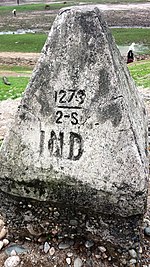
Bangladesh and India share a 4,096-kilometre-long (2,545 mi) international border, the fifth-longest land border in the world, including 262 km (163 mi) in Assam, 856 km (532 mi) in Tripura, 318 km (198 mi) in Mizoram, 443 km (275 mi) in Meghalaya, and 2,217 km (1,378 mi) in West Bengal. The Bangladeshi divisions of Mymensingh, Khulna, Rajshahi, Rangpur, Sylhet, and Chittagong are situated along the border. A number of pillars mark the border between the two states. Small demarcated portions of the border are fenced on both sides.
History

The Radcliffe Line was published on 17 August 1947 as a boundary demarcation line between India and Pakistan upon the partition of India. It was named after its architect, Sir Cyril Radcliffe, who, as chairman of the Border Commissions, was charged with equitably dividing 450,000 square kilometres (175,000 sq mi) of territory with 88 million people.
Issues

BDR (now BGB) Commander checking dead Bangladeshi soldiers at the border
The border is used as a route for smuggling livestock, food items, medicines, and drugs from India to Bangladesh. Moreover, illegal immigrants from Bangladesh cross the border to India. Because of a large number of illegal immigrants crossing from Bangladesh into India, a controversial shoot-on-sight policy has been enforced by the Indian border patrols. This policy was initiated with reports of violence between the illegal migrants and Indian soldiers. The border has also witnessed occasional skirmishes between the Indian Border Security Force (BSF) and the Border Guards Bangladesh (BGB), most notably in 2001.
In July 2009, Channel 4 News reported that hundreds of Indians and Bangladeshis were killed by the BSF along the Indo-Bangladeshi border fence during its construction. The BSF state that the fence’s main purpose is to check illegal immigration and to prevent cross-border terrorism. In 2010, Human Rights Watch (HRW) issued an 81-page report which documented a number abuses committed by the BSF. The report was compiled from the interviews of abuse victims, witnesses, members of the BSF, and its Bangladeshi counterpart, the BGB. The report stated that over 900 Bangladeshi citizens were killed during the first decade of the 21st century, many of whom crossed the border for cattle rustling or other smuggling activities. However, the report also noted that some were killed due to “indiscriminate firing from across the border”. The HRW called for a joint independent investigation to be conducted by both governments.

Bangladesh Last House, on the Bangladesh–India border at Jointa Hill Resort, Tamabil, Sylhet
The BSF has often been accused by the Bangladeshi government of incursions into Bangladeshi territory, and indiscriminate shooting of civilians along the India–Bangladesh border. In a news conference in August 2008, Indian BSF officials admitted that they killed 59 illegals (34 Bangladeshis, 21 Indians, rest unidentified) who were trying to cross the border during the prior six months. Bangladeshi media accused the BSF of abducting 5 Bangladeshi children, aged between 8 and 15, from the Haripur Upazila in Thakurgaon District of Bangladesh, in 2010. The children were setting fishing nets near the border. In 2010, Human Rights Watch accused the Border Security Force of the indiscriminate killings. On 7 January 2011, BSF forces killed 15-year-old Felani Khatun after she became tangled while climbing the border fence during a return trip to Bangladesh. Her body was left hanging from the fence where it was photographed, drawing widespread outrage.
Enclaves

India Bangladesh Border
There were nearly 200 enclaves and counter-enclaves that existed on both sides of the border up until 2015. The enclaves or chitmahals (Bengali: ছিটমহল) that ran along the border between the two nations were a longstanding feature of the region. The enclaves were reputedly part of a high-stakes card game or chess games centuries ago between two regional kings, the Raja of Cooch Behar and the Maharaja of Rangpur, and the result of the confused outcome of a treaty between the Kingdom of Koch Bihar and the Mughal Empire. After the partition of India in 1947, Cooch Behar district merged with India and Rangpur went to then-East Pakistan, which became Bangladesh in 1971.
The prime ministers of India and Bangladesh signed a Land Boundary Agreement in 1974 to exchange all enclaves and simplify the international border. In 1974 Bangladesh approved the proposed Land Boundary Agreement, but India did not ratify it. In 2011 the two countries again agreed to exchange enclaves and adverse possessions. A revised version of the agreement was finally adopted by the two countries when the Parliament of India passed the 119th Amendment to the Indian Constitution on 7 May 2015.
Inside the main part of Bangladesh, there were 111 Indian enclaves (17,160.63 acres), while inside the main part of India, there were 51 Bangladeshi enclaves (7,110.02 acres). Under the Land Boundary Agreement, the enclave residents could continue to reside at their present location or move to the country of their choice. The adverse possession of Boraibari went to Bangladesh. The undemarcated borders between the nations were also finally solved with respect to Daikhata-Dumabari, Muhurichar (an island in the Muhuri River), and Pyrdiwah.
Maritime boundary
India and Bangladesh, with different perceptions of their maritime boundaries and exclusive economic zone, engaged in eight rounds of bilateral negotiations since 1974, which remained inconclusive until 2009 when both agreed to undergo arbitration under the UNCLOS. On 7 July 2014, Arbitration Tribunal resolved the dispute in Bangladesh’s favor, which was amicably accepted by both sides, thus ending the dispute. Dispute also included South Talpatti (also called “New Moore”), a small uninhabited offshore sandbar that emerged as an Island in the aftermath of the Bhola cyclone in 1970, and disappeared around March 2010.
Transportation

India–Bangladesh Friendship Gate between Tamabil (Bangladesh) and Dawki (India) border.
Road links
Designated Integrated Check Posts (ICP, with both customs and immigration facilities) and Land Customs Stations (LCS) are:
- Assam
- Mankachar Land Customs Stations(India) and Rowmari post (Bangladesh)
- Karimganj–Beanibazar Upazila via Sutarkandi integrated checkpost crossing on NH37(India) and Sheola post (Bangladesh)
- Karimganj Steamer and Ferry Station (KSFS) Land Customs Stations(India) and Zakiganj post (Bangladesh)
- West Bengal
- Kolkata–Dhaka via Petrapole integrated checkpost crossing
- Malda–Rajshahi via Mahadipur crossing
- Chandrabangha integrated checkpost
- Hili
- Meghalaya
- Bagmara Land Customs Stations (India) and Bijoyour post (Bangladesh)
- Borsara Land Customs Stations(India) and Borsara post (Bangladesh)
- West Garo Hills–Bakshiganj via Mahendraganj crossing on NH12
- Tura–Nalitabari via Dalu crossing on NH217 (India) and Nakugaon post (Bangladesh)
- Shillong–Sylhet via Dawki integrated checkpost crossing (India) and Tambil post (Bangladesh)
- Tripura
- Agartala–Dhaka via Agartala integrated checkpost (India) and Akhaura checkpost crossing
- Santirbazar–Feni via Santirbazar integrated border checkpost road and railway crossing in South Tripura district
- Mizoram
- Kawarpuchiah integrated checkpost, opened in October 2017 by Prime Minister Narendra Modi.
Bus service
Transport between India and Bangladesh bears much historical and political significance for both countries, which possessed no ground transport links for 43 years, starting with the partition of Bengal and India in 1947. After the establishment of Bangladesh following the Indo-Pakistani War of 1971, bilateral relations improved considerably, but the two governments moved slowly on implementing a 1980 agreement on improving transport links.
The Kolkata–Dhaka Bus started in 1999. In 2001, another bus service was launched to connect Dhaka with Agartala, the capital of the Indian state of Tripura, the second-largest city of Northeast India that borders Bangladesh in the east. In 2015 June direct bus service from Kolkata to Agartala via, Petrapole, Dhaka, Akhoura began. The service is operated by West Bengal surface transport corporation.
India–Bangladesh rail links
Before partition India and Bangladesh had multiple rail links. In the 21st century, the countries are only connected by rail links on the Western Bangladeshi border, although there are plans to rebuild some of the other rail links. 2 scheduled passenger trains run between Kolkata and Bangladesh as the Maitree Express and the Bandhan Express.
India–Bangladesh barrier

The border fence close to the Hili Border station in West Bangladesh
India is constructing the India–Bangladesh barrier, a 3,406-kilometre (2,116 mi) fence of barbed wire and concrete just under 3 metres (9.8 ft) high, to prevent smuggling of narcotics. Out of this, 500 kilometres (310 mi) of fencing was completed at the cost of ₹28.81 billion (US$400 million) by November 2007. The deadline for project completion was set to 2008–09. By October 2009, about 2,649 kilometres (1,646 mi) of fencing along with about 3,326 kilometres (2,067 mi) of border roads were completed. The deadline for project completion was revised to March 2010. By March 2011, 2,735 kilometres (1,699 mi) of fencing was completed and the deadline was revised to March 2012.
The project has run into several delays and there is no clear completion date for the project yet. The barrier when complete will be patrolled by the Border Security Force. The fence will also be electrified at some stretches.
Assam shares 263 kilometres (163 mi) of border with Bangladesh out of which 143.9 kilometres (89.4 mi) is land and 119.1 kilometres (74.0 mi) is riverine. As of November 2011, 221.56 kilometres (137.67 mi) of fencing was completed. India has completed the installation of flood lights for 277 kilometres (172 mi) in the West Bengal sector. Sometimes between 2001 and 2006 Bangladesh Border security troops (BDR) clashed with the Indian Border Security Force when the fence was built beyond the no man’s land.