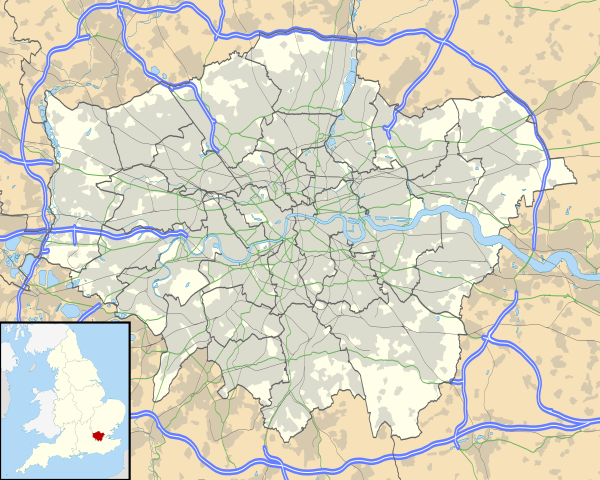
Greater London is a ceremonial county of England that makes up the majority of the London region. This region forms the administrative boundaries of London and is organised into 33 local government districts—the 32 London boroughs and the City of London, which is located within the region but is separate from the county. The Greater London Authority, based in Southwark, is responsible for strategic local government across the region and consists of the Mayor of London and the London Assembly. The City of London Corporation is the principal local authority for the City of London, with a similar role to that of the 32 London borough councils.
Administratively, Greater London was first established as a sui generis council area under the Greater London Council between 1963 and 1986. The county of Greater London was created on 1 April 1965 through the London Government Act 1963. The area was re-established as a region in 1994. The Greater London Authority was formed in 2000.
The region covers 1,572 km2 (607 sq mi) and had a population of 8,174,000 at the 2011 census. In 2018 the estimated population surpassed 9 million. The Greater London Built-up Area is used in some national statistics and is a measure of most of the continuous urban area, and includes areas outside the administrative region.
History
The term Greater London has been and still is used to describe different areas in governance, statistics, history and common parlance.
In terms of ceremonial counties, London is divided into the small City of London and the much wider Greater London. This arrangement has come about because as the area of London grew and absorbed neighbouring settlements, a series of administrative reforms did not amalgamate the City of London with the surrounding metropolitan area, and its unique political structure was retained. Outside the limited boundaries of the City, a variety of arrangements has governed the wider area since 1855, culminating in the creation of the Greater London administrative area in 1965.
The term Greater London was used well before 1965, particularly to refer to the Metropolitan Police District (such as in the 1901 census), the area of the Metropolitan Water Board (favoured by the London County Council for statistics), the London Passenger Transport Area and the area defined by the Registrar General as the Greater London Conurbation. The Greater London Arterial Road Programme was devised between 1913 and 1916. One of the larger early forms was the Greater London Planning Region, devised in 1927, which occupied 1,856 square miles (4,810 km2) and included 9 million people.
Proposals to expand the County of London

Arms of the former London County Council
Although the London County Council (LCC) was created covering the County of London in 1889, the county did not cover all the built-up area, particularly West Ham and East Ham, and many of the LCC housing projects, including the vast Becontree Estates, were outside its boundaries. The LCC pressed for an alteration in its boundaries soon after the end of the First World War, noting that within the Metropolitan and City Police Districts there were 122 housing authorities. A Royal Commission on London Government was set up to consider the issue. The LCC proposed a vast new area for Greater London, with a boundary somewhere between the Metropolitan Police District and the home counties. Protests were made at the possibility of including Windsor, Slough and Eton in the authority. The Commission made its report in 1923, rejecting the LCC’s scheme. Two minority reports favoured change beyond the amalgamation of smaller urban districts, including both smaller borough councils and a central authority for strategic functions. The London Traffic Act 1924 was a result of the Commission. Reform of local government in the County of London and its environs was next considered by the Royal Commission on Local Government in Greater London, chaired by Sir Edwin Herbert, which issued the ‘Herbert Report’ after three years of work in 1960. The commission applied three tests to decide if a community should form part of Greater London: how strong is the area as an independent centre in its own right; how strong are its ties to London; and how strongly is it drawn outwards towards the country rather than inwards towards London.
Greater London is created

Arms of the former Greater London Council
Greater London was created by the London Government Act 1963, which came into force on 1 April 1965, replacing the administrative counties of Middlesex and London, including the City of London, where the London County Council had limited powers, and absorbing parts of Essex, Hertfordshire, Kent and Surrey. Greater London originally had a two-tier system of local government, with the Greater London Council (GLC) sharing power with the City of London Corporation (governing the small City of London) and the 32 London Borough councils. The GLC was abolished in 1986 by the Local Government Act 1985. Its functions were devolved to the City Corporation and the London Boroughs, with some functions transferred to central government and joint boards. Greater London formed the London region in 1994.
Greater London Authority
The 1998 London referendum established a public will to recreate an upper tier of government to cover the region. The Greater London Authority, London Assembly and the directly elected Mayor of London were created in 2000 by the Greater London Authority Act 1999. In 2000, the outer boundary of the Metropolitan Police District was re-aligned to the Greater London boundary. The 2000 and 2004 mayoral elections were won by Ken Livingstone (L), who had been the final leader of the GLC. The 2008 and 2012 elections were won by Boris Johnson (C). The 2016 election was won by Sadiq Khan (L). London was covered by a single Parliamentary constituency in the European Parliament prior to the departure of the United Kingdom from the European Union.
Geography

Map of Greater London showing railway lines, primary roads, motorways, and suburban towns of the county

The London postal district in red in contrast to Greater London
Greater London includes the most closely associated parts of the Greater London Urban Area and their historic buffers and includes, in five boroughs, significant parts of the Metropolitan Green Belt which protects designated greenfield land in a similar way to the city’s parks. The closest and furthest boundaries are with Essex to the northeast between Sewardstonebury next to Epping Forest and Chingford and with the Mar Dyke between Bulphan and North Ockendon. Greater London is also bounded by Hertfordshire to the north, Berkshire and Buckinghamshire to the west, Kent to the southeast and Surrey to the south and southwest. The highest point is Westerham Heights, in the North Downs and on the boundary with Kent, at 245 metres (804 ft). Central government has implemented small boundary changes. The greatest were the 1969 transfers of Farleigh to Surrey and Knockholt to Kent. Others have included exchange of two Thames islands with Surrey and adjustments during the 1990s to parts of the boundaries of three boroughs near the M25. The only part of Greater London outside the motorway is North Ockendon, the furthest land unit from its centre. The majority of Greater London forms the London low emission zone.
The London postal district does not cover all of Greater London.
Governance
|
Politics of London
|
|---|
 London portal London portal Politics portal Politics portal |
Greater London Authority
Greater London is under the strategic local governance of the Greater London Authority (GLA). It consists of an elected assembly, the London Assembly, and an executive head, the Mayor of London.
The current Mayor (not to be confused with the Lord Mayor of London) is Sadiq Khan. He is scrutinised by the elected London Assembly, which may amend his annual budget (by two-thirds majority) but otherwise lacks the power to block his directives. The headquarters of the GLA is at City Hall in Southwark. The Mayor is responsible for Greater London’s strategic planning and is required to produce or amend the London Plan each electoral cycle.
Mayor of London
The Mayor of London is a directly elected politician who, along with the London Assembly, is responsible for the strategic government of Greater London.
London Assembly
For elections to the London Assembly, London is divided into 14 constituencies, each formed from two or three boroughs. The City of London forms part of the City and East constituency.
UK Parliament
London is divided into 73 Parliamentary borough constituencies, formed from the combined area of several wards from one or more boroughs. Typically a borough is covered by two or three constituencies.
Status
The London region does not have city status granted by the Crown. The Cities of London and Westminster within it have received formal city status. Despite this, Greater London is commonly regarded as a city in the general senses of a conurbation and a municipality. A Lord Lieutenant of Greater London is appointed for its area, excluding the City of London. For the purposes of the Lieutenancies Act 1997, this area is defined as a county.
The term “London” usually refers to region or to the conurbation, but not often to the ancient, tiny City of London. That small area is often referred to as “the City” or “the Square Mile” and it forms the main financial district. Archaically, the urbanised area of London was known as the Metropolis. In common usage, the terms “London” and “Greater London” are usually used interchangeably. Greater London is officially divided for some purposes, with varying definitions, into Inner London and Outer London. For some strategic planning purposes it is divided into five sub-regions.
Local government
Greater London is divided into 32 London Boroughs, each governed by a London Borough council. The City of London has a unique government dating back to the 12th century and is separate from the county of Greater London, although is still part of the region served by the Greater London Authority.
All London Borough councils belong to the London Councils association. Three London Boroughs carry the honorific title of Royal Borough: Kensington and Chelsea, Kingston, and Greenwich. Within the City of London are the liberties of Middle Temple and Inner Temple.