
Kingdom of Kosala (Sanskrit: कोसल राज्य) was an ancient Indian kingdom, corresponding the area with the region of Awadh in present-day Uttar Pradesh to Western Odisha. It emerged as a small state during the late Vedic period, with connections to the neighboring realm of Videha. Kosala belonged to the Northern Black Polished Ware culture (c. 700-300 BCE), and the Kosala region gave rise to the Sramana movements, including Jainism and Buddhism. It was culturally distinct from the Painted Grey Ware culture of the Vedic period of Kuru-Panchala west of it, following independent development toward urbanisation and the use of iron.
During the 5th century BCE, Kosala incorporated the territory of the Shakya clan, to which the Buddha belonged. According to the Buddhist text Anguttara Nikaya and the Jaina text, the Bhagavati Sutra, Kosala was one of the Solasa (sixteen) Mahajanapadas (powerful realms) in 6th to 5th centuries BCE, and its cultural and political strength earned it the status of a great power. It was later weakened by a series of wars with the neighbouring kingdom of Magadha and, in the 5th century BCE, was finally absorbed by it. After collapse of the Maurya Empire and before the expansion of the Kushan Empire, Kosala was ruled by the Deva dynasty, the Datta dynasty, and the Mitra dynasty.
Religious textual references
In Vedic Literature


Kosala is not mentioned in the early Vedic literature, but appears as a region in the later Vedic texts of the Shatapatha Brahmana (7th-6th centuries BCE, final version 300 BCE) and the Kalpasutras (6th-century BCE).
In Puranas
In the Ramayana, Mahabharata and the Puranas the ruling family of the Kosala kingdom was the Ikshvaku dynasty, which was descended from king Ikshvaku. The Puranas give lists of kings of the Ikshvaku dynasty from Ikshvaku to Prasenajit (Pali: Pasenadi). According to the Ramayana, Rama ruled the Kosala kingdom from his capital, Ayodhya.
In Buddhist and Jain texts

Procession of Prasenajit of Kosala leaving Sravasti to meet the Buddha, Sanchi.
Mahavira, the 24th Tirthankara of Jainism taught in Kosala. A Buddhist text, the Majjhima Nikaya mentions Buddha as a Kosalan, which indicates that Kosala may have subjugated the Shakya clan, which the Buddha is traditionally believed to have belonged to.
History
Pre-Mauryan
Koshala’s first capital of Shravasti was barely settled by the 6th century BCE, but there is the beginnings of a mud fort. By 500 BCE, Vedic people had spread to Koshala.

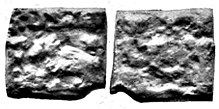
Kosala coin, 400-300 BCE

Kosala Karshapana, 5th century BCE.
By the 5th century BCE under the reign of King Mahakosala, the neighboring Kingdom of Kashi had been conquered. Mahakosala’s daughter was the first wife of King Bimbisara of Magadha. As a dowry, Bimbisara received a Kashi village that had a revenue of 100,000. This marriage temporarily eased tensions between Koshala and Magadha.
The Shakya tribe was eventually brought into the territory of the Koshala kingdom. The Shakyas had their capital at Kapilavastu.
Mahakosala was succeeded by his son Pasenadi (Sanskrit: Prasenajit), who was a follower of the Buddha. During Pasenadi’s absence from the capital, his minister Digha Charayana raised Pasedani’s son Vidudabha (Sanskrit: Virudhaka) to the throne.
In 492 BCE, Ajatashatru assassinated his father, Bimbisara, and became the king of Magadha. His aggressive expansionist policy provoked the ire of Koshala and their vassal state, Kashi. After a long war between Magadha and Koshala, Koshala was forced to cede Kashi to Magadha gave a Koshala princess in marriage to Ajatashatru.
The Kosala kingdom was defeated by (5th or early 4th cent. BCE) of the Magadhan Haryanka dynasty, and absorbed into the Magadha kingdom, which formed the basis of the Maurya empire. Kosala was finally annexed by Shishunaga.
Under the reign of Mahapadma Nanda of Magadha, Koshala rebelled but the rebellion was put down.
Under Mauryan rule
It is assumed that during the Mauryan reign, Kosala was administratively under the viceroy at Kaushambi. The Sohgaura copper plate inscription, probably issued during the reign of Chandragupta Maurya deals with a famine in Shravasti and the relief measures to be adopted by the officials. The Yuga Purana section of the Garga Samhita mentions about the Yavana (Indo-Greek) invasion and subsequent occupation of Saket during the reign of the last Maurya ruler Brihadratha.
Post-Mauryan period
Coin of ruler Muladeva, minted in Ayodhya, Kosala. Obv: Muladevasa, elephant to left facing symbol. Rev: Wreath, above symbol, below snake.

Coin of ruler Aryamitra, issued in Ayodhya, Kosala. Obv: peacock to right facing tree. Rev: Name Ayyamitasa, humped bull to left facing pole.