
Bandipur National Park, established in 1974 as a tiger reserve under Project Tiger, is a national park located in the Indian state of Karnataka, which is the state with the second highest tiger population in India. It is one of the premiere tiger reserves in India alongside Nagarhole National Park, Mudumalai National Park and Wayanad National Park. It was once a private hunting reserve for the Maharaja of the Kingdom of Mysore but has now been upgraded to Bandipur Tiger Reserve. Bandipur is known for its wildlife and has many types of biomes, but dry deciduous forest is dominant.
The park spans an area of 874 square kilometers (337 sq mi), protecting several species of India’s endangered wildlife. Together with the adjoining Nagarhole National Park (643 km2 (248 sq mi)), Mudumalai National Park (320 km2 (120 sq mi)) and Wayanad Wildlife Sanctuary (344 km2 (133 sq mi)), it is part of the Nilgiri Biosphere Reserve totaling 2,183 km2 (843 sq mi) making it the largest protected area in southern India and largest habitat of wild elephants in south Asia.
Bandipur is located in Gundlupet taluk of Chamarajanagar district. It is about 80 kilometers (50 mi) from the city of Mysore on the route to a major tourist destination of Ooty. As a result, Bandipur sees many tourists; many wildlife fatalities caused by speeding vehicles are reported each year. There is a ban on traffic from 9 pm to 6 am of dusk to dawn to help bring down the death rate of wildlife.
History
The Maharaja of the Kingdom of Mysore created a sanctuary of 90 km2 (35 sq mi) in 1931 and named it the Venugopala Wildlife Park. The Bandipur Tiger Reserve was established under Project Tiger in 1973 by adding nearly 800 km2 (310 sq mi) to the Venugopala Wildlife park.
Geography
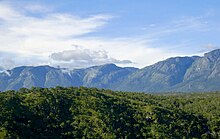
At the Moyar gorge with Nilgiris in the background
Bandipur National Park is located between 75° 12’ 17″ E to 76° 51’ 32″ E and 11° 35’ 34″ N to 11° 57’ 02″ N where the Deccan Plateau meets the Western Ghats, and the altitude of the park ranges from 680 meters (2,230 ft) to 1,454 meters (4,770 ft). As a result, the park has a variety of biomes including dry deciduous forests, moist deciduous forests and shrublands. The wide range of habitats help support a diverse range of organisms. The park is flanked by the Kabini river in the north and the Moyar river in the south. The Nugu river runs through the park. The highest point in the park is on a hill called Himavad Gopalaswamy Betta, where there is a Hindu temple at the summit. Bandipur has typical tropical climate with distinct wet and dry seasons. The dry and hot period usually begins in early March and can last till the arrival of the monsoon rains in June.
Biology and ecology
Bandipur National Park helps protect several species of India’s endangered wildlife and also provides refuge to other threatened and vulnerable species of flora and fauna.
Flora

Forest inside Bandipur
Bandipur supports a wide range of timber trees including: teak (Tectona grandis), rosewood (Dalbergia latifolia), sandalwood (Santalum album V), Indian-laurel (Terminalia tomentosa), Indian kino tree (Pterocarpus marsupium), giant clumping bamboo (Dendrocalamus strictus), clumping bamboo (Bambusa arundinacea) and Grewia tiliaefolia.
There are also several notable flowering and fruiting trees and shrubs including: kadam tree (Adina cordifolia), Indian gooseberry (Emblica officinalis), crape-myrtle (Lagerstroemia lanceolata), axlewood (Anogeissus latifolia), black myrobalan (Terminalia chebula), Schleichera trijuga, Odina wodiar, flame of the forest (Butea monosperma), golden shower tree (Cassia fistula), satinwood (Chloroxylon swietenia), black cutch (Acacia catechu), Shorea talura (E), indigoberry (Randia uliginosa).
Fauna
Bandipur supports a good population of endangered and vulnerable species like Indian elephants, gaurs, tigers, sloth bears, muggers, Indian rock pythons, four-horned antelopes, jackals and dholes.
Mammals

A golden jackal family alongside the Kabini river in Bandipur National Park, Karnataka.
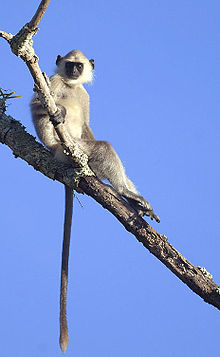
A gray langur