
Bageshwar (Kumaoni: Bāgshyār) is a town and a municipal board in Bageshwar district in the state of Uttarakhand, India. It is located at a distance of 470 km from the National Capital New Delhi and 332 km from the State Capital Dehradun. Bageshwar is known for its scenic environment, glaciers, rivers and temples. It is also the administrative headquarters of Bageshwar district.
Situated on the confluence of Saryu and Gomati rivers, Bageshwar is surrounded by the mountains of Bhileshwar and Nileshwar to its east and west and by the Suraj Kund in the north and Agni Kund in the south. Bageshwar was a major trade mart between Tibet and Kumaun, and was frequented by the Bhotia traders, who bartered Tibetan wares, wool, salt and Borax in exchange for Carpets and other local produces in Bageshwar. The trade routes were, however, closed after the Indo-China War of 1962.
The city is of great religious, historic and political significance. Bageshwar finds mention in various puranas, where, it has been associated with Lord Shiva. The Uttrayani fair held annually in Bageshwar used to be visited by approx 15,000 people in the early twentieth century, and was the largest fair of Kumaon division. The fair became the epicenter of the Coolie Begar Movement in January 1921. The city of Bageshwar gets its name from the Bagnath Temple. Hindi and Sanskrit are the official Languages however Kumaoni is spoken by a large number of people.
History
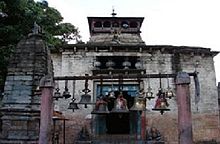
Bagnath Temple was erected in 1640 by King Laxmi Chand
The city and Bagnath Temple find mention in the Manaskhand of Shiva Purana, where it is written that the temple and its surrounding city was built by Chandeesh, a servant of the Hindu deity Shiva. According to another Hindu Legend, Sage Markandeya worshipped Lord Shiva here. Lord Shiva blessed sage Markandeya by visiting here in the form of a Tiger.
Bageshwar has historically been a part of Kumaon Kingdom. Bageshwar was located adjacent to Kartikeypura, the then capital of Katyuri Kings that ruled over Kumaon in the 7th century. After death of Birdeo the last king of united katyuri kingdom. the kingdom disintegrated in the 13th century giving rise to 8 different princely states. Bageshwar region remained under the rule of Baijnath Katyurs descendants of Katyuri kings, till 1565 until king Balo Kalyan Chand of Almora annexed the region to Kumaon In the 10th century, the Chand dynasty was established by Som Chand. He displaced the Katyuri Kings, called his state Kurmanchal and established its capital in Champawat in Kali Kumaon. In 1568, Kalyan Chand established a permanent capital at Khagmara and called it Almora.
In 1791, the Gorkhas of Nepal while expanding their kingdom westwards across Kali River, invaded and overran Almora, the seat of the Kumaon Kingdom and other parts of Kumaon including Bageshwar. The Gorkhas were defeated by the East India Company in Anglo-Nepalese War in 1814 and were forced to cede Kumaon to the British as part of the Treaty of Sugauli in 1816.: 594
The Kumaon region was joined with the eastern half of the Garhwal region and was governed as a chief-commissionership, also known as the Kumaon Province, on the non-regulation system. According to Atkinson’s The Himalayan Gazetteer, Bageshwar had a population of 500 in 1886. In 1891, the division was composed of the three districts of Kumaon, Garhwal and the Tarai; but the two districts of Kumaon and the Tarai were subsequently redistributed and renamed after their headquarters, Nainital and Almora.
Before the First World War, the British Government did a Survey for a rail link connecting Bageshwar with Tanakpur in 1902. However, the project was stalled by British due to The World War. The Surveys restarted in the 1980s after Indira Gandhi visited Bageshwar. The first motor road arrived in Bageshwar in 1952 from Almora via Garur. Bus services started operating on the Bageshwar-Kapkot motorway in 1955-56. After the 1962 India-China War, an important strategic road connecting Bageshwar with Pithoragarh was completed in 1965.
In the early phase of its urban development, the central township of Bageshwar was a group of 9 small mutually tangled group of villages which had three uninhabited and 6 manned village. The Bageshwar State village was formed in 1948 by joining these villages. Bageshwar was declared a town in 1955, under the UP Town Area Act of 1914, and the first Town area committee was constituted in 1957. Bageshwar received the status of a notified area committee in 1962 and municipal Council in 1968. The pumping water supply scheme was introduced in Bageshwar town in 1975. The estimate for water supply was prepared in 1968-69 for a designed population of 6000 persons for the year 1997.
In the early Twentieth century dispensary (1906) and Post Office (1909) were established in Bageshwar. A public school started in 1926, which was made junior high school in 1933. After independence by several attempts from local residents, a private high school was opened in 1949 in memory of Victor Mohan Joshi, which became an Inter College in 1967. The first women’s primary school started in the 1950s and women’s public high school started in 1975. A new Government Degree College was inaugurated in 1974 by the then Chief Minister Hemwati Nandan Bahuguna.
After Independence of India in 1947, Bageshwar was a part of the Almora District. Bageshwar had a population of 1740 people according to the 1951 Census. It was part of the Kanda development block, that was later converted into Bageshwar development block. On 15 September 1997 the Bageshwar district was carved out of Almora district by then Uttar Pradesh Chief Minister Mayawati and Bageshwar became its Headquarter. On 9 November 2000, Bageshwar came in the Uttarakhand State that was created from the Himalayan and adjoining northwestern districts of Uttar Pradesh.
Geography and Climate
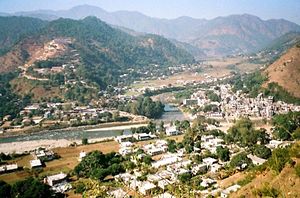
Bageshwar in 2006
Bageshwar is located at 29.49°N 79.45°E in Bageshwar District in Uttarakhand. It is situated 470 km North-East of the National Capital New Delhi and 332 km South-East of the State Capital Dehradun. It lies in the Kumaon division and is situated 153 km North-East of Nainital, the Headquarters of Kumaon. Bageshwar is situated in a valley of the Kumaon Hills of the Central Himalaya range. It has an average elevation of 934 metres (3,064 feet). The chief trees are the Chir Pine, Himalayan Cypress, Pindrow Fir, alder, sal or iron-wood, and saindan. Limestone, sandstone, slate, gneiss and granite constitute the principal geological formations.
Its climate is characterized by relatively high temperatures and evenly distributed precipitation throughout the year. In summer, Bageshwar is largely under the influence of moist, maritime airflow from the western side of the subtropical anticyclonic cells over low-latitude ocean waters. Temperatures are high and can lead to warm, oppressive nights. Summers are usually somewhat wetter than winters, with much of the rainfall coming from convectional thunderstorm activity; tropical cyclones also enhance warm-season rainfall in some regions. The coldest month is usually quite mild, although frosts are not uncommon, and winter precipitation is derived primarily from frontal cyclones along the polar front. The Köppen Climate Classification subtype for this climate is “Cfa”. (Humid Subtropical Climate).

Panoramic view of Central Bageshwar with Saryu river in the foreground. The Saryu-Gomati Confluence (far left), Bagnath Temple (left), Saryu Ghat (center), Nileshwar Mountain (right) and Saryu Bridge (far right) are also visible.
The average temperature for the year in Bageshwar is 20.4 °C (68.8 °F). The warmest month, on average, is June with an average temperature of 27.3 °C (81.2 °F). The highest temperature ever recorded was 38 °C, recorded on 5 June 2017. The coolest month on average is January, with an average temperature of 11 °C (51.8 °F). The average amount of precipitation for the year in Bageshwar is 48.1″ (1221.7 mm). The month with the most precipitation on average is July with 13.0″ (330.2 mm) of precipitation. The month with the least precipitation on average is November with an average of 0.2″ (5.1 mm). There are an average of 63.6 days of precipitation, with the most precipitation occurring in August with 15.3 days and the least precipitation occurring in November with 0.8 days.
| hideClimate data for Bageshwar, India | |||||||||||||
|---|---|---|---|---|---|---|---|---|---|---|---|---|---|
| Month | Jan | Feb | Mar | Apr | May | Jun | Jul | Aug | Sep | Oct | Nov | Dec | Year |
| Average high °C (°F) | 17.2 (63.0) |
19.5 (67.1) |
25.0 (77.0) |
30.7 (87.3) |
33.7 (92.7) |
32.9 (91.2) |
29.4 (84.9) |
28.9 (84.0) |
28.7 (83.7) |
27.4 (81.3) |
23.6 (74.5) |
19.1 (66.4) |
26.4 (79.5) |
| Daily mean °C (°F) | 11.0 (51.8) |
13.1 (55.6) |
18.1 (64.6) |
23.6 (74.5) |
26.8 (80.2) |
27.4 (81.3) |
25.4 (77.7) |
26.8 (80.2) |
24.2 (75.6) |
21.3 (70.3) |
16.8 (62.2) |
12.7 (54.9) |
20.5 (68.9) |
| Average low °C (°F) | 4.9 (40.8) |
6.7 (44.1) |
11.2 (52.2) |
16.5 (61.7) |
19.8 (67.6) |
21.8 (71.2) |
21.5 (70.7) |
21.3 (70.3) |
19.8 (67.6) |
15.2 (59.4) |
10.0 (50.0) |
6.3 (43.3) |
14.6 (58.3) |
| Average precipitation mm (inches) | 32.9 (1.30) |
35.1 (1.38) |
30.1 (1.19) |
24.4 (0.96) |
43.7 (1.72) |
157.0 (6.18) |
328.9 (12.95) |
328.2 (12.92) |
178.4 (7.02) |
42.5 (1.67) |
6.0 (0.24) |
13.6 (0.54) |
1,220.8 (48.06) |
| Average precipitation days | 2.7 | 2.9 | 2.8 | 2.1 | 3.0 | 8.1 | 14.2 | 15.3 | 8.3 | 2.3 | 0.8 | 1.1 | 63.6 |
| Mean daily sunshine hours | 10.9 | 11.6 | 12.4 | 13.3 | 14.1 | 14.5 | 14.3 | 13.6 | 12.7 | 11.8 | 11.1 | 10.7 | 12.6 |
| Source: Weatherbase | |||||||||||||
Demographics
Religions in Bageshwar (2011)
Hinduism (93.34%)
Islam (5.93%)
Sikhism (0.25%)
Christianity (0.26%)
Buddhism (0.01%)
Jainism (0.02%)
Other or not religious (0.19%)
hideBageshwar population
Census Population
1951 1,740
1961 2,189
1971 4,314
1981 4,225
1991 5,772
2001 7,803
2011 9,079
Sources:
According to the 2011 census of India, Bageshwar has a population of 9,079 comprising 4,711 males and 4,368 females. Males constitute approximately 55% of the population and females 45%. The sex ratio of bageshwar is 1090 women per 1000 men, higher than the national Average of 940 women per 1000 men. The City ranked 4th in Uttarakhand in terms of Sex Ratio. Bageshwar has an average literacy rate of 80%, higher than the national average of 72.1%; with 84% of the males and 76% of females literate. 11% of the population is under 6 years of age. 2,219 people belong to the Scheduled Castes while the population of people belonging to Scheduled Tribes is 1,085. Bageshwar had a population of 7803 according to 2001 Census and 5,772 according to the 1991 census. Out of total population, 2,771 were engaged in work or business activity. Of this 2,236 were males while 535 were females. In census survey, worker is defined as person who does business, job, service, and cultivator and labour activity. Of total 2771 working population, 78.06% were engaged in Main Work while 21.94% of total workers were engaged in Marginal Work. Hinduism is practiced by 93.34% of total population and is the religion of the Majority in Bageshwar. Other Religions include Islam (5.93%), Sikhism (0.25%), Christianity (0.26%), Buddhism (0.01%) and Jainism (0.02%). Kumaoni is the majority first language, although Hindi and Sanskrit are the official languages of the state.English is also spoken by a small number of people.
Government and Politics
The Bageshwar Assembly seat is reserved for a person belonging to the Scheduled Castes. Chandan Ram Das from Bharatiya Janata Party is the present MLA OF Bageshwar. Bageshwar is a “Nagar Palika Parishad” (Municipal Council) city in district of Bageshwar, Uttarakhand. The Bageshwar city is divided into 7 wards, for which elections are held every 5 years. The Bageshwar Nagar Palika Parishad has population of 9,079 of which 4,711 are males while 4,368 are females as per report released by Census India 2011. Suresh khetwal from Independent candidate is the Mayor of Bageshwar. Bageshwar Nagar Palika Parishad has total administration over 2,054 houses to which it supplies basic amenities like water and sewerage. It is also authorized to build roads within Nagar Palika Parishad limits and impose taxes on properties coming under its jurisdiction. The Uttarakhand Power Corporation Ltd. (UPCL) is responsible for supply of electricity in the city. Uttarakhand Jal Vidyut Nigam Ltd. generates electricity from the 8.5 MW electric sub-station at Bageshwar. The Notified Area Committee, Bageshwar is responsible for approval of building plans after getting no objection certificate from various departments like Jal Nigam, PWD, Electricity Board and Health Department etc.
Economy
Pindari Glacier trek route; Bageshwar acts as a starting point for many trekking routes notably being to Pindari, Kafni and Sunderdhunga Glacier
Bageshwar’s largest economic sectors include agriculture, trade, transportation, municipal, tourism and resource extraction. Copper Utensils and Carpets were listed as the two most important industrial commodities produced in Bageshwar in the 2011 Census of India. Large portions of the local economy of Bageshwar depend on its geographical location and surrounding natural resources. Per Capita Income of Bageshwar was Rs 22709 in 2015. Bageshwar is a major tourist destination and acts as a starting point for many trekking routes notably being to Pindari, Kafni and Sunderdhunga Glacier. It also lies along the path to Kailash-Mansarovar pilgrimage. Bageshwar has traditionally been a major gateway for trade with Central Asia and Tibet. It carried on a brisk trade between Central Asia and Kumaon, and was described in The Imperial Gazetteer of India as “one of the main outlets for the Tibetan traffic”. The Bhotiya traders travelled to Tibet and sold their wares at major fairs in Bageshwar, Gyanema and Gartok. The city was once rich in agriculture and animal husbandry. Besides growing crops, people were mainly engaged in sheep rearing. However, agriculture and sheep rearing in Bageshwar have suffered as villagers, who are increasingly joining armed forces, after retirement are settling down in Bageshwar town instead of their native villages. The traditional Uttarayani festival organised since centuries on the banks of the Sarju and Gomati rivers was the main place where woollen outfits made by Saukas of Munsiyari were brought form higher valleys for ages, thus strengthening trade links between the two communities. As of 2006, Bageshwar had a total of 6 Health Care units including four Hospitals (Two Allopathic, one Ayurvedi and one Homeopathic), one Maternity & Child welfare centre and one Community Health Centre. Bageshwar has a total of Five Nationalized Bank’s, Two Post Offices, One Telegraph Office, 80 PCO’S and 1844 Telephone Connections. Mobile Communication services are provided by Private companies like Vodafone, Airtel, Idea, Reliance etc.
Culture
Chanchari is a popular folk dance from Danpur region in Bageshwar
Many classical dance forms and folk art are practised in the city. Some well-known dances include Hurkiya Baul, Jhora-Chanchri and Chholiya. Music is an integral part of the Kumaoni culture. Popular types of folk songs include Mangal and Nyoli. These folk songs are played on instruments including dhol, damau, turri, ransingha, dholki, daur, thali, bhankora, mandan and mashakbaja. Music is also used as a medium through which the gods are invoked. Jagar is a form of spirit worship in which the singer, or Jagariya, sings a ballad of the gods, with allusions to great epics, like Mahabharat and Ramayana, that describe the adventures and exploits of the god being invoked. Ramleela has been staged annually during the autumn festival of Navratri since 1948 in Bageshwar. The primary food of Bageshwar is vegetables with wheat being a staple. A distinctive characteristic of Kumaoni cuisine is the sparing use of tomatoes, milk, and milk based products. Coarse grain with high fibre content is very common in Kumaon due to the harsh terrain. Another crop which is associated with Kumaon is Buckwheat (locally called Kotu or Kuttu). Generally, either Desi Ghee or Mustard oil is used for the purpose of cooking food. Simple recipes are made interesting with the use of hash seeds Jakhya as spice. Bal Mithai is a popular fudge-like sweet. Other local dishes include Dubuk, Chains, Kap, Chutkani, Sei, and gulgula. A regional variation of Kadhi called Jhoi or Jholi is also popular.
Temples
Bagnath Temple was erected in 1640 by King Laxmi Chand
Group of Temples at Baijnath; 20 km northwest to Bageshwar
Hinduism is practiced by 93.34% and is the religion of the Majority in Bageshwar therefore Various Temples are situated in Bageshwar. the major one being:
Bagnath Temple
At the junction of the rivers, Gomati and Sarju stands a large temple with its conical tower. Here is the shrine of Bageswar or Vyagreswar, the, “Tiger Lord”, an epithet of Lord Siva. This temple was erected by the Kumaun king, Laxmi Chand, about 1450 A.D., but there is a Sanskrit inscription there of a far earlier date. The temple is flooded with devotees on the annual occasion of Shivratri. This place has a cluster of temples. Prominent among these temples are the Bairav temple, Dattatrey Maharaj, Ganga Mai temple, Hanuman temple, Durga temple, Kalika temple, Thingal Bhirav temple, Panchnam Junakhara and the Vaneshwar temple.
Baijnath Temple
Baijnath Temple is located on the left bank of the Gomti river. This is a shiv temple which was built by a brahmin widow.
Chandika Temple
A temple dedicated to Goddess Chandika stands at a distance of about half a kilometre from Bageshwar. Every year, the temple bustles with activity as the devout congregate here to offer pujas to the deity during the Navratras.
Sriharu Temple
Another important temple, the Sriharu temple, is situated at a distance of about 5 km from Bageshwer. The devotees believe that prayers for wish fulfilment here never go in vein. Every year, a large fair is organised on the Vijya Dashmi day following the Navratras.
Gauri Udiyar
This is situated 8 km from Bageshwer. A large cave, measuring 20 m x 95 m is situated here, which houses the idols of Lord Shiva.
Transport
NH 309A (former UP SH 37) connects Bageshwar to Almora.
Pantnagar Airport, located in Pantnagar is the primary Airport serving entire Kumaon Region. The Government is planning to develop Naini Saini Airport in Pithoragarh which once developed will be much nearer. Indira Gandhi International Airport, located in Delhi is the nearest international Airport. Kathgodam railway station is the nearest railway station. Kathgodam is the last terminus of the broad gauge line of North East Railways that connects Kumaon with Delhi, Dehradun, and Howrah. A new Railway line connecting Bageshwar with Tanakpur has been a long-standing demand of the people of the region. the tanakpur-Bageshwar rail link was first planned by British in 1902. However the project was stalled by Railway ministry in 2016 citing the commercial viability of the rail line. There have also been speculations about another railway line, that would connect Bageshwar to Chaukhutia via Garur.
Bageshwar KMOU station was the only bus station in the city until the opening of Roadways station in 2020.
Bageshwar is well connected by motorable roads with major destinations of Uttarakhand state and northern India. The major roads passing through Bageshwar include NH 109K, NH 309A, Bareilly-Bageshwar Highway, and the Bageshwar-Someshwar-Dwarahat road. Uttarakhand Transport Corporation runs Buses from Bageshwar bus station to Delhi, Dehradun, Bareilly and Almora; while K.M.O.U (Kumaon Motor Owner’s Union) runs 55 buses on various routes to Haldwani, Almora, Takula, Berinag, Pithoragarh, Didihat and Gangolihat. Taxis and Private Buses, mostly run by K.M.O.U, connect Bageshwar to other major destinations of Kumaon region. A Sub Regional Transport Office is located in Bageshwar where Vehicles are registered by the number UK-02. A new bus station was inaugurated on 19 Feb 2020. The Bageshwar roadways bus station, located in Bilona, was constructed over a period of two years at an estimated cost of INR Two Crore.
Education
There are mainly government-run, private unaided (no government help), and private aided schools in the city. The language of instruction in the schools is either English or Hindi. The main school affiliations are CBSE, CISCE or UBSE, the state syllabus defined by the Department of Education of the Government of Uttarakhand. There are Eleven junior basic schools, three senior basic schools, two higher secondary schools and one post-graduate college to serve the needs of the population. The teacher-student ratio in Bageshwar is 1:47. Bageshwar has an average literacy rate of 80%, with 84% of the males and 76% of females literate. The first public school in Bageshwar was started in 1926, which was made junior high school in 1933. Another private high school was opened in 1949 in memory of Victor Mohan Joshi, which became an Inter College in 1967. The first women’s primary school started in the 1950s and women’s public high school started in 1975. A new Government Degree College was inaugurated in 1974 by the then Chief Minister Hemwati Nandan Bahuguna. Kumaon Kesari Pandit Badridutt Pandey Government PG College is located here.
(64.6)23.6
(74.5)26.8
(80.2)27.4
(81.3)25.4
(77.7)26.8
(80.2)24.2
(75.6)21.3
(70.3)16.8
(62.2)12.7
(54.9)20.5
(68.9)Average low °C (°F)4.9
(40.8)6.7
(44.1)11.2
(52.2)16.5
(61.7)19.8
(67.6)21.8
(71.2)21.5
(70.7)21.3
(70.3)19.8
(67.6)15.2
(59.4)10.0
(50.0)6.3
(43.3)14.6
(58.3)Average precipitation mm (inches)32.9
(1.30)35.1
(1.38)30.1
(1.19)24.4
(0.96)43.7
(1.72)157.0
(6.18)328.9
(12.95)328.2
(12.92)178.4
(7.02)42.5
(1.67)6.0
(0.24)13.6
(0.54)1,220.8
(48.06)Average precipitation days2.72.92.82.13.08.114.215.38.32.30.81.163.6Mean daily sunshine hours10.911.612.413.314.114.514.313.612.711.811.110.712.6Source: Weatherbase
Demographics
Religions in Bageshwar (2011)
| hideBageshwar population | ||||
|---|---|---|---|---|
| Census | Population | %± | ||
| 1951 | 1,740 |
—
|
||
| 1961 | 2,189 | 1941 | 165,204 | +0.90% |
| 1951 | 167,713 | +0.15% | ||
| 1961 | 190,436 | +1.28% | ||
| 1971 | 227,902 | +1.81% | ||
| 1981 | 268,366 | +1.65% | ||
| 1991 | 317,622 | +1.70% | ||
| 2001 | 373,372 | +1.63% | ||
| 2011 | 441,162 | +1.68% | ||
| source: | ||||
According to the 2011 census Boudh district has a population of 441,162, roughly equal to the nation of Malta. This gives it a ranking of 552nd in India (out of a total of 640). The district has a population density of 142 inhabitants per square kilometre (370/sq mi) . Its population growth rate over the decade 2001-2011 was 17.82%. Baudh has a sex ratio of 991 females for every 1000 males, and a literacy rate of 72.51%.
At the time of the 2011 Census of India, 78.69% of the population in the district spoke Odia and 20.55% Sambalpuri as their first language.
Languages of Boudh district in 2011 census
Culture
Boudh is a new district but the civilization of Boudh area is as old as the oldest river valley civilizations of the world. As all civilization started on the banks of the river and the riverine passage was the mode of transport in the days of yore, people of Boudh claimed to be inheritors of rich culture. From 2nd century AD up to a period of one thousand years, Boudh was an important seat of Jagannathism , i.e Odia Vaishnavism, Shaivism and Shakti cult in the country. Boudh is part of Odia Culture. It was highly developed educationally and culturally during the Soma Vanshi period and also during the Gangas and Surya Vanshi period.
Communal dance
Various types of dances are prevalent in the district. These are usually held during socio-religious functions. An account of some of the major dances is given below.
Karma dance
The Karma dance of Boudh is quite different from the Karama dance of the Oraons of Sundergarh District. In Boudh, the Ghasis perform this festival and dance. They observe Sana Karama festival on the 11th day of the dark fortnight in the month of Bhadrab (August–September) and Karama festival on the 11th day of the bright fortnight of the same month. On both the occasions, males and females belonging to the Ghasi community perform the Karama dance. The girls sing Karama songs and the boy play on the Mrudunga and Madala. They generally sing songs relating to goddess Karama whom they worship on the occasion.
Danda Nata

Danda Nata
Danda Nata is a ritual dance and is very popular in Boudh. The participants of the dance are the devotees of the god Hara and goddess Parvati. They perform the dance in the month of Chaitra (March–April) and Vaishakha (April–May).
Dalkhai dance
The people of Boudh perform this dance during the month of Aswina (September–October) on the occasion of Bhaijuntia (Bhatri Dwitya) In this dance young girls stand in a line or in a semi-circular pattern with songs known as Dalkhai songs.
Fairs and festivals
The Hindus of the district observe a number of festivals all year round. These festivals may broadly be divided into two categories, viz. domestic festivals observed in each household and public festivals and fairs where people congregate in large numbers on some auspicious days. The domestic festivals are confined to worship of family deities, observance of Ekadashi, various vratas, etc. most of them being guided by phases of the moon. The public festivals are usually religious ceremonies attended by a large number of men, women, and children who come for worship as well as entertainment. An account of some of the important festivals in the district is given below.
Chuda Khai Jatra
This function is observed in the last Friday of Margasira (November–December) wherein both males and females gather in a place and scold each other in filthy languages and also fight each other. The concept behind this is that by such function the land will yield good crops.
Ratha Jatra
The Ratha Jatra or Car Festival of Lord Jagannath is held on the 2nd day of the bright fortnight in the month of Asadha (June–July). The festival is observed at different places of Boudh, but the festival observed in the Boudh town deserves special mention. During this festivals, people of this district wear new dresses and make delicious food. Thousands of people from nearby villages of the district congregate at Boudh for this occasion. The Raja of Boudh performs the ritual as in case of Ratha Jatra of Puri. The three deities – Lord Jagannath, Balabhadra, and Subhadra are taken in a car from the main temple to the Mausima temple. The deities stay there for 7 days. During this time different types melas, mina bazaar are organized at Boudh as large numbers of people come to Boudh.
Laxmi Puja
Laxmi Puja is observed in almost all Hindu households on every Thursday in the month of Margasira (November–December). The Hindu women celebrate this festival with great austerity and devotion. On the Thursdays, the house and the courtyard are decorated with chita or alpana designs, and Laxmi, the goddess of wealth and prosperity, is evoked and worshipped. The last Thursday of the month marks the end of the Puja when rice cakes and other preparations of sweets are offered to the goddess.
Nuakhai
Nuakhai is an agricultural festival. It is observed more or less in all parts of the district. This ceremony generally takes place in the bright fortnight of Bhadraba (August–September) on an auspicious day fixed by the astrologer. On this occasion, preparations of new rice are offered to gods, goddesses, and ancestors, after which members of the family along with friends and relatives partake of the new rice. The head of the family officiates in this function.
Sivaratri
Sivaratri festival is observed in all Siva temples on the 14th day of the dark fortnight in the month of Phalguna (February–March). The devotees remain awake throughout the night and worship Lord Siva. At midnight a lamp called Mahadipa is taken to the top of the temple and is kept burning throughout the night. The devotees break their fast after seeing the Mahadipa. This festival is observed with great pomp and splendor in the Siva temple of Boudh town namely Matengeswar, Chandrachuda, Mallisahi, and at Charisambhu (Jagati), Karadi, Sarsara, Dapala, Bhejigora, and Raniganj.
Dasahara

Vijayadashami (Dasahara)
The Durga Puja and Dasahara festivals are celebrated during the bright fortnight in the month of Aswina (September–October). Generally, this Puja continues for 4 days from Saptami up to Dasami. The images of goddess Durga are worshipped in a few places in the district of which celebrations held at Boudh town and at Sakta shrine of Purunakatak deserve special mention.
Dasahara has a special significance to the warrior caste. They worship their old weapons of war and exhibit physical feats on the occasion. Their heroic forebears used to start on fresh military expeditions during this season of the year.
Dola Jatra
Dola Jatra is usually celebrated from the day of Phagu Dasami to Phagu Purnima. In some places, it is observed from the next day of Phagu Purnima to Chaitra Krishna Panchami. On this occasion, the images of Radha and Krishna are placed in a decorated biman and carried in procession to the accompaniment of music. At places, the bimans carrying Radha-Krishna images from different places assemble together for a community worship. This assembly of the gods called melan is usually celebrated with great pomp and show. This is the main festival of the people belonging to the Gaura caste. They worship the cow and play naudi (a play with sticks) by singing songs relating to Radha and Krishna.
Puajiuntia and Bhaijiuntia
The Puajintuia ceremony is celebrated on the 8th day of the dark fortnight in the month of Aswina (September–October). On this occasion almost all the mothers worship the deity Dutibahana for long life and prosperity of their sons.
On the 8th day of the bright fortnight of Aswina (September–October), Bhaijiuntia is observed. The sisters worship goddess Durga on this occasion for the long and happy life of their brothers.
Ramaleela
Ramanavami or Ramaleela celebration is celebrated during the month of Chaitra. It is observed for 8 to 30 days at different temples of Rama. It is a dance drama in open theatre for the entertainment of people during which seven parts of the epic Ramayana is being played by different artists on different nights. It is observed with great pomp and shows in Raghunath temple at Boudh town for 18 days. It is also famously observed at Laxmiprasad village of Boudh town. It is also observed with religious fervor at Raghunath Jew temple of Debgarh and in the village Bahira.
Kailashi Jatra
Kailashi or Kalashi Jatra is observed on the 11th day of bright fortnight of Kartika which is also an auspicious month for Hindu. It is observed in the kalashi kothi (worshipping place). The walls of the kalashi kothi is painted with different god and goddess. A special type of musical instrument called Dhunkel is being played during this occasion inside the worshipping place. Girasinga is famous for this festival in the district. It is also observed in Palas, Landibandha, Gandhinagar Khuntbandha, Chandrapur, gundulia, Sarsara, Samapaju, Sidhapur, Khaligaon, Ramgad and Khaliabagicha of Boudh town.
Christian festivals
The Christians of the district observe New Year’s Day, Good Friday, Easter Saturday, Easter Sunday, Easter Monday, Christmas Eve and Christmas Day with great pomp and show.
Muslim festivals
The Muslim inhabitants celebrate Id-Ul-Fitre, Id-Ul-Zuha, Shab-E-Barat, Shab-E-Quadar, Juma-Tul-Wida, Muharram, Shab-E-Meraj, Milad-Un-Nabi, and Ramzan like their fellow brethren in other parts of the state.
Recreation
Leisure and recreation are essential for life. People usually gather in the evening at the temple or in a common place where the priest or Puran panda recites and explains from the religious texts like the Bhagabat, the Mahabharat, the Ramayan, the Haribansa, or other Puranas. The singing of Bhajan or kirtan accompanied with musical instruments like khanjani, gini, mrudanga or harmonium is also another popular form of entertainment for the people. Occasionally acrobatic feats, monkey dance, beard dance, and snake charming and magic performed by itinerant professional groups also provide entertainment to the people. In urban areas cinema, opera are a common source of entertainment. Besides this recreational clubs are also functioning in the district.
Tourism
Boudh is known for its century-old temples, ancient Buddha statues, and caves. With the spread of Saivism, Vaishnavism and a number of other cults, numerous shrines dedicated to various deities were found in this region.
Buddha Statues
Three remarkable Buddhist statues are found in Boudh are indicative of the fact that it was once a center of Buddhist culture. One of the statues is present in Boudh town. The total height of this image is 6 ft. 9 inches of which the seated figure measures 4 ft. 3 inches in height and 3 ft. 10 inches from knee to knee. It is seated in the bhumisparsa mudra on a lotus throne 1 ft. 2 inches in height placed on a pedestal 11 inches in height and 4 ft. 6 inches in breadth. The whole image is built up in sections with carved stones. The only attendant figures are two Gandharvas flying with garlands in their hands on the sides of the head. On the whole, this colossus of Boudh compares favourably with similar colossi at Udayagiri and Lalitgiri in Cuttack district. The image is uninscribed and beneath the pedestal is the ancient stone pavement of the original shrine. This appears to be the site of an ancient Buddhist monastery the remains of which are still to be found.
At a distance of 40 km. from Boudh town the image of Buddha is in the village shyamsundarpur. The height of the statue is 5 ft. and the image is in the same posture as in Boudh town. Here also the only attendant figures are two Gandharvas flying with garlands in their hands at the back of the Budhha statue. The image is built up of sandstone. Locally it is known as Jharabaudia Mahaprabhu.
Another Budhha statue is also seen in the village Pragalapur, which is 2 km from Shyamsundarpur. The height of this statue is 3.5 ft. In the left-hand side of the statue there are three numbers of the invisible image and on the right-hand side, their lies five numbers of an image called ugratara.
Ramanath Temple
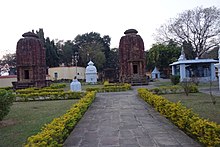
Rameshwar – Ramnath Temples
A group of three temples of Siva at Boudh town are called the Rameswar or Ramanath temples, dating back to the 9th century AD are reputed for their special feature. The decorative motifs and the plastic art of three temples at Boudh are certainly superior to and older than the great Lingaraj and Ananta Vasudeva group. One particular feature of the Ramanath temple is worth particular attention. Their plan is quite different from any other temples. In plan, these temples are eight-rayed stars and the argha-pattas of the lingas are also similar. These magnificent temples built of red sandstone and profusely carved are stated to have been constructed in the mid-9th century AD. The temples with rich texture and curved surfaces are noteworthy. Each of these temples stands by itself on a raised platform, and consists of a cell and an attached portico. The minute recesses and angularities produce a charming effect of light and shade and confer an appearance of greater height from the continued cluster of vertical lines than they really possess. Archaeological Survey of India has preserved this temple.
Jogindra Villa Palace
This is the palace of ex-Ruler of Boudh locally known as Raja batis. This was constructed during the reign of Raja Jogindra Dev, who was a benevolent and generous ruler. The palace is a picturesque and handsome building commanding a fine view of Mahanadi.
Hanuman Temple
This temple is situated in the midst of the river Mahandai to the east of Boudh town. The Hanuman temple was constructed by a religious mendicant. This shrine was constructed on a large stone. The temple commands an extensive view, especially during rain when the Mahanadi is in full bloom.
Chandra Chuda and Matengeswar Temple
The Chandra Chuda and Matengeswar temple are situated on the bank of river Mahanadi in Boudh town. Both the temples are Shiva temples. In the Matengeswar temple, there is also a separate temple for goddess Parvati.
Madan Mohan Temple
In Madan Mohan temples idol of Radha-Krishna has been worshipped. One Gayatri Pragnya Mandir is also situated at the adjacent to these temples.
Jagannath Temple
This temple is one of the ancient temples of Odisha. It is situated in the heart of Boudh town.
Debagarh
The Raghunath temple at Debagarh is 14 km from Boudh town. The marble statue of Rama, Laxman, Sita and Hanuman are being worshipped here. There is also a pond here.
Chari Sambhu Temple
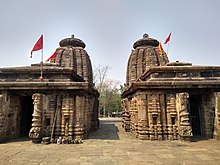
Chari Sambhu Temple
The Chari sambhu temple was previously named as Gandharadi temple. It is situated near the village Jagati at a distance of 16 km. from Boudh. It is the renowned twin temples of Nilamadhava and Sidheswar. These temples were constructed under the patronage of the Bhanja rulers of Khinjali mandala in the 9th century AD. These two temples were built on one platform which is exactly similar to each other. The one on the left hand is dedicated to Siva named Siddheswar and its shikhara is surmounted by a Sivalinga. The second is dedicated to Vishnu, named Nilamadhava and its shikhara is surmounted by a wheel of blue chlorite. The principle of construction of the jagamohans at Gandhara is slightly different from that of other temples. Their roofs are built on the cantilever principle and originally it appears to have been supported on twelve large pillars arranged as a hollow square.
Thus each side had four pillars of which the central ones flanked an opening. Originally these two jagamohanas appear to have been open on all sides; but later on, the lintels on all sides appear to have given away and then it became necessary to fill in the gaps between pillars with the exception of the four openings with ashlar masonry. At the same time, the side openings were filled up with a jali or lattice of blue chlorite towards the bottom and a frieze of four miniature temple shikhara over it. This arrangement is not followed in later temples where the ingress of light into jagamohana is through four or five stone pillars in the opening used as window bars.
The style of ornamentation in the jagamohans of the Gandharadi temples is altogether different. Even stylized chaitya-windows are rarely to be seen at Gandharadi except at the bases of the pilasters of the vimana. the ornamentation on these two jagamohans is very simple and much less overcrowded. The importance of the Gandharadi temples lies in the fact that they provide a link and that a very important one, in the chain of the evolution, in the chain of the evolution of the medieval Orissa temple type.
The Gandharadi temple is also locally known as ‘Chari Sambhu Mandira‘ (the temple of four Sambhus or Siva lingas). In the Siva temple Siddheswar is the presiding deity. In the Jagamohan, to the left of the door leading to the sanctum is the siva Linga called Jogeswar and to the right of the door is the linga called Kapileswar. At a little distance from Siddheswar stands the temples of Paschima Somanath (Siva), the door of the temple opening to the west.
Some images of considerable antiquity are found worshipped in shrines nearby. Notable among them are the images of Ganesh in the temple of Paschima Somanath and an image of eight armed Durga worshipped under a banyan tree, the later image being badly eroded due to the vagaries of weather. These images probably once adorned the Siddheswar temple. Portions of carved doorsteps in black chlorite and other decorative motifs have been unearthed. In the vicinity of the temple. Five feet (1.52 meters) high Hanuman image of good workmanship is being worshipped near the village Jagati and a carved Nabagraha slab is lying in the cornfield. Archaeological Survey of India has preserved this place.
Purunakatak

Bhairabi Temple, Purunakatak
Purunakatak, 30 km from Boudh on Boudh-Bhubaneswar road, is a trading center of some importance. Goddess Bhairabi is the presiding deity of Boudh District. Durga puja festival is observed here for 16 days. Just opposite to the Bhairabi temple is the temple of Maheswar Mahadev. One Inspection Bungalow is nearby for staying.
Places of Interest
- Padmatola Sanctuary
- Dambarugada Mountains
- Nayakpada Cave (Patali Shrikhetra)
- Marjakud Island
Apart from the above places, there are numerous places in Boudh for tourist visits e.g. Asurgada, Shiva temple at Karadi, Sarsara and Baunsuni, Jatasamadhi temple at Balasinga (Temple of Mahima Cult), and Paljhir Dam.
Legislation
Vidhan Sabha Constituencies
The following are the 2 Vidhan sabha constituencies of Boudh district and the elected members of that area.
| No. | Constituency | Reservation | Extent of the Assembly Constituency (blocks) | Member of 15th Assembly | Party |
|---|---|---|---|---|---|
| 85 | Kantamal | None | Kantamal, Boudh (part) | Mahidhar Rana | BJD |
| 86 | Boudh | None | Harbhanga, Boudhgarh (NAC), Boudh (part) | Pradip Kumar Amat | BJD |
Star Wars92% (130 reviews)90 (24 reviews)N/AThe Empire Strikes Back94% (102 reviews)82 (25 reviews)N/AReturn of the Jedi82% (94 reviews)58 (24 reviews)N/AStar Wars: Episode I – The Phantom Menace52% (232 reviews)51 (36 reviews)A−Star Wars: Episode II – Attack of the Clones65% (253 reviews)54 (39 reviews)A−Star Wars: Episode III – Revenge of the Sith80% (299 reviews)68 (40 reviews)A−Star Wars: The Force Awakens92% (437 reviews)80 (55 reviews)AStar Wars: The Last Jedi90% (472 reviews)84 (56 reviews)AStar Wars: The Rise of Skywalker51% (495 reviews)54 (61 reviews)B+Spin-off filmsStar Wars: The Clone Wars18% (171 reviews)35 (30 reviews)B−Rogue One: A Star Wars Story84% (446 reviews)65 (51 reviews)ASolo: A Star Wars Story69% (475 reviews)62 (54 reviews)A−Television filmsStar Wars Holiday Special27% (15 reviews)N/AN/AThe Ewok Adventure21% (14 reviews)N/AN/AEwoks: The Battle for Endor33% (3 reviews)N/AN/A
Accolades
Academy Awards
The eleven live-action films together have been nominated for 37 Academy Awards, of which they have won seven. The films were also awarded a total of three Special Achievement Awards. The Empire Strikes Back and Return of the Jedi received Special Achievement Awards for their visual effects, and Star Wars received a Special Achievement Award for its alien, creature and robot voices.
| Film | Best Picture | Best Director | Best Supporting Actor | Best Original Screenplay | Best Costume Design | Best Film Editing | Best Makeup | Best Original Score | Best Production Design | Best Sound Editing | Best Sound Mixing | Best Visual Effects | Ref. |
|---|---|---|---|---|---|---|---|---|---|---|---|---|---|
| Star Wars | Nominated | Nominated | Nominated | Won | category not yet introduced | Won | Won | Won | |||||
| The Empire Strikes Back | Nominated | Special Achievement | |||||||||||
| Return of the Jedi | Nominated | ||||||||||||
| The Phantom Menace | Nominated | ||||||||||||
| Attack of the Clones | |||||||||||||
| Revenge of the Sith | Nominated | ||||||||||||
| The Force Awakens | Nominated | Nominated | Nominated | Nominated | |||||||||
| Rogue One | |||||||||||||
| The Last Jedi | Nominated | Nominated | |||||||||||
| Solo | Nominated | ||||||||||||
| The Rise of Skywalker | Nominated | Nominated | Nominated | ||||||||||
Grammy Awards
The franchise has received a total of fifteen Grammy Award nominations, winning six.
| Film | Album of the Year | Best Pop Instrumental Performance | Best Score Soundtrack for Visual Media | Best Instrumental Composition | Ref. |
|---|---|---|---|---|---|
| Star Wars | Nominated | Won | Won | Won | |
| The Empire Strikes Back | Nominated | Won | Won | ||
| Return of the Jedi | Nominated | ||||
| The Phantom Menace | Nominated | ||||
| Revenge of the Sith | Nominated | Nominated | |||
| The Force Awakens | Won | ||||
| Solo | Nominated |
- Notes
- ^ Alec Guinness for his performance as Obi-Wan Kenobi.
- ^ For “Star Wars – Main Title”
- ^ For “Yoda’s Theme”
- ^ For The Empire Strikes Back. Also nominated for “The Imperial March (Darth Vader’s Theme) and “Yoda’s Theme”.
- ^ For “Anakin’s Betrayal”
Library of Congress
In 1989, the Library of Congress selected the original Star Wars film for preservation in the U.S. National Film Registry, as being “culturally, historically, or aesthetically significant.” The Empire Strikes Back was selected in 2010. 35mm reels of the 1997 Special Editions were the versions initially presented for preservation because of the difficulty of transferring from the original prints, but it was later revealed that the Library possessed a copyright deposit print of the original theatrical releases. By 2015, Star Wars had been transferred to a 2K scan which can be viewed by appointment.
Emmy Awards
Caravan of Courage: An Ewok Adventure was one of four films to be juried-awarded Emmys for Outstanding Special Visual Effects at the 37th Primetime Emmy Awards. The film was additionally nominated for Outstanding Children’s Program but lost in this category to an episode of American Playhouse.
At the 38th Primetime Emmy Awards, Ewoks: The Battle for Endor and the CBS documentary Dinosaur! were both juried-awarded Emmys for Outstanding Special Visual Effects. The film additionally received two nominations for Outstanding Children’s Program and Outstanding Sound Mixing for a Miniseries or a Special.
Unproduced and rumored films
In early 2013, Bob Iger announced the development of a spin-off film written by Simon Kinberg, reported by Entertainment Weekly to focus on bounty hunter Boba Fett during the original trilogy. In mid-2014, Josh Trank was officially announced as the director of an undisclosed spin-off film, but had left the project a year later due to creative differences, causing a teaser for the film to be scrapped from Star Wars Celebration. In May 2018, it was reported that James Mangold had signed on to write and direct a Fett film, with Kinberg attached as producer and co-writer. By October, the Fett film was reportedly no longer in production, with the studio instead focusing on The Mandalorian, which utilizes a similar character design.
In August 2017, it was rumored that films focused on Jabba the Hutt, and Jedi Masters Obi-Wan and Yoda were being considered or were in development. Stephen Daldry was reportedly in early negotiations to co-write and direct the Obi-Wan movie. At D23 Expo in August 2019, it was announced that a streaming series about the character would be produced instead.
Felicity Jones, who played Jyn Erso in Rogue One, has the option of another Star Wars film in her contract; notwithstanding her character’s fate in Rogue One, it has been speculated that she could return in other anthology films. In 2018, critics noted that Solo was intentionally left open for sequels. Alden Ehrenreich and Emilia Clarke confirmed that their contracts to play Han Solo and Q’ira extended for additional films, if required.
An unannounced film centered around the Mos Eisley Spaceport was reportedly put on hold or cancelled in mid-2018, leading to rumors of the cancellation or postponement of the anthology series. Lucasfilm swiftly denied the rumors as “inaccurate”, confirming that multiple unannounced films were in development.
Game of Thrones creators David Benioff and D. B. Weiss were to write and produce a trilogy of Star Wars films scheduled to be released in December 2022, 2024, and 2026, which were first announced to be in development in February 2018. However, citing their commitment to a Netflix deal, the duo stepped away from the project in October 2019. Kennedy stated her openness to their returning when their schedules allow.
Additionally, though unconfirmed by Lucasfilm, BuzzFeed reported in May 2019 that Laeta Kalogridis was writing the script for the first film in a potential Knights of the Old Republic trilogy. In January 2020, a film set in the era of The High Republic was rumored to be in development.