
Protests against the 2022 Russian invasion of Ukraine occurred spontaneously and simultaneously in many places worldwide.
Russia
In the seven days from 24 February to March 2, over 6,500 people in 53 cities across Russia have been detained by police for protesting against the invasion.
In violation of the Russian Constitution and international human rights law, Putin has made peaceful public protest without permission of the authorities illegal.
This background information is necessary to understand the extreme intimidation caused by the large number of arrests and by the seemingly reasonable warning of the authorities to not take part in “unsanctioned” protests. Russian authorities warned Russians of legal repercussions for joining anti-war protests. Over 60 Russian activists and journalists have been arrested.
On 27 February, another 2,063 people were detained at street protests against the war.
On 27 February, a van with markings that read “People, wake up!”, “This is war”, “Putin is scum!” crashed and caught fire in Pushkinskaya Square.
More than 10,000 technology workers, 6,000 medical workers, over 3,400 architects, more than 2,000 actors, directors and other creative figures, and 1,500 teachers signed petitions calling for Putin’s government to stop the war.
147,000 Russians have signed a petition to impeach Putin.
Academics
Troitsky variant (also known as TrV-Nauka), an independent Russian popular science newspaper, published an open letter against war signed by more than 4750 Russian scientists including many famous academician and members of the Russian Academy of Sciences. Oleg Anisimov, a scientist delegate from Russia, apologized to his colleague from Ukraine at the UN climate conference. Mikhail Gelfand, bioinformatician and a member of the Academia Europaea, also made a statement against war.
Activists
On 24 February, human rights activist Lev Ponomaryov started a petition to protest the invasion, garnering 289,000 signatures by the end of the day.
Celebrities
The invasion was condemned by television presenter Ksenia Sobchak, pop star Valery Meladze, writer Dmitry Glukhovsky, journalist and YouTuber Yury Dud, film director Roman Volobuev, rapper Noize MC, Dynamo Moscow striker Fyodor Smolov, actress Chulpan Khamatova and the television host Ivan Urgant. Urgant’s late-night show subsequently disappeared from the scheduled programs on the state-owned TV station Channel One. Opera singer Anna Netrebko also spoke out against the war. Dozens of other Russian artists, TV presenters and other celebrities spoke out on social networks against Russia’s military actions in Ukraine.
Russian rapper Oxxxymiron cancelled six sold-out concerts in Moscow and St. Petersburg, stating, “I cannot entertain you when Russian missiles are falling on Ukraine. When residents of Kyiv are forced to hide in basements and in the metro, while people are dying.”
Sports
NHL hockey player Alexander Ovechkin criticized Russia’s invasion of Ukraine. Tennis players Medvedev, Rublev and Kafelnikov and other Russian sportsmen also made statements against the war.
Military
A commander of Russia’s 74th Motorized Rifle Brigade was reportedly quoted as saying; “We were not going to fight – we were collecting information” after the entire platoon was reportedly captured in Chernihiv.
Organizations
The founders of the “Immortal Regiment” commemoration movement, in which ordinary Russians carry photographs of veteran family members in marches around Russia held annually to mark WWII Victory Day on 9 May, called on the Putin “to cease fire”, describing the use of force as “inhuman”.
Olga Larkina, the director of Russia’s Committee of Soldiers’ Mothers, raised concerns to Russian investigative news outlet Meduza that many of the soldiers in Ukraine had been forcibly sent to Ukraine. Larkina alleged that Russian conscripts had been pressured or forced into signing contracts to become soldiers, sent to Ukraine and family members have lost contact with them.
Politicians
Jailed Russian opposition leader Alexei Navalny condemned Russia’s attack on Ukraine and called those who launched the war “bandits and thieves.” Russian opposition activist and politician Marina Litvinovich called for anti-war protests in Russian cities. She was detained by Russian police as she left her house.
State Duma deputy Mikhail Matveev voted in favor of the recognition of the Donetsk and Luhansk People’s Republics but later denounced the 2022 Russian invasion of Ukraine, stating “I voted for peace, not for war. I wanted Russia to become a shield so that Donbas would not be bombed, not for Kyiv to be bombed.” State Duma deputy Oleg Smolin said he was “shocked” by the invasion. Liza Peskova, daughter of Putin’s spokesman Dmitry Peskov, shared an image with the “No to war” hashtag on Instagram.
More than 100 Russian municipal deputies signed a letter against the war with Ukraine.
Press
Russian Nobel Peace Prize winner Dmitry Muratov announced that the Novaya Gazeta newspaper would publish its next edition in both Ukrainian and Russian. Muratov, journalist Mikhail Zygar, director Vladimir Mirzoyev, and others signed a document stating that Ukraine was not a threat to Russia and calling for Russian citizens “to say no to this war.” Elena Chernenko, a journalist at Kommersant, circulated a critical open letter that was signed by 170 journalists and academics.
Other professional communities
Open letters against the war were also published by professional associations of doctors and healthcare workers, NGO workers, lawyers, psychologists and psychiatrists, teachers, students, economists, employees of IT companies, workers of culture and art, comedians, workers in the beauty and fashion industry, film makers, advertising and gaming industries, designers, animators, and architects.
Outside Russia
Pro-Ukrainian protests have occurred at several of Russia’s embassies and consulates abroad, including those in:
- Albania
- Andorra
- Argentina
- Armenia
- Azerbaijan
- Bangladesh
- Belarus
- Belgium
- Bosnia and Herzegovina
- Brazil
- Bulgaria
- Canada
- Chile
- Colombia
- Croatia
- Czech Republic
- Denmark
- Estonia
- Finland
- France
- Georgia
- Greece
- Hungary
- Iceland
- India
- Iran
- Ireland
- Israel
- Italy
- Kazakhstan
- Kosovo
- Kyrgyzstan
- Latvia
- Lebanon
- Lithuania
- Malaysia
- Malta
- Mexico
- Moldova
- Montenegro
- Netherlands
- New Zealand
- North Macedonia
- Norway
- Peru
- Poland
- Philippines
- Portugal
- Romania
- Serbia
- Slovakia
- Slovenia
- South Africa
- South Korea
- Spain
- Sri Lanka
- Sweden
- Taiwan
- Thailand
- Turkey
- United Kingdom
- United States
Unable to protest at the Russian embassy in Tehran, Iranian protests took place at the Ukrainian embassy instead.

Protest rally in Tel Aviv, Israel on 26 February 2022
During a constitutional referendum vote, Belarusian protestors in Minsk chanted “No to war” at polling stations. According to Ministry of internal affairs of Belarus, 800 people were detained on that day.
Protests were also held in Amman, Bern, Hong Kong, Istanbul, Luxembourg City, Nicosia, Sydney, Tokyo, and Vienna. In Valencia, Venezuela, a group of students held a protest.
On 25 February, the Slovak tabloid Nový čas published Putin’s photo edited to look like Hitler with the term ‘Putler’ on its cover. Similar photos were also published by the British tabloid Daily Star (which called Putin “bloody Vlad”) and by the Italian newspaper La Ragione.
On 25 February, climate activist Greta Thunberg protested outside the Russian embassy in Stockholm.
On 26 February, Ukrainians gathered at St. Nicholas Cathedral in Mapo District, Seoul, South Korea, praying for the peace of their motherland. After the prayer, they went out the church and raised the Ukrainian flag and protesting signs. In the next day, around 300 people, including Ukrainians living in South Korea and their supporters, protest against Russia’s invasion near the Russian Embassy in Seoul.
On 27 February, more than 100,000 gathered in Berlin to protest against Russia’s invasion of Ukraine. On 28 February, instead of the traditional Carnival parade Kölner Rosenmontagszug, which had been cancelled due to COVID-19 a few days earlier, more than 250,000 (instead of the anticipated 30,000) gathered in Cologne in a peace march to protest against the Russian invasion.
On 27 February, Taras Ostapchuk, a Ukrainian mechanic, appeared in Mallorcan court on charges of partially sinking the $7 million superyacht that he worked on. He stated that his boss ran a Russian state-owned supplies of military products and that he had gotten angry at the thought that his boss’s company has supplied the missile that had struck a Kyiv apartment building that he had watched on his cellphone. Ostapchuk stated, “What do I need a job for if I don’t have a country?”, telling the court, “I don’t regret anything I’ve done, and I would do it again.”
Protest gallery
-

Members of the European Party of Armenia protesting in support of Ukraine outside the Russian embassy in Yerevan, 24 February 2022.
The above file’s purpose is being discussed and/or is being considered for deletion. See files for discussion to help reach a consensus on what to do.
-

Minsk, Belarus. People shout “No to war!”
-
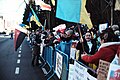
Protest in Brussels, Belgium.
-

Protest in Montreal, Canada.
-
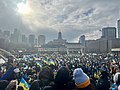
Protest in Toronto, Canada.
-
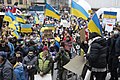
Anti-war protest in Vancouver, Canada.
-

Protest at the Embassy of Russia in Bogotá, Colombia.
-

Protest at the Russian Consulate in Brno, Czech Republic.
-

Protest outside the Folketing in Copenhagen, Denmark.
-

Protest in Tartu, Estonia.
-

Protest in Helsinki, Finland.
-

Protest in Audincourt, France.
-

Protest in Belfort, France.
-

Protest in Chaux, France.
-

Protest in Lyon, France.
-

Protest in Mulhouse, France.
-
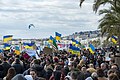
Protest in Nice, France.
-

Protest in Paris, France.
-

Protest in Toulouse, France.
-

Protest in solidarity with Ukraine in Tbilisi, Georgia.
-
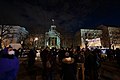
Protest at the Russian embassy in Berlin, Germany.
-

Flowers and signs laid outside the Ukrainian embassy in Berlin to commemorate the victims of the invasion.
-

Protest in Cologne, Germany.
-
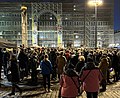
Protest in Dortmund, Germany.
-

Protest in Erfurt, Germany.
-
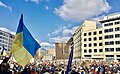
Protest in Frankfurt, Germany.
-

Protest in Hannover, Germany.
-
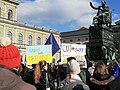
Protest in Munich, Germany.
-

Anti-war protest against the invasion of Ukraine in Nördlingen, Germany.
-

Protest in Wolfsburg, Germany.
-

Protest in Athens, Greece.
-

Protests at the Russian embassy in Budapest, Hungary.
-
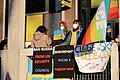
Protests in Venice, Italy.
-
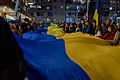
Protest in Tel Aviv, Israel.
-

Protest in Tokyo, Japan.
-
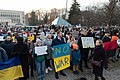
Protesters at the Russian embassy in Riga, Latvia.
-

Protest in Groningen, Netherlands.
-

Protest in Maastricht, Netherlands.
-

Protest in Auckland, New Zealand.
-

Protest in Bydgoszcz, Poland.
-
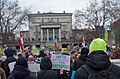
Protest in Poznań, Poland.
-
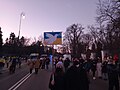
Protest in Warsaw, Poland.
-

Protest in Wrocław, Poland.
-

Protest in Lisbon, Portugal.
-
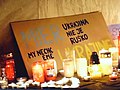
Candles lit in memory of the victims of the invasion, Bratislava, Slovakia.
-

Candles lit in memory of the victims of the invasion, Prešov, Slovakia.
-

Protest in Barcelona, Spain.
-
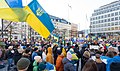
Protest in Stockholm, Sweden.
-
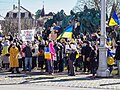
Protest in Bern, Switzerland.
-
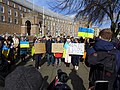
Protest in Bristol, U.K.
-

Protest in Glasgow, U.K.
-
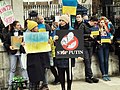
Protest in London, U.K.
-
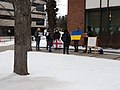
Student demonstration at Binghamton University, U.S.
-

Prayer in Boise, U.S.
-
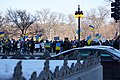
Protest in Chicago, U.S.
-

Protest in Columbus, U.S.
-

Protest in Madison, U.S.
-
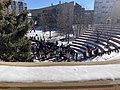
Student rally at the Massachusetts Institute of Technology, U.S.
-

Protest in New York City, U.S.
-

Rally in support of Ukraine in Times Square, New York City
-

Protest in Raleigh, North Carolina, U.S.
-

A Pro-Ukraine demonstration in Lafayette Square, Washington, D.C., U.S.
-

A protest outside The White House, Washington, D.C., U.S.
-
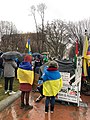
A Pro-Ukraine demonstration outside The White House, Washington, D.C., U.S.
-
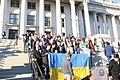
A protest outside the Utah State Capitol, U.S.
-

Protest on Quezon City,Philippines February 28
Buildings lit up in the Ukrainian colours
 |
Wikimedia Commons has media related to Buildings illuminated in support of Ukraine during the 2022 Russian invasion of Ukraine. |
Several landmarks around the world were illuminated in the colours of the flag of Ukraine as a statement of solidarity.[143]
-

The EU’s Berlaymont building in Brussels, Belgium
-

The CN Tower in Toronto, Canada
-

US Embassy in Nicosia, Cyprus.
-

The Eiffel Tower in Paris, France
-
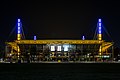
RheinEnergieStadion in Cologne, Germany.
-

Szczecin Philharmonic in Szczecin, Poland
-

The Foreign, Commonwealth and Development Office in London, United Kingdom
-

The Oxo Tower in London
-

Somerset House in London
-

US Embassy in London