
Upper Egypt (Arabic: صعيد مصر Ṣaʿīd Miṣr, shortened to الصعيد, Egyptian Arabic pronunciation: , locally: ; Coptic: ⲙⲁⲣⲏⲥ, romanized: Mares) is the southern portion of Egypt and is composed of the lands on both sides of the Nile that extend upriver from Lower Egypt in the north to Nubia in the south.
In ancient Egypt, Upper Egypt was known as tꜣ šmꜣw, literally “the Land of Reeds” or “the Sedgeland”. It is believed to have been united by the rulers of the supposed Thinite Confederacy who absorbed their rival city states during the Naqada III period (c. 3200–3000 BC), and its subsequent unification with Lower Egypt ushered in the Early Dynastic period. Upper and Lower Egypt became intertwined in the symbolism of pharaonic sovereignty such as the Pschent double crown. Upper Egypt remained as a historical region even after the classical period.
Geography
Upper Egypt is between the Cataracts of the Nile beyond modern-day Aswan, downriver (northward) to the area of El-Ayait, which places modern-day Cairo in Lower Egypt. The northern (downriver) part of Upper Egypt, between Sohag and El-Ayait, is also known as Middle Egypt.
In Arabic, inhabitants of Upper Egypt are known as Sa’idis and they generally speak Sai’idi Egyptian Arabic.
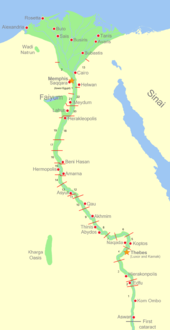
Map of Ancient Egypt with its historical nomes. “Upper Egypt” is in the lower portion of the map.
History

Hedjet, the White Crown of Upper Egypt
Predynastic Egypt
The main city of prehistoric Upper Egypt was Nekhen. The patron deity was the goddess Nekhbet, depicted as a vulture.
By approximately 3600 BC, Neolithic Egyptian societies along the Nile based their culture on the raising of crops and the domestication of animals. Shortly thereafter, Egypt began to grow and increase in complexity. A new and distinctive pottery appeared, related to the Levantine ceramics, and copper implements and ornaments became common. Mesopotamian building techniques became popular, using sun-dried adobe bricks in arches and decorative recessed walls.
In Upper Egypt, the predynastic Badari culture was followed by the Naqada culture (Amratian), closely related to the Nubian and Northeastern African populations, and the Proto-dynastic kings emerged from the Naqada region. Excavations at Hierakonpolis (Upper Egypt) found archaeological evidence of ritual masks similar to those used further south of Egypt, and obsidian linked to Ethiopian quarry sites. According to bioarchaeologist Nancy Lovell, the morphology of ancient Egyptian skeletons gives strong evidence that “In general, the inhabitants of Upper Egypt and Nubia had the greatest biological affinity to people of the Sahara and more southerly areas” but exhibited local variation in an African context.
These cultural advances paralleled the political unification of towns of the upper Nile River, or Upper Egypt, while the same occurred in the societies of the Nile Delta, or Lower Egypt. This led to warfare between the two new kingdoms. During his reign in Upper Egypt, King Narmer defeated his enemies on the delta and became sole ruler of the two lands of Upper and Lower Egypt, a sovereignty which endured throughout Dynastic Egypt.
Dynastic Egypt
In royal symbolism, Upper Egypt was represented by the tall White Crown Hedjet, the flowering lotus, and the sedge. Its patron deity, Nekhbet, was depicted by the vulture. After unification, the patron deities of Upper and Lower Egypt were represented together as the Two Ladies, to protect all of the ancient Egyptians, just as the two crowns were combined into a single pharaonic diadem.
For most of Egypt’s ancient history, Thebes was the administrative center of Upper Egypt. After its devastation by the Assyrians, the importance of Egypt declined. Under the dynasty of the Ptolemies, Ptolemais Hermiou took over the role of the capital city of Upper Egypt.
Medieval Egypt
In the eleventh century, large numbers of pastoralists, known as Hilalians, fled Upper Egypt and moved westward into Libya and as far as Tunis. It is believed that degraded grazing conditions in Upper Egypt, associated with the beginning of the Medieval Warm Period, were the root cause of the migration.
20th-century Egypt
In the twentieth-century Egypt, the title Prince of the Sa’id (meaning Prince of Upper Egypt) was used by the heir apparent to the Egyptian throne.
Although the Kingdom of Egypt was abolished after the Egyptian revolution of 1952, the title continues to be used by Muhammad Ali, Prince of the Sa’id.
List of rulers of prehistoric Upper Egypt
The following list may not be complete (there are many more of uncertain existence):
| Name | Image | Comments | Dates |
|---|---|---|---|
| Elephant | End of 4th millennium BC | ||
| Bull | 4th millennium BC | ||
| Scorpion I | Oldest tomb at Umm el-Qa’ab had scorpion insignia | c. 3200 BC? | |
| Iry-Hor |
 |
Possibly the immediate predecessor of Ka. | c. 3150 BC? |
| Ka |
 |
May be read Sekhen rather than Ka. Possibly the immediate predecessor of Narmer. | c. 3100 BC |
| Scorpion II |
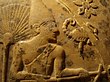 |
Potentially read Serqet; possibly the same person as Narmer. | c. 3150 BC |
| Narmer |
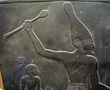 |
The king who combined Upper and Lower Egypt. | c. 3150 BC |
List of nomes
| Number | Ancient Name | Capital | Modern Capital | Translation | God |
|---|---|---|---|---|---|
| 1 | Ta-khentit | Abu / Yebu (Elephantine) | Aswan | The Frontier/Land of the Bow | Khnemu |
| 2 | Wetjes-Hor | Djeba (Apollonopolis Magna) | Edfu | Throne of Horus | Horus-Behdety |
| 3 | Nekhen | Nekhen (Hierakonpolis) | al-Kab | Shrine | Nekhebet |
| 4 | Waset | Niwt-rst / Waset (Thebes) | Karnak | Sceptre | Amun-Ra |
| 5 | Harawî | Gebtu (Coptos) | Qift | Two Falcons | Min |
| 6 | Aa-ta | Iunet / Tantere (Tentyra) | Dendera | Crocodile | Hathor |
| 7 | Seshesh | Seshesh (Diospolis Parva) | Hu | Sistrum | Hathor |
| 8 | Ta-wer | Tjenu / Abjdu (Thinis / Abydos) | al-Birba | Great Land | Onuris |
| 9 | Min | Apu / Khen-min (Panopolis) | Akhmim | Min | Min |
| 10 | Wadjet | Djew-qa / Tjebu (Antaeopolis) | Qaw al-Kebir | Cobra | Hathor |
| 11 | Set | Shashotep (Hypselis) | Shutb | Set animal | Khnemu |
| 12 | Tu-ph | Per-Nemty (Hieracon) | At-Atawla | Viper Mountain | Horus |
| 13 | Atef-Khent | Zawty (Lycopolis) | Asyut | Upper Sycamore and Viper | Apuat |
| 14 | Atef-Pehu | Qesy (Cusae) | al-Qusiya | Lower Sycamore and Viper | Hathor |
| 15 | Wenet | Khemenu (Hermopolis) | Hermopolis | Hare | Thoth |
| 16 | Ma-hedj | Herwer? | Hur? | Oryx | Horus |
| 17 | Anpu | Saka (Cynopolis) | al-Kais | Anubis | Anubis |
| 18 | Sep | Teudjoi / Hutnesut (Alabastronopolis) | el-Hiba | Set | Anubis |
| 19 | Uab | Per-Medjed (Oxyrhynchus) | el-Bahnasa | Two Sceptres | Set |
| 20 | Atef-Khent | Henen-nesut (Heracleopolis Magna) | Ihnasiyyah al-Madinah | Southern Sycamore | Heryshaf |
| 21 | Atef-Pehu | Shenakhen / Semenuhor (Crocodilopolis, Arsinoë) | Faiyum | Northern Sycamore | Khnemu |
| 22 | Maten | Tepihu (Aphroditopolis) | Atfih | Knife | Hathor |