
The Corded Ware culture comprises a broad archaeological horizon of Europe between c. 2900 BCE – circa 2350 BCE, thus from the late Neolithic, through the Copper Age, and ending in the early Bronze Age. Corded Ware culture encompassed a vast area, from the contact zone between the Yamnaya culture and the Corded ware culture in south Central Europe, to the Rhine on the west and the Volga in the east, occupying parts of Northern Europe, Central Europe and Eastern Europe.
According to Haak et al. (2015), the Corded Ware people of Central Europe carried mostly Western Steppe Herder (WSH) ancestry and were closely related to the people of the Yamna culture (or Yamnaya), “documenting a massive migration into the heartland of Europe from its eastern periphery,” the Eurasiatic steppes. The Corded Ware language may be ancestral to the Proto-Germanic and Proto-Balto-Slavic Indo-European languages in Europe. The eastern Corded Ware Culture also shows genetic affinity with the later Sintashta culture, where the Proto-Indo-Iranian language may have originated.
Nomenclature
The term Corded Ware culture (German: Schnurkeramik-Kultur, Dutch: touwbekercultuur, French: céramique cordée) was first introduced by the German archaeologist Friedrich Klopfleisch in 1883. He named it after cord-like impressions or ornamentation characteristic of its pottery. The term Single Grave culture comes from its burial custom, which consisted of inhumation under tumuli in a crouched position with various artifacts. Battle Axe culture, or Boat Axe culture, is named from its characteristic male grave offering, a stone boat-shaped battle axe.
Geography
Corded Ware encompassed most of continental northern Europe from the Rhine on the west to the Volga in the east, including most of modern-day Germany, the Netherlands, Denmark, Poland, Lithuania, Latvia, Estonia, Belarus, Czech Republic, Austria, Hungary, Slovakia, Switzerland, northwestern Romania, northern Ukraine, and the European part of Russia, as well as coastal Norway and the southern portions of Swedenand Finland. In the Late Eneolithic/Early Bronze Age, it encompassed the territory of nearly the entire Balkan Peninsula, where Corded Ware mixed with other steppe elements.
Archaeologists note that Corded Ware was not a “unified culture,” as Corded Ware groups inhabiting a vast geographical area from the Rhine to Volga seem to have regionally specific subsistence strategies and economies.:226 There are differences in the material culture and in settlements and society. At the same time, they had several shared elements that are characteristic of all Corded Ware groups, such as their burial practices, pottery with “cord” decoration and unique stone-axes.
The contemporary Beaker culture overlapped with the western extremity of this culture, west of the Elbe, and may have contributed to the pan-European spread of that culture. Although a similar social organization and settlement pattern to the Beaker were adopted, the Corded Ware group lacked the new refinements made possible through trade and communication by sea and rivers.
Origins

Corded Ware stone-axe in the Museum für Vor- und Frühgeschichte (Berlin). Ca. 2800-2400 BCE.
The origins and dispersal of Corded Ware culture is one of the pivotal unresolved issues of the Indo-European Urheimat problem, and there is a stark division between archaeologists regarding the origins of Corded Ware. The Corded Ware culture has long been regarded as Indo-European, with archaeologists seeing an influence from nomadic pastoral societies of the steppes. Alternatively, some archaeologists believed it developed independently in central Europe.
Influence from Yamnaya culture
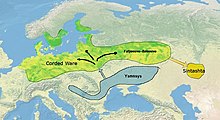
According to Allentoft (2015), the Sintashta culture probably derived at least partially from the Corded Ware Culture. Nordqvist and Heyd (2020) confirm this.
The Corded Ware culture was once presumed to be the Urheimat of the Proto-Indo-Europeans based on their possession of the horseand wheeled vehicles, apparent warlike propensities, wide area of distribution and rapid intrusive expansion at the assumed time of the dispersal of Indo-European languages. Today this specific idea has lost currency, as the Kurgan hypothesis is currently the most widely accepted proposal to explain the origins and spread of the Indo-European languages, but the formative influence of the Yamnaya culture remains.
Its relative lack of settlements compared to preceding cultures suggests a mobile, pastoral economy, similar to that of the Yamna culture, and the culture of the Indo-Europeans inferred from philology. According to Haak et al. (2015), palaeogenomic data show that samples of the Corded Ware population from ca. 2400 BCE were genetically at least 75% similar to the Yamna population of the steppes, suggesting massive migrations from the steppes as a source for the Corded Ware culture.
Yet, subsequent studies also noted that although Corded Ware is presumed to be largely derived from the Yamnaya culture, most Corded Ware males carried mostly R1a Y-DNA, while males of the Yamnaya primarily carried R1b-M269. And the degree to which cultural change generally represents immigration is a matter of debate, and such debate has figured strongly in discussions of Corded Ware. While honouring the possibilities of genetic research, the idea of a “mass migration” has been questioned by archaeologists as being too simple, as it ignores the complex processes involved in archaeological explanations.
Its wide area of distribution indicates rapid expansion at the assumed time of the dispersal of Indo-European languages. In a number of regions Corded Ware appears to herald a new culture and physical type. On most of the immense, continental expanse that it covered, the culture was clearly intrusive, and therefore represents one of the most impressive and revolutionary cultural changes attested by archaeology.
Goldberg et al. (2016) found that Neolithic farming migration into Europe “was driven by mass migration of both males and females in roughly equal numbers, perhaps whole families”, while Bronze Age Pontic steppe “migration and cultural shift were instead driven by male migration, potentially connected to new technology and conquest.” Kristiansen et al. (2017) theorise that the Corded Ware culture originated from male Yamnaya pastoralists migrating northwards, and marrying local farmer woman, who contributed specific farmer aspects to the male Yamnaya culture, which transformed into the Corded ware culture. This culture was carried further into Europe by their offspring.
The Middle Dnieper culture forms a bridge between the Yamnaya culture and the Corded ware culture. From the Middle Dnieper culture the Corded Ware culture spread both west and east. The eastward migration gave rise to the Fatyanova culture which had a formative influence on the Abashevo culture, which in turn contributed to the proto-Indo-IranianSintashta culture.
Independent development
In favour of the second view was the fact that Corded Ware coincides considerably with the earlier north-central European Funnelbeaker culture (TRB). According to Gimbutas, the Corded Ware culture was preceded by the Globular Amphora culture (3400–2800 BCE), which she regarded to be an Indo-European culture. The Globular Amphora culture stretched from central Europe to the Baltic sea, and emerged from the Funnelbeaker culture.
According to controversial radiocarbon dates, Corded Ware ceramic forms in single graves develop earlier in the area that is now Poland than in western and southern Central Europe. The earliest radiocarbon dates for Corded Ware indeed come from Kujawy and Lesser Poland in central and southern Poland and point to the period around 3000 BCE.
However, subsequent review has challenged this perspective, instead pointing out that the wide variation in dating of the Corded Ware, especially the dating of the culture’s beginning, is based on individual outlier graves, is not particularly in line with other archaeological data and runs afoul of plateaus in the radiocarbon calibration curve; in the one case where the dating can be clarified with dendrochronology, in Switzerland, Corded Ware is found for only a short period from 2750 BCE to 2400 BCE. Furthermore, because the short period in Switzerland seems to represent examples of artifacts from all the major sub-periods of the Corded Ware culture elsewhere, some researchers conclude that Corded Ware appeared more or less simultaneously throughout North Central Europe approximately in the early 29th century BCE (around 2900 BCE), in a number of “centers” which subsequently formed their own local networks.:297 Carbon-14 dating of the remaining central European regions shows that Corded Ware appeared after 2880 BCE. According to this theory, it spread to the Lüneburg Heath and then further to the North European Plain, Rhineland, Switzerland, Scandinavia, the Baltic region and Russia to Moscow, where the culture met with the pastoralists considered indigenous to the steppes.
Subgroups
Middle Dnieper culture
The Middle Dnieper culture is a formative early expression of the Corded Ware culture. It has very scant remains, but occupies the easiest route into Central and Northern Europe from the steppe.
Fatyanovo–Balanovo culture
The Middle Dnieper culture and the Eastern Baltic Corded Ware culture gave rise to the Fatyanovo–Balanovo culture on the upper Volga, which in turn contributed to the Abashevo culture, a predecessor of the proto-Indo-Iranian Sintashta culture.
The Fatyanovo–Balanovo culture may have been a culture with an Indo-European superstratum over a Uralic substratum, and may account for some of the linguistic borrowings identified in the Indo-Uralic thesis. However, according to Häkkinen, the Uralic–Indo-European contacts only start in the Corded Ware period and the Uralic expansion into the Upper Volga region postdates it. Häkkinen accepts Fatyanovo-Balanovo as an early Indo-European culture, but maintains that their substratum (identified with the Volosovo culture) was neither Uralic nor Indo-European. Genetics seems to support Häkkinen.
Schnurkeramikkultur
The prototypal Corded Ware culture, German Schnurkeramikkultur, is found in Central Europe, mainly Germany and Poland, and refers to the characteristic pottery of the era: twisted cord was impressed into the wet clay to create various decorative patterns and motifs. It is known mostly from its burials, and both sexes received the characteristic cord-decorated pottery. Whether made of flax or hemp, they had rope.
Single Grave culture

Protruding-Foot Beaker culture (PFB), subset of the Single Grave culture.
Single Grave term refers to a series of late Neolithic communities of the 3rd millennium BCE living in southern Scandinavia, Northern Germany, and the Low Countries that share the practice of single burial, the deceased usually being accompanied by a battle-axe, amber beads, and pottery vessels.
The term Single Grave culture was first introduced by the Danish archaeologist Andreas Peter Madsen in the late 1800s. He found Single Graves to be quite different from the already known dolmens, long barrows and passage graves. In 1898, archaeologist Sophus Müller was first to present a migration-hypothesis stating that previously known dolmens, long barrows, passage graves and newly discovered single graves may represent two completely different groups of people, stating “Single graves are traces of new, from the south coming tribes”.
The cultural emphasis on drinking equipment already characteristic of the early indigenous Funnelbeaker culture, synthesized with newly arrived Corded Ware traditions. Especially in the west (Scandinavia and northern Germany), the drinking vessels have a protruding foot and define the Protruding-Foot Beaker culture (PFB) as a subset of the Single Grave culture. The Beaker culture has been proposed to derive from this specific branch of the Corded Ware culture.

Boat-shaped battle axe, characteristic of Scandinavian and coastal-German Corded Ware.
 |
This section needs additional citations for verification. (May 2019) (Learn how and when to remove this template message)
|
The Danish-Swedish-Norwegian Battle Axe culture, or the Boat Axe culture, appeared ca. 2800 BCE and is known from about 3,000 graves from Scania to Uppland and Trøndelag. The “battle-axes” were primarily a status object. There are strong continuities in stone craft traditions, and very little evidence of any type of full-scale migration, least of all a violent one. The old ways were discontinued as the corresponding cultures on the continent changed, and the farmers living in Scandinavia took part in a few of those changes since they belonged to the same network. Settlements on small, separate farmsteads without any defensive protection is also a strong argument against the people living there being aggressors.
About 3000 battle axes have been found, in sites distributed over all of Scandinavia, but they are sparse in Norrland and northern Norway. Less than 100 settlements are known, and their remains are negligible as they are located on continually used farmland, and have consequently been plowed away. Einar Østmo reports sites inside the Arctic Circle in the Lofoten, and as far north as the present city of Tromsø.
The Swedish-Norwegian Battle Axe culture was based on the same agricultural practices as the previous Funnelbeaker culture, but the appearance of metal changed the social system. This is marked by the fact that the Funnelbeaker culture had collective megalithic graves with a great deal of sacrifices to the graves, but the Battle Axe culture has individual graves with individual sacrifices.
A new aspect was given to the culture in 1993, when a death house in Turinge, in Södermanland was excavated. Along the once heavily timbered walls were found the remains of about twenty clay vessels, six work axes and a battle axe, which all came from the last period of the culture. There were also the cremated remains of at least six people. This is the earliest find of cremation in Scandinavia and it shows close contacts with Central Europe.
In the context of the entry of Germanic into the region, Einar Østmo emphasizes that the Atlantic and North Sea coastal regions of Scandinavia, and the circum-Baltic areas were united by a vigorous maritime economy, permitting a far wider geographical spread and a closer cultural unity than interior continental cultures could attain. He points to the widely disseminated number of rock carvings assigned to this era, which display “thousands” of ships. To seafaring cultures like this one, the sea is a highway and not a divider.
Finnish Battle Axe culture
The Finnish Battle Axe culture was a mixed cattle-breeder and hunter-gatherer culture, and one of the few in this horizon to provide rich finds from settlements.
Economy
There are very few discovered settlements, which led to the traditional view of this culture as exclusively nomadic pastoralists. However, this view was modified, as some evidence of sedentary farming emerged. Traces of emmer, common wheat and barley were found at a Corded Ware site at Bronocice in south-east Poland. Wheeled vehicles (presumably drawn by oxen) are in evidence, a continuation from the Funnelbeaker culture era.
Cows’ milk was used systematically from 3400 BCE onwards in the northern Alpine foreland. Sheep were kept more frequently in the western part of Switzerland due to the stronger Mediterranean influence. Changes in slaughter age and animal size are possibly evidence for sheep being kept for their wool at Corded Ware sites in this region.
Graves

Late battle axe from Gotland
Burial occurred in flat graves or below small tumuli in a flexed position; on the continent males lay on their right side, females on the left, with the faces of both oriented to the south. However, in Sweden and also parts of northern Poland the graves were oriented north-south, men lay on their left side and women on the right side – both facing east. Originally, there was probably a wooden construction, since the graves are often positioned in a line. This is in contrast with practices in Denmark where the dead were buried below small mounds with a vertical stratigraphy: the oldest below the ground, the second above this grave, and occasionally even a third burial above those. Other types of burials are the niche-graves of Poland. Grave goods for men typically included a stone battle axe. Pottery in the shape of beakers and other types are the most common burial gifts, generally speaking. These were often decorated with cord, sometimes with incisions and other types of impressions.
The approximately contemporary Beaker culture had similar burial traditions, and together they covered most of Western and Central Europe. The Beaker culture originated around 2800 BCE in the Iberian Peninsula and subsequently extended into Central Europe, where it partly coexisted with the Corded Ware region.
In April 2011, it was reported that a deviant Corded Ware burial had been discovered in a suburb of Prague. The remains, believed to be male, were orientated in the same way as women’s burials and were not accompanied by any gender-specific grave goods. The excavators suggested the grave may have been that of a “member of a so-called third gender, which were people either with different sexual orientation or transsexuals or just people who identified themselves differently from the rest of the society”, while media reports heralded the discovery of the world’s first “gay caveman”. Archaeologists and biological anthropologists criticised media coverage as sensationalist. “If this burial represents a transgendered individual (as well it could), that doesn’t necessarily mean the person had a ‘different sexual orientation’ and certainly doesn’t mean that he would have considered himself (or that his culture would have considered him) ‘homosexual,'” anthropologist Kristina Killgrove commented. Other items of criticism were that someone buried in the Copper Age was not a “caveman” and that identifying the sex of skeletal remains is difficult and inexact. A detailed account of the burial has not yet appeared in scientific literature.
Role in formation of the Indo-European languages in Europe

Corded Ware pottery in the Museum für Vor- und Frühgeschichte (Berlin). Ca. 2500 BCE
West-European Indo-European languages
The Corded Ware culture may have played a central role in the spread of the Indo-European languages in Europe during the Copper and Bronze Ages. According to Mallory (1999), the Corded Ware culture may have been “the common prehistoric ancestor of the later Celtic, Germanic, Baltic, Slavic, and possibly some of the Indo-European languages of Italy.” Yet, Mallory (1999) also notes that the Corded Ware can not account for Greek, Illyrian, Thracian and East Italic, which may be derived from Southeast Europe. Mallory (2013) proposes that the Beaker culture was associated with a European branch of Indo-European dialects, termed “North-west Indo-European”, spreading northwards from the Alpine regions and ancestral to not only Celtic but equally Italic, Germanic and Balto-Slavic.
According to Anthony (2007), the Corded Ware horizon may have introduced Germanic, Baltic and Slavic into northern Europe. According to Anthony, the Pre-Germanic dialects may have developed in the Usatovo culture in south-eastern Central Europe between the Dniestr and the Vistula between c. 3,100 and 2,800 BCE, and spread with the Corded Ware culture. Between 3100 and 2800/2600 BCE, a real folk migration of Proto-Indo-European speakers from the Yamna-culture took place into the Danube Valley, which eventually reached as far as Hungary, where pre-Celtic and pre-Italic may have developed. Slavic and Baltic developed at the middle Dniepr (present-day Ukraine).
Haak et al. (2015) note that German Corded Ware “trace ~75% of their ancestry to the Yamna,” envisioning a west-north-west migration from the Yamna culture into Germany.Allentoft et al. (2015) envision a migration from the Yamna culture towards north-western Europe via Central Europe, and towards the Baltic area and the eastern periphery of the Corded Ware culture via the territory of present-day Ukraine, Belarus and Russia.
Language shift
According to Gimbutas’ original theory, the process of “Indo-Europeanization” of Corded Ware (and, later, the rest of Europe) was essentially a cultural transformation, not one of physical type. The Yamna migration from Eastern to Central and Western Europe is understood by Gimbutas as a military victory, resulting in the Yamna imposing a new administrative system, language and religion upon the indigenous groups. The social organization greatly facilitated the Yamna people’s effectiveness in war, their patrilineal and patriarchal structure. The Old Europeans (indigenous groups) had neither a warrior class nor horses. They lived in (probably) theocratic monarchies presided over by a queen-priestess or were egalitarian societies. This Old European social structure contrasted with the social structure of the Yamna-derived cultures that followed them.
David Anthony (2007), in his “revised Steppe hypothesis” proposes that the spread of the Indo-European languages probably did not happen through “chain-type folk migrations,” but by the introduction of these languages by ritual and political elites, which were emulated by large groups of people, a process which he calls “elite recruitment”. Yet, in supplementary information to Haak et al. (2015) Anthony, together with Lazaridis, Haak, Patterson, and Reich, notes that the mass migration of Yamna people to northern Europe shows that “the Steppe hypothesis does not require elite dominance to have transmitted Indo-European languages into Europe. Instead, our results show that the languages could have been introduced simply by strength of numbers: via major migration in which both sexes participated.”
Linguist Guus Kroonen points out that speakers of Indo-European languages encountered existing populations in Europe that spoke unrelated, non-Indo-European languages when they migrated further into Europe from the Yamna culture’s steppe zone at the margin of Europe. He focuses on both the effects on Indo-European languages that resulted from this contact and investigation of the pre-existing languages. Relatively little is known about the Pre-Indo-European linguistic landscape of Europe, except for Basque, as the “Indo-Europeanization” of Europe caused a largely unrecorded, massive linguistic extinction event, most likely through language shift. Kroonen’s 2015 study purports to show that Pre-Indo-European speech contains a clear Neolithic signature emanating from the Aegean language family and thus patterns with the prehistoric migration of Europe’s first farming populations.:10
Marija Gimbutas, as part of her theory, had already inferred that the Corded Ware culture’s intrusion into Scandinavia formed a synthesis with the indigenous people of the Funnelbeaker culture, giving birth to the Proto-Germanic language. According to Edgar Polomé, 30% of the non-Indo-European substratum found in modern German derives from non-Indo-European-speakers of Funnelbeaker culture, indigenous to southern Scandinavia. When Yamna Indo-European speakers came into contact with the indigenous peoples during the 3rd millennium BCE, they came to dominate the local populations yet parts of the indigenous lexicon persisted in the formation of Proto-Germanic, thus giving Proto-Germanic the status of being an “Indo-Europeanized” language.
Genetic studies
Y-DNA
As of October 2019, the Y-DNA of more than 26 Corded Ware males has been extracted. The majority of them have been found to be carriers of haplogroup R1a, while remaining males have been found to be carriers of R1b and I2a. It is notable that although Corded Ware is presumed to be largely derived from the Yamnaya culture, most Corded Ware males carried Y-DNA of different lineages than males of the Yamnaya, who primarily carried R1b-M269. According to Malmström et al. (2019), neither R1a nor R1b-M269 have been reported among Neolithic populations of central and western Europe, although it was common among earlier hunter gatherers of Eastern Europe. Yet, Linderholm et al. (2020) found seven CW males with R1b-M269, while Allentoft et al. (2015) report two CW males with R1b, and Fürtwangler et al. (2020) report three CW males with R1b. According to Sjögren et al. (2020), R1b-M269 “is the major lineage associated with the arrival of Steppe ancestry in western Europe after 2500 BC.”
An overview of reported CW genes:
- Haak et al. (2008), published in the Proceedings of the National Academy of Sciences of the United States of America, included an analysis of three males (probably a father and his two children) from a single Corded Ware burial in Eulau, Germany. All of them were carrying R1a.
- Haak et al. (2015), published in Nature, included an analysis of a Corded Ware male from Esperstedt. He was found to be carrying R1a1a1.
- Allentoft et al. (2015), published in Nature, included an analysis of several males from the Corded Ware culture. A male from the Battle-Axe culture in Viby, Kristianstad was found to be carrying R1a1a1. A Corded Ware male of Bergrheinfeld, Germany was also found to have carried R1a1a1. A Corded Ware male of Leki Male was found to have carried R1b1a. Two Corded Ware males from Tiefbrunn, Germany were found to have carried R1 and R1b1 respectively.
- Mathieson et al. (2015), published in Nature, included an analysis of eight Corded Ware males buried in Esperstedt. Six carried R1a or various subclades of it, while two carried R.
- Saag et al. (2017), published in Current Biology, included an analysis of five males from the Corded Ware culture in Estonia. Four of them carried R1a-Z645, while the other carried R1a1-Z283.
- Mathieson et al. (2018), published in Nature, included an analysis of three Corded Ware males from the Czech Republic. The three were found to be carrying the paternal haplogroups R1a1a, R1a1 and I2a2a2 respectively.
- Malmström et al. (2019), published in Proceedings of the Royal Society B, the Y-DNA of two Corded Ware males was extracted. Both were found to be carriers of R1a.
- Linderholm et al. (2020) report seven Polish CW males with R1b. Modern Poles : Modern Polish males that are mainly R1a(1) and R1b Y-DNA carriers have remarkably similar DNA to Corded Ware DNA
Genetics and migration as theoretical construct
A genetic study conducted by Haak et al. (2015) found that a large proportion of the ancestry of the Corded Ware culture’s population is similar to the Yamna culture, tracing the Corded Ware culture’s origins to migrations of the Yamna from the steppes 4,500 years ago. About 75% of the DNA of late Neolithic Corded Ware skeletons found in Germany was a precise match to DNA from individuals of the Yamna culture. The same study estimated a 40–54% ancestral contribution of the Yamna in the DNA of modern Central & Northern Europeans, and a 20–32% contribution in modern Southern Europeans, excluding Sardinians (7.1% or less), and to a lesser extent Sicilians (11.6% or less). Haak et al. also note that their results “suggest” that haplogroups R1b and R1a “spread into Europe from the East after 3,000 BCE.”
Autosomal DNA tests also indicate that westward migration from the steppes introduced a component of ancestry referred to as “Ancient North Eurasian” admixture into western Europe. “Ancient North Eurasian” is the name given in genetic literature to a component that represents descent from the people of the Mal’ta-Buret’ culture or a population closely related to them. The “Ancient North Eurasian” genetic component is visible in tests of the Yamna people as well as modern-day Europeans, but not of Western or Central Europeans predating the Corded Ware culture. Haak et al. (2015) also warned:
We caution that the sampled Yamna individuals from Samara might not be directly ancestral to Corded Ware individuals from Germany. It is possible that a more western Yamna population, or an earlier (pre-Yamna) steppe population may have migrated into central Europe, and future work may uncover more missing links in the chain of transmission of steppe ancestry.
— W. Haak et al., Nature (2015)
This warning was emphasized further by Heyd (2017). Heyd has cautioned to be careful with drawing too strong conclusions from those genetic similarities between Corded Ware and Yamna, noting the small number of samples; the late dates of the Esperstadt graves, which could also have undergone Bell Beaker admixture; the presence of Yamna-ancestry in western Europe before the Danube-expansion; and the risks of extrapolating “the results from a handful of individual burials to whole ethnically interpreted populations.” Heyd confirms the close connection between Corded Ware and Yamna, but also states that “neither a one-to-one translation from Yamnaya to CWC, nor even the 75:25 ratio as claimed (Haak et al. 2015:211) fits the archaeological record.”
Relations with later cultures
A 2015 study by Allentoft et al. in Nature found the people of the Corded Ware culture to be closely genetically related to the Beaker culture, the Unetice culture and the Nordic Bronze Age. People of the Nordic Bronze Age and Corded Ware show the highest lactose tolerance among Bronze Age Europeans.
The study also found a close genetic relationship between the Corded Ware culture and the Sintashta culture, suggesting that the Sintashta culture emerged as a result on an eastward expansion of Corded Ware peoples. The Sintashta culture is in turn closely genetically related to the Andronovo culture, by which it was succeeded. Many cultural similarities between the Sintashta/Andronovo culture, the Nordic Bronze Age and the people of the Rigveda have been detected.
Narasimhan et al. (2019) found the Sintashta culture, the Potapovka culture, the Andronovo culture and the Srubnaya culture to be closely related to the Corded Ware culture.These cultures were found to harbor mixed ancestry from the Yamnaya culture and peoples of the Middle Neolithic of Central Europe. The genetic data suggested that these cultures were ultimately derived of a remigration of Central European peoples with steppe ancestry back into the steppe.