Volodymyr Oleksandrovych Zelenskyy (Ukrainian: Володимир Олександрович Зеленський, pronounced ; born 25 January 1978) is a Ukrainian politician, former actor and comedian who is the sixth and current president of Ukraine.
Zelenskyy grew up as a native Russian speaker in Kryvyi Rih, a major city in the Dnipropetrovsk Oblast of central Ukraine. Prior to his acting career, he obtained a degree in law from the Kyiv National Economic University. He then pursued comedy and created the production company Kvartal 95, which produces films, cartoons, and TV shows including Servant of the People, in which Zelenskyy played the role of president of Ukraine. The series aired from 2015 to 2019 and was immensely popular. A political party bearing the same name as the television show was created in March 2018 by employees of Kvartal 95.
Zelenskyy announced his candidacy for the 2019 Ukrainian presidential election on the evening of 31 December 2018, alongside the New Year’s Eve address of President Petro Poroshenko on 1+1 TV Channel. A political outsider, he had already become one of the frontrunners in opinion polls for the election. He won the election with 73.2 per cent of the vote in the second round, defeating Poroshenko. Identifying as a populist, he has positioned himself as an anti-establishment, anti-corruption figure.
As president, Zelenskyy has been a proponent of e-government and unity between the Ukrainian-speaking and Russian-speaking parts of the country’s population. His communication style heavily utilises social media, particularly Instagram. His party won a landslide victory in a snap legislative election held shortly after his inauguration as president. During his administration, Zelenskyy oversaw the lifting of legal immunity for members of the Verkhovna Rada, Ukraine’s parliament, the country’s response to the COVID-19 pandemic and subsequent economic recession, and some progress in tackling corruption in Ukraine. Critics of Zelenskyy claim that in taking power away from the Ukrainian oligarchs, he has sought to centralise authority and strengthen his personal position.
Zelenskyy promised to end Ukraine’s protracted conflict with Russia as part of his presidential campaign, and attempted to engage in dialogue with Russian President Vladimir Putin. Zelenskyy’s administration faced an escalation of tensions with Russia in 2021, culminating in the launch of an ongoing full-scale Russian invasion in February 2022. Zelenskyy’s strategy during the Russian military buildup was to calm the Ukrainian populace and assure the international community that Ukraine was not seeking to retaliate. He initially distanced himself from warnings of an imminent war, while also calling for security guarantees and military support from NATO to “withstand” the threat. After the commencement of the invasion, Zelenskyy declared martial law across Ukraine and general mobilisation. His leadership during the crisis won him widespread international admiration, and he has been described as a statesman.
Early life
Volodymyr Oleksandrovych Zelenskyy was born to Jewish parents on 25 January 1978 in Kryvyi Rih, then in the Ukrainian Soviet Socialist Republic. His father, Oleksandr Zelenskyy, is a professor and the head of the Department of Cybernetics and Computing Hardware at the Kryvyi Rih State University of Economics and Technology; his mother, Rymma Zelenska, used to work as an engineer. His grandfather, Semyon (Simon) Ivanovych Zelenskyy, served in the Red Army (in the 57th Guards Motor Rifle Division) during World War II; Semyon’s father and three brothers were murdered in the Holocaust. Prior to starting elementary school, Zelenskyy lived for four years in the Mongolian city of Erdenet, where his father worked. Zelenskyy grew up speaking Russian. At the age of 16, he passed the Test of English as a Foreign Language and received an education grant to study in Israel, but his father did not allow him to go. He later earned a law degree from the Kryvyi Rih Institute of Economics, then a department of Kyiv National Economic University and now part of Kryvyi Rih National University, but did not go on to work in the legal field.
Entertainment career
At age 17, he joined the local KVN (a comedy competition) team and was soon invited to join the united Ukrainian team “Zaporizhia-Kryvyi Rih-Transit” which performed in the KVN’s Major League and eventually won in 1997. That same year, he created and headed the Kvartal 95 team which later transformed into the comedy outfit Kvartal 95. From 1998 to 2003, Kvartal 95 performed in the Major League and the highest open Ukrainian league of KVN, the team members spent a lot of the time in Moscow and constantly toured around post-Soviet countries. In 2003, Kvartal 95 started producing TV shows for the Ukrainian TV channel 1+1, and in 2005, the team moved to fellow Ukrainian TV channel Inter.
In 2008, he starred in the feature film Love in the Big City, and its sequel, Love in the Big City 2. Zelenskyy continued his movie career with the film Office Romance. Our Time in 2011 and with Rzhevsky Versus Napoleon in 2012. Love in the Big City 3 was released in January 2014. Zelenskyy also played the leading role in the 2012 film 8 First Dates and in sequels which were produced in 2015 and 2016. He recorded the voice of Paddington Bear in the Ukrainian dubbing of Paddington (2014) and Paddington 2 (2017).

Zelenskyy in Prague in 2009
Zelenskyy was a member of the board and the general producer of the TV channel Inter from 2010 to 2012.
In August 2014, Zelenskyy spoke out against the intention of the Ukrainian Ministry of Culture to ban Russian artists from Ukraine. Since 2015, Ukraine has banned Russian artists and other Russian works of culture from entering Ukraine. In 2018, the romantic comedy Love in the Big City 2 starring Zelenskyy was banned in Ukraine.
After the Ukrainian media had reported that during the war in Donbas Zelenskyy’s Kvartal 95 had donated 1 million hryvnias to the Ukrainian army, some Russian politicians and artists petitioned for a ban on his works in Russia. Once again, Zelenskyy spoke out against the intention of the Ukrainian Ministry of Culture to ban Russian artists from Ukraine.

Kvartal 95 performance in 2018
In 2015, Zelenskyy became the star of the television series Servant of the People, where he played the role of the president of Ukraine. In the series, Zelenskyy’s character was a high-school history teacher in his 30s who won the presidential election after a viral video showed him ranting against government corruption in Ukraine.
The comedy series Svaty (“In-laws”), in which Zelenskyy appeared, was banned in Ukraine in 2017, but unbanned in March 2019.
Zelenskyy worked mostly in Russian language productions. His first role in the Ukrainian language was the romantic comedy I, You, He, She, which appeared on the screens of Ukraine in December 2018. The first version of the script was written in Ukrainian but was translated into Russian for the Lithuanian actress Agnė Grudytė. Then the movie was dubbed into Ukrainian.
Start of political career
The political party Servant of the People was created in March 2018 by people from the television production company Kvartal 95, which also created the television series of the same name.
In a March 2019 interview with Der Spiegel, Zelenskyy stated he went into politics to restore trust in politicians and that he wanted “to bring professional, decent people to power” and “would really like to change the mood and timbre of the political establishment, as much as possible”.
Starting 31 December 2018, Zelenskyy led a successful, almost entirely virtual, presidential campaign to unseat incumbent President of Ukraine Petro Poroshenko, in just three to four months. Zelenskyy clearly won both the first round of elections on 31 March, and the run-off election on 21 April 2019. One of Zelenskyy’s presidential campaign promises was that he would serve only one term in office (i.e., five years).
2019 presidential campaign
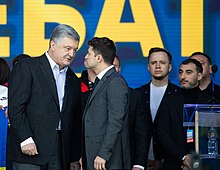
Zelenskyy and then Ukrainian President Petro Poroshenko, 19 April 2019
Six months before he announced his candidacy for the Ukrainian presidential election in 2019 (31 December 2018), Zelenskyy was already one of the frontrunners in opinion polls. After months of ambiguous responses, during the Kvartal 95 New Year’s Eve evening show on the TV channel 1+1, he announced his candidacy for the election. In so doing, he up-staged the New Year’s Eve address of President Petro Poroshenko on that particular channel. Zelenskyy later denied that up-staging the president was intentional, and attributed this to a technical glitch.
During the election campaign Zelenskyy continued to tour with Kvartal 95. During the campaign his engagement with mainstream media was minimal. He talked to the electorate on social media channels and in YouTube clips. On 16 April 2019, 20 Ukrainian news outlets called on Zelenskyy to stop avoiding journalists. Two days later, Zelenskyy stated that he was not hiding from journalists but that he did not want to go to talk shows where “people of the old power” were “just doing PR” and that he just did not have time to satisfy all interview requests. Prior to the elections, Zelenskyy presented a team that included former Finance Minister Oleksandr Danylyuk and others. During the campaign, concerns were raised over his links to the oligarch Ihor Kolomoyskyi. President Poroshenko and his supporters claimed that Zelenskyy’s victory would benefit Russia. On 19 April 2019 at Olimpiyskiy National Sports Complex presidential debates were held in the form of a show. In his introductory speech, Zelenskyy acknowledged that in 2014 he voted for Poroshenko, but “I was mistaken. We were mistaken. We voted for one Poroshenko, but received another. The first appears when there are video cameras, the other Petro sends Medvedchuk privietiki (greetings) to Moscow”.
show
During the election, Zelenskyy stated that he was running for only one term. In May 2021, he stated that it was too early to say whether he will run for a second term, but this decision would depend on the attitude to him in society and would be influenced by his family.
Zelenskyy was elected President of Ukraine on 21 April 2019, beating the incumbent, Petro Poroshenko with nearly 73 per cent of the vote to Poroshenko’s 25 per cent. Polish President Andrzej Duda was one of the first European leaders to congratulate Zelenskyy. French President Emmanuel Macron received Zelenskyy at the Élysée Palace in Paris on 12 April 2019. On 22 April, U.S. President Donald Trump congratulated Zelenskyy on his victory over the telephone. European Commission President Jean Claude Juncker and European Council President Donald Tusk also issued a joint letter of congratulations and stated that the European Union (EU) will work to speed up the implementation of the remainder of the EU-Ukraine Association Agreement, including the Deep and Comprehensive Free Trade Area.
Presidency
| Presidential styles of Volodymyr Zelensky |
|
|---|---|
 |
|
| Reference style | Його Високоповажність, Президент України. His Excellency, the President of Ukraine |
| Spoken style | Президент України. President of Ukraine |
| Alternative style | Пане Президенте. Mr President |
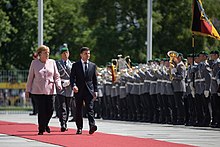
Zelenskyy with German Chancellor Angela Merkel at the Federal Chancellery Complex in Berlin, June 2019.

Zelenskyy and Belarusian President Alexander Lukashenko in Zhytomyr, October 2019.
Zelenskyy was inaugurated on 20 May 2019. Various foreign officials attended the ceremony in Ukraine’s parliament (Verkhovna Rada), including Salome Zourabichvili (Georgia), Kersti Kaljulaid (Estonia), Raimonds Vējonis (Latvia), Dalia Grybauskaitė (Lithuania), János Áder (Hungary), Maroš Šefčovič (European Union), and Rick Perry (United States). Zelenskyy is the first Jewish President of Ukraine. With Volodymyr Groysman as Prime Minister, Ukraine became the second country to have both a Jewish President and Prime Minister. In his inaugural address, Zelensky dissolved the then Ukrainian parliament and called for early parliamentary elections (which had originally been due to be held in October of that year). One of Zelenskyy’s coalition partners, the People’s Front, opposed the move and withdrew from the ruling coalition.
Zelenskyy appointed Andriy Bohdan as head of the Presidential Administration of Ukraine. Prior to this, Bohdan had been the lawyer of Ukrainian oligarch Ihor Kolomoyskyi. Under the rules of Lustration in Ukraine, introduced in 2014 following Euromaidan, Bohdan is not entitled to hold any state office until 2024 (because of his government post during the Second Azarov Government). Bohdan, however, contended that because heading the presidential administration is not considered civil service work, lustration did not apply to him. A number of the members of the Presidential Administration Zelenskyy appointed were former colleagues from his former production company, Kvartal 95, including Ivan Bakanov, who became deputy head of the Ukrainian Secret Service. Former Deputy Foreign Minister Olena Zerkal declined an appointment as deputy head of the presidential administration, but did agree to serve as the Ukrainian representative of the international courts concerning Russia. Zelenskyy’s requests to replace the foreign minister, defence minister, chief prosecutor and head of Ukraine’s security service were rejected by parliament. Zelensky also dismissed and replaced 20 of the the governors of Ukraine’s 24 oblasts.
On 28 May, Zelenskyy restored the Ukrainian citizenship of Mikheil Saakashvili.
Zelenskyy’s first major proposal to change the electoral system was rejected by the Ukrainian parliament.
In addition, on 6 June, lawmakers refused to include Zelenskyy’s key initiative on reintroducing criminal liability for illegal enrichment in the parliament’s agenda, and instead included a similar bill proposed by a group of deputies. In June 2019 it was announced that the president’s third major initiative, which seeks to remove immunity from lawmakers, diplomats and judges, would be submitted after the July 2019 Ukrainian parliamentary election.
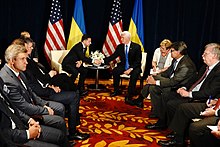
U.S. Vice President Mike Pence and U.S. delegation meets with Zelenskyy in Warsaw on 1 September 2019

Zelenskyy meets with U.S. President Donald Trump in New York City on 25 September 2019
On 8 July, Zelenskyy ordered the cancellation of the annual Kyiv Independence Day Parade on Maidan Nezalezhnosti, citing costs. Despite this, Zelenskyy highlighted that the day would “honor heroes” on Independence Day, however the “format will be new”. He also proposed to spend the money that would have been used to finance the parade on veterans.
In 2020, Zelenskyy’s party proposed reforms to Ukraine’s media laws with the intent to increase competition and loosen the dominance of Ukrainian oligarchs on television and radio broadcasters. Critics said it risked increasing media censorship in Ukraine because its clause of criminal responsibility for the distribution of disinformation could be abused.
Zelenskyy was criticized for a secret trip to Oman in January 2020 that was not published on his official schedule and on which he appeared to mix a personal holiday with government business. Although the president’s office said the trip had been paid for by Zelenskyy himself and not with government money, Zelenskyy came under heavy criticism for the lack of transparency around the trip, which was compared unfavourably to a secret vacation his predecessor Petro Poroshenko took in the Maldives, and which Zelenskyy himself had criticized at the time.
In January 2021, parliament passed a bill updating and reforming Ukraine’s referendum laws, which Ukraine’s Constitutional Court had declared unconstitutional in 2018. Fixing the referendum law had been one of Zelenskyy’s campaign promises.
Honcharuk government
In the 21 July 2019 parliamentary election, Zelenskyy’s political party, Servant of the People, won the first single-party majority in modern Ukrainian history in parliament, with 43 per cent of the party-list vote. His party gained 254 of the 424 seats.
Following the elections, Zelenskyy nominated Oleksiy Honcharuk as prime minister, who was quickly confirmed by parliament. Parliament also confirmed Andrii Zahorodniuk as defence minister, Vadym Prystaiko as foreign minister and Ivan Bakanov as head of the SBU. Arsen Avakov, a controversial figure due to longstanding corruption allegations, was kept on as interior minister, with Honcharuk arguing that the relatively inexperienced government needed experienced administrators and that Avakov had been “‘drawn red lines’ that cannot be crossed.”
Zelenskyy dismissed Bohdan as head of his presidential administration on 11 February 2020 and appointed Andriy Yermak as his successor the same day.
Attempts to end the Donbas Conflict
One of Zelenskyy’s central campaign promises had been to end the War in Donbas and resolve the Russia-sponsored separatist movement there. On 3 June, Zelenskyy appointed former president Leonid Kuchma as the Ukraine’s representative in the Tripartite Contact Group for a settlement in the conflict. On 11 July 2019, Zelenskyy held his first telephone conversation with Russian President Vladimir Putin, during which he urged Putin to enter into talks mediated by European countries. The two leaders also discussed the exchange of prisoners held by both sides. In October 2019, Zelenskyy announced a preliminary deal struck with the separatists, under which the Ukrainian government would respect elections held in the region in exchange for Russia withdrawing its unmarked troops. The deal was met with heavy criticism and protests by both politicians and the Ukrainian public. Detractors noted that elections held in Donbas were unlikely to be free and fair, that the seperatists had long driven out most pro-Ukrainian residents out of the region to ensure a pro-Russia majority, and that it would be impossible to ensure Russia kept its end of the agreement. Zelenskyy defended his negotiations, saying the elections would not be held before a Russian withdrawal.
UIA Flight 752
On 8 January 2020, the Presidential Office announced that Volodymyr Zelenskyy was cutting his trip to Oman short due to the Ukraine International Airlines Flight 752 plane crash in nearby Iran the same day. The same day, internet news site Obozrevatel.com released information that on 7 January 2020, Ukrainian politician of the Opposition Platform — For Life Viktor Medvedchuk – who has exclusive relations with the current President of Russia – may have arrived in Oman. On 9 January 2020, investigative journalists from Skhemy (Schemes: corruption in details) reported that arrival of the President was delayed for almost a whole day and published photos of his arrival. Soon, rumors began that Zelenskyy may have had some additional meetings beside the ones that were announced. On 14 January 2020, Andriy Yermak dismissed the rumors as speculations and baseless conspiracy theories, while Medvedchuk stated that the plane was used by his older daughter’s family to fly from Oman to Moscow. Later, Yermak contacted the on-line newspaper Ukrainian Truth and gave more details about the visit to Oman and the plane crash in Iran.

Zelenskyy and Mohammed bin Rashid Al Maktoum, Prime Minister of the United Arab Emirates, in February 2021
On 17 January 2020, the presidential appointee Minister of Foreign Affairs Vadym Prystaiko was unable to give answers during the “times of questions to the government” in parliament when the people’s deputies of Ukraine asked him about the visit’s official agenda, the invitation from Oman, officials of the Ministry of Foreign Affairs who were preparing the visit, as well as how the President actually crossed the border while visiting Oman. On 20 January 2020, Prystaiko followed up by giving a briefing to the press in the Office of the president of Ukraine and saying that he would explain everything about the visit that when the time came.
Formation of Shmyhal government
On 6 March 2020, the Honcharuk government gave way to the government of Denys Shmyhal. At the time, there was disquiet in the press over the hasty departure of Honcharuk. In his 4 March address to the Rada, Zelenskyy recommitted to reforms domestic and financial, and remarked that he “cannot always become a psychologist for people, a crisis manager for someone, a collector who requires honestly earned money, and a nanny of the ministry in charge.” By September 2020, Zelenskyy’s approval ratings had fallen to less than 32 per cent.

Zelenskyy and Turkish President Recep Tayyip Erdoğan on 16 October 2020
On 24 March 2021, Zelenskyy signed the Decree 117/2021 approving the “strategy for de-occupation and reintegration of the temporarily occupied territory of the Autonomous Republic of Crimea and the city of Sevastopol.”
Foreign relations

Zelenskyy, Ukraine’s Defense Minister Andriy Taran and U.S. Secretary of Defense Lloyd Austin on 31 August 2021
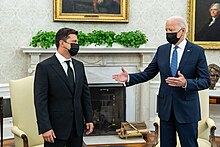
Zelenskyy and U.S. President Joe Biden on 1 September 2021
Zelenskyy’s first official trip abroad as president was to Brussels in June 2019, where he met with European Union and NATO officials.
In August 2019, Zelenskyy promised to lift the moratorium on exhuming Polish mass graves in Ukraine after the previous Ukrainian government banned the Polish side from carrying out any exhumations of Polish victims of the Ukrainian Insurgent Army-perpetrated Volhynian massacres, following the removal of a memorial to the Ukrainian Insurgent Army in Hruszowice, southeastern Poland.
In September 2019, it was reported that U.S. President Donald Trump had allegedly blocked payment of a congressionally mandated $400 million military aid package to Ukraine in order to pressure Zelenskyy during a July phone call between the two presidents to investigate alleged wrongdoing by Joe Biden and his son Hunter Biden, who took a board seat on Ukrainian natural gas company Burisma Holdings. This report was the catalyst for the Trump–Ukraine scandal and the impeachment inquiry against Donald Trump. Zelenskyy has denied that he was pressured by Trump and declared that “he does not want to interfere in a foreign election.”

Zelenskyy and Azerbaijan’s President Ilham Aliyev on 17 December 2019
In December 2019, he visited Azerbaijan and met with President Ilham Aliyev. Zelenskyy said: “We are doing everything to restore peace and the territorial integrity of our state. Unfortunately, the same threat faces Azerbaijan, which seeks to restore its territorial integrity. But I am convinced that our countries will successfully pass these tests.”
On a trip to the United States in September 2021, Zelenskyy engaged in talks and commitments with U.S. President Joe Biden, Secretary of Defense Lloyd Austin, Secretary of Energy Jennifer Granholm, and Secretary of State Antony Blinken. President Zelenskyy and First Lady Olena Zelenska also took part in the opening of Ukrainian House in Washington, D.C. On the same trip, he met with Apple CEO Tim Cook and with Ukrainians in senior positions at Silicon Valley tech companies and spoke at Stanford University. While Zelenskyy was still in the U.S., just after delivering a speech at the United Nations, an assassination attempt was made in Ukraine on Serhiy Shefir, his closest aide. Shefir was unhurt in the attack, although his driver was hospitalized with three bullet wounds.
2021–22 Russo-Ukrainian crisis
In April 2021, in response to Russian military build-up at the Ukrainian borders, Zelenskyy spoke to American president Joe Biden and urged NATO members to speed up Ukraine’s request for membership.
On 26 November 2021, Zelenskyy accused Russia and Ukrainian oligarch Rinat Akhmetov of backing a plan to overthrow his government. Russia denied any involvement in a coup plot and Akhmetov said in a statement that “the information made public by Volodymyr Zelenskiy about attempts to draw me into some kind of coup is an absolute lie. I am outraged by the spread of this lie, no matter what the president’s motives are.” In December 2021, Zelenskyy called for preemptive action against Russia.
On 19 January 2022, Zelenskyy said in a video message that the country’s citizens should not panic and appealed to the media to be “methods of mass information and not mass hysteria.” On 28 January, Zelenskyy called on the West not to create a “panic” in his country over a potential Russian invasion, adding that constant warnings of an “imminent” threat of invasion are putting the economy of Ukraine at risk. Zelenskyy said that “we do not see a bigger escalation” than in early 2021 when Russia’s military build-up started. Zelenskyy and U.S. President Joe Biden disagreed on how imminent the threat was.
On 19 February, as worries of a Russian invasion of Ukraine grew, Zelenskyy warned a security forum that Western nations should abandon their “appeasement” attitude toward Moscow. “Ukraine has been granted security assurances in exchange for giving up the world’s third-largest nuclear arsenal. We don’t have any firearms. And there’s no security… But we have a right to urge a transformation from an appeasement policy to one that ensures security and peace,” he stated.
In the early hours of 24 February, shortly before the start of the Russian invasion, Zelenskyy recorded an address to the citizens of both Ukraine and Russia. In part of the address, he spoke in Russian to the people of Russia, appealing to them to pressure their leadership to prevent war. He also refuted claims of the Russian government about the presence of neo-Nazis in the Ukrainian government and stated that he had no intention of attacking the Donbas region, while highlighting his personal connections to the area.
2022 Russian invasion of Ukraine
On the morning of 24 February, Putin announced that Russia was initiating a “special military operation” in the Donbas. Russian missiles struck a number of military targets in Ukraine, and Zelenskyy declared martial law. Zelenskyy also announced that diplomatic relations with Russia were being severed, effective immediately. Later in the day, he announced general mobilisation.
On 25 February, Zelenskyy said that despite Russia’s claim that it was targeting only military sites, civilian sites were also being hit. In an early morning address that day, Zelenskyy said that his intelligence services had identified him as Russia’s top target, but that he is staying in Kyiv and his family will remain in the country. “They want to destroy Ukraine politically by destroying the head of state”, he said.
In the early hours of 26 February, during the most significant assault by Russian troops on the capital of Kyiv, the United States government and Turkish president Recep Tayyip Erdoğan urged Zelenskyy to evacuate to a safer location, and both offered assistance for such an effort. Zelenskyy turned down both offers and opted to remain in Kyiv with its defense forces, saying that “the fight is here ; I need ammunition, not a ride”.
Zelenskyy gained worldwide recognition as the wartime leader of Ukraine during the Russian invasion; historian Andrew Roberts compared him to Winston Churchill. He has been widely described as a national hero or a “global hero” by many commentators including publications such as The Hill, Deutsche Welle, Der Spiegel, USA Today and The Forward. BBC News and The Guardian reported that his response to the invasion had received praise even from previous critics and political opponents. He contributed to the renewed popularity of the salute Slava Ukraini as a symbol of resistance.
Political views
Economic issues
Zelenskyy stated that as president he would develop the economy and attract investment to Ukraine through “a restart of the judicial system” and restoring confidence in the state. He also proposed a tax amnesty and a 5 per cent flat tax for big business which could be increased “in dialogue with them and if everyone agrees”. According to Zelenskyy, if people would notice that his new government “works honestly from the first day”, they would start paying their taxes.
In a mid-June interview with BIHUS info a representative of the President of Ukraine at the Cabinet of Ministers, Andriy Herus stated that Zelenskyy had never promised to lower communal tariffs, but that a campaign video in which Zelenskyy stated that the price of natural gas in Ukraine could fall by 20–30 per cent or maybe more was a not a direct promise but actually “half-hinting” and “joking”. Notably, Zelenskyy’s election manifesto mentioned tariffs only once—that money raised from a capital amnesty would go towards “lowering the tariff burden on low-income citizens”.
In June 2021, Zelenskyy submitted to the Verkhovna Rada a bill, “On the prevention of threats to national security related to the excessive influence of persons of significant economic or political importance in public life (oligarchs).” The purpose of the law, according to the President, is to fight against people who have significant wealth and significant influence in society and politics (oligarchs). A person is identified as an oligarch if he meets 3 of the 4 criteria, and then he must be entered in a special register.
Foreign policy
During his presidential campaign, Zelenskyy said that he supported Ukraine’s becoming a member of the European Union and NATO, but he said Ukrainian voters should decide on the country’s membership of these two organisations in referenda. At the same time, he believed that the Ukrainian people had already chosen “eurointegration”. Zelenskyy’s close advisor Ivan Bakanov also said that Zelenskyy’s policy is supportive of membership of both the EU and NATO, and proposes holding referendums on membership. Zelenskyy’s electoral programme claimed that Ukrainian NATO membership is “the choice of the Maidan and the course that is enshrined in the Constitution, in addition, it is an instrument for strengthening our defense capability”. The program states that Ukraine should set the goal to apply for a NATO Membership Action Plan in 2024. The programme also states that Zelenskyy “will do everything to ensure” that Ukraine can apply for European Union membership in 2024. Two days before the second round, Zelenskyy stated that he wanted to build “a strong, powerful, free Ukraine, which is not the younger sister of Russia, which is not a corrupt partner of Europe, but our independent Ukraine”.
In October 2020, he spoke in support of Azerbaijan in regards to the Nagorno-Karabakh war between Azerbaijan and ethnic Armenians over the disputed region of Nagorno-Karabakh. Zelenskyy said: “We support Azerbaijan’s territorial integrity and sovereignty just as Azerbaijan always supports our territorial integrity and sovereignty.”
In February 2022, he applied for Ukraine to join the European Union.
Zelensky has tried to position Ukraine as a neutral party in the political and trade tensions between the United States and China. In January 2021, Zelenskyy said in an interview with Axios that he does not perceive China as a geopolitical threat and that he does not agree with the United States assertions that it represents one.
Russo-Ukrainian War
Zelenskyy supported the late 2013 and early 2014 Euromaidan movement. During the war in Donbas, he actively supported the Ukrainian army. Zelenskyy helped fund a volunteer battalion fighting on Donbas.
In a 2014 interview with Komsomolskaya Pravda in Ukraine, Zelenskyy said that he would have liked to pay a visit to Crimea, but would avoid it because “armed people are there”. In August 2014, Zelenskyy performed for Ukrainian troops in Mariupol and later his studio donated a million hryvnias to the Ukrainian army. Regarding the 2014 Russian annexation of Crimea, Zelenskyy said that, speaking realistically, it would be possible to return Crimea to Ukrainian control only after a regime change in Russia.
In an interview in December 2018, Zelenskyy stated that as president he would try to end the ongoing war in Donbas by negotiating with Russia. As he considered the leaders of the Donetsk People’s Republic and the Luhansk People’s Republic (DPR and LPR) to be Russia’s “puppets”, it would “make no sense to speak with them”. He did not rule out holding a referendum on the issue. In an interview published three days before the 2019 presidential election (on 21 April), Zelenskyy stated that he was against granting the Donbas region “special status”. In the interview he also said that if he were elected president he would not sign a law on amnesty for the militants of the DPR and LPR.
Zelenskyy has come out against targeting the Russian language in Ukraine and the banning of artists for their political opinions (such as those viewed by the Ukrainian Government as anti-Ukrainian). In April 2019, he stated that he was not against a Ukrainian language quota (on radio and TV) and that Russian artists “who have turned into (anti-Ukrainian) politicians” should remain banned from entering Ukraine. He simultaneously floated this idea about the Ukrainian language quota: “you can change them a little”.
In response to suggestions to the contrary, he stated in April 2019 that he regarded Russian President Vladimir Putin “as an enemy”. On 2 May 2019, Zelenskyy wrote on Facebook that “the border is the only thing Russia and Ukraine have in common”.
In August 2021, Zelenskyy warned that the Nord Stream 2 natural gas pipeline between Russia and Germany was “a dangerous weapon, not only for Ukraine but for the whole of Europe.”
Government reform

Zelenskyy with NATO Secretary General Jens Stoltenberg in June 2019
During the presidential campaign, Zelenskyy promised bills to fight corruption, including removal of immunity from the president of the country, members of the Verkhovna Rada (the Ukrainian parliament) and judges, a law about impeachment, reform of election laws, and providing efficient trial by jury. He promised to bring the salary for military personnel “to the level of NATO standards”.
Although Zelenskyy prefers elections with open list election ballots, after he called the snap 2019 Ukrainian parliamentary election his draft law “On amendments to some laws of Ukraine in connection with the change of the electoral system for the election of people’s deputies” proposed to hold the election with closed list because the 60-day term to the snap election did not “leave any chances for the introduction of this system”.
Social issues
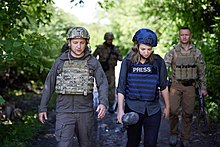
Zelenskyy in the Donetsk region in June 2021
Zelenskyy supports the free distribution of medical cannabis, free abortion in Ukraine, and the legalisation of prostitution and gambling. He opposes the legalisation of weapons.
Zelenskyy stated in April 2019 that “of course” he supports the decommunization of Ukraine, but is not happy with its current form. In an interview with RBC-Ukraine in April 2019, Zelenskyy said that OUN-B leader Stepan Bandera, a controversial figure in Ukrainian history, was “a hero for a certain part of Ukrainians, and this is a normal and cool thing. He was one of those who defended the freedom of Ukraine. But I think that when we name so many streets, bridges by the same name, this is not quite right.” In that same interview, Zelenskyy went on to criticise the overuse of tributes to Taras Shevchenko, a famous 19th century Ukrainian poet and painter. Zelenskyy concluded: “We must remember the heroes of today, heroes of the arts, heroes of literature, simply heroes of Ukraine. Why don’t we use their names – the names of the heroes that today unite Ukraine?”
Controversies
 |
This article’s Criticism or Controversy section may compromise the article’s neutral point of view of the subject. (February 2022)
|
In January 2020, Zelenskyy said “Romania occupied Northern Bukovina”, which brought criticism from Romania. Then the Ukrainian Ambassador to Romania apologized, saying there was a misunderstanding in the translation from Ukrainian to Romanian.
The October 2021 Pandora Papers revealed that Zelenskyy and his chief aide and the head of the Security Service of Ukraine Ivan Bakanov operated a network of offshore companies in the British Virgin Islands, Cyprus, and Belize. These companies included some that owned expensive London property. Around the time of his 2019 election, Zelenskyy handed his shares in a key offshore company over to Shefir, but the two men appear to have made an arrangement for Zelenskyy’s family to continue receiving the money from these companies. Zelenskyy’s election campaign had centred on pledges to clean up the government of Ukraine. In a 17 October 2021 interview with ICTV Zelenskyy did not deny that in 2012 he used offshore companies. He claimed he did this to avoid (his then satirical TV shows) being “influenced by politics.” Zelenskyy stressed that neither he nor any member of “Kvartal 95” was involved in money laundering.
Personal life
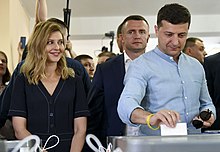
Volodymyr Zelenskyy and Olena Zelenska in 2019 parliamentary election
In September 2003, Zelenskyy married Olena Kiyashko, with whom he had attended school. The couple’s first daughter, Oleksandra, was born in July 2004. Their son, Kyrylo, was born in January 2013. In Zelenskyy’s 2014 movie 8 New Dates, their daughter played Sasha, the daughter of the protagonist. In 2016, she participated in the show The Comedy Comet Company Comedy’s Kids and won 50,000 hryvnias.
Zelenskyy’s first language is Russian, and he is also fluent in Ukrainian and English. His assets were worth about 37 million hryvnias (about $1.5 million USD) in 2018.
Selected filmography
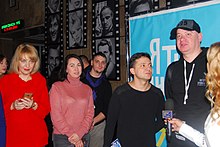
The film premiere of I, You, He, She
Film
| Year | Title | Role |
|---|---|---|
| 2009 | Love in the Big City | Igor |
| 2011 | Office Romance. Our Time | Anatoly Efremovich Novoseltsev |
| 2012 | Love in the Big City 2 | Igor |
| Rzhevsky Versus Napoleon | Napoleon | |
| 8 First Dates | Nikita Sokolov | |
| 2014 | Love in Vegas | Igor Zelensky |
| Paddington (Ukrainian dub) | Paddington Bear (voice) | |
| 2015 | 8 New Dates | Nikita Andreevich Sokolov |
| 2018 | I, You, He, She | Maksym Tkachenko |
Television series and shows
| Year | Title | Role | Notes |
|---|---|---|---|
| 2006 | Dancing with the Stars (Ukraine) | as contestant | |
| 2008–2012 | Svaty | as producer | |
| 2015–2019 | Servant of the People | Vasyl Petrovych Holoborodko |