
The Yamnaya culture (/ˈjamnaja/), from Russian Я́мная культу́ра, or Yamnaya Horizon, (mistakenly) Yamna culture, (translated) Pit Grave culture, or Ochre Grave culture, was a late Copper Age to early Bronze Age archaeological culture of the region between the Southern Bug, Dniester, and Ural rivers (the Pontic steppe), dating to 3300–2600 BC. Its name derives from its characteristic burial tradition: Я́мная (romanization: yamnaya) is a Russian adjective that means ‘related to pits (yama)’, and these people used to bury their dead in tumuli (kurgans) containing simple pit chambers. “Yamna” is the name that is derived from the same word in Ukrainian (ямна, romanization: yamna).
The people of the Yamnaya culture were likely the result of a genetic admixture between the descendants of Eastern European Hunter-Gatherers and people related to hunter-gatherers from the Caucasus. People with this ancestral component are known as Western Steppe Herders. Their material culture was very similar to the Afanasevo culture, and the populations of both cultures are genetically indistinguishable. They lived primarily as nomads, with a chiefdom system and wheeled carts that allowed them to manage large herds.
They are also closely connected to Final Neolithic cultures, which later spread throughout Europe and Central Asia, especially the Corded Ware people and the Bell Beaker culture, as well as the peoples of the Sintashta, Andronovo, and Srubnaya cultures. Back migration from Corded Ware also contributed to Sintashta and Andronovo. In these groups, several aspects of the Yamnaya culture are present. Genetic studies have also indicated that these populations derived large parts of their ancestry from the steppes.
The Yamnaya culture is identified with the late Proto-Indo-Europeans, and is the strongest candidate for the Urheimat (original homeland) of the Proto-Indo-European language.
Origins
 |
This section needs expansion. You can help by adding to it. (August 2019)
|

Corded ware pot, Yamnaya culture
| showOrigins of Yamnaya culture |
|---|
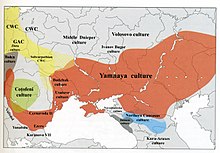
Largest expansion of the Yamnaya culture. Ca. 3500 origins of Usatovo culture; 3400 origins of Yamnaya; c.3400-3200 expansion of Yamnaya across the Pontic-Caspian steppe; c.3000 end of Tripolye culture, and transformation of Yamnaya into Corded Ware in the contact zone east of the Carpatian mountains; 3100-2600 Yamnaya-expansion into the Danube Valley.
According to Pavel Dolukhanov (1996) the emergence of the Pit-Grave culture represents a social development of various local Bronze Age cultures, representing “an expression of social stratification and the emergence of chiefdom-type nomadic social structures”, which in turn intensified inter-group contacts between essentially heterogeneous social groups.
According to Mallory (1999), “The origin of the Yamnaya culture is still a topic of debate,” with proposals for its origins pointing to both Khvalynsk and Sredny Stog. The Khvalynsk culture (4700–3800 BCE) (middle Volga) and the Don-based Repin culture (ca.3950–3300 BCE) in the eastern Pontic-Caspian steppe, and the closely related Sredny Stog culture (c. 4500–3500 BCE) in the western Pontic-Caspian steppe, preceded the Yamnaya culture (3300–2500 BCE).
According to Anthony (2007), the Yamnaya culture (3300–2600 BCE) originated in the Don–Volga area at ca. 3400 BCE, preceded by the middle Volga-based Khvalynsk culture and the Don-based Repin culture (c. 3950–3300 BC), arguing that late pottery from these two cultures can barely be distinguished from early Yamnaya pottery. Earlier continuity from eneolithic but largely hunter-gatherer Samara culture and influences from the more agricultural Dnieper–Donets II are apparent.
Alternatively, Parpola (2015) relates both the Corded ware culture and the Yamnaya culture to the late Tripolye culture. He hypothesizes that “the Tripolye culture was taken over by PIE speakers by c. 4000 BCE,” and that in its final phase the Tripolye culture expanded to the steppes, morphing into various regional cultures which fused with the late Sredny Stog pastoralist cultures. This gave rise to the Yamnaya culture.
According to Anthony (2007), the early Yamnaya horizon spread quickly across the Pontic–Caspian steppes between c. 3400 and 3200 BC:
The spread of the Yamnaya horizon was the material expression of the spread of late Proto-Indo-European across the Pontic–Caspian steppes.
The Yamnaya horizon is the visible archaeological expression of a social adjustment to high mobility – the invention of the political infrastructure to manage larger herds from mobile homes based in the steppes.
The Yamnaya (Pit-grave) culture was succeeded in its western range by the Catacomb culture (2800–2200 BC); in the east, by the Poltavka culture (2700–2100 BC) at the middle Volga. These two cultures were followed by the Srubnaya culture (18th–12th century BC).
Characteristics
Proto-Indo-European
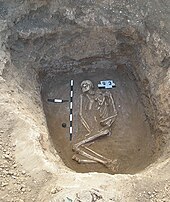
Yamnaya culture grave, Volgograd Oblast
The Yamnaya culture is identified with the late Proto-Indo-Europeans (PIE) in the Kurgan hypothesis of Marija Gimbutas. It is the strongest candidate for the Urheimat (original homeland) of the Proto-Indo-European language, along with the preceding Sredny Stog culture, now that archaeological evidence of the culture and its migrations has been closely tied to the evidence from linguistics and genetics. Significantly, there were animal grave offerings, a feature associated with Proto-Indo-Europeans. The culture was predominantly nomadic, with some agriculture practiced near rivers and a few hillforts. Characteristic for the culture are the burials in pit graves under kurgans (tumuli). The dead bodies were placed in a supine position with bent knees and covered in ochre. Multiple graves have been found in these kurgans, often as later insertions. In the northern Pontic steppes were excavated the oldest wheels in the world, which may tentatetively be associated with the Indo-Europeans.
Archaeogenetics
According to Jones et al. (2015) and Haak et al. (2015), autosomic tests indicate that the Yamnaya people were the result of a genetic admixture between two different hunter-gatherer populations: distinctive “Eastern European hunter-gatherers” (also known as “Eastern Hunter-Gatherers” or “EHG”) with high affinity to the Mal’ta–Buret’ culture or other, closely related people from Siberia and a population of “Caucasus hunter-gatherers” (CHG) who probably arrived from the Caucasus. Each of those two populations contributed about half the Yamnaya DNA. According to co-author Andrea Manica of the University of Cambridge:
The question of where the Yamnaya come from has been something of a mystery up to now … we can now answer that, as we’ve found that their genetic make-up is a mix of Eastern European hunter-gatherers and a population from this pocket of Caucasus hunter-gatherers who weathered much of the last Ice Age in apparent isolation.
Several genetic studies performed since 2015 have given support to the Kurgan theory of Marija Gimbutas regarding the Proto-Indo-European homeland – that Indo-European languages spread throughout Europe from the Eurasian steppes and that the Yamnaya culture were Proto-Indo-Europeans. According to those studies, haplogroups R1b and R1a, now the most common in Europe (R1a is also common in South Asia), would have expanded from the Pontic–Caspian steppes, along with the Indo-European languages. They also detected an autosomal component present in modern Europeans which was not present in Neolithic Europeans, which would have been introduced with paternal lineages R1b and R1a, presumably along with North-Western Indo-European dialects in the Bronze Age.
Recent studies display genetic continuity between the paternal lineages of the Dnieper-Donets culture and the Yamnaya culture, as the males of both cultures have been found to have been mostly carriers of R1b, and to a lesser extent I2. While the mtDNA of the Dnieper-Donets people is exclusively types of U, which is associated with the Eastern Hunter-Gatherers (EHGs) of Eastern Europe and the Western Hunter Gatherers (WHGs) of Western Europe, the mtDNA of the Yamnaya also includes types frequent among Caucasian Hunter-Gatherers (CHGs) and Early European Farmers (EEFs). This admixture is referred to as Western Steppe Herder (WSH), and has earlier been found among the Sredny Stog culture and the Khvalynsk culture, who preceded the Yamnaya culture on the Pontic–Caspian steppe. Unlike their Khvalynsk predecessors, however, the Y-DNA of the Yamnaya is exclusively of EHG and WHG origin. This suggests that the leading clans of the Yamnaya were of EHG and WHG paternal origin. Admixture between EHGs and CHGs is believed to have occurred on the eastern Pontic-Caspian steppe starting around 5,000 BC, while admixture with EEFs happened in the southern parts of the Pontic-Caspian steppe sometime later. As Yamnaya Y-DNA is exclusively of the EHG and WHG type, the admixture appears to have occurred predominately between EHG males, and CHG and EEF females. According to David W. Anthony, this implies that the Indo-European languages were the result of “a dominant language spoken by EHGs that absorbed Caucasus-like elements in phonology, morphology, and lexicon.” (spoken by CHGs)
Eastern European hunter-gatherers

Arrow points, Yamnaya culture
According to Haak et al. (2015), “Eastern European Hunter-Gatherers” (EHG) in today’s Russia had a high genetic affinity to a c. 24,000-year-old Siberian from Mal’ta–Buret’ culture, which in turn resembles other remains of Siberia, such as the Afontova Gora. Remains of the “Eastern European hunter-gatherers” have been found in Mesolithic or early Neolithic sites in Karelia and Samara Oblast, Russia, and put under analysis. Three such hunter-gathering individuals of the male sex have had their DNA results published. Each was found to belong to a different Y-DNAhaplogroup: R1a, R1b, and J.
Near East population
The Near East population were most likely hunter-gatherers from the Caucasus (CHG), though one study suggested that farmers with a CHG component dated to the Chalcolithic era in what is now Iran may be a better fit for the Yamnaya’s Near Eastern descent.
Jones et al. (2015) analyzed genomes from males from western Georgia, in the Caucasus, from the Late Upper Palaeolithic (13,300 years old) and the Mesolithic (9,700 years old). These two males carried Y-DNA haplogroup: J* and J2a. The researchers found that these Caucasus hunters were probably the source of the Near Eastern DNA in the Yamnaya. Their genomes showed that a continued mixture of the Caucasians with Middle Eastern took place up to 25,000 years ago, when the coldest period in the last Ice Age started.
An analysis carried out by Gallego-Llorente et al. (2016), concludes that Iranian populations are not a likelier source of the ‘southern’ component in the Yamnaya than Caucasus hunter-gatherers.
Genetic relationship with the Catacomb culture
A genetic study published in August 2014 examined the DNA of the remains of a number of individuals from the Yamnaya culture and the Catacomb culture, who succeeded the Yamnaya culture as the dominant force on the Pontic steppe. Catacomb people were found to have much higher frequencies of the maternal haplogroups U5 and U4 than people of the Yamnaya culture. Haplogroups U5 and U4 are typical of Western Hunter-Gatherers and Eastern Hunter-Gatherers. A generic similarity between Catacomb people and northern hunter-gatherers, particularly the people of the Pitted Ware culture of southern Scandinavia, was detected. It was suggested that the Catacomb people and the Yamnaya people were not as genetically admixed as previously believed. Interestingly, the modern population of Ukraine was found to be more closely related to people of the Yamnaya culture than people of the Catacomb culture.
Haplogroups
Haplogroup R1b is the most common Y-DNA haplogroup found among both the Yamnaya and modern-day Western Europeans. However, the clade of R1b found in Yamnaya, R1b-L23, is very rare in Western Europeans, meaning that Western Europeans did not get their R1b from the Yamnaya.
Mathieson (2015) analyzed twelve individuals ascribed to the Yamna culture. Eleven belonged to haplogroup R1b, specifically to the R1b-L23 subclade, while one belonged to haplogroup I2a2a1b1b.
Mathieson (2018) analysed a Yamnaya male in Bulgaria. He carried haplogroup I2a2a1b1b.
Wang (2019) analyzed four Yamnaya individuals from the Caucasus. One male carried the paternal R1b1a1a2. With regards to mtDNA, three carried U5a1 or subclades of it, while one carried T2a1.
Inconsistencies and implications for the genetic research
There is a fundamental inconsistency in the genetic research, which challenges the assumption of the Yamnaya’s importance to the genetic and linguistic transformation of Europe.
While the Yamnaya belonged primarily to haplogroup R1b, the Corded Ware people, their supposed direct descendants, belonged mostly to haplogroup R1a. No R1a has ever been found in a Yamnaya fossil, which raises questions about how the Corded Ware people could be related to the Yamnaya.
Furthermore, the Bell Beaker people, and most modern Western Europeans, belong to haplogroup R1b, but not the same clade as the Yamnaya, who belonged to a highly divergent L23 clade, known as the “eastern” R-GG400 variant. This means that the Yamnaya did not contribute haplogroup R1b to modern western Europeans.
British archaeologist Barry Cunliffe describes this inconsistency as “disconcerting for the model a whole”.
Russian archaeologist Leo Klejn has echoed Cunliffe’s position; noting that in the Yamnaya population, R1b-L23 is predominant, whereas Corded Ware males belong mostly to R1a, as well as far-removed R1b clades not found in Yamnaya. Thus, the assumption of an unbroken succession from Yamnaya to Corded Ware has no basis in the genetic evidence.
In 2021, American anthropologist David Anthony offered a new hypothesis, with the aim of resolving the questions surrounding the utter absence of evidence for haplogroup R1a in Yamnaya. He speculates that haplogroup R1a must have been present in the Yamnaya, but that it was initially extremely rare, and that the Corded Ware culture are the descendants of this wayward population that migrated north from the Pontic steppe and greatly expanded in size and influence, later returning to dominate the Pontic-Caspian steppe.
Physical characteristics
Examination of physical remains of the Yamnaya people has determined that they were Europoid, tall, and massively built. Their cephalic index varies depending on the region, with brachycephaly being prevalent in its southern and southeastern areas, and dolichocephaly being prevalent in its northeastern areas.
aDNA analysis indicates that the KITLG allele for blond hair was found in the Yamnaya. It is suggested that the massive migration of Yamnaya steppe pastoralists played a role in the lightening of the skin and hair color of modern Europeans.
The Yamnaya are believed to have been light skinned and brown eyed.
It has been hypothesized that the Yamnaya were responsible for the spread of lactase persistence in Europe, as 25% of sampled Yamnaya remains carried the rs4988235A allele associated with lactose tolerance. This allele is conspicuously absent in western and central European fossils which pre-date the Steppe migrations.
Western Europe

Expansion of Yamnaya-related people, according to Anthony (2007),2017; Narasimhan et al. (2019); Nordqvist and Heyd (2020):
* 3000 BC: Initial eastward migration initiating the Afanasievo culture, possibly Proto-Tocharian.
* 2900 BC: North-westward migrations carrying Corded Ware culture, transforming into Bell Beaker; according to Anthony, westward migration west of Carpatians into Hungary as Yamnaya, transforming into Bell Beaker, possibly ancestral to Italo-Celtic (disputed).
* 2700 BC: Second eastward migration starting east of Carpatian mountains as Corded Ware, transforming into Fatyanovo-Balanova (2800 BCE) → Abashevo(2200 BCE) → Sintashta (2100–1900 BCE) → Andronovo (1900–1700 BCE) → Indo-Aryans.
Haak et al. (2015) conducted a genome-wide study of 69 ancient skeletons from Europe and Russia. They concluded that Yamnaya autosomal characteristics are very close to the Corded Ware culturepeople, with an estimated 73% ancestral contribution from the Yamnaya DNA in the DNA of Corded Ware skeletons from Germany. The same study estimated a (38.8–50.4 %) ancestral contribution of the Yamnaya in the DNA of modern Central, and Northern Europeans, and an 18.5–32.6 % contribution in modern Southern Europeans; this contribution is found to a lesser extent in Sardinians (2.4–7.1 %) and Sicilians (5.9–11.6 %). Haak et al. also note that their results state that haplogroup R-M269 spread into Europe from the East after 3000 BC. Studies that analysed ancient human remains in Ireland and Portugal support the thesis that R-M269 was introduced in these places along with autosomal DNA from the Eastern European steppes.
Autosomal tests also indicate that the Yamnaya are the most likely vector for “Ancient North Eurasian” admixture into Europe. “Ancient North Eurasian” is the name given in literature to a genetic component that represents descent from the people of the Mal’ta–Buret’ culture or a population closely related to them. That genetic component is visible in tests of the Yamnaya people as well as modern-day Europeans, but not of Europeans predating the Bronze Age.
Eastern Europe and Finland
In the Baltic, Jones et al. (2017) found that the Neolithic transition – the passage from a hunter-gatherer economy to a farming-based economy – coincided with the arrival en masse of individuals with Yamnaya-like ancestry. This is different from what happened in Western and Southern Europe, where the Neolithic transition was caused by a population that came from the Near East, with Pontic steppe ancestry being detected from only the late Neolithic onward.
Per Haak et al. (2015), the Yamnaya contribution in the modern populations of Eastern Europe ranges from 46.8% among Russians to 42.8% in Ukrainians. Finland has one of the highest Yamnaya contributions in all of Europe (50.4%).
Central and South Asia
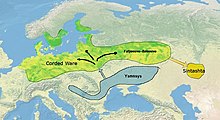
According to Allentoft (2015), the Sintashta culture probably derived from the Corded Ware Culture.

Map of the approximate maximal extent of the Andronovo culture. The formative Sintashta-Petrovka culture is shown in darker red. The location of the earliest spoke-wheeled chariotfinds is indicated in purple. Adjacent and overlapping cultures (Afanasevo, Srubna, Bactria-Margiana Culture are shown in green.
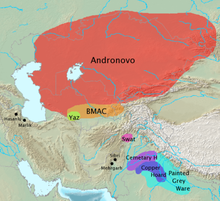
Archaeological cultures associated with Indo-Iranian migrations and Indo-Aryan migrations (after EIEC). The Andronovo, BMAC and Yaz cultureshave often been associated with Indo-Iranian migrations. The GGC, Cemetery H, Copper Hoard and PGWcultures are candidates for cultures associated with Indo-Aryan migrations.
Studies also point to the strong presence of Yamnaya descent in the current nations of South Asia, especially in groups that are referred to as Indo-Aryans.
According to Pathak et al. (2018), the “North-Western Indian & Pakistani” populations (PNWI) showed significant Middle-Late Bronze Age Steppe (Steppe_MLBA) ancestry along with Yamnaya Early-Middle Bronze Age (Steppe_EMBA) ancestry, but the Indo-Europeans of Gangetic Plains and Dravidian people only showed significant Yamnaya (Steppe_EMBA) ancestry and no Steppe_MLBA. The study also noted that ancient south Asian samples had significantly higher Steppe_MLBA than Steppe_EMBA (or Yamnaya). The study infers, “The Rors stand out in South Asia as the population with the highest proportion of Steppe ancestry”.
Lazaridis et al. (2016) notes “The demographic impact of steppe related populations on South Asia was substantial, as the Mala, a south Indian population with minimal ANI (Ancestral North Indian) along the ‘Indian Cline’ of such ancestry is inferred to have a minimum~ 18 % steppe-related ancestry, while the Kalash of Pakistan are inferred to have ~ 50 % steppe-related ancestry.” Lazaridis et al.’s 2016 study estimated (6.5–50.2 %) steppe related admixture in South Asians.
Lazaridis et al. (2016) further notes that “A useful direction of future research is a more comprehensive sampling of ancient DNA from steppe populations, as well as populations of central Asia (east of Iran and south of the steppe), which may reveal more proximate sources of the ANI than the ones considered here, and of South Asia to determine the trajectory of population change in the area directly.”
According to Unterländer et al. (2017), Iron Age Scythians from the southern Ural region, East Kazakhstan and Tuva can best be described as a mixture of Yamnaya-related ancestry and an East Asian component, the latter occurring at only trace levels – if at all – among earlier steppe inhabitants.
According to Narasimhan et al. (2019), the Yamnaya-related ancestry, termed Western_Steppe_EMBA, that reached central and south Asia was not the initial expansion from the steppe to the east, but a secondary expansion that involved a group possessing ~67% Western_Steppe_EMBA ancestry and ~33% ancestry from the European cline. This group included people similar to that of Corded Ware, Srubnaya, Petrovka, and Sintashta. Moving further east in the central steppe, it acquired ~9% ancestry from a group of people that possessed West Siberian Hunter Gatherer ancestry, thus forming the Central Steppe MLBA cluster, which is the primary source of steppe ancestry in South Asia, contributing up to 30% of the ancestry of the modern groups in the region.
Artifacts
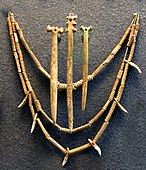
- From the Hermitage Museum collections
-

Corded ware pot
-
-

-
