
Cillian Murphy born 25 May 1976 is an Irish actor. He began his career performing as a rock musician. After turning down a record deal, he began his acting career in theatre, and in short and independent films in the late 1990s. His first notable film roles include Darren in Disco Pigs (2001), Jim in 28 Days Later (2002), John in Intermission (2003), Jackson Rippner in Red Eye (2005), and Patrick “Kitten” Braden in Breakfast on Pluto (2005). For Breakfast on Pluto, he was nominated for a Golden Globe Award for Best Actor in a Musical or Comedy, and won an Irish Film and Television Award for Best Actor. Murphy is known for his collaborations with director Christopher Nolan, playing the Scarecrow in Christopher Nolan’s The Dark Knight Trilogy (2005–2012); as well as appearing in Inception (2010) and Dunkirk (2017).
Other lead and major film roles include Damien O’Donovan in The Wind That Shakes the Barley (2006), Robert Capa in Sunshine (2007), Raymond Leon in In Time (2011), Jozef Gabčík in Anthropoid (2016), and Emmett in A Quiet Place Part II (2020). Since 2013, Murphy has portrayed Thomas Shelby, the lead role of the BBC gangster series Peaky Blinders, which has won him two Irish Film and Television Awards for Best Actor, in 2017 and 2018, respectively.
In 2011, Murphy won the Irish Times Theatre Award for Best Actor, and the Drama Desk Award for Outstanding Solo Performance for the one-man play Misterman. In 2020, he was ranked number 12 on The Irish Times‘ list of Ireland’s greatest film actors.
Early life
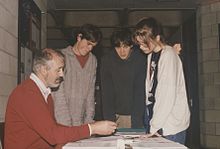
Murphy (centre), with Dr. Tim Smyth, Eoin Ó Súilleabháin and Maria-Theresa Grandfield, c. 1992
Murphy was born in Douglas, County Cork, Ireland, and was raised in Ballintemple, Cork. His father Brendan worked for the Irish Department of Education, and his mother was a French teacher. His grandfather, aunts and uncles were also teachers. Murphy started playing music and writing songs at the age of 10. He has a younger brother, Páidi Murphy, and two younger sisters, Sile Murphy and Orla Murphy.
He was raised Roman Catholic, and attended the Catholic secondary school Presentation Brothers College; there he did well academically but got into trouble often, sometimes being suspended, until he decided in his fourth year that misbehaving was not worth the hassle. Not keen on sports, a major part of the school’s life, Murphy found that creative pursuits were not fully nurtured at the school. However, it was in secondary school that he got his first taste of performing, when he participated in a drama module presented by Pat Kiernan, the director of the Corcadorca Theatre Company; Murphy later described the experience as a “huge high” and a “fully alive” feeling that he set out to chase. His English teacher, the poet and novelist William Wall, encouraged him to pursue acting; however, to Murphy, performing meant becoming a rock star.
In his late teens and early twenties, Murphy pursued a career as a musician, singing and playing on the piano in several bands alongside his brother, Páidi; the Beatles-obsessed pair named their most successful band ‘The Sons of Mr. Greengenes’, after a 1969 song by another idol, Frank Zappa, which he said “specialised in wacky lyrics and endless guitar solos”. They were offered a five-album record deal by Acid Jazz Records, but did not sign the contract; this was owing to Páidi still being in secondary school, and to the small recompense involved in ceding the rights to Murphy’s compositions to the record label. Murphy later confessed: “I’m very glad in retrospect that we didn’t sign because you kind of sign away your life to a label and the whole of your music.”
He began studying law at University College Cork (UCC) in 1996, but he failed his first-year exams because, as he put it, he had “no ambitions to do it”. Not only was he busy with his band, but he has said that he knew within days after starting at UCC that law was not what he wanted to do. After seeing Corcadorca’s stage production of A Clockwork Orange, directed by Kiernan, acting had begun to pique his interest. His first major role was in the UCC Drama Society’s amateur production of Observe the Sons of Ulster Marching Towards the Somme, which also starred Irish-American comedian Des Bishop. Murphy also played the lead in a UCC Drama production of Little Shop of Horrors, which was performed in the Cork Opera House. According to Murphy, his primary motivation then was to party and meet women, not to begin an acting career.
Career
1996–2001: Early work
Murphy pressured Pat Kiernan until he got an audition at Corcadorca Theatre Company, and in September 1996, he made his professional acting debut on the stage, playing the part of a volatile Cork teenager in Enda Walsh’s Disco Pigs. Walsh recalled meeting and discovering Murphy: “There was something about him – he was incredibly enigmatic and he would walk into a room with real presence and you’d go, “My God”. It had nothing to do with those bloody eyes that everyone’s going on about all the time.” Murphy observed, “I was unbelievably cocky and had nothing to lose, and it suited the part, I suppose.” Originally intended to run for three weeks in Cork, Disco Pigs ended up touring throughout Europe, Canada and Australia for two years, and Murphy left both university and his band. Though he had intended to go back to playing music, he secured representation after his first agent caught a performance of Disco Pigs, and his acting career began to take off.
He starred in many other theatre productions, including Shakespeare’s Much Ado About Nothing (1998), The Country Boy, and Juno and the Paycock (both 1999). He began appearing in independent films such as On the Edge (2001), and in short films, including Filleann an Feall (2000) and Watchmen (2001). He also reprised his role for the film adaption of Disco Pigs (2001) and appeared in the BBC television mini-series adaptation of The Way We Live Now. During this period, he moved from Cork, relocating first to Dublin for a few years, then to London in 2001.
2002–2004: 28 Days Later and breakthrough
In 2002, Murphy starred as Adam in a theatre production of Neil LaBute’s The Shape of Things at the Gate Theatre in Dublin. Writing for The Irish Times, Fintan O’Toole praised Murphy’s performance: “Murphy measures out his metamorphosis with an impressive subtlety and intelligence.”
He was cast in the lead role in Danny Boyle’s horror film 28 Days Later (2002). He portrayed pandemic survivor Jim, who is “perplexed to find himself alone in the desolate, post-apocalyptic world” after waking from a coma in a London hospital. Casting director Gail Stevens suggested that Boyle audition Murphy for the role, having been impressed with his performance in Disco Pigs. Stevens stated that it was only after seeing his slender physique during filming that they decided to feature him fully nude at the beginning of the film. She recalled that Murphy was shy on set with the tendency to look slightly away from the camera, but enthused that he had a “dreamy, slightly de-energised, floating quality that is fantastic for the film.” Released in the UK in late 2002, by the following July 28 Days Later had become a sleeper hit in North America and a success worldwide, putting Murphy in front of a mass audience for the first time. His performance earned him a nomination for Best Newcomer at the 8th Empire Awards and Breakthrough Male Performance at the 2004 MTV Movie Awards. Murphy professed that he considered the film to be much deeper than a zombie or horror film, expressing surprise at the film’s success and that American audiences responded well to its content and violence. Murphy said, “the film did so well. And you watch zombie stuff , we were the first people to make zombies run, and changed everything. It has a very special place in my heart, that movie.”
In 2005, he played the role of Konstantine in a stage production of Chekhov’s The Seagull at the Edinburgh International Festival. Murphy said he wanted to play Kontastine because the character “goes on this amazing journey through the play he comes to realise there’s no point being an iconoclastic writer just for the sake of it, and that the search for new forms has to have something behind it.”
He starred as a lovelorn, hapless supermarket stocker who plots a bank heist with Colin Farrell in Intermission (2003), which became the highest-grossing Irish independent film in Irish box office history (until The Wind That Shakes the Barley broke the record in 2006). Reflecting on his roles in 28 Days Later and the “sad-sack Dublin shelf-stacker” in Intermission, Sarah Lyall of the International Herald Tribune stated that Murphy brought “fluent ease to the roles he takes on, a graceful and wholly believable intensity. His delicate good looks have, as much as his acting prowess, caused people to mark him as Ireland’s next Colin Farrell, albeit one who seems less likely to be caught tomcatting around or brawling drunkenly at premieres”. He had a minor supporting role in the successful Hollywood period drama Cold Mountain (2003). He portrayed a deserting soldier who shares a grim scene with Jude Law’s character, and was only on location in Romania for a week. Murphy stated that it was a “massive production”, remarking that director Anthony Minghella was the calmest director he’d ever met. Murphy also had a role as a butcher in Girl with a Pearl Earring (2003) with Scarlett Johansson and Colin Firth.
In 2004, he toured Ireland with the Druid Theatre Company, in The Playboy of the Western World (playing the character of Christy Mahon) under the direction of Garry Hynes—who had previously directed Murphy back in 1999 in the theatre productions of Juno and the Paycock—and also in The Country Boy.
2005–2006: Villainous roles and critical success
Murphy starred as Dr. Jonathan Crane in Christopher Nolan’s Batman Begins (2005). Originally asked to audition for the role of Bruce Wayne/Batman, Murphy never saw himself as having the right physique for the superhero, but leapt at the chance to connect with director Nolan. Though the lead went to Christian Bale, Nolan was so impressed with Murphy that he gave him the supporting role of Dr. Crane, whose alter ego is supervillain Scarecrow. Nolan told Spin magazine, “He has the most extraordinary eyes, and I kept trying to invent excuses for him to take his glasses off in close-ups.” He starred as Jackson Rippner, who terrorises Rachel McAdams on an overnight flight in Wes Craven’s thriller, Red Eye (2005). The New York Times film critic Manohla Dargis asserted that Murphy made “a picture-perfect villain” and that his “baby blues look cold enough to freeze water and his wolfish leer suggests its own terrors.” The film was favourably reviewed and earned almost $100 million worldwide.
Murphy received several awards nominations for his 2005 villainous roles, among them a nomination as Best Villain at the 2006 MTV Movie Awards for Batman Begins. Entertainment Weekly ranked him among its 2005 “Summer MVPs”, a cover story list of 10 entertainers with outstanding breakthrough performances. The New Yorker‘s David Denby wrote: “Cillian Murphy, who has angelic looks that can turn sinister, is one of the most elegantly seductive monsters in recent movies.”
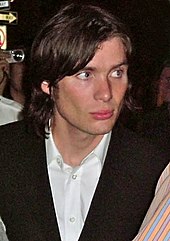
Murphy at the New York Film Festival premiere of Breakfast on Pluto, 2005
Murphy starred as Patrick/”Kitten” Braden, a transgender Irish woman in search of her mother, in Neil Jordan’s comedy-drama Breakfast on Pluto (2005), based on the novel of the same title by Patrick McCabe. Seen against the film’s kaleidoscopic backdrop of 1970s glitter rock fashion, magic shows, red-light districts and IRA violence, Murphy transforms from androgynous teen to high drag blond bombshell. He had auditioned for the role in 2001, and though Jordan liked him for the part, the director of The Crying Game was hesitant to revisit transgender and IRA issues. The actor lobbied Jordan for several years in a bid to get the film made before Murphy became too old to play the part; in 2004, he prepared for the role by meeting a transvestite who dressed him and took him clubbing with other transvestites. The role required “serious primping” with eyebrow plucking and chest and leg hair removal, and Roger Ebert noted the way that Murphy played the character with a “bemused and hopeful voice”. While lukewarm reviews of Breakfast on Pluto tended to praise Murphy’s performance highly, a few critics dissented: The Village Voice, which panned the film, found him “unconvincing” and overly cute. Murphy was nominated for a Golden Globe Award for Best Actor in a Musical or Comedy for Breakfast on Pluto and won the fourth Irish Film and Television Academy Best Actor Award. Premiere magazine cited his performance as Kitten in their “The 24 Finest Performances of 2005” feature.
In 2006, Murphy starred in The Wind That Shakes the Barley, a film about the Irish War of Independence and the Irish Civil War, which won the Palme d’Or at the 2006 Cannes Film Festival and became the most successful Irish independent film at the Irish box office. Murphy was especially keen on appearing in the film due to his intimate connections to Cork, Ireland, where the film was shot. Murphy auditioned six times for the role of Damien O’Donovan, a young doctor turned revolutionary, before winning the part. Murphy considered it a very special privilege to have been given the role and stated that he was “tremendously proud” of the film, remarking that the “memories run very, very deep – the politics, the divisions and everybody has stories of family members who were caught up in the struggle.” David Denby noted Murphy’s moments of deep stillness and idiosyncrasies in portraying the character. Kenneth Turan of the Los Angeles Times wrote that “Murphy is especially good at playing the zealotry as well as the soul-searching and the regret, at showing us a man who is eaten up alive because he’s forced to act in ways that are contrary to his background and his training.” GQ magazine presented Murphy with its 2006 Actor of the Year award for his work in The Wind That Shakes the Barley.
2006–2010: Further theatre and film roles
Murphy returned to the stage starring opposite Neve Campbell at the New Ambassadors Theatre in London’s West End from November 2006 to February 2007, playing the lead role of John Kolvenbach’s play Love Song. Theatre Record described his character of Beane as a “winsomely cranky” mentally unstable “sentimentalised lonely hero”, noting how he magnetically, with “all blue eyes and twitching hands”, moves “comically from painfully shy “wallpaper” to garrulous, amorous male.” Variety magazine considered his performance to be “as magnetic onstage as onscreen”, remarking that his “unhurried puzzlement pulls the slight preciousness in the character’s idiot-savant naivete back from the brink”.
He starred in the science fiction film Sunshine (2007) as a physicist-astronaut charged with re-igniting the sun, also directed by Danny Boyle. He starred opposite Lucy Liu in Paul Soter’s romantic comedy Watching the Detectives (2007); the indie film premiered at the 2007 Tribeca Film Festival and was released direct-to-DVD. Murphy starred as Richard Neville, editor of the psychedelic radical underground magazine Oz in the film Hippie Hippie Shake, which was filmed in 2007, but the project, much delayed, was eventually shelved in 2011.
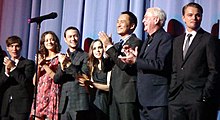
Murphy (far left) with the cast of Inception at a premiere, July 2010
Murphy made a brief re-appearance as the Scarecrow in Nolan’s The Dark Knight (2008), the sequel to Batman Begins, before starring in The Edge of Love—about a love quadrangle involving the poet Dylan Thomas—with Keira Knightley, Sienna Miller and Matthew Rhys. In July 2008, Murphy made a debut appearance in another medium—on a postage stamp; the Irish Post Office, An Post, released a series of four stamps paying homage to the creativity of films recently produced in Ireland, including one featuring Murphy in a still from The Wind That Shakes the Barley. In 2009, Murphy starred opposite rock singer Feist and actor David Fox in The Water, directed by Kevin Drew of Broken Social Scene. The 15-minute Canadian short film, released online in April 2009, is nearly silent until the Feist song of the same title plays close to the end. Murphy was attracted to the role as a fan of Broken Social Scene and the prospect of making a silent movie, which he considered to be the “hardest test for any actor”. Murphy also starred in Perrier’s Bounty, a crime dramedy from the makers of Intermission, in which he portrayed a petty criminal on the run from a gangster played by Brendan Gleeson.
In 2010, he made a return to theatre in From Galway to Broadway and back again, which was a stage show that celebrated the Druid Theatre Company’s 35th birthday. The direct-to-video psychological thriller Peacock (2010), co-starring Elliot Page, Susan Sarandon and Bill Pullman, starred Murphy as a man with a split personality who fools people into believing he is also his own wife. Christian Toto of The Washington Times referred to the film as “a handsomely mounted psychological drama with an arresting lead turn by Cillian Murphy”, and noted that although Murphy wasn’t a stranger to playing in drag, his work in the film set a “new standard for gender-bending performances”. Murphy next starred in Christopher Nolan’s Inception (2010), playing entrepreneur Robert Fischer, whose mind is infiltrated by DiCaprio’s character Cobb to convince him to dissolve his business. That year, Murphy also made an uncredited cameo as programmer Edward Dillinger Jr., son of original Tron antagonist Ed Dillinger (David Warner) in Tron: Legacy.
2011–present: Thrillers and Peaky Blinders
In 2011, Murphy performed in the stage monodrama Misterman, written and directed by Enda Walsh, whom Murphy previously worked with on Disco Pigs. The production was initially staged in Galway and was taken to St. Ann’s Warehouse in Brooklyn, New York City. Murphy commented of the role, “The live nature of it makes it so dangerous. You’re only there because of the good will of the audience, and that’s compounded by its being a one-man show”. His performance earned critical acclaim, garnering Irish Times Theatre Award and a Drama Desk Award. Sarah Lyall of the International Herald Tribune described Murphy’s character Thomas Magill to be a “complicated mixture of sympathetic and not nice at all – deeply wounded, but with a dangerous, skewed moral code”, praising his ability to mimic wickedly. Lyall noted Murphy’s “unusual ability to create and inhabit creepy yet fascinating characters from the big screen to the small stage in the intense one-man show Misterman“, and documented that on one evening the “theater was flooded, not with applause but with silence”, eventually culminating in a standing ovation at his powerful performance. He played the lead in the British horror film Retreat (2011), which had a limited release. He also appeared in the science fiction film In Time (2011), starring Justin Timberlake and Amanda Seyfried, which was poorly reviewed.
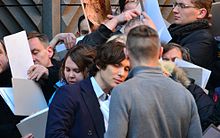
Murphy in Berlin, 2014
Murphy starred in Red Lights (2012) with Robert De Niro and Sigourney Weaver. He played Tom Buckley, the assistant to Weaver’s character who is a paranormal investigator. Murphy considered working with De Niro to have been one of the most intimidating moments in his career. He remarked: “My first scene when I come to visit him my character is supposed to be terrified and intimidated. There was no acting involved. The man has presence. You can’t act presence. I’ll never have that. Watching him use it…when you put a camera on it, it just becomes something else.” The film was panned by critics and under-performed at the box office. Murphy went on to reprise his role as the Scarecrow for the third time in The Dark Knight Rises (2012), and had a supporting role as Mike, the favourite teacher of the main character Skunk, in the British independent film Broken (2012). His performance earned him a British Independent Film Award for Best Supporting Actor nomination.
Since 2013, Murphy has played the lead role, Tommy Shelby, in the BBC television series Peaky Blinders, a series about a criminal gang in post-First World War Birmingham. He explained his enthusiasm for the show in an interview with The Independent: ” were so compelling and confident, and the character was so rich and complex, layered and contradictory. I was like, ‘I have to do this.'” Peaky Blinders was praised and received high ratings. A second series began broadcasting on the BBC in October 2014. On August 25, the first episode of season 5 was broadcast on BBC One. In an interview with Digital Spy, director Anthony Byrne said, “if we did start shooting in January (2021), we wouldn’t finish until May or June and then it’s another 6 months of editing.” This would place the release date for Peaky Blinders season 6 at the end of 2021, or the beginning of 2022. In 2013, Murphy made his directorial debut with a music video for the band Money’s single Hold Me Forever. The video features dancers from the English National Ballet and was filmed at The Old Vic Theatre in London.
In 2014, he co-starred in the drama Aloft with Jennifer Connelly, and Wally Pfister’s Transcendence with Johnny Depp and Rebecca Hall. Both of these features garnered mostly unfavourable critic reviews according to the aggregator Rotten Tomatoes. That same year, Murphy reunited with Enda Walsh in the play Ballyturk. He starred in Ron Howard’s 2015 film, In the Heart of the Sea, which also features Benjamin Walker and Chris Hemsworth. In 2015, he contributed spoken vocals to the tracks “8:58” and “The Clock” from Paul Hartnoll’s album 8:58. The two previously met while Hartnoll was scoring the second season of Peaky Blinders. Murphy portrayed Czechoslovak World War II army soldier Jozef Gabčík, who was involved in Operation Anthropoid, the assassination of Reinhard Heydrich in Anthropoid (2016). Rupert Hawksley of The Telegraph believed Cillian’s performance, but opined that he is “not asked to do an awful lot, other than smoke and look perplexed.”
Murphy played a shell-shocked army officer who is recovered from a wrecked ship in Christopher Nolan’s war film, Dunkirk (2017). Murphy felt his character, who is nameless and was credited simply as “Shivering Soldier”, was “representative of something experienced by thousands of soldiers, which is the profound emotional and psychological toll that war can have”.
Personal life
Family
In mid-2004, Murphy married his long-time girlfriend, Yvonne McGuinness whom he had met in 1996 at one of his rock band’s shows. The couple live in Dublin (where they moved back in 2015 after previously living for 14 years in London) and have two sons, Malachy, born in December 2005, and Aran, born in July 2007. He has expressed no desire to move to Hollywood. He prefers not to speak about his personal life, and did not appear on any television talk shows until 2010, when he was a guest on The Late Late Show on Ireland’s RTÉ to promote Perrier’s Bounty, yet still remained reserved.
Music is still an important part of Murphy’s life. In 2004, he said, “The only extravagant thing about my lifestyle is my stereo system, buying music and going to gigs.” He no longer plays in a rock band, but regularly plays music with friends and on his own, and still writes songs. Murphy does not plan to start another band, and said, “Even if I was good, the very notion of being an actor with a rock band on the side would mean I’d never be taken seriously.”
Murphy was a vegetarian for many years, not due to any moral objection to the killing of animals, but because of qualms about unhealthy agribusiness practices. He began eating meat again for his role in Peaky Blinders. He is a dedicated runner. Murphy had previously been verging on agnostic, but confirmed his atheism after researching his role as a physicist-astronaut in Sunshine (2007).
Murphy does not have a stylist or a personal publicist, travels without an entourage, and often attends film premieres alone. Reserved and private, Murphy professes a lack of interest in the celebrity scene, finding the red carpet experience “a challenge… and not one I want to overcome”. He intentionally practises a lifestyle that will not interest the tabloids: “I haven’t created any controversy, I don’t sleep around, I don’t go and fall down drunk”. In 2005, Murphy stated he was friends with fellow Irish actors Colin Farrell, Jonathan Rhys Meyers and Liam Neeson, looking up to the latter like a “surrogate movie dad”. But primarily, Murphy’s close friendships are those he made before becoming a star.
Murphy participated in the 2007 Rock the Vote Ireland campaign, targeting young voters for the general election, and campaigning for the rights of the homeless with the organisation Focus Ireland. In 2011, he became a patron of the UNESCO Child and Family Research Centre at the National University of Ireland Galway. He is closely associated with the work of Professor Pat Dolan Director UCFRC and UNESCO Chair in Children, Youth and Civic Engagement. In February 2012, he wrote a message of support to the former Vita Cortex workers involved in a sit-in at their plant, congratulating them for “highlighting is hugely important to us all as a nation”. In 2015, he was named one of GQ’s 50 best dressed men.