Leicester City Football Club is a professional football club based in Leicester in the East Midlands, England. The club competes in the Premier League, the top division of England’s football league system, and plays its home matches at the King Power Stadium.
The club was founded in 1884 as Leicester Fosse F.C., playing on a field near Fosse Road. They moved to Filbert Street in 1891, were elected to the Football League in 1894 and adopted the name Leicester City in 1919. They moved to the nearby Walkers Stadium in 2002, which was renamed the King Power Stadium in 2011.
Leicester won the 2015–16 Premier League, their first top tier title, becoming one of seven clubs to have won the Premier League since its inception in 1992. A number of newspapers described Leicester’s title win as the greatest sporting shock ever; multiple bookmakers had never paid out at such long odds for any sport. As a result, the team was dubbed “The Unbelievables”, a spin-off harking back to Arsenal’s undefeated team “The Invincibles”.
The club’s previous highest ever league finish was second place in the top flight, in 1928–29, then known as the First Division. Leicester hold a joint-record seven second tier titles and have competed in four FA Cup finals; a competition the club is yet to win. They have won the League Cup three times and played in five European competitions to date.
History

The Leicester Fosse team of 1892
Founding and early years (1884–1949)
Formed in 1884 by a group of old boys of Wyggeston School as “Leicester Fosse”, the club joined The Football Association (FA) in 1890. Before moving to Filbert Street in 1891, the club played at five different grounds, including Victoria Park south-east of the city centre and the Belgrave Road Cycle and Cricket Ground. The club also joined the Midland League in 1891, and were elected to Division Two of the Football League in 1894 after finishing second. Leicester’s first ever Football League game was a 4–3 defeat at Grimsby Town, with a first League win the following week, against Rotherham United at Filbert Street. The same season also saw the club’s largest win to date, a 13–0 victory over Notts Olympic in an FA Cup qualifying game. In 1907–08 the club finished as Second Division runners-up, gaining promotion to the First Division, the highest level of English football. However, the club were relegated after a single season which included the club’s record defeat, a 12–0 loss against Nottingham Forest.
In 1919, when League football resumed after World War I, Leicester Fosse ceased trading due to financial difficulties of which little is known. The club was reformed as “Leicester City Football Club”, particularly appropriate as the borough of Leicester had recently been given city status. Following the name change, the club enjoyed moderate success in the 1920s; under the management of Peter Hodge, who left in May 1926 to be replaced two months later by Willie Orr, and with record goalscorer Arthur Chandler in the side, they won the Division Two title in 1924–25 and recorded their second-highest league finish in 1928–29 as runners-up by a single point to The Wednesday. However the 1930s saw a downturn in fortunes, with the club relegated in 1934–35 and, after promotion in 1936–37, another relegation in 1938–39 would see them finish the decade in Division Two.

Historical league positions of Leicester City in the Football League
Post-World War II (1949–2000)
City reached the FA Cup final for the first time in their history in 1949, losing 3–1 to Wolverhampton Wanderers. The club, however, was celebrating a week later when a draw on the last day of the season ensured survival in Division Two. Leicester won the Division Two championship in 1954, with the help of Arthur Rowley, one of the club’s most prolific strikers. Although they were relegated from Division One the next season, under Dave Halliday they returned in 1957, with Rowley scoring a club record 44 goals in one season. Leicester remained in Division One until 1969, their longest period ever in the top flight.
Under the management of Matt Gillies and his assistant Bert Johnson, Leicester reached the FA Cup final on another two occasions, but lost in both 1961 and 1963. As they lost to double winners Tottenham Hotspur in 1961, they were England’s representatives in the 1961–62 European Cup Winners’ Cup. In the 1962–63 season, the club led the First Division during the winter, thanks to a sensational run of form on icy and frozen pitches the club became nicknamed the “Ice Kings” eventually placed fourth, the club’s best post-war finish. Gillies guided Leicester to their first piece of silverware in 1964, when Leicester beat Stoke City 4–3 on aggregate to win the League Cup for the first time. Leicester also reached the League Cup final the following year, but lost 3–2 on aggregate to Chelsea. Gillies and Johnson received praise for their version of the “whirl” and the “switch” system, a system that had previously been used by the Austrian and Hungarian national teams. After a bad start to the season, Matt Gillies resigned in November 1968. His successor, Frank O’Farrell was unable to prevent relegation, but the club reached the FA Cup final in 1969 for the last time to date, losing to Manchester City 1–0.

Robbie Savage in action against Barnsley during the 1997–98 season.
In 1971, Leicester were promoted back to Division One, and won the Charity Shield for the only time. Unusually, due to double winners Arsenal’s commitments in European competition, Division Two winners Leicester were invited to play FA Cup runners-up Liverpool, beating them 1–0 thanks to a goal by Steve Whitworth. Jimmy Bloomfield was appointed for the new season, and his team remained in the First Division for his tenure. No period since Bloomfield has seen the club remain in the top division for so long. Leicester reached the FA Cup semi-final in 1973–74.
Frank McLintock, a noted player for seven years for Leicester in a successful period from the late Fifties to the mid Sixties, succeeded Jimmy Bloomfield in 1977. City were relegated at the end of the 1977–78 season and McLintock resigned. Jock Wallace resumed the tradition of successful Scottish managers (after Peter Hodge and Matt Gillies) by steering Leicester to the Division Two championship in 1980. Unfortunately, Wallace was unable to keep Leicester in Division One, but they reached the FA Cup semi-final in 1982. Under Wallace, one of City’s most famous home-grown players, Gary Lineker, emerged into the first team squad. Leicester’s next manager was Gordon Milne, who achieved promotion in 1983. Lineker helped Leicester maintain their place in the First Division but was sold to Everton in 1985 and two years later Leicester were relegated, having failed to find a suitable replacement to partner Alan Smith, who was sold to Arsenal after Leicester went down.
Milne left in 1986 and was replaced in 1987 by David Pleat, who was sacked in January 1991 with Leicester in danger of relegation to the Third Division. Gordon Lee was put in charge of the club until the end of the season. Leicester won their final game of the season, which guided them clear of relegation to the third tier of the football league.
Brian Little took over in 1991 and by the end of the 1991–92 season Leicester had reached the playoff final for a place in the new FA Premier League, but lost to Blackburn Rovers and a penalty from former Leicester striker Mike Newell. The club also reached the playoff final the following year, losing 4–3 to Swindon Town, having come back from 3–0 down. In 1993–94 City were promoted from the playoffs, beating Derby County 2–1 in the final. Little quit as Leicester manager the following November to take charge at Aston Villa, and his successor Mark McGhee was unable to save Leicester from finishing second from bottom in the 1994–95 season.
McGhee left the club unexpectedly in December 1995 while Leicester were top of the First Division to take charge of Wolverhampton Wanderers. McGhee was replaced by Martin O’Neill. Under O’Neill, Leicester qualified for the 1996 Football League play-offs and beat Crystal Palace 2–1 in the final through a 120th minute Steve Claridge goal to gain promotion to the FA Premier League. Following promotion, Leicester established themselves in the Premier League with four successive top ten finishes. O’Neill ended Leicester’s 33-year wait for a major trophy, winning the League Cup twice, in 1997 and 2000, and Leicester were runners-up in 1999. Thus, the club qualified for the UEFA Cup in 1997–98 and 2000–01, the club’s first European competition since 1961. In June 2000, O’Neill left Leicester City to take over as manager of Celtic.
Decline in the early 21st century (2000–2008)
O’Neill was replaced by former England under-21 coach Peter Taylor. During this time, one of Leicester’s European appearances ended in a 3–1 defeat to Red Star Belgrade on 28 September 2000 in the UEFA Cup. Leicester began well under Taylor’s management, topping the Premier League for two weeks in the autumn and remaining in contention for a European place for most of the campaign, before a late season collapse dragged them down to a 13th-place finish.
Taylor was sacked after a poor start to the 2001–02 season, and his successor Dave Bassett lasted just six months before being succeeded by his assistant Micky Adams, the change of management being announced just before relegation was confirmed. Leicester won just five league matches all season.

The East Stand, King Power Stadium
Leicester moved into the new 32,314-seat Walkers Stadium at the start of the 2002–03 season, ending 111 years at Filbert Street. Walkers, the Leicestershire-based crisp manufacturers, acquired the naming rights for a ten-year period. In October 2002, the club went into administration with debts of £30 million. Some of the reasons were the loss of TV money (ITV Digital, itself in administration, had promised money to First Division clubs for TV rights), the large wage bill, lower than expected fees for players transferred to other clubs and the £37 million cost of the new stadium. Adams was banned from the transfer market for most of the season, even after the club was rescued with a takeover by a consortium led by Gary Lineker. Adams guided Leicester to the runners-up spot in Division One and automatic promotion back to the Premier League with more than 90 points. However, Leicester lasted only one season in the top flight and were relegated to the newly labelled Championship, previously known as Division One.
When Adams resigned as manager in October 2004, Craig Levein was appointed boss. This would prove to be an unsuccessful period and after 15 months in charge, Levein was sacked, having failed to get the Foxes anywhere near the promotion places. Assistant manager Rob Kelly took over as caretaker manager, and after winning three out of four matches, was appointed to see out the rest of the season. Kelly steered Leicester to safety and in April 2006 was given the manager’s job on a permanent basis.
In October 2006, ex-Portsmouth chairman Milan Mandarić was quoted as saying he was interested in buying the club, reportedly at a price of around £6 million, with the current playing squad valued at roughly £4.2 million. The takeover was formally announced on 13 February 2007. On 11 April 2007, Rob Kelly was sacked as manager and Nigel Worthington appointed as caretaker manager until the end of the season. Worthington saved the club from relegation, but was not offered the job on a permanent basis. On 25 May 2007, the club announced former Milton Keynes Dons manager Martin Allen as their new manager with a three-year contract. Allen’s relationship with Mandarić became tense and after only four matches, Allen left by mutual consent on 29 August 2007. On 13 September 2007, Mandarić announced Gary Megson as the new manager of the club, citing Megson’s “wealth of experience” as a deciding factor in the appointment. However, Megson left on 24 October 2007 after only six weeks in charge, following an approach made for his services by Bolton Wanderers. Mandarić placed Frank Burrows and Gerry Taggart in the shared position as caretaker managers until a professional manager was appointed.
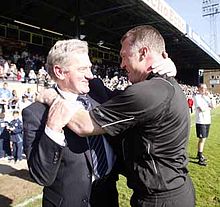
Pearson and Mandarić after winning the Football League One title.
On 22 November, Ian Holloway was appointed manager, and he became the first Leicester manager in over 50 years to win his first league match in charge, beating Bristol City 2–0. However, this success did not last, and Leicester were relegated from the Championship at the end of the 2007–08 season. Holloway left by mutual consent after less than a season at the club, being replaced by Nigel Pearson.
Third tier to Premier League and takeover (2008–2015)
The 2008–09 campaign was Leicester’s first season outside the top two levels of English football, but they hit this nadir only seven years before becoming the 2015–16 Premier League champions – the fastest seven-year rise to the top of the English football league system apart from Ipswich Town in 1962. Following relegation to the third tier the previous season, Leicester returned to the Championship at the first attempt in 2008–09, finishing as champions of League One after a 2–0 win at Southend United, with two matches in hand. The 2009–10 season saw Leicester’s revival under manager Nigel Pearson continue, as the club finished fifth and reached the Championship play-offs in their first season back in the second tier. Though coming from 2–0 down on aggregate, away to Cardiff City, to briefly lead 3–2, they eventually lost to a penalty shoot-out in the play-off semi-final. At the end of the season, Pearson left Leicester to become the manager of Hull City, claiming he felt the club seemed reluctant to keep him, and that Paulo Sousa had been the club’s guest at both play-off games, hinting at a possible replacement. On 7 July 2010, Sousa was confirmed as Pearson’s replacement.
In August 2010, following agreement on a three-year shirt sponsorship deal with duty-free retailers the King Power Group, Mandarić sold the club to Thai-led consortium Asian Football Investments (AFI), fronted by King Power Group’s Vichai Srivaddhanaprabha. Mandarić, an investor in AFI, was retained as club chairman. On 1 October 2010, after a poor start that saw Leicester bottom of the Championship with only one win out of the first nine league matches, Paulo Sousa was sacked by the club with immediate effect. Two days later, Sven-Göran Eriksson, who had been approached by the club after the 6–1 loss to then bottom-of-the-table Portsmouth two weeks earlier, was appointed as his replacement, signing a two-year contract with the club. On 10 February 2011, Vichai Raksriaksorn, part of the Thai-based Asia Football Investments consortium, was appointed new chairman of the club after Mandarić left in November to take over Sheffield Wednesday.
Leicester were viewed as one of the favourites for promotion in the 2011–12 season, but on 24 October 2011, following an inconsistent start with the Foxes winning just 5 out of their first 13 matches, Eriksson left the club by mutual consent. Three weeks later, Nigel Pearson returned to the club as Eriksson’s successor. Pearson would go on to lead The Foxes to a sixth-place finish in the 2012–13 season, ensuring Leicester were in the Championship play-offs. However, Leicester lost the playoff semi-final 3–2 on aggregate to Watford after Anthony Knockaert missed a late penalty and Troy Deeney scored right at the end after a swift counterattack from a Manuel Almunia double save.
In 2014, Leicester’s march up the league system hit a breakthrough. Their 2–1 home win over Sheffield Wednesday, combined with losses by Queens Park Rangers and Derby County, allowed Leicester City to clinch promotion to the Premier League after a ten-year absence. Later that month, a win at Bolton saw Leicester become the champions of the 2013–14 Championship, the seventh time they had been champions of England’s second tier.
Leicester started their first season in the Premier League since 2004 with a good run of results in their first five league matches, starting with a 2–2 draw on the opening day against Everton. The Foxes then claimed their first Premier League win since May 2004, with a 0–1 win at Stoke City. On 21 September 2014, Leicester went on to produce one of the greatest comebacks in Premier League history to beat Manchester United 5–3 at the King Power Stadium after coming back from 3–1 down with 30 minutes left to score four goals. They also made Premier League history by becoming the first team to beat Manchester United from a two-goal deficit since the league’s launch in 1992.
During the 2014–15 season, a dismal run of form saw the team slip to the bottom of the league table with only 19 points from 29 matches. By 3 April 2015, they were seven points adrift from safety. This could have brought a sudden end to Leicester’s seven-year rise, but seven wins from their final nine league matches meant the Foxes finished the season in 14th place with 41 points. They finished the season with a 5–1 thrashing of relegated Queens Park Rangers. Their upturn in results was described as one of the Premier League’s greatest ever escapes from relegation. They also became only the third team in Premier League history to survive after being bottom at Christmas (the other two being West Bromwich Albion in 2005 and Sunderland in 2014), and no team with fewer than 20 points from 29 matches had previously stayed up.
Premier League champions (2015–16)


On 30 June 2015, Pearson was sacked, with the club stating, “The working relationship between Nigel and the Board is no longer viable.” The sacking was linked to a number of public relations issues involving Pearson throughout the season, with the final straw involving his son James’ role in a “racist sex tape” made by three Leicester reserve players in Thailand during a post-season goodwill tour. Leicester reacted by appointing former Chelsea manager Claudio Ranieri as their new manager for the new 2015–16 Premier League season. Despite an initially sceptical reaction to Ranieri’s appointment, the club made an exceptional start to the season. Striker Jamie Vardy scored 13 goals over 11 consecutive matches from August to November, breaking Ruud van Nistelrooy’s Premier League record of scoring in 10 consecutive matches. On 19 December, Leicester defeated Everton 3–2 at Goodison Park to top the Premier League on Christmas Day, having been bottom exactly 12 months earlier. A 2–0 victory at Sunderland on 10 April, coupled with Tottenham Hotspur’s 3–0 win over Manchester United, ensured Leicester’s qualification for the UEFA Champions League for the first time in their history.
Leicester won the Premier League on 2 May 2016 after Tottenham threw away a 2–0 lead against Chelsea, drawing 2–2 at the “Battle of Stamford Bridge”. This completed the fastest seven-year rise to the title except for Ipswich Town in 1962. Bookmakers thought Leicester’s victory was so unlikely that Ladbrokes and William Hill offered odds of 5,000–1 for it at the start of the season. Neither bookmaker had ever paid out such long odds, and the trophy resulted in the largest payout in British sporting history with total winnings of £25 million. The scale of the surprise attracted global attention for the club and the city of Leicester. The Economist declared it would be “pored over for management lessons”. Several commentators have viewed it as an inspiration to other clubs and fundamentally transforming the expectations similar sized clubs face in English football.
Leicester became known for their counterattacking style of play, “incredible pace in the areas it is most essential” and defensive solidarity. Former boss Nigel Pearson was credited by several pundits and fans as having laid the foundations for Leicester’s title winning season. Players were often praised for their work ethic and togetherness which was apparent throughout the squad. Reacting to City winning the Premier League, Executive chairman Richard Scudamore said:
If this was a once in every 5,000-year event, then we’ve effectively got another 5,000 years of hope ahead of us.
A film has been planned of the story, centred on Jamie Vardy.
Established Premier League side (2016–present)
Leicester, while performing well in the Champions League, struggled domestically during 2016–17, spending much of the first few months in the bottom half of the table. In December 2016, Ranieri was awarded coach of the year and Leicester team of the year at the BBC Sports Personality of the Year. However, on 23 February 2017, Ranieri was sacked due to the club’s continuing poor form, resulting in them being only one point above the relegation zone. The sacking was met with significant upset and anger from the media, with Gary Lineker called the sacking “very sad” and “inexplicable”, while Manchester United manager José Mourinho blamed it on “selfish players”. Rumours began emerging some days later that players had been meeting with the owners to discuss Ranieri’s sacking without Ranieri knowing, which sparked widespread outrage over social media, but these were never proven.
Craig Shakespeare took over as caretaker manager, and in his first match in charge, Leicester won 3–1 against fifth-placed Liverpool, with Vardy scoring a brace. In his second match as caretaker, Shakespeare led Leicester to another 3–1 victory, over Hull City. Following two impressive results and initiating “the type of positive response that we hoped change would bring”, the club’s owners then decided Shakespeare would become the club’s manager until the end of the season.
The 2016–17 campaign was also the first season in 15 years that Leicester qualified for European football. Leicester were placed in Group G of the 2016–17 UEFA Champions League, alongside Porto, Copenhagen and Club Brugge. In their inaugural Champions League campaign, they went undefeated in their first five matches to progress to the knockout stages as group winners. The Foxes then faced La Liga club Sevilla in the round of 16 and defeated the Spanish side 2–0 on the night, and 3–2 on aggregate to advance to the quarter-finals. There they faced Atlético Madrid, and drew 1–1 in the second leg, but lost 1–2 on aggregate after losing 1–0 in the first leg. This put an end to Leicester’s 2016–17 European campaign, and they finished as Champions League quarter-finalists. Despite the loss, Leicester remained unbeaten at home in the 2016–17 Champions League.
Shakespeare, having impressed during his caretaker spell, was appointed full-time on a three-year contract. However, following a poor start to the season he was sacked in October 2017 after four months officially in charge, with Leicester in 18th place in the table. He was replaced with former Southampton boss Claude Puel on 25 October 2017. By Christmas, Leicester were in 8th position in the Premier League and went on to finish one place lower in 9th at the end of the season.
Despite rumours that Puel would leave, he remained at the club for the next season and performed well. However, the team suffered a poor run of games in 2019 which saw Leicester suffer 4 successive home defeats, and following a 4–1 home defeat to Crystal Palace, Puel was sacked on 24 February 2019 with the club in 12th place. Two days later on 26 February 2019, former Liverpool manager Brendan Rodgers was appointed as his replacement. They finished the season again in 9th place.
On 25 October 2019, Leicester recorded a 9–0 away win at Southampton in the Premier League, the joint largest win in Premier League history and the largest away win in English top flight history. Despite being in the top 4 for most of the season, Leicester finished the season in 5th – their second highest Premier League finish in their history in addition to securing a Europa League place for the following season.
Helicopter crash
Club owner Vichai Srivaddhanaprabha’s helicopter crashed outside the King Power Stadium, shortly after taking off from the pitch on 27 October 2018, killing Srivaddhanaprabha and all four other people on board.
Crest and colours
 |
Wikimedia Commons has media related to Leicester City F.C. kits. |





This City shirt, worn in 1948, was their first to bear a club badge.
The club’s home colours of royal blue shirts, white shorts, and either white or royal blue socks have been used for the team’s kits throughout most of its history.

Leicester City’s badge for the 2009–10 season to commemorate 125 years as a football club.
The Foxes is the most common nickname for the club. An image of a fox was first incorporated into the club crest in 1948, as Leicestershire is known for foxes and fox hunting. This is the origin of the nickname “The Foxes”.
The club mascot is a character called “Filbert Fox”. There are also secondary characters “Vickie Vixen” and “Cousin Dennis.” Since 1992, the club’s badge has featured a fox’s head overlaid onto a Cinquefoil; the Cinquefoil is similar to the one used on the coat of arms of Leicester. In the 2009–10 season, the club’s 125th anniversary year, the home kit featured no sponsor and a new central crest with “125 Years” written beneath it, while the away colours were a return to Fosse’s initial shirt, albeit with black shorts as opoosed to the original white.
In 1941, the club adopted the playing of the Post Horn Galop prior to home matches. It was played over the PA system as the teams came out of the tunnel at all home games. The club since replaced it with a modern version, which is now played as teams emerge for the second half. For the first half, the post horn has been played live on pitch by Paul Hing since 2009. “Foxes Never Quit” is the club’s motto, which is placed above the tunnel entrance as the teams head out onto the pitch.
On 8 July 2016, the club launched their new third kit for the 2016–17 Premier League season. It featured in their 2016–17 UEFA Champions League campaign, and was also in use for Leicester’s debut match in the competition. The design took inspiration from the 1983–84 kit, boasting a clean white design with thin blue pinstripes on the shirt and a textured form stripe design across both the shirt and shorts.
Kit suppliers and shirt sponsors
 |
This section does not cite any sources. (February 2015) (Learn how and when to remove this template message)
|
| Year | Kit Manufacturer | Primary Shirt Sponsor | Sleeve Sponsor |
|---|---|---|---|
| 1962–1964 | Bukta | none | none |
| 1976–1979 | Admiral | ||
| 1979–1983 | Umbro | ||
| 1983–1986 | Admiral | Ind Coope | |
| 1986–1987 | John Bull | ||
| 1987 | Walkers Crisps | ||
| 1988–1990 | Scoreline | ||
| 1990–1992 | Bukta | ||
| 1992–2000 | Fox Leisure | ||
| 2000–2001 | Le Coq Sportif | ||
| 2001–2003 | LG | ||
| 2003–2005 | Alliance & Leicester | ||
| 2005–2007 | JJB Sports | ||
| 2007–2009 | Jako | Topps Tiles | |
| 2009–2010 | Joma | LOROS | |
| 2010–2012 | Burrda | King Power | |
| 2012–2016 | Puma | ||
| 2017–2018 | Siam Commercial Bank | ||
| 2018–2020 | Adidas | Bia Saigon | |
| 2020– | Tourism Authority of Thailand |
Since 2018, Leicester City’s kit has been manufactured by German sportswear company Adidas. Previous manufacturers have included Bukta (1962–64, 1990–92), Admiral (1976–79, 1983–88), Umbro (1979–83), Scoreline (1988–90), Fox Leisure (1992–2000), Le Coq Sportif (2000–05), JJB (2005–07), Jako (2007–09), Joma (2009–10), Burrda (2010–12), and Puma (2012–18).
The main shirt sponsor is Tourism Authority of Thailand featuring the message “Thailand Smiles With You.” This replaces long-time sponsor King Power, a company also owned by the club’s owners, however King Power will continue to be the shirt sponsor for domestic cup and European competitions. The first sponsorship logo to appear on a Leicester shirt was that of Ind Coope in 1983. British snack food manufacturer Walkers Crisps held a long association with the club, sponsoring their shirts from 1987 to 2001, and their ground from construction in 2002 until 2011, when King Power took over. Other sponsors have included John Bull (1986–87), LG (2001–03), Alliance & Leicester (2003–07), Topps Tiles (2007–09), Jessops (2009–10), and Loros (2009–10). Siam Commercial Bank became their first sleeve sponsor. The deal was valid for the 2017–18 season. For the 2018–19 and 2019–20 seasons, the sleeve sponsor was Bia Saigon.
Home stadium and training ground

The “Double Decker” Stand at Filbert Street
In their early years, Leicester played at numerous grounds, but have only played at two since they joined the Football League. When first starting out they played on a field by the Fosse Road, hence the original name Leicester Fosse. They moved from there to Victoria Park, and subsequently to Belgrave Road. Upon turning professional the club moved to Mill Lane. After eviction from Mill Lane the club played at the County Cricket ground while seeking a new ground. The club secured the use of an area of ground by Filbert Street, and moved there in 1891.
Some improvements by noted football architect Archibald Leitch occurred in the Edwardian era, and in 1927 a new two tier stand was built, named the Double Decker, a name it would keep till the ground’s closure in 2002. The ground wasn’t developed any further, apart from compulsory seating being added, till 1993 when work began on the new Carling Stand. The stand was impressive while the rest of the ground was untouched since at least the 1920s; this led manager Martin O’Neill to say he used to “lead new signings out backwards” so they only saw the Carling Stand.

The King Power Stadium, formerly known as the Walkers Stadium, has been Leicester’s home ground since 2002
The club moved away from Filbert Street in 2002 to a new 32,500 all-seater stadium. The stadium was originally named The Walkers Stadium in a deal with food manufacturers Walkers, whose brand logo can still be found in some areas around the outside of the stadium. The first match hosted at Walkers was a 1–1 friendly draw against Athletic Bilbao, with Bilbao’s Tiko being the first scorer at the stadium and Jordan Stewart being the first Leicester player to score. The first competitive match was a 2–0 victory against Watford. The stadium has since hosted an England international against Serbia and Montenegro, which finished 2–1 to England, as well as internationals between Brazil and Jamaica, and Jamaica and Ghana. The stadium has been used to host the Heineken Cup European Rugby semi-finals for the Leicester Tigers rugby club, itself based within a mile of the King Power Stadium.
On 19 August 2010, it emerged that the new owners King Power wanted to rename the stadium the King Power Stadium, and had plans to increase the capacity to 42,000 should Leicester secure promotion. On 5 July 2011, Leicester City confirmed the Walkers Stadium would now be known as the King Power Stadium. In 2020, the club moved into a new state-of-the-art training complex, described as having “some of the very best facilities in the world.” The club’s former training ground Belvoir Drive now serves as the training ground for Leicester City W.F.C.
Rivalries
Most Leicester fans consider Nottingham Forest to be their main rivals, with Derby County as secondary rivals. An East Midlands derby is any match involving two of these three clubs.
Leicester also have a rivalry with Coventry City, 24 miles away. The game between the two clubs has become known as the M69 derby, named after the M69 motorway which connects the two cities together.
European record
| Season | Competition | Round | Club | Home | Away | Aggregate |
|---|---|---|---|---|---|---|
| 1961–62 | European Cup Winners’ Cup | PR |  Glenavon Glenavon |
3–1 | 4–1 | 7–2 |
| 1R |  Atlético Madrid Atlético Madrid |
1–1 | 0–2 | 1–3 | ||
| 1997–98 | UEFA Cup | 1R | Atlético Madrid |
0–2 | 1–2 | 1–4 |
| 2000–01 | UEFA Cup | 1R |  Red Star Belgrade Red Star Belgrade |
1–1 | 1–3 | 2–4 |
| 2016–17 | UEFA Champions League | GS |  Porto Porto |
1–0 | 0–5 | 1st |
 Club Brugge Club Brugge |
2–1 | 3–0 | ||||
| Copenhagen |
1–0 | 0–0 | ||||
| R16 | Sevilla |
2–0 | 1–2 | 3–2 | ||
| QF | Atlético Madrid |
1–1 | 0–1 | 1–2 | ||
| 2020–21 | UEFA Europa League | GS | Braga |
4–0 | 3–3 | 1st |
 AEK Athens AEK Athens |
2–0 | 2–1 | ||||
 Zorya Luhansk Zorya Luhansk |
3–0 | 0–1 | ||||
| R32 |  Slavia Prague Slavia Prague |
0–2 | 0–0 | 0–2 |
- Notes
- Goals by Leicester are listed first.
- PR: Preliminary round
- 1R: First round
- GS: Group stage
- R32: Round of 32
- R16: Round of 16
- QF: Quarter-final
- ^ ‘Away’ leg held at the Gerhard Hanappi Stadium, Vienna, Austria
Honours
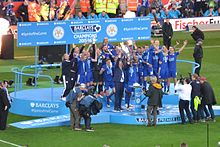
Leicester City players lifting the Premier League trophy after the 2015–16 season.
League
- First Division / Premier League (first tier)
- Champions: 2015–16
- Runners-up: 1928–29
- Second Division / First Division / Championship (second tier)
- Champions (7): 1924–25, 1936–37, 1953–54, 1956–57, 1970–71, 1979–80, 2013–14
- Runners-up: 1907–08, 2002–03
- Play-off winners: 1993–94, 1995–96
- Third Division / Second Division / League One (third tier)
- Champions: 2008–09
Cup
- League Cup / EFL Cup
- Winners: 1963–64, 1996–97, 1999–2000
- Runners-up: 1964–65, 1998–99
- Charity Shield / FA Community Shield
- Winners: 1971
- Runners-up: 2016
- FA Cup
- Runners-up: 1948–49, 1960–61, 1962–63, 1968–69
Regional competitions
- Wartime League
- Champions: 1942
- Wartime Cup
- Winners: 1941
Managerial history
Up until Peter Hodge was hired after World War I, the club had no official manager. A nominal role of secretary/manager was employed, though the board and the selection committee took control of most team affairs. It was Hodge who instated a system at the club for the manager having complete control over player and staff recruitment, team selection and tactics. Though Hodge was originally also titled “secretary/manager” he has retrospectively been named as the club’s first official “manager”.
Leicester have had a total of nine permanent secretary/managers and 36 permanent managers (not including caretakers). Nigel Pearson and Peter Hodge have both had two separate spells in charge of the club. Dave Bassett also had a second spell as caretaker manager after his spell as permanent manager.
Records and statistics
Graham Cross holds the record for the most Leicester appearances, with the defender playing 599 games between 1960–1976, although Adam Black holds the record for the most appearances in the league with 528 between 1920–1935.
Striker Arthur Chandler is currently the club’s all-time record goal scorer, netting 273 in his 12 years at the club; he also found the net in 8 consecutive matches in the 1924–25 season. The most goals managed in a single season for the club is 44 by Arthur Rowley, in the 1956–57 season. The fastest goal in the club’s history was scored by Matty Fryatt, when he netted after just nine seconds against Preston North End in April 2006.
Jamie Vardy broke the Premier League record for scoring 13 goals in 11 consecutive league games, in the 2015–16 Premier League season. Vardy is also the ninth player to score 20 top-flight goals in a season, following Arthur Chandler, Ernie Hine, Arthur Rowley, Jimmy Walsh, Ken Keyworth, Jackie Sinclair, Frank Worthington and Gary Lineker. Vardy’s goal at Sunderland on 10 April 2016 saw him become the first player since Gary Lineker in 1984–85 to score 20 top flight goals for the club, having already become Leicester’s highest Premier League scorer in a single season.
The record transfer fee paid by Leicester for a player was around £40 million for Monaco midfielder Youri Tielemans. The highest transfer fee received for a Leicester player was approximately £80 million from Manchester United for Harry Maguire; at the time of the transfer this was the eleventh highest ever fee, the highest ever move between two English teams and the highest ever for a defender.
The club’s record attendance is 47,298 against Tottenham Hotspur at Filbert Street, in a fifth round FA Cup clash in 1928. The highest league record at their current home, the King Power Stadium, was 32,242 for a competitive match against Sunderland on 8 August 2015. The highest ever attendance for a non-competitive football match of 32,188, was seen at a pre-season friendly against Spanish giants Real Madrid on 30 July 2011.
Leicester’s highest ever league finish is first in the Premier League in 2015–16. Their lowest ever league finish was first in League One in 2008–09. Leicester are joint equal with Manchester City for having won the most English second tier titles (7). The club has reached four FA Cup finals, yet lost them all. This is the record for the most FA Cup final appearances without winning the trophy.
Leicester’s longest ever unbeaten run in the league was between 1 November 2008 and 7 March 2009, to which they remained unbeaten for 23 games on their way to the League One title. (This was their only ever season in the third tier of English football). Their longest run of consecutive victories in the league is nine, which they achieved between 21 December 2013 and 1 February 2014 (in the Championship).
In the 2015–16 season, Leicester won what The Daily Telegraph described as “one of the most astonishing league titles of all-time” and achieved many new historical, club records. They had the fewest away defeats in any top flight season, as they were defeated only twice on their travels. They also recorded the fewest losses in any of the club’s Premier League seasons, losing just three matches throughout their entire campaign. The club produced another record for the most consecutive wins in the top flight, each coming against Watford, Newcastle United, Crystal Palace, Southampton and Sunderland. Coincidentally, they kept a record of five-straight clean sheets all set against each of the same five opponents. The King Power Stadium home crowd in 2015–16 saw their team beaten just once in the Premier League all season.
Leicester made their UEFA Champions League debut in the 2016–17 season, their fourth appearance in European football. The club became the third English team to win on their Champions League debut, after Manchester United in 1994 and Newcastle United in 1997. They are also the first English team to win away on their Champions League debut, and win all three of their opening games in the competition. They are the first team in Champions League history to keep clean sheets in each of their opening four games in the competition.
Between September 2015 and November 2016, the club went 20 league games unbeaten at home. The stint was ended by West Bromwich Albion on 6 November 2016 in a 1–2 defeat.
In March 2017, the club became the 50th team to reach the Champions League quarter-finals.
On 25 October 2019, Leicester City set the record for the highest margin of away victory in the English top tier, defeating Southampton 9–0 at St Mary’s Stadium. In doing so they also tied the record for the highest margin of victory in Premier League history, equalling Manchester United’s 9–0 home victory over Ipswich Town in 1995.
League history
Since their election to the Football League in 1894, Leicester have spent much of their history within the top two tiers of English football. Leicester have played outside the top two tiers only once in their history to date; during the 2008–09 season they played in League One, the third tier of English football, after relegation from the Championship the season prior. However, they made a swift return to the second tier, as they were promoted as champions in the 2008–09 season. The club have never played lower than England’s third tier.
|
|
|
|
|
- Seasons spent at Level 1 of the football league system: 51
- Seasons spent at Level 2 of the football league system: 62
- Seasons spent at Level 3 of the football league system: 1
(up to and including 2018–19)
Players
First-team squad
- As of 31 January 2021
Note: Flags indicate national team as defined under FIFA eligibility rules. Players may hold more than one non-FIFA nationality.
|
|
Out on loan
Note: Flags indicate national team as defined under FIFA eligibility rules. Players may hold more than one non-FIFA nationality.
|
|
Under-23s and Academy
Former players
Club staff
As of 24 February 2021
| Directors & Senior Management | |
|---|---|
| Role | Person |
| Chairman |  Aiyawatt Srivaddhanaprabha Aiyawatt Srivaddhanaprabha |
| Vice Chairman | Apichet Srivaddhanaprabha |
| Vice Chairman |  Liu Shilai Liu Shilai |
| Chief Executive |  Susan Whelan Susan Whelan |
| Finance Director |  Simon Capper Simon Capper |
| Director of Football | Jon Rudkin |
| Football Operations Director | Andrew Neville |
| Commercial Director | Dan Barnett |
| Director Estates and Infrastructure | Mags Mernagh |
| General Counsel | Matthew Phillips |
| Operations Director | Anthony Mundy |
| HR Director | Liam Dolan-Barr |
| Communications Director | Anthony Herlihy |
| First Team Management | |
|---|---|
| Role | Person |
| First Team Manager | Brendan Rodgers |
| First Team Assistant Manager |  Chris Davies Chris Davies |
| First Team Coach |  Kolo Touré Kolo Touré |
| First Team Coach | Adam Sadler |
| First Team Coach & Goalkeeping Coach | Mike Stowell |
| First Team Fitness Coach | Glen Driscoll |
| Head of Fitness & Conditioning | Matt Reeves |
| Head of Medicine | Bryan English |
| First Team Physiotherapist | Simon Murphy |
| Kit Manager | Paul McAndrew |
| Head of Senior Player Recruitment | Lee Congerton |
| Academy Director | Jon Rudkin |
Player statistics
Captains
|
|
This section does not cite any sources. (May 2016) (Learn how and when to remove this template message)
|
| Dates | Name |
|---|---|
| 1987–? |  Ally Mauchlen Ally Mauchlen |
| 1992–1993 | Steve Walsh |
| 1993–1994 | Gary Mills |
| 1995–1996 | Garry Parker |
| 1996–1999 | Steve Walsh |
| 1999–2005 | Matt Elliott |
| 2005–2006 |  Danny Tiatto Danny Tiatto |
| 2006–2007 | Paddy McCarthy |
| 2007–2008 | Stephen Clemence |
| 2008–2011 | Matt Oakley |
| 2011–2012 | Matt Mills |
| 2012– |  Wes Morgan Wes Morgan |
Player of the Year
Leicester City’s Player of the Year award is voted for by the club’s supporters at the end of every season.
|
|
|

English Hall of Fame members
The following have played for Leicester and have been inducted into the English Football Hall of Fame:
- Gordon Banks 2002 (Inaugural Inductee)
- Peter Shilton 2002 (Inaugural Inductee)
- Gary Lineker 2003
- Don Revie 2004 (Inducted as a manager)
- Frank McLintock 2009
Football League 100 Legends
The Football League 100 Legends is a list of “100 legendary football players” produced by The Football League in 1998, to celebrate the 100th season of League football. It also included Premier League players, and the following former Leicester City players were included:
- Arthur Rowley
- Gordon Banks
- Frank McLintock
- Peter Shilton
- Gary Lineker
World Cup players
|
|
This section does not cite any sources. (May 2016) (Learn how and when to remove this template message)
|
The following players have been selected by their country in the World Cup Finals, while playing for Leicester.
- John Anderson (1954)
- Willie Cunningham (1958)
- Ken Leek (1958)
- Gordon Banks (1966) – Won the 1966 World Cup while at Leicester
- John O’Neill (1982, 1986)
- Paul Ramsey (1986)
- Gary McAllister (1990)
- David Kelly (1990)
- Matt Elliott (1998)
 Kasey Keller (1998)
 Muzzy Izzet (2002)
 Riyad Mahrez (2014)
- Kasper Schmeichel (2018)
- Harry Maguire (2018)
- Jamie Vardy (2018)
 Shinji Okazaki (2018)
 Wilfred Ndidi (2018)
- Kelechi Iheanacho (2018)
- Ahmed Musa (2018)
- Adrien Silva (2018)
- Ricardo Pereira (2018)
 Yohan Benalouane (2018)
International honours
|
|
This section does not cite any sources. (December 2019) (Learn how and when to remove this template message)
|
- As of 19 November 2020
The following players have been selected by their country while being playing for Leicester City (including players both on loan at and away from the club). The number of caps won whilst at the club are given, along with the date of the first cap being won while with Leicester City. Players listed in bold are current Leicester City players.
- Alfred Watkins (2 Caps, 19 March 1898)
- Richard Jones (1 Cap, 19 March 1898)
- Mick Cochrane (1 Cap, 23 February 1901)
- Horace Bailey (5 Caps, 16 March 1908)
- Andy Aitken (3 Caps, 2 April 1910)
- Douglas McWhirter (4 Caps, 21 March 1913)
- Ronald Brebner (3 Caps, 15 November 1913)
- John Paterson (1 Cap, 10 April 1920)
- Mick O’Brien (3 Caps, 4 March 1922)
- John Duncan (1 Cap, 31 October 1925)
- Sid Bishop (4 Caps, 2 April 1927)
- Reg Osborne (1 Cap, 28 November 1927)
- Leonard Barry (5 Caps, 17 May 1928)
- Ernest Hine (6 Caps, 22 October 1928)
- Hugh Adcock (5 Caps, 9 May 1929)
- David Jones (7 Caps, 4 November 1933)
- Thomas Mills (1 Cap, 29 September 1934)
- Septimus Smith (1 Cap, 19 October 1935)
- William Maldwyn Griffiths (11 Caps, 16 April 1947)
- Tommy Godwin (5 Caps, 9 October 1949)
- Arthur Lever (1 Cap, 18 October 1952)
- John Anderson (1 Cap, 25 May 1954)
- Willie Cunningham (24 Caps, 3 November 1954)
- Kenneth Leek (16 Caps, 20 October 1960)
- Gordon Banks (35 Caps, 6 April 1963)
- David Gibson (7 Caps, 4 May 1963)
- Frank McLintock (3 Caps, 4 May 1963)
- Derek Dougan (8 Caps, 2 October 1965)
- Peter Rodrigues (16 Caps, 30 March 1966)
- Jackie Sinclair (1 Cap, 18 June 1966)
- Peter Shilton (20 Caps, 25 November 1970)
- Keith Weller (4 Caps, 11 May 1974)
- Frank Worthington (8 Caps, 15 May 1974)
- Stephen Whitworth (7 Caps, 12 March 1975)
- Joe Waters (1 Cap, 13 October 1976)
- John O’Neill (39 Caps, 26 March 1980)
- Gerry Daly (1 Cap, 22 September 1982)
- Paul Ramsey (14 Caps, 21 September 1983)
- Gary Lineker (7 Caps, 26 May 1984)
- Ian Wilson (2 Caps, 23 May 1987)
 Jari Rantanen (10 Caps, 9 September 1987)
- Robbie James (2 Caps, 9 September 1987)
- James Quinn (4 Caps, 14 September 1988)
- David Kelly (7 Caps, 25 April 1990)
- Gary McAllister (3 Caps, 25 April 1990)
- Brian Carey (1 Cap, 23 March 1994)
- Iwan Roberts (3 Caps, 20 April 1994)
- Colin Hill (16 Caps, 29 March 1995)
- Zeljko Kalac (2 Caps, 25 February 1996)
- Neil Lennon (29 Caps, 27 March 1996)
- Kasey Keller (21 Caps, 3 November 1996)
 Pontus Kåmark (17 Caps, 30 April 1997)
- Robbie Savage (20 Caps, 20 August 1997)
- Matt Elliott (18 Caps, 12 November 1997)
- Theodoros Zagorakis (18 Caps, 17 February 1998)
 Arnar Gunnlaugsson (3 Caps, 10 March 1999)
- Emile Heskey (5 Caps, 28 April 1999)
- Frank Sinclair (17 Caps, 26 May 1999)
- Stephen Guppy (1 Cap, 10 October 1999)
- Gerry Taggart (6 Caps, 26 April 2000)
- Mustafa Izzet (8 Caps, 15 June 2000)
- Callum Davidson (5 Caps, 2 September 2000)
- Matt Jones (8 Caps, 24 March 2001)
- Trevor Benjamin (2 Caps (1 won while on loan to Gillingham), 20 November 2002)
- Keith Gillespie (9 Caps, 6 September 2003)
- Paul Dickov (5 Caps, 6 September 2003)
- Nikos Dabizas (6 Caps, 18 February 2004)
- Benjamin Thatcher (3 Caps, 31 March 2001)
- Danny Coyne (3 Caps, 31 March 2001)
- Peter Canero (1 Cap, 28 April 2004)
- Ian Walker (1 Cap, 5 June 2004)
- Joey Guðjónsson (6 Caps, 18 August 2004)
 Lars Hirschfeld (1 Cap, 26 March 2005)
- Alan Maybury (1 Cap, 29 March 2005)
- Danny Tiatto (1 Cap, 9 May 2005)
- Robert Douglas (1 Cap, 17 August 2005)
- Iain Hume (7 Caps, 16 November 2005)
 Mohammed Sylla (3 Caps, 7 January 2006)
 Elvis Hammond (1 Cap, 1 March 2006)
- Patrick Kisnorbo (3 Caps, 14 November 2006)
 Hossein Kaebi (2 Caps, 15 July 2007)
 Márton Fülöp (7 Caps (won while on loan from Sunderland), 22 August 2007)
 Radostin Kishishev (4 Caps (2 won while on loan at Leeds United), 22 August 2007)
- Gareth McAuley (4 Caps, 17 October 2007)
- Aleksander Tunchev (5 Caps, 6 September 2008)
- Andy King (50 Caps (3 won while on loan at Swansea City), 29 May 2009)
- Ryan McGivern (3 Caps (won while on loan from Manchester City), 14 October 2009)
- Yuki Abe (4 Caps), 8 October 2010)
- Greg Cunningham (1 Cap (won while on loan from Manchester City), 17 November 2010)
 Jeffrey Bruma (1 Cap (won while on loan from Chelsea), 7 June 2011)
- Sean St Ledger (19 Caps (3 won while on loan at Millwall), 10 August 2011)
 Gelson Fernandes (4 Caps (won while on loan from Saint-Étienne), 6 September 2011)
- John Paintsil (8 Caps, 5 November 2011)
- Souleymane Bamba (8 Caps, 12 November 2011)
- Jeffrey Schlupp (15 Caps, 15 November 2011)
- Kasper Schmeichel (60 Caps, 6 February 2013)
 Chris Wood (9 Caps (1 won while on loan at Ipswich Town), 22 March 2013)
- Jermaine Beckford (5 Caps (won while on loan at Huddersfield Town), 22 March 2013)
- Wes Morgan (30 Caps, 7 September 2013)
 Simonas Stankevičius (10 Caps, 18 November 2013)
- Márkó Futács (3 Caps (won while on loan at Diósgyőr-Vasgyári Testgyakorlók Köre), 5 March 2014)
- Riyad Mahrez (39 Caps, 31 May 2014)
 Harrison Panayiotou (12 Caps (5 won while on loan at Raith Rovers), 8 October 2014)
 Alie Sesay (3 Caps, 11 October 2014)
 Andrej Kramarić (10 Caps (5 won while on loan at 1899 Hoffenheim), 28 March 2015)
- Jamie Vardy (26 Caps, 7 June 2015)
- Shinji Okazaki (26 Caps, 3 September 2015)
 Christian Fuchs (11 Caps, 5 September 2015)
- Gökhan Inler (5 Caps, 8 September 2015)
- Tom Lawrence (6 Caps (2 won while on loan at Blackburn Rovers, 2 at Cardiff City and 2 at Ipswich Town), 13 October 2015)
- Daniel Amartey (18 Caps, 24 March 2016)
 N’Golo Kanté (8 Caps, 25 March 2016)
- Danny Drinkwater (3 Caps, 29 March 2016)
- Ahmed Musa (17 Caps (8 won while on loan at CSKA Moscow), 3 September 2016)
 Bartosz Kapustka (3 Caps, 4 September 2016)
- Islam Slimani (26 Caps (3 won while on loan at Newcastle United, 2 at Fenerbahçe and 5 at AS Monaco), 4 September 2016)
 Faiq Jefri Bolkiah (6 Caps, 15 October 2016)
- Wilfred Ndidi (30 Caps, 23 March 2017)
- Kelechi Iheanacho (18 Caps, 1 September 2017)
- Aleksandar Dragović (8 Caps (won while on loan from Bayer Leverkusen), 2 September 2017)
- Harry Maguire (20 Caps, 8 October 2017)
 Admiral Muskwe (4 Caps, 8 November 2017)
- Yohan Benalouane (5 Caps, 23 March 2018)
- Adrien Silva (6 Caps, 26 March 2018)
- George Thomas (3 Caps (2 won while on loan at Scunthorpe United), 29 May 2018)
- Ricardo Pereira (3 Caps, 30 June 2018)
- Çağlar Söyüncü (14 Caps, 7 September 2018)
- Jonathan Evans (19 Caps, 8 September 2018)
- Rachid Ghezzal (3 Caps, 8 September 2018)
- Ben Chilwell (11 Caps, 11 September 2018)
- Danny Ward (6 Caps, 20 November 2018)
- Youri Tielemans (15 Caps (4 won while on loan from AS Monaco), 21 March 2019)
- Filip Benković (1 Cap (won while on loan at Celtic), 11 June 2019)
- Dennis Praet (6 Caps, 6 September 2019)
- James Maddison (1 Cap, 14 November 2019)
- Timothy Castagne (4 Caps, 5 September 2020)
- Cengiz Ünder (5 Caps (won while on loan from A.S. Roma), 7 October 2020)
- Harvey Barnes (1 Cap, 8 October 2020)
Players with over 300 appearances for Leicester
Includes competitive appearances only. Current players in bold.
- Graham Cross 599
- Adam Black 557
- Hugh Adcock 460
- Mark Wallington 460
- Steve Walsh 450
- Arthur Chandler 419
- John Sjoberg 413
- Mal Griffiths 409
- Kasper Schmeichel 406
- Steve Whitworth 400
- Andy King 379
- Sep Smith 373
- Mike Stringfellow 370
- Richie Norman 365
- Gordon Banks 356
- John O’Neill 345
- Dave Gibson 339
- Peter Shilton 339
- Jamie Vardy 333
- Colin Appleton 333
- Dennis Rofe 324
- Paul Ramsey 322
- Arthur Rowley 321
- Wes Morgan 320
- Arthur Lochhead 320
- Muzzy Izzet 319
- Ian Wilson 318
- Derek Hines 317
- Lenny Glover 305
Players with 50 or more goals for Leicester
Includes competitive appearances only. Current players in bold.
- Arthur Chandler 273
- Arthur Rowley 265
- Ernie Hine 156
- Jamie Vardy 144
- Derek Hines 117
- Arthur Lochhead 114
- Gary Lineker 103
- Mike Stringfellow 97
- Johnny Duncan 95
- Jimmy Walsh 91
- Jack Lee 84
- Alan Smith 84
- Frank Worthington 78
- Mal Griffiths 76
- Ken Keyworth 76
- Danny Liddle 71
- Arthur Maw 64
- Matty Fryatt 62
- Andy King 62
- Steve Walsh 62
- Steve Lynex 60
- David Nugent 59
- Fred Shinton 58
- Jack Bowers 56
- Dave Gibson 53
- Jackie Sinclair 53
- Hugh Adcock 52
- George Dewis 51
- Gary McAllister 51
Personnel honours and awards
Ballon d’Or nominees
The following players have been nominated for the Ballon d’Or while playing for Leicester; the award is also referred to as the World or European Footballer of the Year.
- Gordon Banks (1966)
- Jamie Vardy (2016)
- Riyad Mahrez (2016)
PFA Player of the Year
The following players have been named the PFA Player of the Year whilst playing for Leicester:
- 2016 – Riyad Mahrez
FWA Footballer of the Year
The following players have been named the FWA Footballer of the Year whilst playing for Leicester:
- 2016 – Jamie Vardy
English Golden Boot
The following players have won the English Golden Boot for being the country’s top goalscorer, while at Leicester (Note: This applies only to players playing in the top tier of English football):
- Gary Lineker (1984–85) (joint winner)
- Jamie Vardy (2019–20)
English Second Division Golden Boot
The following players have won the golden boot for being the top goalscorer in the second tier of English football while at Leicester:
- David Skea (1894–95)
- Arthur Chandler (1924–25)
- Jack Bowers (1936–37)
- Arthur Rowley (1952–53), (1956–57)
- Willie Gardiner (1955–56)
- Gary Lineker (1982–83)
Football League Awards Player of the Year
The following players have been named the best player in their division in the Football League Awards while at Leicester:
- Matty Fryatt (League One, 2009)
LMA Manager of the Year
The following managers have been named the LMA Manager of the Year or won their division award while at Leicester:
- Nigel Pearson (Championship, 2014)
 Claudio Ranieri (Overall, 2016; Premier League, 2016)
The Best FIFA Men’s Player
The following players have been shortlisted for The Best FIFA Men’s Player award, while playing for Leicester:
- Jamie Vardy (2016)
- Riyad Mahrez (2016)
The Best FIFA Men’s Coach
The following managers have been shortlisted and won, The Best FIFA Men’s Coach award while managing Leicester:
- Claudio Ranieri (2016)
The Best FIFA Goalkeeper
The following goalkeepers have been shortlisted for The Best FIFA Goalkeeper award, while playing for Leicester:
- Kasper Schmeichel (2018)
BBC Sports Personality Coach of the Year Award
- Claudio Ranieri (2016)
BBC Sports Personality Team of the Year Award
- Leicester City (2016)
ESPN Team of the Year
- Leicester City (2016)
Laureus World Sports Award
- Leicester City (2017)
FIFA FIFPro World11 nominees
The following players have been shortlisted for the FIFA FIFPro World11, while playing for Leicester:
- Jamie Vardy (2016)
PFA Team of the Year
The following players have been named in the PFA Team of the Year while at Leicester:
- 1979 – Second Division – Mark Wallington
- 1982 – Second Division – Mark Wallington
- 1989 – Second Division – Gary McAllister
- 1990 – Second Division – Gary McAllister
- 1996 – First Division – Garry Parker, Steve Claridge
- 2003 – First Division – Muzzy Izzet, Paul Dickov
- 2009 – League One – Jack Hobbs, Matt Oakley, Matty Fryatt
- 2011 – Championship – Kyle Naughton, Andy King
- 2013 – Championship – Kasper Schmeichel, Wes Morgan
- 2014 – Championship – Kasper Schmeichel, Wes Morgan, Danny Drinkwater
- 2016 – Premier League – Wes Morgan, N’Golo Kanté, Riyad Mahrez, Jamie Vardy
- 2020 – Premier League – Çağlar Söyüncü, Jamie Vardy