
The Gadsden flag is a historical American flag with a yellow field depicting a timber rattlesnake coiled and ready to strike. Beneath the rattlesnake are the words: “Dont Tread on Me”. Some modern versions of the flag include an apostrophe.
The flag is named after politician Christopher Gadsden (1724–1805), who designed it in 1775 during the American Revolution. It was used by the Continental Marines as an early motto flag, along with the Moultrie flag. It is often used in the United States as a symbol for gun rights and limited government.
Appearance and symbolism
Variations in appearance
Many variations of the Gadsden flag exist. The motto sometimes includes an apostrophe in the word “Don’t” and sometimes not;:339 the typeface used for the motto is sometimes a serif typeface and other times sans-serif. The rattlesnake sometimes is shown as resting on a green ground; representations dating from 1885 and 1917 do not display anything below the rattlesnake. The rattlesnake usually faces to the left, and the early representations mentioned above face left. However, some versions of the flag show the snake facing to the right.
History of rattlesnake symbol in America
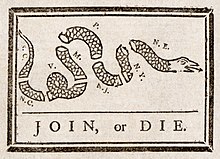
Benjamin Franklin’s Join, or Die cartoon
The timber rattlesnake can be found in the area of the original Thirteen Colonies. Like the bald eagle, part of its significance is that it was unique to the Americas, serving as a means of showing a separate identity from the Old World. Its use as a symbol of the American colonies can be traced back to the publications of Benjamin Franklin. In 1751, he made the first reference to the rattlesnake in a satirical commentary published in his Pennsylvania Gazette. It had been the policy of Parliament to send convicted criminals to the Americas (primarily Georgia), so Franklin suggested that they thank them by sending rattlesnakes to Britain.
In 1754, during the French and Indian War, Franklin published his famous woodcut of a snake cut into eight sections. It represented the colonies, with New England joined together as the head and South Carolina as the tail, following their order along the coast. Under the snake was the message “Join, or Die”. This was the first political cartoon published in an American newspaper.
In 1774, Paul Revere added Franklin’s iconic cartoon to the nameplate of Isaiah Thomas’s paper, the Massachusetts Spy, depicted there as fighting a British Griffin.
In December 1775, Benjamin Franklin published an essay in the Pennsylvania Journal under the pseudonym American Guesser in which he suggested that the rattlesnake was a good symbol for the American spirit.

Flag of the Culpeper Minutemen
The rattlesnake symbol was first officially adopted by the Continental Congress in 1778 when it approved the design for the official Seal of the War Office. At the top center of the Seal is a rattlesnake holding a banner that says: “This We’ll Defend”. This design of the War Office Seal was carried forward—with some minor modifications—into the subsequent designs as well as the Department of the Army’s Seal, Emblem and Flag. As such, some variation of a rattlesnake symbol has been in continuous official use by the US Army for over 236 years.
Other American flags that use a rattlesnake motif include The United Companies of the Train of Artillery of the Town of Providence, the traditional version of the First Navy Jack, and the Culpeper Minutemen flag, among others.
History of Gadsden’s flag

Gadsden’s flag in an 1885 schoolbook
In the fall of 1775, the Continental Navy was established by General George Washington in his role as Commander in Chief of all Continental Forces, before Esek Hopkins was named Commodore of the Navy. Those first ships were used to intercept incoming transport ships carrying war supplies to the British in the colonies in order to supply the Continental Army, which was desperately undersupplied in the opening years of the American Revolutionary War. The Second Continental Congress authorized the mustering of five companies of Marines to accompany the Navy on their first mission.
Continental Colonel Christopher Gadsden represented his home state of South Carolina and was one of seven members of the Marine Committee outfitting the first naval mission.:289 The first Marines enlisted in the city of Philadelphia and carried drums painted yellow and depicting a coiled rattlesnake with thirteen rattles along with the motto “Don’t Tread on Me.” This is the first recorded mention of the future Gadsden flag’s symbolism.
Before the departure of that first mission in December 1775, the newly appointed commander-in-chief of the Navy, Commodore Esek Hopkins, received a yellow rattlesnake flag from Gadsden to serve as the distinctive personal standard of his flagship.:289 Hopkins had previously led The United Companies of the Train of Artillery of the Town of Providence, which had a similar flag, before being appointed to lead the Navy.
Gadsden also presented a copy of this flag to the Congress of South Carolina in Charleston, South Carolina. This was recorded in the South Carolina congressional journals on February 9, 1776:
Col. Gadsden presented to the Congress an elegant standard, such as is to be used by the commander in chief of the American Navy; being a yellow field, with a lively representation of a rattlesnake in the middle in the attitude of going to strike and these words underneath, “Don’t tread on me.”
Modern use
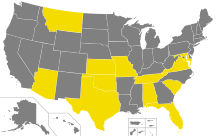
Map of states (colored yellow) that offer Gadsden flag specialty license plates.
For historical reasons, the Gadsden flag is still popularly flown in Charleston, South Carolina, the city where Christopher Gadsden first presented the flag and where it was commonly used during the revolution, along with the blue and white crescent flag of pre-Civil War South Carolina.
The Gadsden flag has become a popular specialty license plate in several states. As of 2018, the following states offer the option of obtaining a Gadsden flag specialty license plate: Alabama, Arizona, Maryland, Missouri, Montana, Oklahoma, South Carolina, Tennessee, Texas, and Virginia.
Use as a libertarian symbol
In the 1970s the Gadsden flag started being used by libertarians, using it as a symbol representing individual rights and limited government. The libertarian Free State Project uses a modified version of the flag with the snake replaced with a porcupine, a symbol of the movement.
Use as a Tea Party symbol
Beginning in 2009, the Gadsden flag became widely used as a protest symbol by American Tea Party movement protesters. It was also displayed by members of Congress at Tea Party rallies. In some cases, the flag was ruled to be a political, rather than a historic or military, symbol due to the strong Tea Party connection.

Gadsden Flag being used by Protesters in the area of riots during the storming of the Capitol.
Far-right ideology
The Gadsden Flag has also been used as a symbol by far-right groups and individuals. In 2014, the flag was used by Jerad and Amanda Miller, the perpetrators of the 2014 Las Vegas shootings who killed two police officers and a civilian. The Millers reportedly placed the Gadsden Flag on the corpse of one of the officers they killed.
The Gadsden flag was featured prominently in a story surrounding the 2021 storming of the United States Capitol where 34-year-old Rosanne Boyland was allegedly trampled to death while brandishing it over her shoulders.
Legal cases involving the Gadsden flag
In March 2013, the Gadsden flag was raised at a vacant armory building in New Rochelle, New York without permission from city officials. The city ordered its removal and the United Veterans Memorial & Patriotic Association, which had maintained the U.S. flag at the armory, filed suit against the city. A federal judge dismissed the case, rejecting the United Veterans’ First Amendment argument and ruling that the flagpole in question was city property and thus did not represent private speech.
In 2014, a US Postal Service employee filed a complaint about a coworker repeatedly wearing a hat with a Gadsden Flag motif at work. Postal service administration dismissed the complaint, but the United States Equal Employment Opportunity Commission reversed the decision and called for a careful investigation. The EEOC issued a statement clarifying that it did not make any decision that the Gadsden flag was a “racist symbol,” or that wearing a depiction of it constituted racial discrimination.

A rainbow Gadsden flag
Modern derived designs and parodies
Street Patrol, a 1990s queer self defense group affiliated with Queer Nation/San Francisco, used as its logo a coiled snake over a triangle holding a ribbon with the motto “Don’t Tread on Me”. Some libertarian circles use a version of the flag with the snake and motto placed over a rainbow flag. Following the 2016 Orlando nightclub shooting, posters containing a rainbow Gadsden flag inscribed with “#ShootBack” were placed around West Hollywood, upsetting members of the community and city government who opposed its apparent violent message.
Parodies of the Gadsden flag are common, altering the image or motto to mock the symbol. One common parody design replaces the “Dont Tread on Me” motto with “No Step on Snek”, sometimes paired with a crudely drawn snake.
Appearances in popular culture
The Gadsden Flag has made numerous appearances in popular culture, particularly in post-apocalyptic stories.
In film and television
- In season 1, episode 7 of The West Wing, Sam Seaborn has a modified version of the Gadsden flag behind his desk.
- In the apocalyptic 2006 CBS TV drama Jericho, the flag makes several appearances, most notably in the series finale as Jericho’s acting mayor takes down the flag of the “Allied States of America”, which had been flying at the town hall and replaces it with a Gadsden Flag which the previous mayor had kept framed in his office.
- In the Futurama episode All the Presidents’ Heads, Professor Farnsworth discovered a means of time travel using the fluid used to preserve heads and attempted to use it to prevent the nefarious actions of his ancestor David Farnsworth. After the original timeline is restored from one where Britain had won the American Revolutionary War, a modified version of the Gadsden flag featuring Bender and his catchphrase “Bite My Shiny Metal Ass” is displayed in the Head Museum’s Hall of Presidents.
- In the Simpsons episode “Bart Gets an F”, during a dream sequence in which Bart sees the signing of the Declaration of Independence, Benjamin Franklin picks up a sled with a modified version of the flag reading “Don’t Sled on Me”.
- In the Parks and Recreation episode “The Master Plan,” a historical flag set that includes the Gadsden flag is featured on the desk behind Ron Swanson as he describes his libertarian beliefs.
In video games
- In the video game Red Dead Redemption 2, in the gun store in Rhodes there is a Gadsden Flag hung on a wall.
- In Hideo Kojima’s video game Metal Gear Solid 2: Sons of Liberty, a variation of the flag can be seen on one of the connecting bridges of the “Big Shell” facility, in a reference to both the original meaning and usage of the flag.
In the video game Assassins Creed 3 Remastered Gadsden flags can be found in Boston.
In music
- American heavy metal band Metallica recorded a song called “Don’t Tread on Me” on their self-titled fifth studio album, released in 1991. The album cover features a dark grey picture of a coiled rattlesnake like the one found on the Gadsden Flag.
- A verse from the 1970 song “Uncle John’s Band” by the Grateful Dead contains the words “Their walls are built of cannonballs, their motto is ‘Don’t tread on me'”.
- The Gadsden flag is represented on the front cover of the Country Ghetto album (2007) by Southern rock band JJ Grey & Mofro with the words “Don’t Tread on Me” on the rear of the booklet.
Elsewhere in Culture
- NASCAR driver Carl Edwards displayed the Gadsden Flag next to his facsimile signature on his race car.
- In WWE, the tag team Real Americans, composed by Jack Swagger, Cesaro and the manager Zeb Colter, used the Gadsden Flag. Also Dolph Ziggler often has the snake as a design on his long wrestling tights.
- In the 1979 novel Alongside Night, the flag is used by an organization called the Revolutionary Agorist Cadre which seeks a second American Revolution. The flag also appears in the 2014 Alongside Night movie adaptation.