
Javier Felipe Ricardo Pérez de Cuéllar y de la Guerra KCMG (/ˈpɛrɛs də ˈkweɪjɑː/; Spanish: ; January 19, 1920 – March 4, 2020) was a Peruvian diplomat and politician who served as the fifth Secretary-General of the United Nationsfrom January 1, 1982 to December 31, 1991. He ran unsuccessfully against Alberto Fujimori for President of Peru in 1995 and following Fujimori’s resignation over corruption charges, he was Prime Minister and Minister of Foreign Affairs from November 2000 until July 2001. In December 2004, he stepped down from his position as Peru’s Ambassador to France, where he formerly resided. He was also a member of the Club de Madrid, a group of more than 100 former Presidents and Prime Ministers of democratic countries, which works to strengthen democracy worldwide. At the age of 100 years, 45 days, at the time of his death in March 2020 Pérez de Cuéllar was both the oldest living former Peruvian prime minister and Secretary General of the United Nations.
Biography
Early years
Javier Pérez de Cuéllar was born on January 19, 1920 in Lima to a wealthy family of Spanish descent with ancestry from Cuéllar.He studied in Colegio San Agustín of Lima, and then at Pontifical Catholic University of Peru.
Diplomatic career
Pérez de Cuéllar joined the Ministry of Foreign Affairs in 1940 and the diplomatic service in 1944, serving subsequently as Secretary at Peru’s embassy in France, where he met and married his first wife in 1947, Yvette Roberts (1922–2013). He also held posts in the United Kingdom, Bolivia, and Brazil, and later served as ambassador to Switzerland, the Soviet Union, Poland, and Venezuela. From his first marriage, he has a son, Francisco, born in Paris, and a daughter, Águeda Cristina, born in London.
He was a junior member of the Peruvian delegation to the first session of the General Assembly, which convened in London in 1946, and a member of the delegations to the 25th through 30th sessions of the Assembly. In 1971, he was appointed permanent representative of Peru to the United Nations, and he led his country’s delegation to all sessions of the Assembly from then until 1975.
In 1973 and 1974, he represented his country in the Security Council, serving as its President at the time of the events in Cyprus in July 1974. On September 18, 1975, he was appointed Special Representative of the Secretary-General in Cyprus – a post he held until December 1977, when he rejoined the Peruvian Foreign Service. On October 29, 1975, in Cyprus, Mr. Pérez de Cuéllar married his second wife, the former Marcela Temple Seminario (August 14, 1933, – July 3, 2013) with whom he had no children.
On February 27, 1979, he was appointed as United Nations Under-Secretary-General for Special Political Affairs. From April 1981, while still holding this post, he acted as the Secretary-General’s Personal Representative on the situation relating to Afghanistan. In that capacity, he visited Pakistan and Afghanistan in April and August of that year in order to continue the negotiations initiated by the Secretary-General some months earlier.
United Nations Secretary-General
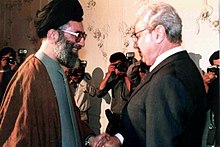
Pérez de Cuéllar and Iranian President Ali Khamenei in Tehran, 1987
On December 31, 1981, Pérez de Cuéllar succeeded Kurt Waldheim as Secretary-General and was re-elected for a second term in October 1986. During his two terms, he led mediations between Great Britain and Argentina in the aftermath of the Falklands War and promoted the efforts of the Contadora Group to bring peace and stability to Central America. He also interceded in the negotiations for the independence of Namibia, the conflict in Western Sahara between Morocco and the Polisario Front, the war between Croatian forces seeking independence and the Yugoslav People’s Army as well as local Serb forces, and the Cyprus issue. In 1986 he presided over an international arbitration committee that ruled on the Rainbow Warrior incident between New Zealand and France. In 1983, he initiated the World Commission on Environment and Development (WCED) in order to unite countries to pursue sustainable development.
Shortly before the end of his second term, he rejected an unofficial request by members of the Security Council to reconsider his earlier decision not to run for a third term, shortened to two years, as a search for his successor had not, as of then, yielded a consensus candidate. A suitable candidate, Boutros Boutros Ghali of Egypt, was agreed upon in late December 1991, and his second term as Secretary-General concluded, as scheduled, on December 31, 1991.
Later life and death

Pérez de Cuéllar in 2008
On July 22, 2005, Pérez de Cuéllar suffered a heart attack and was admitted to a hospital in Paris; he was released on July 30. On June 19, 2017, with a lifespan of 35,581 days he surpassed Alfredo Solf y Muro (1872–1969) in terms of longevity and had the longest life of any Prime Minister in Peru’s history.
Pérez de Cuéllar turned 100 in January 2020 and died in Lima on March 4, 2020, at age 100.
Honours and awards
- 1992: Freedom medal
- Journalistic prize Golden Doves for Peace issued by the Italian Research Institute Archivio Disarmo
- US Presidential Medal of Freedom awarded in 1991 by George H.W. Bush, under section Other Political Figures.
- Golden Plate Award of the American Academy of Achievement in 1991
- Member, Inter-American Dialogue
- Jawaharlal Nehru Award
He has received several honorary degrees : National University of San Marcos, Vrije Universiteit Brussel, Jagiellonian University, University of Cambridge, Université Laval, University of Valladolid, University of Salamanca, Université libre de Bruxelles, University of Coimbra, Humboldt University of Berlin, Pontifical Catholic University of Peru, University of Paris II Panthéon-Assas, University of Nice Sophia Antipolis, Charles University, Sofia University, Carleton University, Visva-Bharati University, Osnabrück University, National University of Mongolia, Moscow State University, University of Malta, Leiden University, La Salle University, Tufts University, Johns Hopkins University.