
Wahhabism (Arabic: الوهابية, Al-Wahhābiyyah) is a religious reform movement and doctrine associated with the teachings of Muhammad ibn Abd al-Wahhab. It has been variously described as “orthodox”, “puritan(ical)”; and as an Islamic “reform movement” to restore “pure monotheistic worship” by devotees. The term Wahhabi(sm) is chiefly used by outsiders polemically and adherents reject its use, preferring to be called “Salafi”, (a term used by followers of other Islamic reform movements as well) and view themselves as muwahhid (Unitarians), to emphasize the principle of Tawhid (the “uniqueness” and “unity” of God). The term has also been described as a Sunniphobic slur. It adheres to the Athari theology.
Wahhabism is named after an eighteenth-century Islamic scholar, theologian, preacher and activist, Muhammad ibn Abd al-Wahhab (1703–1792). He started a reform movement in the remote, sparsely populated region of Najd, advocating a purging of widespread practices such as veneration of saints and pilgrimages to their tombs and shrines that were practiced by the people of Najd, but which he considered idolatrous impurities and innovations in Islam (bid’ah). Eventually he formed a pact with a local leader, Muhammad bin Saud, offering political obedience and promising that protection and propagation of the Wahhabi movement meant “power and glory” and rule of “lands and men”.
The alliance between followers of ibn Abd al-Wahhab and Muhammad bin Saud’s successors (the House of Saud) proved to be a durable one. The House of Saud continued to maintain its politico-religious alliance with the Wahhabi sect through the waxing and waning of its own political fortunes over the next 150 years, through to its eventual proclamation of the Kingdom of Saudi Arabia in 1932, and then afterwards, on into modern times. Today Ibn Abd Al-Wahhab’s teachings are the official, state-sponsored form of Sunni Islam in Saudi Arabia. With the help of funding from Saudi petroleum exports (and other factors), the movement underwent “explosive growth” beginning in the 1970s and now has worldwide influence. The US State Department has estimated that over the past four decades concerns in Riyadh have directed at least $10bn (£6bn) to select charitable foundations toward the subversion of mainstream Sunni Islam by Wahhabism. The Saudi Crown Prince Muhammad Bin Salman, on the other hand, denied that Wahhabism ever existed and that “No one can define this Wahhabism”. (As of 2017 changes to Saudi religious policy by Crown Prince Muhammad bin Salman have led some to suggest that “Islamists throughout the world will have to follow suit or risk winding up on the wrong side of orthodoxy”.)
The “boundaries” of Wahhabism have been called “difficult to pinpoint”, but in contemporary usage, the terms Wahhabi and Salafiare often used interchangeably, and they are considered to be movements with different roots that have merged since the 1960s.However, Wahhabism has also been called “a particular orientation within Salafism”, or as a conservative, Saudi branch of Salafism. The national poet of Pakistan, Muhammad Iqbal praised the 18th-century Najdi reform movement as “the first throb of life in modern Islam” which revolted against the rigidity of the ulema. Noting its inspiration on the 19th-century religious reformers, Iqbal stated that “to the inspiration of this movement are traceable, directly or indirectly, nearly all the great modern movements of Muslim Asia and Africa”.
Definitions and etymology
Definitions
Some definitions or uses of the term Wahhabi Islam include:
- “a corpus of doctrines”, and “a set of attitudes and behavior, derived from the teachings of a particularly severe religious reformist who lived in central Arabia in the mid-eighteenth century” (Gilles Kepel)
- “pure Islam” (David Commins, paraphrasing supporters’ definition), that does not deviate from Sharia law in any way and should be called Islam and not Wahhabism. (King Salman bin Abdul Aziz, King of Saudi Arabia)
- “a misguided creed that fosters intolerance, promotes simplistic theology, and restricts Islam’s capacity for adaption to diverse and shifting circumstances” (David Commins, paraphrasing opponents’ definition)
- “a conservative reform movement … the creed upon which the kingdom of Saudi Arabia was founded, and has influenced Islamic movements worldwide” (Encyclopedia of Islam and the Muslim world)
- “a sect dominant in Saudi Arabia and Qatar” with footholds in “India, Africa, and elsewhere”, with a “steadfastly fundamentalist interpretation of Islam in the tradition of Ibn Hanbal” (Cyril Glasse)
- an “eighteenth-century reformist/revivalist movement for sociomoral reconstruction of society”, “founded by Muhammad ibn Abd al-Wahhab” (Oxford Dictionary of Islam).
- A movement that sought “a return to the pristine message of the Prophet” and attempted to free Islam from all “the superimposed doctrines” and “superstitions that have obscured its message”. Its spiritual meaning of “striving after an inner renewal of Muslim society”, got corrupted when “its outer goal – the attainment of social and political power – was realised” (Muhammad Asad)
- “a political trend” within Islam that “has been adopted for power-sharing purposes”, but cannot be called a sect because “It has no special practices, nor special rites, and no special interpretation of religion that differ from the main body of Sunni Islam” (Abdallah Al Obeid, the former dean of the Islamic University of Medina and member of the Saudi Consultative Council)
- “the true salafist movement”. Starting out as a theological reform movement, it had “the goal of calling (da’wa) people to restore the ‘real’ meaning of tawhid (oneness of God or monotheism) and to disregard and deconstruct ‘traditional’ disciplines and practices that evolved in Islamic history such as theology and jurisprudence and the traditions of visiting tombs and shrines of venerated individuals.” (Ahmad Moussalli)
- a term used by opponents of Salafism in hopes of besmirching that movement by suggesting foreign influence and “conjuring up images of Saudi Arabia”. The term is “most frequently used in countries where Salafis are a small minority” of the Muslim community but “have made recent inroads” in “converting” the local population to Salafism. (Quintan Wiktorowicz)
- a blanket term used inaccurately to refer to “any Islamic movement that has an apparent tendency toward misogyny, militantism, extremism, or strict and literal interpretation of the Quran and hadith” (Natana J. DeLong-Bas)
- “No one can define Wahhabism. There is no Wahhabism. We don’t believe we have Wahhabism.” (Mohammed bin Salman, Crown Prince of Saudi Arabia)
Etymology
According to Saudi writer Abdul Aziz Qassim and others, it was the Ottomans who “first labelled Abdul Wahhab’s school of Islam in Saudi Arabia as Wahhabism”. The British also adopted it and popularised the term’s usage in the Middle East. The term Wahhabi should not be confused to Wahbi which is the dominant creed within Ibadism.
Algerian scholar Muhammad El Hajjoui states that it was Ottomans who first attached the label of “Wahhabism” to the Sunni Hanbalis of Najd, hiring “Muslim scholars in all countries to compose, write and lie about the Hanbalis of Najd” for political purposes.
Naming controversy and confusion: Wahhabis, Muwahhidun, and Salafis
An interesting incident on the devastating popular misunderstanding of the term “Wahhabi” occurred in North and sub-Saharan Africa. In the Eighth Century C.E (2nd century Hijra) there arose an Ibaadi Kharijite movement in North Africa led by the Rustamid Dynasty. They were known as the “Wahhabis”, after their leader Abd Al Wahhab ibn Abd Al Rahman ibn Rustam. Muhammad al-Shuwair was visiting Mauritania in 1408 A.H/1987 C.E, and he met with Muslim leaders there who said they like the Saudis but they wish they would give up the “Wahhabi” school that divides the Muslims. Upon asking them what their source for their views was, they referred to rulings given by scholars of North Africa, such as al-Wanshireesi, who lived long before Muhammad ibn Abdul-Wahhab. Al-Shuwair had to explain to them that those “Wahhabis” had nothing to do with Salafis. The confusion is further compounded because various authoritarian governments use the label “Wahhabi extremists” for all opposition, legitimate and illegitimate, and thus are able to justify massive repressions on any dissident.
Wahhabis do not like the term. Ibn Abd-Al-Wahhab was averse to the elevation of scholars and other individuals, including using a person’s name to label an Islamic school.
According to Robert Lacey “the Wahhabis have always disliked the name customarily given to them” and preferred to be called Muwahhidun (Unitarians). Another preferred term was simply “Muslims” since their creed is “pure Islam”. However, critics complain these terms imply non-Wahhabis are not monotheists or Muslims. Additionally, the terms Muwahhidun and Unitarians are associated with other sects, both extant and extinct.
Other terms Wahhabis have been said to use and/or prefer include ahl al-hadith (“people of hadith”), Salafi Da’wa or al-da’wa ila al-tawhid (“Salafi preaching” or “preaching of monotheism”, for the school rather than the adherents) or Ahl ul-Sunna wal Jama’a (“people of the tradition of Muhammad and the consensus of the Ummah”), Ahl al-Sunnah (“People of the Sunna”), or “the reform or Salafi movement of the Sheikh” (the sheikh being ibn Abdul-Wahhab). The self-designation as “People of the Sunna” was important for Wahhabisms authencity, because during the Ottoman period only Sunnism was the legitimate doctrine.
Many, such as writer Quinton Wiktorowicz, urge use of the term Salafi, maintaining that “one would be hard pressed to find individuals who refer to themselves as Wahhabis or organizations that use ‘Wahhabi’ in their title, or refer to their ideology in this manner (unless they are speaking to a Western audience that is unfamiliar with Islamic terminology, and even then usage is limited and often appears as ‘Salafi/Wahhabi’)”. A New York Times journalist writes that Saudis “abhor” the term Wahhabism, “feeling it sets them apart and contradicts the notion that Islam is a monolithic faith”. Saudi King Salman bin Abdulaziz Al Saud for example has attacked the term as “a doctrine that doesn’t exist here (Saudi Arabia)” and challenged users of the term to locate any “deviance of the form of Islam practiced in Saudi Arabia from the teachings of the Quran and Prophetic Hadiths”. Ingrid Mattson argues that “‘Wahhbism’ is not a sect. It is a social movement that began 200 years ago to rid Islam of rigid cultural practices that had (been) acquired over the centuries.”
On the other hand, according to authors at Global Security and Library of Congress the term is now commonplace and used even by Wahhabi scholars in the Najd, a region often called the “heartland” of Wahhabism. Journalist Karen House calls ‘Salafi’ “a more politically correct term” for ‘Wahhabi’.
In any case, according to Lacey, none of the other terms have caught on, and so like the Christian Quakers, Wahhabis have “remained known by the name first assigned to them by their detractors”.
Wahhabis and Salafis
Modern Salafists consider the 18th-century scholar Muhammed bin ‘Abd al-Wahhab and many of his students to have been Salafis. Salafism (from salaf, meaning “ancestors” or “predecessors”) is a movement within Sunni islam that advocate for the return of ‘pure’ islam as practiced by the Prophet and the early generation of Muslim scholars. As stated by ibn Baz:
The Salafi call is the call to what God have sent by His Prophet Muhammad, may peace and blessings be upon him, it is the call to adhere to the Quran and the Sunnah, this call to Salafism is the call to follow the practices that the Messenger used to follow in Mecca, then Medina. From teaching dawa to Muslims, to directing people to do good, teaching them what God sent by His Prophet on the oneness of God (monotheism), loyalty to him, and faith in His Messenger Muhammad, may peace and blessings be upon him.
Many scholars and critics distinguish between Wahhabi and Salafi. According to American scholar Christopher M. Blanchard, Wahhabism refers to “a conservative Islamic creed centered in and emanating from Saudi Arabia”, while Salafiyya is “a more general puritanical Islamic movement that has developed independently at various times and in various places in the Islamic world”.
However, many view Wahhabism as the Salafism native to Arabia. Wahhabism is the Arabian version of Salafism, according to Mark Durie, who states Saudi leaders “are active and diligent” in using their considerable financial resources “in funding and promoting Salafism all around the world”. Ahmad Moussalli tends to agree Wahhabism is a subset of Salafism, saying “As a rule, all Wahhabis are salafists, but not all salafists are Wahhabis.”
History
The Wahhabi mission started as a revivalist and reform movement in the remote, arid region of Najd. Muhammad ibn Abd al-Wahhab advocated a purging of widespread practices such as veneration of stones,trees,caves, praying to saints and pilgrimages to their tombs and shrines that were practiced by the people of Najd, but which he considered idolatrous impurities and innovations in Islam (bid’ah). The movement emphasized adherence to Qur’an and Hadith, and advocated the use of Ijtihad. Eventually, he formed a pact with a local leader, Muhammad bin Saud, offering political obedience and promising that protection and propagation of the Wahhabi movement meant “power and glory” and rule of “lands and men”. With the collapse of the Ottoman Empire after World War I, the Al Saud dynasty, and with it Wahhabism, spread to the holy cities of Mecca and Medina. After the discovery of petroleum near the Persian Gulf in 1939, it had access to oil export revenues, revenue that grew to billions of dollars. This money – spent on books, media, schools, universities, mosques, scholarships, fellowships, lucrative jobs for journalists, academics and Islamic scholars – gave Wahhabism a “preeminent position of strength” in Islam around the world.
In the country of Wahhabism’s founding – and by far the largest and most powerful country where it is the state religion – Wahhabi ulama gained control over education, law, public morality and religious institutions in the 20th century, while permitting as a “trade-off” doctrinally objectionable actions such as the import of modern technology and communications, and dealings with non-Muslims, for the sake of the consolidation of the power of its political guardian, the Al Saud dynasty.
However, in the last couple of decades of the twentieth century several crises worked to erode Wahhabi “credibility” in Saudi Arabia and the rest of the Muslim world – the November 1979 seizure of the Grand Mosque by militants; the deployment of US troops in Saudi Arabia during the 1991 Gulf War against Iraq; and the 9/11 2001 al-Qaeda attacks on New York and Washington.
In each case the Wahhabi ulema was called on to support the dynasty’s efforts to suppress religious dissent – and in each case it did – exposing its dependence on the Saudi dynasty and its often unpopular policies.
In the West, the end of the Cold War and the anti-communist alliance with conservative, religious Saudi Arabia, and the 9/11 attacks created enormous distrust towards the kingdom and especially its official religion.
Muhammad ibn Abd-al-Wahhab
The founder of Wahhabism, Mohammad ibn Abd-al-Wahhab, was born around 1702–03 in the small oasis town of ‘Uyayna in the Najd region, in what is now central Saudi Arabia.He studied in Basra, in what is now Iraq, and possibly Mecca and Medina while there to perform Hajj, before returning to his home town of ‘Uyayna in 1740. There he worked to spread the call (da’wa) for what he believed was a restoration of true monotheistic worship (Tawhid). He also believed that any act or statement that involves worship to a being other than God and associates another creature with God’s power is tantamount to idolatry (shirk). The core of the controversy between him and his adversaries was over the scope of these acts. Those who made acts of devotion such as seeking aid (istigatha) from objects, tombs of dead saints, etc were heretics guilty of Shirk(polytheism).
Such heretics would not be killed outright, first, they would be given a chance to repent. If he does repent, his repentance is accepted. If he does not repent after the clarification of proofs he is executed as an apostate. With the support of the ruler of the town – Uthman ibn Mu’ammar – he carried out some of his religious reforms in ‘Uyayna, including the demolition of the tomb of Zayd ibn al-Khattab, one of the Sahaba (companions) of the prophet Muhammad, and the stoning to death of an adulterous woman. However, a more powerful chief (Sulaiman ibn Muhammad ibn Ghurayr) pressured Uthman ibn Mu’ammar to expel him from ‘Uyayna.
When Muhammad began preaching his da’wa in the Ottoman-controlled Hejaz, where the veneration of saints and superstitions became prevalent, he was initially rejected and called a “deviant”. Later, however, his call to dawah became extremely popular.
Alliance with the House of Saud

The First Saudi state 1744–1818
The ruler of a nearby town, Muhammad ibn Saud, invited ibn ‘Abd al-Wahhab to join him, and in 1744 a pact was made between the two.Ibn Saud would protect and propagate the doctrines of the Wahhabi mission, while ibn Abdul Wahhab “would support the ruler, supplying him with ‘glory and power'”. Whoever championed his message, ibn Abdul Wahhab promised, “will, by means of it, rule the lands and men”.Ibn Saud would abandon un-Sharia taxation of local harvests, and in return God might compensate him with booty from conquest and sharia compliant taxes that would exceed what he gave up. The alliance between the Wahhabi mission and Al Saud family has “endured for more than two and half centuries”, surviving defeat and collapse. The two families have intermarried multiple times over the years and in today’s Saudi Arabia, the minister of religion is always a member of the Al ash-Sheikh family, i.e., a descendant of Ibn Abdul Wahhab.
According to Natana DeLong-Bas, Ibn Abd al-Wahhab was restrained in urging fighting with perceived unbelievers, preferring to preach and persuade rather than attack. Ibn Abdul Wahhab followed a non-interference policy in Ibn Saud’s state consolidation project. While Ibn Saud was in charge of political and military issues, he promised to uphold Ibn Abdul Wahhab’s religious teachings. However, the military campaigns of Ibn Saud weren’t necessarily met with approval by Ibn Abdul Wahhab. Delineating the specific roles of Amir(political leader) and Imam(religious leader), ibn Abdul Wahhab stipulated that only the imam(religious leader) could declare the military campaign as Jihad after meeting the legal religious stipulations. Ibn Abdul Wahhab only authorized Jihad when the Wahhabi community were attacked first, as a defensive measure. However, after the death of Muhammad bin Saud in 1765, Muhammad bin Saud’s son and successor, Abdulaziz bin Muhammad, used a “convert or die” approach to expand his domain. Ibn Abd al-Wahhab resigned his position as imam and withdrew from active political and financial life in 1773. Abd al-Aziz continued with his expansionist vision beyond the confines of Najd.
Conquest expanded through the Arabian Peninsula until it conquered Mecca and Medina in the early 19th century. It was at this time that Wahhabis embraced the ideas of Ibn Taymiyya, which declared self-professed Muslims who do not follow Islamic law to be non-Muslims – to justify their warring and conquering the Muslim Sharifs of Hijaz.
One of their most noteworthy and controversial attacks was on the Shia-majority city of Karbala in 1802. According to Wahhabi chronicler ‘Uthman b. ‘Abdullah b. Bishr the Saudi armies killed many of its inhabitants, plundered its wealth and distributed amongst the populace.
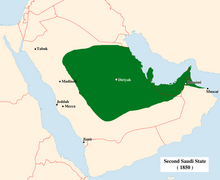
The Second Saudi state 1850
By 1805, the Saudi armies had taken control of Mecca and Medina. The Saudi amir Saud bin Abdulaziz bin Muhammad bin Sauddenounced the Ottoman sultan and called into question the validity of his claim to be caliph and guardian of the sanctuaries of the Hejaz. The Ottoman Empire, suspicious of the ambitious Muhammad Ali of Egypt, instructed him to fight the Wahhabis, as the defeat of either would be beneficial to them. Tensions between Muhammad Ali and his troops also prompted him to send them to Arabia and fight against the Saudis where many were massacred. This led to the Ottoman-Saudi War. The Egyptian forces acting under the Ottoman Empire and led by Ibrahim Pasha, were eventually successful in defeating the Saudis in a campaign starting from 1811. In 1818 they defeated Al Saud, leveling the capital Diriyah, slaughtering its inhabitants, executing the Al-Saud emir and exiling the emirate’s political and religious leadership, and unsuccessfully attempted to stamp out not just the House of Saud but the Wahhabi mission as well. The British empire welcomed Ibrahim Pasha’s Destruction of Diriya with the goal of promoting trade interests in the region. Captain George Forster Sadleir, an officer of the British Army in India was dispatched from Bombay to consult with Ibrahim Pasha in Dariyya.
A second, smaller Saudi state (Emirate of Nejd) lasted from 1819 to 1891. Its borders being within Najd, Wahhabism was protected from further Ottoman or Egyptian campaigns by the Najd’s isolation, lack of valuable resources, and that era’s limited communication and transportation.
By the 1880s, at least among townsmen if not Bedouin, the orthodox monotheistic doctrine of Salafiyya had become the native religious culture of the Najd.
Abdulaziz Ibn Saud

Ibn Saud, the first king of Saudi Arabia
In 1901, Abdulaziz Ibn Saud, a fifth generation descendant of Muhammad ibn Saud, began a military campaign that led to the conquest of much of the Arabian peninsula and the founding of present-day Saudi Arabia, after the collapse of the Ottoman Empire. Under the reign of Abdulaziz, “political considerations trumped religious idealism” favored by pious Wahhabis. His political and military success gave the Wahhabi ulama control over religious institutions with jurisdiction over considerable territory, and in later years Wahhabi ideas formed the basis of the rules and laws concerning social affairs, and shaped the kingdom’s judicial and educational policies. At the same time, Ibn Saud tempered the Wahhabi zeal when it came to realpolitik such as stabilising power in Hijaz and al-Hasa, maintaining a positive relationship with the British government, adopting modern technology, establishing a simple governmental administrative framework, or signing an oil concession with the U.S. The Wahhabi ulama also sided with Ibn Saud over the Ikhwan affirming that “only the ruler could declare a jihad,” upholding his right as sovereign to collect taxes and denied Ikhwan any right to disobey Ibn Saud.
As the realm of Wahhabism expanded under Ibn Saud into Shiite areas (al-Hasa, conquered in 1913) and Hejaz (conquered in 1924–25), radical factions amongst Wahhabis such as the Ikhwan pressed for forced conversion of Shia and an eradication of (what they saw as) idolatry. Ibn Saud sought “a more relaxed approach”. In al-Hasa, efforts to stop the observance of Shia religious holidays and replace teaching and preaching duties of Shia clerics with Wahhabi, lasted only a year. In Mecca and Jeddah (in Hejaz) prohibition of tobacco, alcohol, playing cards and listening to music on the phonograph was looser than in Najd. Over the objections of Wahhabi ulama, Ibn Saud permitted both the driving of automobiles and the attendance of Shia at hajj.
Enforcement of the commanding right and forbidding wrong, such as enforcing prayer observance, Islamic sex-segregation guidelines, etc developed a prominent place during the Third Saudi emirate, and in 1926 a formal committee for enforcement was founded in Mecca.
While Wahhabi warriors swore loyalty to monarchs of Al Saud, there was one major rebellion. King Abdulaziz put down rebelling Ikhwan – nomadic tribesmen turned Wahhabi warriors who opposed his “introducing such innovations as telephones, automobiles, and the telegraph” and his “sending his son to a country of unbelievers (Egypt)”. Britain had warned Abdulaziz when the Ikhwan attacked the British protectorates of Transjordan, Iraq and Kuwait, as a continuation of jihad to expand the Wahhabist realm. Ikhwan were mostly Bedouin tribesmen who believed they were entitled to free-lance Jihad, raiding, etc without permission of the Amir and they had conflicts with both Wahhabi ulema and Saudi rulers. They also objected to Saudi taxations on nomadic tribes. After their raids against Saudi townsmen, Ibn Saud went for a final showdown against the Ikhwan with the backing of the Wahhabi ulema in 1929. The Ikhwan was decisively defeated and sought the backing of foreign rulers of Kuwait and British Empire. In January 1930, the main body of Ikhwansurrendered to the British near the Saudi-Kuwaiti border. The Wahhabi movement was perceived as a movement of settled populations of Arabian Peninsula against the nomadic domination of trade-routes, taxes as well as their jahiliyya customs. Muhammad ibn Abd al-Wahhab had criticized the nomadic tribes and the Wahhabi chroniclers praised Saudi rulers for taming the Bedouins.
Connection with the outside world
Before Abdulaziz, during most of the second half of the 19th century, there was a strong aversion to mixing with “idolaters” (including most of the inhabitants of the Muslim world) in Wahhabi lands. At the very least, voluntary contact was considered sinful by Wahhabi clerics, and if one enjoyed the company of idolaters, and “approved of their religion”, it was considered an act of unbelief. Travel outside the pale of Najd to the Ottoman lands “was tightly controlled, if not prohibited altogether”.
Over the course of its history, however, Wahhabism has become more accommodating towards the outside world. In the late 1800s, Wahhabis found Muslims with similar beliefs – first with Ahl-i Hadith in India, and later with Islamic revivalists in Arab states (one being Mahmud al-Alusi in Baghdad). The revivalists and Wahhabis shared a common interest in Ibn Taymiyya’s thought, the permissibility of ijtihad, and the need to purify worship practices of innovation. In the 1920s, Rashid Rida, a pioneer Salafist whose periodical al-Manar was widely read in the Muslim world, published an “anthology of Wahhabi treatises”, and a work praising the Ibn Saud as “the savior of the Haramayn and a practitioner of authentic Islamic rule”.

The Kingdom of Saudi Arabia after unification in 1932
In a bid “to join the Muslim mainstream and to erase the reputation of extreme sectarianism associated with the Ikhwan”, in 1926 Ibn Saud convened a Muslim congress of representatives of Muslim governments and popular associations. By the early 1950s, the “pressures” on Ibn Saud of controlling the regions of Hejaz and al-Hasa – “outside the Wahhabi heartland” – and of “navigating the currents of regional politics” “punctured the seal” between the Wahhabi heartland and the “land of idolatry” outside.
A major current in regional politics at that time was secular nationalism, which, with Gamal Abdul Nasser, was sweeping the Arab world. To combat it, Wahhabi missionary outreach worked closely with Saudi foreign policy initiatives. In May 1962, a conference in Mecca organized by Saudis discussed ways to combat secularism and socialism. In its wake, the World Muslim League was established. To propagate Islam and “repel inimical trends and dogmas”, the League opened branch offices around the globe. It developed closer association between Wahhabis and leading Salafis, and made common cause with the Islamic revivalist Muslim Brotherhood, Ahl-i Hadith and the Jamaat-i Islami, combating Sufism and “innovative” popular religious practices and rejecting the West and Western “ways which were so deleterious of Muslim piety and values”. Missionaries were sent to West Africa, where the League funded schools, distributed religious literature, and gave scholarships to attend Saudi religious universities. One result was the Izala Society which fought Sufism in Nigeria, Chad, Niger, and Cameroon.
An event that had a great effect on Wahhabism in Saudi Arabia was the “infiltration of the transnationalist revival movement” in the form of thousands of pious, Islamist Arab Muslim Brotherhood refugees from Egypt following Nasser’s clampdown on the Brotherhood (and also from similar nationalist clampdowns in Iraq and Syria), to help staff the new school system of the (largely illiterate) Kingdom.
The Brotherhood’s Islamist ideology differed from the more conservative Wahhabism which preached loyal obedience to the king. The Brotherhood dealt in what one author (Robert Lacey) called “change-promoting concepts” like social justice and anticolonialism, and gave “a radical, but still apparently safe, religious twist” to the Wahhabi values Saudi students “had absorbed in childhood”. With the Brotherhood’s “hands-on, radical Islam”, jihad became a “practical possibility today”, not just part of history.
The Brethren were ordered by the Saudi clergy and government not to attempt to proselytize or otherwise get involved in religious doctrinal matters within the Kingdom, but nonetheless “took control of Saudi Arabia’s intellectual life” by publishing books and participating in discussion circles and salons held by princes. In time they took leading roles in key governmental ministries, and had influence on education curriculum. An Islamic university in Medina created in 1961 to train – mostly non-Saudi – proselytizers to Wahhabism became “a haven” for Muslim Brother refugees from Egypt. The Brothers’ ideas eventually spread throughout the kingdom and had great effect on Wahhabism – although observers differ as to whether this was by “undermining” it or “blending” with it.
Growth
In the 1950s and 1960s within Saudi Arabia, the Wahhabi ulama maintained their hold on religious law courts, and presided over the creation of Islamic universities and a public school system which gave students “a heavy dose of religious instruction”. Outside of Saudi the Wahhabi ulama became “less combative” toward the rest of the Muslim world. In confronting the challenge of the West, Wahhabi doctrine “served well” for many Muslims as a “platform” and “gained converts beyond the peninsula”.
A number of reasons have been given for this success: the growth in popularity and strength of both Arab nationalism (although Wahhabis opposed any form of nationalism as an ideology, Saudis were Arabs, and their enemy the Ottoman caliphate was ethnically Turkish), and Islamic reform (specifically reform by following the example of those first three generations of Muslims known as the Salaf); the destruction of the Ottoman Empire which sponsored their most effective critics; the destruction of another rival, the Khilafa in Hejaz, in 1925.
Not least in importance was the money Saudi Arabia earned from exporting oil.
Petroleum export era
The pumping and export of oil from Saudi Arabia started during World War II, and its earnings helped fund religious activities in the 1950s and 60s. But it was the 1973 oil crisis and quadrupling in the price of oil that both increased the kingdom’s wealth astronomically and enhanced its prestige by demonstrating its international power as a leader of OPEC. By 1980, Saudi Arabia was earning every three days the income from oil it had taken a year to earn before the embargo. Tens of billions of US dollars of this money were spent on books, media, schools, scholarships for students (from primary to post-graduate), fellowships and subsidies to reward journalists, academics and Islamic scholars, the building of hundreds of Islamic centers and universities, and over one thousand schools and one thousand mosques. During this time, Wahhabism attained what Gilles Kepel called a “preeminent position of strength in the global expression of Islam”.
Afghanistan jihad
The “apex of cooperation” between Wahhabis and Muslim revivalist groups was the Afghan jihad.
In December 1979, the Soviet Union invaded Afghanistan. Shortly thereafter, Abdullah Yusuf Azzam, a Muslim Brother cleric with ties to Saudi religious institutions, issued a fatwa declaring defensive jihad in Afghanistan against the atheist Soviet Union, “fard ayn”, a personal (or individual) obligation for all Muslims. The edict was supported by Saudi Arabia’s Grand Mufti (highest religious scholar), Abd al-Aziz ibn Baz, among others.
Between 1982 and 1992 an estimated 35,000 individual Muslim volunteers went to Afghanistan to fight the Soviets and their Afghan regime. Thousands more attended frontier schools teeming with former and future fighters. Somewhere between 12,000 and 25,000 of these volunteers came from Saudi Arabia. Saudi Arabia and the other conservative Gulf monarchies also provided considerable financial support to the jihad – $600 million a year by 1982.
By 1989, Soviet troops had withdrawn and within a few years the pro-Soviet regime in Kabul had collapsed.
This Sunni Islamic religious triumph further stood out in the Muslim world because many Muslim-majority states (and the PLO) were allied with the Soviet Union and did not support the Afghan jihad. But many jihad volunteers (most famously Osama bin Laden) returning home to Saudi Arabia and elsewhere were often radicalized by Islamic militants who were “much more extreme than their Saudi sponsors”.
“Erosion” of Wahhabism
Islamic Revolution in Iran
The February 1979 Islamic Revolution in Iran challenged Saudi Wahhabism in a number of ways on a number of fronts. It was a revolution of Shia, not Sunni, and Wahhabism held that Shia were misguided Muslims. Nonetheless, its massive popularity in Iran and its overthrow of a pro-American secular monarchy generated enormous enthusiasm among pious Sunni, not just Shia Muslims around the world. Its leader (Ruhollah Khomeini) preached that monarchy was against Islam and America was Islam’s enemy, and called for the overthrow of al-Saud family. (In 1987 public address Khomeini declared that “these vile and ungodly Wahhabis are like daggers which have always pierced the heart of the Muslims from the back”, and announced that Mecca was in the hands of “a band of heretics”.) All this spurred Saudi Arabia – a kingdom allied with America – to “redouble their efforts to counter Iran and spread Wahhabism around the world”, and reversed any moves by Saudi leaders to distance itself from Wahhabism or “soften” its ideology.
Grand Mosque seizure
In 1979, 400–500 Islamist insurgents, using smuggled weapons and supplies, took over the Grand mosque in Mecca, called for an overthrow of the monarchy, denounced the Wahhabi ulama as royal puppets, and announced the arrival of the Mahdi of “end time”. The insurgents deviated from Wahhabi doctrine in significant details, but were also associated with leading Wahhabi ulama (Abd al-Aziz ibn Baz knew the insurgent’s leader, Juhayman al-Otaybi). Their seizure of Islam’s holiest site, the taking hostage of hundreds of hajj pilgrims, and the deaths of hundreds of militants, security forces and hostages caught in crossfire during the two-week-long retaking of the mosque, all shocked the Islamic world and did not enhance the prestige of Al Saud as “custodians” of the mosque.
The incident also damaged the prestige of the Wahhabi establishment. Saudi leadership sought and received Wahhabi fatawa to approve the military removal of the insurgents and after that to execute them, but Wahhabi clerics also fell under suspicion for involvement with the insurgents. In part as a consequence, Sahwa clerics influenced by Brethren’s ideas were given freer rein. Their ideology was also thought more likely to compete with the recent Islamic revolutionism/third-worldism of the Iranian Revolution.
Although the insurgents were motivated by religious puritanism, the incident was not followed by a crackdown on other religious purists, but by giving greater power to the ulama and religious conservatives to more strictly enforce Islamic codes in myriad ways – from the banning of women’s images in the media to adding even more hours of Islamic studies in school and giving more power and money to the religious police to enforce conservative rules of behaviour.
1990 Gulf War
In August 1990 Iraq invaded and annexed Kuwait. Concerned that Saddam Hussein might push south and seize its own oil fields, Saudis requested military support from the US and allowed tens of thousands of US troops to be based in the Kingdom to fight Iraq. But what “amounted to seeking infidels’ assistance against a Muslim power” was difficult to justify in terms of Wahhabi doctrine.
Again Saudi authorities sought and received a fatwa from leading Wahhabi ulama supporting their action. The fatwa failed to persuade many conservative Muslims and ulama who strongly opposed US presence, including the Muslim Brotherhood-supported Sahwah “Awakening” movement that began pushing for political change in the kingdom. Outside the kingdom, Islamist revival groups that had long received aid from Saudi and had ties with Wahhabis (Arab jihadists, Pakistani and Afghan Islamists) supported Iraq, not Saudi.
During this time and later, many veterans of Afghan Jihad (such as Osama bin Laden) no longer looked to the Saudi monarch as an emir of Islam, but rather declared the Saudi Kingdom to be an apostate regime. They supported its overthrow, focusing on jihad against the US and (what they believe are) other enemies of Islam. (This movement is known as Salafi-Jihadi or Qutbi.)
After 9/11
Attacking Saudi’s putative ally (killing almost three thousand people and causing at least $10 billion in property and infrastructure damage) was assumed by many, at least outside the kingdom, to be “an expression of Wahhabism” since the al-Qaeda leader Osama bin Laden and most of the hijackers were Saudi nationals. A backlash in the formerly hospitable US against the kingdom focused on its official religion, which some came to consider “a doctrine of terrorism and hate”.}}.
Inside the kingdom, Crown Prince Abdullah addressed the country’s religious, tribal, business and media leadership following the attacks in a series of televised gatherings calling for a strategy to correct what had gone wrong. According to Robert Lacey, the gatherings and later articles and replies by a top cleric, Abdullah Turki, and two top Al Saud princes, Prince Turki Al-Faisal and Prince Talal bin Abdul Aziz, served as an occasion to sort out who had the ultimate power in the kingdom: not the ulama, but rather the Al Saud dynasty. They declared that Muslim rulers were meant to exercise power, while religious scholars were meant to advise.
In 2003–2004, Saudi Arabia saw a wave of al-Qaeda-related suicide bombings, attacks on Non-Muslim foreigners (about 80% of those employed in the Saudi private sector are foreign workers and constitute about 30% of the country’s population), and gun battles between Saudi security forces and militants. One reaction to the attacks was a trimming back of the Wahhabi establishment’s domination of religion and society. “National Dialogues” were held that included “Shiites, Sufis, liberal reformers, and professional women”. In 2009, as part of what some called an effort to “take on the ulama and reform the clerical establishment”, King Abdullah issued a decree that only “officially approved” religious scholars would be allowed to issue fatwas in Saudi Arabia. The king also expanded the Council of Senior Scholars (containing officially approved religious scholars) to include scholars from Sunni schools of Islamic jurisprudence other than the Hanbali madhab – Shafi’i, Hanafi and Maliki schools.
Relations with the Muslim Brotherhood have deteriorated steadily. After 9/11, the then interior minister Prince Nayef blamed the Brotherhood for extremism in the kingdom, and he declared it guilty of “betrayal of pledges and ingratitude” and “the source of all problems in the Islamic world”, after it was elected to power in Egypt. In March 2014 the Saudi government declared the Brotherhood a “terrorist organization”.
In April 2016, Saudi Arabia stripped its religious police, who enforce Islamic law on the society and are known as the Commission for the Promotion of Virtue and Prevention of Vice, from their power to follow, chase, stop, question, verify identification, or arrest any suspected persons when carrying out duties. They were told to report suspicious behaviour to regular police and anti-drug units, who would decide whether to take the matter further.
Muhammad bin Salman
Reformist actions on religious policy taken by Crown Prince Muhammad bin Salman (MbS) in 2017 have led some to question the future of Wahhabi conservatism. In an October 2017 interview with The Guardian newspaper, MbS stated
What happened in the last 30 years is not Saudi Arabia. What happened in the region in the last 30 years is not the Middle East. After the Iranian revolution in 1979, people wanted to copy this model in different countries, one of them is Saudi Arabia. We didn’t know how to deal with it. And the problem spread all over the world. Now is the time to get rid of it.
MbS has ruled in favor of allowing women to drive and enter sport stadiums, eventually reopening cinemas. According to Kamel Daoud, MbS is “above all … putting pressure on the clergy and announcing the review and certification of the great canons of Muslim orthodoxy, including the hadiths, the collection of the Prophet Muhammad’s sayings”.
Memoirs of Mr. Hempher
A widely circulated but discredited apocryphal description of the founding of Wahhabism known as Memoirs of Mr. Hempher, The British Spy to the Middle East (other titles have been used) alleges that a British agent named Hempher was responsible for the creation of Wahhabism. The book has been criticized as “an Anglophobic variation on The Protocols of the Elders of Zion“.
Practices
As a religious revivalist movement that works to bring Muslims back from what it believes are foreign accretions that have corrupted Islam, and believes that Islam is a complete way of life and so has prescriptions for all aspects of life, Wahhabism is quite strict in what it considers Islamic behavior. As a result, it has been described as the “strictest form of Sunni Islam”. On the other hand, critics argue, Wahhabism is not strict, but a distorted version of Islam and not based on traditional Shari’a law, nor is their practise typical or mired in the roots of Islam. Unlike other schools of Sunnism, Wahhabis admonishes to ground Islamic principles solely on the Quran and Hadith, rejecting much material derived within Islamic culture.
This does not mean, however, that all adherents agree on what is required or forbidden, or that rules have not varied by area or changed over time. In Saudi Arabia the strict religious atmosphere of Wahhabi doctrine is visible in the conformity in dress, public deportment, and public prayer, and makes its presence felt by the wide freedom of action of the “religious police”, clerics in mosques, teachers in schools, and judges (who are religious legal scholars) in Saudi courts.
The “boundaries” of Wahhabism have been called “difficult to pinpoint”, but in contemporary usage, the terms Wahhabi and Salafi are often used interchangeably, and they are considered to be movements with different roots that have merged since the 1960s. However, Wahhabism has also been called “a particular orientation within Salafism”, or a conservative, Saudi brand of Salafism.
Commanding right and forbidding wrong
Wahhabism is noted for its policy of “compelling its own followers and other Muslims strictly to observe the religious duties of Islam, such as the five prayers”, and for “enforcement of public morals to a degree not found elsewhere”. Due to the main interest in purification of Islam, the teaching becomes very repressive to the followers.
While other Muslims might urge abstention from alcohol, modest dress, and salat prayer, for Wahhabis prayer “that is punctual, ritually correct, and communally performed not only is urged but publicly required of men.” Not only is wine forbidden, but so are “all intoxicating drinks and other stimulants, including tobacco”. Not only is modest dress prescribed, but the type of clothing that should be worn, especially by women (a black abaya, covering all but the eyes and hands) is specified.
Following the preaching and practice of ibn Abd al-Wahhab that coercion should be used to enforce following of sharia, an official committee has been empowered to “Command the Good and Forbid the Evil” (the so-called “religious police”) in Saudi Arabia – the one country founded with the help of Wahhabi warriors and whose scholars and pious citizens dominate many aspects of the Kingdom’s life. Committee “field officers” enforce strict closing of shops at prayer time, segregation of the sexes, prohibition of the sale and consumption of alcohol, driving of motor vehicles by women, and other social restrictions.
A large number of practices have been reported forbidden by Saudi Wahhabi officials, preachers or religious police. Practices that have been forbidden as Bid’a (innovation) or shirk (polytheism) and sometimes “punished by flogging” during Wahhabi history include performing or listening to music, dancing, fortune telling, amulets, television programs (unless religious), smoking, playing backgammon, chess, or cards, drawing human or animal figures, acting in a play or writing fiction (both are considered forms of lying), dissecting cadavers (even in criminal investigations and for the purposes of medical research), recorded music played over telephones on hold or the sending of flowers to friends or relatives who are in the hospital. Common Muslim practices Wahhabis believe are contrary to Islam include visiting tombs (including the tomb of Muhammad), celebrating mawlid (birthday of the Prophet), the use of ornamentation on or in mosques, all of which is considered orthodoxy in the rest of non-Salafi world.
Wahhabism emphasizes “Thaqafah Islamiyyah” or Islamic culture and the importance of avoiding non-Islamic cultural practices and non-Muslim friendship no matter how innocent these may appear, on the grounds that the Sunna forbids imitating non-Muslims. Foreign practices sometimes punished or sometimes simply condemned by Wahhabi preachers as unIslamic, include celebrating foreign days (such as Valentine’s Day or Mothers Day) shaving, cutting or trimming of beards, giving of flowers,standing up in honor of someone, celebrating birthdays (including the Prophet’s), keeping or petting dogs. Wahhabi scholars have warned against taking non-Muslims as friends, smiling at or wishing them well on their holidays.
Wahhabis are not in unanimous agreement on what is forbidden as sin. Some Wahhabi preachers or activists go further than the official Saudi Arabian Council of Senior Scholars in forbidding (what they believe to be) sin. Juhayman al Utaybi declared football forbidden for a variety of reasons including it is a non-Muslim, foreign practice, because of the revealing uniforms and because of the foreign non-Muslim language used in matches. The Saudi Grand Mufti, on the other hand, rejected such fatwas and called on the religious police to prosecute its author.
Senior Wahhabi leaders in Saudi Arabia have determined that Islam forbids the traveling or working outside the home by a woman without their husband’s permission – permission which may be revoked at any time – on the grounds that the different physiological structures and biological functions of the two sexes mean that each is assigned a distinctive role to play in the family. Sexual intercourse out of wedlock may be punished with flogging, although sex out of wedlock was permissible with a female slave until the practice of slavery was banned in 1962 (Prince Bandar bin Sultan was the product of “a brief encounter” between his father Prince Sultan bin Abdul Aziz – the Saudi defense minister for many years – and “his slave, a black servingwoman”).
Despite this strictness, senior Wahhabi scholars of Islam in the Saudi kingdom have made exceptions in ruling on what is haram. Foreign non-Muslim troops are forbidden in Arabia, except when the king needed them to confront Saddam Hussein in 1990; gender mixing of men and women is forbidden, and fraternization with non-Muslims is discouraged, but not at King Abdullah University of Science and Technology (KAUST). Movie theaters and driving by women are forbidden, except at the ARAMCO compound in eastern Saudi, populated by workers for the company that provides almost all the government’s revenue. The exceptions made at KAUST are also in effect at ARAMCO.
More general rules of what is permissible have changed over time. Abdulaziz Ibn Saud imposed Wahhabi doctrines and practices “in a progressively gentler form” as his early 20th-century conquests expanded his state into urban areas, especially the Hejab. After vigorous debate Wahhabi religious authorities in Saudi Arabia allowed the use of paper money (in 1951), the abolition of slavery (in 1962), education of females (1964), and use of television (1965). Music, the sound of which once might have led to summary execution, is now commonly heard on Saudi radios. Minarets for mosques and use of funeral markers, which were once forbidden, are now allowed. Prayer attendance, which was once enforced by flogging, is no longer.
Appearance
The uniformity of dress among men and women in Saudi Arabia (compared to other Muslim countries in the Middle East) has been called a “striking example of Wahhabism’s outward influence on Saudi society”, and an example of the Wahhabi belief that “outward appearances and expressions are directly connected to one’s inward state.”
A “badge” of a particularly pious Salafi or Wahhabi man is a robe too short to cover the ankle, an untrimmed beard, and no cord (Agal) to hold the head scarf in place. The warriors of the Ikhwan Wahhabi religious militia wore a white turban in place of an agal.
Wahhabiyya mission
Wahhabi mission, or Dawah Wahhabiyya, is the idea of spreading Wahhabism throughout the world. Tens of billions of dollars have been spent by the Saudi government and charities on mosques, schools, education materials, scholarships, throughout the world to promote Islam and the Wahhabi interpretation of it. Tens of thousands of volunteersand several billion dollars also went in support of the jihad against the atheist communist regime governing Afghanistan.
Regions
Wahhabism originated in the Najd region, and its conservative practices have stronger support there than in regions in the kingdom to the east or west of it. Glasse credits the softening of some Wahhabi doctrines and practices on the conquest of the Hejaz region “with its more cosmopolitan traditions and the traffic of pilgrims which the new rulers could not afford to alienate”.
The only other country “whose native population is Wahhabi and that adheres to the Wahhabi creed”, is the small gulf monarchy of Qatar, whose version of Wahhabism is notably less strict. Unlike Saudi Arabia, Qatar made significant changes in the 1990s. Women are now allowed to drive and travel independently; non-Muslims are permitted to consume alcohol and pork. The country sponsors a film festival, has “world-class art museums”, hosts Al Jazeera news service, will hold the 2022 football World Cup, and has no religious force that polices public morality. Qataris attribute its different interpretation of Islam to the absence of an indigenous clerical class and autonomous bureaucracy (religious affairs authority, endowments, Grand Mufti), the fact that Qatari rulers do not derive their legitimacy from such a class.
Contacts with other reform movements
Ahl-i-Hadith
The Najdi movement was part of the overall trends of Islamic Revivalist thoughts of the 18th century. It would be influenced by and impart influence on many other Islamic reform-revivalist movements across the globe. Ahl-i-Hadith movement of subcontinent was a reform-revivalist movement inspired by the thoughts of Shah Waliullah Dehlawi, Shawkani and Syed Ahmed Barelvi. They fully condemn taqlid and advocate for ijtihad based on scriptures. Founded in the mid-19th century in Bhopal, it places great emphasis on hadith studies and condemns imitation to the canonical law schools. They identify with the early school of Ahl al-Hadith. During the late 19th century, Najdi scholars would establish contacts with Ahl-i-Hadith and many Najdi students would study under the scholars of Ahl-i-Hadith, amongst them prominent scholars.
Both the Najdi da’wa and Ahl-i-Hadith shared common opposition to Sufi practices such as visiting shrines, seeking aid from dead awliya (istigatha), etc. Both the movements revived the teachings of the medieval Sunni theologian and jurist, Ibn Taymiyya, whom they considered as “Shaykh al-Islam“. With the resources of Muslim principality of Bhopal at his disposal, Muhaddith Nawab Siddiq Hasan Khan had promoted the Ahl-i-Hadith cause. Suffering from the instabilities of 19th-century Arabia, many Najdi scholars would make their way to India and study under Ahl-i-Hadith patronage. Prominent Najdi scholar Hamad Ibn Atiq would make correspondence with Siddiq Hasan Khan and requesting him to send various classical works, due to scarcity of classical works amomgst the 19th-century Najdi scholars. He would send his eldest son, Sa’d ibn Atiq, to India to study under Siddiq Hasan Khan as well as Sayyid Nazir Hussain for over nine years. Sa’d Ibn Atiq would become a major scholarly authority in the Third Saudi State appointed by Ibn Saud as the qadi of Riyadh as well as the Imam of Grand Mosque of Riyad giving him great influence in education of Wahhabi ulema. Amongst his students was Abd al Aziz Ibn Baz, who was highly influenced by Ahl-i-Hadith teachings. Another son of Sa’d Ibn Atiq as well as other prominent Najdi scholars from Aal Ash-Shaykh would study with the Ahl-i-Hadith during the 19th and early 20th centuries.
In 1931, an Indian Ahl-i-Hadith, Shaykh Ahmad ibn Muhammad Al Dehlawi, founded the Dar-ul-Hadith institute, which would later be attached to the Islamic University of Medina. It would encourage the study of Hadith across Hejaz and also pave the way for Albani and his Muhaddith factions in the 1960s, with the support of Ibn Baz, culminating in the consolidation of the contemporary Salafi Manhaj. Ibn Baz, who was highly influenced by Ahl-i-Hadith, shared the passion for revival of Hadith sciences. After establishment of third Saudi state and oil boom, the Saudi Sheikhs would repay their debts by supporting Ahl-i-Hadith through finances as well as mass publications. Mufti Muhammad ibn Ibrahim’s teachers also included students of Ahl-i-Hadith scholars and he too made efforts to support the Ahl-i-Hadith cause. After Mufti Muhammad, Ibn Baz as the Grand Mufti of Saudi Arabia would highly support the movement. Prominent Ahl-i-Hadith scholars such as Shaykh Abdul Ghaffar Khan would be appointed to teach in Saudi Universities. His famous students included Safar al Hawali and Muqbil bin Hadi al Wadi. With Saudi patronage, a vast Ahl-i-Hadith network was developed. Ahl-i-Hadith seminaries underwent a phenomenal increase from 134 in 1988 to 310 in 2000 (131 percent) and currently number around 500. According to Pakistani estimates 34,000 students studied under Ahl-i-Hadith madrassas in 2006 compared to 18,800 in 1996 (as opposed to 200,000 Deobandi students and 190,000 Barelvi students in 2006). Ahl-i-Hadith has had remarkable success in converting Muslims from other schools of thought.
Ottoman Salafiyya
During the early 19th century, Egyptian Muslim scholar Abd al Rahman al Jabarti had defended the Najdi da’wa. From the 19th century, prominent Ottoman Salafiyya reformers would maintain correspondence with Wahhabis and defend them against Sufi critiques. These included Shihab al Din al Alusi, Abd al Hamid al Zahrawi, Abd al Qadir al Jabarti, Abd al Hakim al Afghani, Nu’man Khayr al-Din Al-Alusi, Mahmud Shukri Al Alusi and his disciple Muhammad Bahjat Al-Athari, Jamal al Din al Qasimi, Tahir al Jaza’iri, Muhibb al Din al Khatib, Muhammad Hamid al Fiqi and most notably, Muhammad Rasheed Rida who was considered as the “leader of Salafis”. All these scholars would correspond with Najdi as well as Ahl-i-Hadith scholars and champion the reformist thought. They shared a common interest in opposing various Sufi practices, denouncing blind following and reviving correct theology and Hadith sciences. They also opened Zahiriyya library, Salafiyya library, Al Manar Library, etc., propagating Salafi thought as well as promoting scholars like Ibn Taymiyya and Ibn Hazm. Rashid Rida would succeed in his efforts to rehabilitate Wahhabis in the Islamic World and would attain the friendship of many Najdi scholars. With the support of the Third Saudi State by the 1920s, a concept of “Salafiyya” emerged on a global scale claiming heritage to the thought of 18th-century Islamic reform movements and the pious predecessors(Salaf). Many of Rida’s disciples would be assigned to various posts in Saudi Arabia, some of whom stayed in Saudi Arabia. Others would spread the Salafi da’wa to their respective countries. Prominent amongst these disciples were the Syrian Muhammad Bahjat al-Bitar (1894–1976), Egyptian Muhammad Hamid al-Fiqi (1892–1959) and the Moroccan Taqi al-Din al-Hilali(1894–1987).
Syrian scholar Muhammad Nasiruddin al-Albani, an avid reader of Al-Manar and a student of Muhammad Bahjat al Bitar (disciple of Rida and Al-Qasimi) would fully adhere to Salafiyya methodology. Encouraged by their call for hadith re-evaluation and revival, he would invest himself in Hadith studies, becoming a renowned Muhaddith. He followed in the footsteps of the ancient Ahlul Hadith school and took the call of Ahl-i-Hadith. In the 1960s, he would teach in Saudi Arabia making a great amount of influence. By the 1970s, Albani’s thoughts would gain popularity and the notion of “Salafi Manhaj” was consolidated.
Views
| hidePart of a series on Islam Aqidah |
|---|
 |
| Including: 1Al-Ahbash; Barelvis 2Deobandi 3Salafis (Ahl-i Hadith & Wahhabis) 4Sevener-Qarmatians, Assassins & Druzes 5Alawites, Qizilbash & Bektashism; 6Jahmīyya 7Ajardi, Azariqa, Bayhasiyya, Najdat & Sūfrī8Nukkari; 9Bektashis & Qalandaris; Mevlevis,Süleymancıs & various Ṭarīqah 10Bahshamiyya, Bishriyya & Ikhshîdiyya  Islam portal |
Adherents to the Wahhabi movement identify as Sunni Muslims. The primary Wahhabi doctrine is affirmation of the uniqueness and unity of God (Tawhid), and opposition to shirk (violation of tawhid – “the one unforgivable sin”, according to Ibn Abd Al-Wahhab). They call for adherence to the beliefs and practices of the salaf (exemplary early Muslims). They strongly oppose what they consider to be heterodox doctrines, particularly those held by the vast majority of Sunnis and Shiites, and practices such as the veneration of Prophets and saints in the Islamic tradition. They emphasize reliance on the literal meaning of the Quran and hadith, rejecting rationalistic theology (kalam). Wahhabism has been associated with the practice of takfir (labeling Muslims who disagree with their doctrines as apostates). Adherents of Wahhabism are favourable to derivation of new legal rulings (ijtihad) so long as it is true to the essence of the Quran, Sunnah and understanding of the salaf, and they do not regard this as bid’ah (innovation).
Theology
In theology Wahhabism is closely aligned with the Athari (literal) school, which represents the prevalent theological position of the Hanbali school of law. Athari theology is characterized by reliance on the zahir (apparent or literal) meaning of the Quran and hadith, and opposition to the rational argumentation in matters of belief favored by Ash’ari and Maturidi theology. However, Wahhabism diverges in some points of theology from other Athari movements. These include a zealous tendency toward takfir, which bears a resemblance to the Kharijites. Another distinctive feature is a strong opposition to mysticism. Although it is typically attributed to the influence of Ibn Taymiyyah, Jeffry Halverson argues that Ibn Taymiyyah only opposed what he saw as Sufi excesses and never mysticism in itself, being himself a member of the Qadiriyyah Sufi order. DeLong-Bas writes that Ibn Abd al-Wahhab did not denounce Sufism or Sufis as a group, but rather attacked specific practices which he saw as inconsistent with the Quran and hadith.
Ibn Abd al-Wahhab considered some beliefs and practices of the Shia to violate the doctrine of monotheism. According to DeLong-Bas, in his polemic against the “extremist Rafidah sect of Shiis”, he criticized them for assigning greater authority to their current leaders than to Muhammad in interpreting the Quran and sharia, and for denying the validity of the consensus of the early Muslim community. In his treatise “Risalah fi al-radd ala al-Rafidah” (Treatise/Letter on the Denial/Rejection Pertaining to the Rafidah), Ibn Abd al-Wahhab addressed thirty-two topics on points of both theology and law refuting the Raafida. In doing so, Ibn Abdul Wahhab spoke as a scholar who had studied Shi’i scholarly works, outlining a broad and systematic perspective of the Shi’i worldview and theology. He also believed that the Shia doctrine of infallibility of the imams constituted associationism with God. However, at no point did Ibn Abdul Wahhab suggest that violence of any sort should be used against the Rafidah or Shi’is. Instead, Ibn Abd al-Wahhab ordered his followers to peacefully clarify their own legal teachings. He instructed that this procedure of education and debate should be carried out with the support of truthful ulama, hadith transmitters, and righteous people employing logic, rhetoric, examination of the primary texts and scholarly debates.
In Ibn Abd al-Wahhab’s major work, a small book called Kitab al-Tawhid, he states that worship in Islam is limited to conventional acts of worship such as the five daily prayers (salat); fasting for Ramadan (Sawm); Dua (supplication); Istia’dha (seeking protection or refuge); Ist’ana (seeking help), and Istigatha to Allah (seeking benefits and calling upon Allah alone). Worship beyond this – making du’a or tawassul – are acts of shirk and in violation of the tenets of tawhid (monotheism).
The essence of Ibn Abd al-Wahhab’s justification for fighting his opponents in Arabia can be summed up as his belief that the original pagans the Prophet Muhammad fought “affirmed that God is the creator, the sustainer and the master of all affairs; they gave alms, they performed pilgrimage and they avoided forbidden things from fear of God”. What made them pagans whose blood could be shed and wealth plundered was that “they sacrificed animals to other beings; they sought the help of other beings; they swore vows by other beings.” Someone who does such things even if their lives are otherwise exemplary is not a Muslim but an unbeliever (as Ibn Abd al-Wahhab believed). Once such people have received the call to “true Islam”, understood it and then rejected it, their blood and treasure are forfeit.
This disagreement between Salafis and other Sunnis over the definition of worship and monotheism has remained much the same since 1740, according to David Commins.
According to another source, defining aspects of Wahhabism include a very literal interpretation of the Quran and Sunnah and a tendency to reinforce local practices of the Najd.
Whether the teachings of Muhammad ibn Abd al-Wahhab included the need for social renewal and “plans for socio-religious reform of society” in the Arabian Peninsula, rather than simply a return to “ritual correctness and moral purity”, is disputed.
On Taqlid and Ijtihad
The Wahhabi ulema upheld the right of qualified scholars to perform Ijtihad on legal questions and condemned Taqleed of Mujtahids. This stance pitted them against the Ottoman Sufi clergy who shunned Ijtihad and obligated Taqleed. Ottoman Salafiyya reformers of 19th and 20th centuries would defend the Wahhabis on the Ijtihad issue as well as join forces with Wahhabis to condemn various Sufi practices and orders(tariqats) which they considered to be reprehensible Bid’ah(innovation). Prominent amongst those Salafi-Ottoman scholars who backed Wahhabism included Khayr al-Din al-Alusi, Tahir al-Jaza’iri, Rashid Rida, Jamal al-Din al-Qasimi, Mahmud Shukri Al-Alusi, etc.
The earliest substantial Najdi treatise on Ijtihad was written by the scholar Ibn Mu’ammar (d. 1810), a student of Ibn Abd al-Wahhab and a Qadi of First Saudi state. In his treatise “Risalat al-Ijtihad wal Taqlid“. Ibn Muammar distinguished between two ranks of Mujtahids: independent Mujtahid and Mujtahid al-Muqayyid bound to the Imams. According to Ibn Mu’ammar, Taqlid is permissible for laymen and scholar without sufficient knowledge, but forbidden for those who can comprehend the bases of the law. He also criticized strict adherence to a madhab.
The Wahhabi scholars also advocated for a principle in Islamic legal theory often referred to as “the rule against Ijtihad reversal”. This principle allows overturning a scholar’s fatwa(legal judgement) when he bases it on personal Ijtihad(personal legal reasoning), rather than a clear textual source from Qur’an and Hadith. In effect, this allowed the Wahhabi qadis to remain autonomous. Opponents of Wahhabi movement harshly rebuked them for advocating Ijtihad and not recognising the finality of the four canonical mad’habs(law schools).
Jurisprudence (fiqh)
Of the four major sources in Sunni fiqh – the Quran, the Sunna, consensus (ijma), and analogical reasoning (qiyas) – Ibn Abd al-Wahhab’s writings emphasized the Quran and Sunna. He used ijma only “in conjunction with its corroboration of the Quran and hadith” (and giving preference to the ijma of Muhammad’s companions rather than the ijma of legal specialists after his time), and qiyas only in cases of extreme necessity. He rejected deference to past juridical opinion (taqlid) in favor of independent reasoning (ijtihad), and opposed using local customs. He urged his followers to “return to the primary sources” of Islam in order “to determine how the Quran and Muhammad dealt with specific situations” without considering interpretations of previous Islamic scholarship, when using ijtihad. According to Edward Mortimer, it was imitation of past judicial opinion in the face of clear contradictory evidence from hadith or Qur’anic text that Ibn Abd al-Wahhab condemned. Natana DeLong-Bas writes that the Wahhabi tendency to consider failure to abide by Islamic law as equivalent to apostasy was based on the ideology of Ibn Taymiyya rather than Ibn Abd al-Wahhab’s preaching and emerged after the latter’s death.
According to an expert on law in Saudi Arabia (Frank Vogel), Ibn Abd al-Wahhab himself “produced no unprecedented opinions”. The “Wahhabis’ bitter differences with other Muslims were not over fiqh rules at all, but over aqida, or theological positions”. Scholar David Cummings also states that early disputes with other Muslims did not center on fiqh, and that the belief that the distinctive character of Wahhabism stems from Hanbali legal thought is a “myth”.
Some scholars are ambivalent as to whether Wahhabis belong to the Hanbali legal school. The Encyclopedia of Islam and the Muslim World maintains Wahhabis “rejected all jurisprudence that in their opinion did not adhere strictly to the letter of the Qur’an and the hadith”. Cyril Glasse’s New Encyclopedia of Islam states that “strictly speaking”, Wahhabis “do not see themselves as belonging to any school”, and that in doing so they correspond to the ideal aimed at by Ibn Hanbal, and thus they can be said to be of his ‘school’. According to DeLong-Bas, Ibn Abd al-Wahhab never directly claimed to be a Hanbali jurist, warned his followers about the dangers of adhering unquestionably to fiqh, and did not consider “the opinion of any law school to be binding”. He did, however, follow the Hanbali methodology of judging everything not explicitly forbidden to be permissible, avoiding the use of analogical reasoning, and taking public interest and justice into consideration.
On Social Reforms
Muhammad ibn Abd al-Wahhab concerned himself with the social reformation of his people. In line with his methodology, Ibn Abd al-Wahhab denounced the practice of instant triple talaq, counting it as only a single talaq(regardless of the number of pronouncements). The outlawing of triple talaq has been considered to be one of the most significant reforms in the Islamic World in the 20th and 21st centuries. As an 18th-century reformer, Muhammad ibn Abd al Wahhab advocated for Ijtihad of qualified scholars in accordance with the teachings of Qur’an and Hadeeth. His thoughts reflected the major trends apparent in the 18th-century Islamic reform movements. Numerous significant socio-economic reforms would be advocated by the Imam during his lifetime. After his death, his followers continued his legacy. However, the destruction of the First Saudi State after Wahhabi Wars of 1818 and subsequent persecution of Salafis would result in a halt to the social reforms implemented by the Salafi ulema and suspicions towards the outside world would linger throughout the 19th century.
Starting from the late 19th century and emergence of sweeping reform currents of Salafiyya across the world, the Salafis of Najd too would undergo resurgence. After the establishment of The Third Saudi State and Unification of Saudi Arabia, a Salafiyya Global movement would crystallise with the backing of a state. Ibn Saud’s reforms would get criticism from zealots amongst the Wahhabi clerics reminiscent of the 19th-century harshness. However, other ulema would allow them, eventually paving way for gradual reforms in KSA. Thus new education policy would be approved that would teach foreign languages, sciences, geography, etc. Over the objections of Ikhwan, the Wahhabi ulema would permit the introduction of telegraph and other wireless communication systems. Soon after, oil industries would be developed with the discovery of petroleum. Influential clerics such as Mufti Muhammad ibn Ibrahim Aal ash-Shaykh would endorse female education.
Politics
According to ibn Abdal-Wahhab there are three objectives for Islamic government and society: “to believe in Allah, enjoin good behavior, and forbid wrongdoing”. This doctrine has been sustained in missionary literature, sermons, fatwa rulings, and explications of religious doctrine by Wahhabis since the death of ibn Abdal-Wahhab. Ibn Abd al-Wahhab saw a role for the imam, “responsible for religious matters”, and the amir, “in charge of political and military issues”. (In Saudi history the imam has not been a religious preacher or scholar, but Muhammad ibn Saud and subsequent Saudi rulers.)
He also taught that the Muslim ruler is owed unquestioned allegiance as a religious obligation from his people so long as he leads the community according to the laws of God. A Muslim must present a bayah, or oath of allegiance, to a Muslim ruler during his lifetime to ensure his redemption after death. Any counsel given to a ruler from community leaders or ulama should be private, not through public acts such as petitions, demonstrations, etc. (This strict obedience can become problematic if a dynastic dispute arises and someone rebelling against the ruler succeeds and becomes the ruler, as happened in the late 19th century at the end of the second al-Saud state. Is the successful rebel a ruler to be obeyed, or a usurper?)
While this gives the king wide power, respecting shari’a does impose limits, such as giving qadi (Islamic judges) independence. This means not interfering in their deliberations, but also not codifying laws, following precedents or establishing a uniform system of law courts – both of which violate the qadi’s independence.
Wahhabis have traditionally given their allegiance to the House of Saud, but a movement of “Salafi jihadis” has developed among those who believe Al Saud has abandoned the laws of God. According to Zubair Qamar, while the “standard view” is that “Wahhabis are apolitical and do not oppose the State”, there is another “strain” of Wahhabism that “found prominence among a group of Wahhabis after the fall of the second Saudi State in the 1800s”, and post 9/11 is associated with Jordanian/Palestinian scholar Abu Muhammad al-Maqdisi and “Wahhabi scholars of the ‘Shu’aybi’ school”.
Wahhabis share the belief of Islamists such as the Muslim Brotherhood in Islamic dominion over politics and government and the importance of dawah (proselytizing or preaching of Islam) not just towards non-Muslims but towards erroring Muslims. Ibn Abdul Wahhab’s original pact promised whoever championed his message, ‘will, by means of it, rule and lands and men’.”}}
Notable leaders
There has traditionally been a recognized head of the Wahhabi “religious estate”, often a member of Al ash-Sheikh (a descendant of Muhammad ibn Abd al-Wahhab) or related to another religious head. For example, Abd al-Latif was the son of Abd al-Rahman ibn Hasan.
- Muhammad ibn Abd al-Wahhab (1703–1792) was the founder of the Wahhabi movement.
- Abd Allah ibn Muhammad ibn Muhammad ibn Abd al-Wahhab (1752–1826) was the head of Wahhabism after his father retired from public life in 1773. After the fall of the first Saudi emirate, Abd Allah went into exile in Cairo where he died.
- Sulayman ibn Abd Allah (1780–1818) was a grandson of Muhammad ibn Abd al-Wahhab and author of an influential treatise that restricted travel to and residing in land of idolaters.
- Abd al-Rahman ibn Hasan (1780–1869) was head of the religious estate in the second Saudi emirate.
- Abd al-Latif ibn Abd al-Rahman (1810–1876) Head of religious estate in 1860 and early 1870s.
- Abd Allah ibn Abd al-Latif Al ash-Sheikh (1848–1921) was the head of religious estate during period of Rashidi rule and the early years of King Abd al-Aziz ibn Saud.
- Muhammad ibn Ibrahim Al ash-Sheikh (1893–1969) was the head of Wahhabism in the mid-twentieth century. He has been said to have “dominated the Wahhabi religious estate and enjoyed unrivaled religious authority”.
- Ghaliyya al-Wahhabiyya was a female military leader who defended Mecca against recapture by Ottoman forces.
In more recent times, two Wahhabi clerics have risen to prominence with no relation to ibn Abd al-Wahhab.
- Abdul Aziz bin Baz (1910–1999) has been called “the most prominent proponent” of Wahhabism during his time.
- Muhammad ibn al-Uthaymeen (1925–2001) is another “giant”. According to David Dean Commins, no one “has emerged” with the same “degree of authority in the Saudi religious establishment” since their deaths.
International influence and propagation
Explanation for influence
Khaled Abou El Fadl attributed the appeal of Wahhabism to some Muslims as stemming from
- Arab nationalism, which followed the Wahhabi attack on the Ottoman Empire
- Reformism, which followed a return to Salaf (as-Salaf aṣ-Ṣāliḥ);
- Destruction of the Hejaz Khilafa in 1925;
- Control of Mecca and Medina, which gave Wahhabis great influence on Muslim culture and thinking;
- Oil, which after 1975 allowed Wahhabis to promote their interpretations of Islam using billions from oil export revenue.
Scholar Gilles Kepel, agrees that the tripling in the price of oil in the mid-1970s and the progressive takeover of Saudi Aramco in the 1974–1980 period, provided the source of much influence of Wahhabism in the Islamic World.
… the financial clout of Saudi Arabia had been amply demonstrated during the oil embargo against the United States, following the Arab-Israeli war of 1973. This show of international power, along with the nation’s astronomical increase in wealth, allowed Saudi Arabia’s puritanical, conservative Wahhabite faction to attain a preeminent position of strength in the global expression of Islam. Saudi Arabia’s impact on Muslims throughout the world was less visible than that of Khomeini’s Iran, but the effect was deeper and more enduring … it reorganized the religious landscape by promoting those associations and ulamas who followed its lead, and then, by injecting substantial amounts of money into Islamic interests of all sorts, it won over many more converts. Above all, the Saudis raised a new standard – the virtuous Islamic civilization – as foil for the corrupting influence of the West.
Funding factor
Estimates of Saudi spending on religious causes abroad include “upward of $100 billion”; $2–3 billion per year since 1975 (compared to the annual Soviet propaganda budget of $1 billion/year); and “at least $87 billion” from 1987 to 2007.
Its largesse funded an estimated “90% of the expenses of the entire faith”, throughout the Muslim World, according to journalist Dawood al-Shirian. It extended to young and old, from children’s madrasas to high-level scholarship. “Books, scholarships, fellowships, mosques” (for example, “more than 1,500 mosques were built from Saudi public funds over the last 50 years”) were paid for. It rewarded journalists and academics, who followed it and built satellite campuses around Egypt for Al Azhar, the oldest and most influential Islamic university. Yahya Birt counts spending on “1,500 mosques, 210 Islamic centres and dozens of Muslim academies and schools”.
This financial aid has done much to overwhelm less strict local interpretations of Islam, according to observers like Dawood al-Shirian and Lee Kuan Yew, and has caused the Saudi interpretation (sometimes called “petro-Islam”) to be perceived as the correct interpretation – or the “gold standard” of Islam – in many Muslims’ minds.
Militant and political Islam
According to counter-terrorism scholar Thomas F. Lynch III, Sunni extremists perpetrated about 700 terror attacks killing roughly 7,000 people from 1981 to 2006. What connection, if any, there is between Wahhabism and the Jihadi Salafis such as Al-Qaeda who carried out these attacks, is disputed.
Natana De Long-Bas, senior research assistant at the Prince Alwaleed Center for Muslim-Christian Understanding at Georgetown University, argues:
The militant Islam of Osama bin Laden did not have its origins in the teachings of Ibn Abd-al-Wahhab and was not representative of Wahhabi Islam as it is practiced in contemporary Saudi Arabia, yet for the media it came to define Wahhabi Islam during the later years of bin Laden’s lifetime. However “unrepresentative” bin Laden’s global jihad was of Islam in general and Wahhabi Islam in particular, its prominence in headline news took Wahhabi Islam across the spectrum from revival and reform to global jihad.
Noah Feldman distinguishes between what he calls the “deeply conservative” Wahhabis and what he calls the “followers of political Islam in the 1980s and 1990s”, such as Egyptian Islamic Jihad and later Al Qaeda leader Ayman al-Zawahiri. While Saudi Wahhabis were “the largest funders of local Muslim Brotherhood chapters and other hard-line Islamists” during this time, they opposed jihadi resistance to Muslim governments and assassination of Muslim leaders because of their belief that “the decision to wage jihad lay with the ruler, not the individual believer”.
Karen Armstrong states that Osama bin Laden, like most extremists, followed the ideology of Sayyid Qutb, not “Wahhabism”.
More recently the self-declared “Islamic State” in Iraq and Syria headed by Abu Bakr al-Baghdadi has been described as both more violent than al-Qaeda and more closely aligned with Wahhabism.
For their guiding principles, the leaders of the Islamic State, also known as ISIS or ISIL, are open and clear about their almost exclusive commitment to the Wahhabi movement of Sunni Islam. The group circulates images of Wahhabi religious textbooks from Saudi Arabia in the schools it controls. Videos from the group’s territory have shown Wahhabi texts plastered on the sides of an official missionary van.
According to scholar Bernard Haykel, “for Al Qaeda, violence is a means to an ends; for ISIS, it is an end in itself.” Wahhabism is the Islamic State’s “closest religious cognate”. ISIS borrowed two elements of Qutbism and 20th-century Islamism into its Wahhabi tradition. While Wahhabism shuns violent rebellion against earthly rulers, ISIS embraces political call to revolutions. While historically Wahhabis were not champions of a Caliphate, ISIS borrowed the idea of restoration of a global Caliphate.
Although the religious character of ISIS is mostly Wahhabi, it departs from Wahhabi tradition in four critical aspects: dynastic alliance, call to establish a global caliphate, sheer violence, and apocalyptism.
ISIS did not follow the pattern of the first three Saudi-Wahhabi states in allying the religious mission of Wahhabism with the Al Saud family, rather they consider them apostates. The call for a global caliphate is another departure from Wahhabism. The caliphate, understood in Islamic law as the ideal Islamic polity uniting all Muslim territories, does not figure much in traditional Wahhabi writings. Ironically, Wahhabism emerged as an anti-caliphate movement.
Although violence was not absent in the First Saudi State, Islamic State’s gut-wrenching displays of beheading, immolation, and other forms of extreme violence aimed at inspiring fear are no throwback to Wahhabi practices. They were introduced by Abu Musab Al-Zarqawi, former leader of Al-Qaeda in Iraq, who took inspiration from the Egyptian Jihadi scholar, Abu Abdallah Al Muhajir. It is the latter’s legal manual on violence, popularly known as Fiqh al-dima (The Jurisprudence of Blood), that is the Islamic State’s standard reference for justifying its extraordinary acts of violence.
The Islamic State’s apocalyptic dimension also lacks a mainstream Wahhabi precedent.
Criticism and Support
Criticism by other Muslims
Among the criticism, or comments made by critics, of the Wahhabi movement are:
- That it is not so much strict and uncompromising as aberrant, going beyond the bounds of Islam in its restricted definition of tawhid (monotheism), and much too willing to commit takfir (declare non-Muslim and subject to execution) Muslims it found in violation of the doctrines of Wahhabism (in the second Wahhabi-Saudi jihad/conquest of the Arabian peninsula, an estimated 400,000 were killed or wounded according to some estimates);
- That Muhammad bin Saud’s agreement to wage jihad to spread Ibn Abdul Wahhab’s teachings had more to do with traditional Najd practice of raiding – “instinctive fight for survival and appetite for lucre” – than with religion;
- That its rejection of the “orthodox” belief in saints, which had become a cardinal doctrine in Sunni Islam very early on, represents a departure from something which has been an “integral part of Islam … for over a millennium.” In this connection, mainstream Sunni scholars also critique the Wahhabi citing of Ibn Taymiyyah as an authority when Ibn Taymiyyah himself adhered to the belief in the existence of saints;
- That its use of Ibn Hanbal, Ibn al-Qayyim, and even Ibn Taymiyyah’s name to support its stance is inappropriate, as it is historically known that all three of these men revered many aspects of Sufism, save that the latter two critiqued certain practices among the Sufis of their time. Those who criticize this aspect of Wahhabism often refer to the group’s use of Ibn Hanbal’s name to be a particularly egregious error, arguing that the jurist’s love for the relics of Muhammad, for the intercession of the Prophet, and for the Sufis of his time is well established in Islamic tradition.
Initial opposition
It has been reported that Ibn Abdul Wahhab’s father, was critical of his son. The dispute arose when Ibn Abdul Wahhab began his public dawa activities in Huraymila. However, none of the sources state the exact nature of this disagreement. Salafi scholar Ibn Uthaymin notes that it probably was not concerning an issue of aqeedah (beliefs) as Abdul Wahhab, “did not lend any support to the saint-cults and other false practices”. It is speculated that they disputed over payment of judges in solving disputes and in the manner of giving dawa, spreading Islamic teachings. Until his father’s death in 1153 A.H Muhammad ibn Abdul Wahhab was not overly active and public in his dawah efforts.
Ibn Abd al-Wahhab’s brother wrote a book in refutation of his brother’s new teachings, called: “The Final Word from the Qur’an, the Hadith, and the Sayings of the Scholars Concerning the School of Ibn ‘Abd al-Wahhab”, also known as: “Al-Sawa`iq al-Ilahiyya fi Madhhab al-Wahhabiyya” (“The Divine Thunderbolts Concerning the Wahhabi School”).It has been reported that his brother repented and eventually returned to his call.
In “The Refutation of Wahhabism in Arabic Sources, 1745–1932”, Hamadi Redissi provides original references to the description of Wahhabis as a divisive sect (firqa) and outliers (Kharijites) in communications between Ottomans and Egyptian Khedive Muhammad Ali. Redissi details refutations of Wahhabis by scholars (muftis); among them Ahmed Barakat Tandatawin, who in 1743 describes Wahhabism as ignorance (Jahala).
Sunni opposition
Wahhabism has been vehemently criticized by many mainstream Sunni Muslims and continues to be condemned by prominent traditional Sunni scholars in the strongest terms as a “new faction, a vile sect”.
Regarding Wahhabism, Azharite Sunni scholar and intellectual Muhammad Abu Zahra said:
“The Wahhabis exaggerated Ibn Taymiyya’s positions … The Wahhabis did not restrain themselves to proselytism only, but resorted to warmongering against whoever disagreed with them on the grounds that they were fighting innovation (bid`a), and innovations are an evil that must be fought … Whenever they were able to seize a town or city they would come to the tombs and turn them into ruins and destruction … and they would destroy whatever mosques were with the tombs also … And when the ruler of the Hijaz regions caved in to them they destroyed all the graves of the Companions and razed them to the ground … More than that, they consider what others than themselves do in the way of erecting tombs and circumambulating them, as near to idolatry … In this respect they are near the Khawarij who used to declare those who dissented with them apostate and fight them as we already mentioned.”
The Ash’arite Sunni scholars for centuries had rejected Ibn Taymiyah’s ideas; however, Wahhabism has made this controversial scholar its central figure.
In the 18th century, the Hanafi scholar Ibn Abidin declared the Wahhabi movement of Muhammad ibn Abd al-Wahhab to be a modern-day manifestation of the Kharijites.Another important early rebuttal of Wahhabism came from the Sunni jurist Ibn Jirjis, who argued that supplicating the saints is permitted to whomever “declares that there is no god but God and prays toward Mecca” for, according to him, supplicating the saints is not a form of worship but merely calling out to them, and that worship at graves is not idolatry unless the supplicant believes that buried saints have the power to determine the course of events. These arguments were specifically rejected as heretical by the Wahhabi leader at the time.
Morocco
The influential Sunni jurist and son of the renowned Moroccan scholar Abdullah al-Ghumari, Abu’l-Fayd Ahmad, staunchly condemned Wahhabism and attacked it for straying away from classical tradition, stating: “And nothing has emerged … to bring about earthquakes and discord in the religion like Muhammad ibn Abd al-Wahhab, who was astray and led others astray. Hence he was the Devil’s Horn foretold by the Messenger (upon him be blessings and peace), and he abstained from offering prayer for Najd because of him, and because of the dissensions which would flow from his demonic preaching.”
Kuwait
The prominent Kuwaiti Sunni Shafi’i jurist Yusuf ibn al-Sayyid Hashim al-Rifa`i (1932–1999) remained a severe critic of Wahhabism throughout his scholarly life, and penned a famous fifty-seven-point critique of the movement, titled Advice to the Scholars of Najd. He criticized the followers of the movement for allegedly labeling all other Sunnis “pagans”, “innovators” and “deviants”.
Turkey
The leader of the Gulen movement movement Fethullah Gülen accuses Arabs]] of conspiring against the Ottoman state as well as reducing Islam strictly to Wahhabism and Arab norms.
Malaysia
Malaysia’s largest Islamic body, the National Fatwa Council, has described Wahhabism as being against Sunni teachings, Dr Abdul Shukor Husin, chairman of the National Fatwa Council, was quoted as saying that Wahhabis “view every practice that was not performed by Prophet Muhammad as bid’ah, a departure from Islam, not in accordance with the sunnah.” However, the fatwa by the National Fatwa Council has been criticised by the permanent chairman of the ulama wing of PAS, Dr Hamdan Muhammad, who was quoted as saying that the state authority was hasty in issuing its decree.
South Asia
Opposition against wahabbism started in South Asia in 19th century which was led by prominent Islamic scholers of the time most notable of them was Maulana Fazl-e-Haq Khairabadi. By the late 19th century it was led by Maulana Ahmed Raza Khan, whose extensive written refutation of wahabbism along with active opposition of wahabbism by his disciples and other sunni ulama (Islamic scholars) became a movement. The movement was letter known as Barelvi movement. South Asia’s Barelvi movement rejects Wahhabi beliefs. According to Barelvi scholars, Wahhabis preach violence as opposed to Barelvis who promote peace. In 2016 Barelvis banned Wahhabis from their mosques nationwide. The founder of the movement Ahmed Raza Khan said Wahhabis are not Muslims, and any Muslim who has difficulty understanding this, has also left Islam.
Somalia
The Somalia based paramilitary group Ahlu Sunna Waljama’a actively battles Salafi-Jihadi militants to prevent imposition of Wahhabi ideology.
Lebanon
The transnational Lebanon Al-Ahbash movement uses takfir against Wahhabi and Salafi leaders. The head of Al-Ahbash, Abdullah al-Harari says Wahhabis offer anthropomorphic descriptions of God thereby imitate polytheists.
United States
The Sufi Islamic Supreme Council of America founded by the Naqshbandi Sufi Shaykh Hisham Kabbani classify Wahhabism as being extremist and heretical based on Wahhabism’s role as a terrorist ideology and labelling of other Muslims, especially Sufis as polytheists, a practice known as takfir.
2016 joint fatwa in Chechnya
In late 2016, at a conference of over a hundred Sunni scholars in Chechnya, Al-Azhar’s current dean, Ahmed el-Tayeb was said to have taken an uncompromising stand against Wahhabism by defining orthodox Sunnism as “the Ash’arites and Muturidis (adherents of the theological systems of Imam Abu Mansur al-Maturidi and Imam Abul Hasan al-Ash’ari) … followers of any of the four schools of thought (Hanafi, Shafi’i, Maliki or Hanbali) and … also the followers of the Sufism of Imam Junaid al-Baghdadi in doctrines, manners and purification.” Having said that, Sheikh Ahmad al-Tayeb allegedly excluded the “Salafists” from the term of Ahluls Sunna (Sunnis) stating that Salafists – also known as Wahhabis – are not from among the Sunnis.
Non-religious motivations
According to at least one critic, the 1744–1745 alliance between Ibn Abdul Wahhab and the tribal chief Muhammad bin Saud to wage jihad on neighboring allegedly ignorant Muslims, was a “consecration” by Ibn Abdul Wahhab of bin Saud tribe’s long-standing raids on neighboring oases by “renaming those raids jihad”. Part of the Najd’s “Hobbesian state of perpetual war pitted Bedouin tribes against one another for control of the scarce resources that could stave off starvation.” And a case of substituting fath, “the ‘opening’ or conquest of a vast territory through religious zeal”, for the “instinctive fight for survival and appetite for lucre”.
The European Parliament (EP) accused Wahhabism of supporting “armed rebel groups” involved in global terrorism, inspiring the ideology of the Islamic State of Iraq and the Levant (ISIL), and for causing disunity in Muslim communities by labelling Muslims who disagreed with the Wahhabi definition of monotheism as apostates (takfir) and justifying their killing. It has also been criticized for the destruction of historic shrines of saints, mausolea, and other Muslim and non-Muslim buildings and artifacts.
However, scholars such as Bernard Haykel rejected this view, saying the “vast majority of Salafis are nonviolent and the few jihadis appear motivated by a sense of collective and personal humiliation as well as a fantasy political utopia.” Traditional Salafism is also active in combating political violence.
Support
Pakistani poet Muhammad Iqbal praised the movement, while observing that
The essential thing to note is the spirit of freedom manifested in it, though inwardly this movement, too, is conservative in its own fashion. While it rises in revolt against the finality of the schools, and vigorously asserts the right of private judgement, its vision of the past is wholly uncritical, and in matters of law it mainly falls back on the traditions of the Prophet.
Islamic scholar Bilal Philips stated that the label “Wahhabi” is the most commonly used epithet to describe those who dare to deny the infallibility of all the four mad’habs as innovators and apostates. He also supported the Najdi movement, noting that:
“It is interesting to note that separate places of prayer for each of the Madh-habs remained around the Ka’bah until the first quarter of the twentieth century when ‘Abdul-‘Azeez ibn Sa’oud and his army conquered Makkah (October of 1924) and united all worshippers behind a single Imaam regardless of his or their Madh-habs”