
The Witch: A New England Folktale, or simply The Witch (stylized as The VVitch) is a 2015 period supernatural horror film written and directed by Robert Eggers in his feature directorial debut. The film stars Anya Taylor-Joy, Ralph Ineson, Kate Dickie, Harvey Scrimshaw, Ellie Grainger, and Lucas Dawson. Set in the 1630s, The Witch follows a Puritan family who encounter forces of evil in the woods beyond their New England farm.
An international co-production of the United States and Canada, the film premiered at the 2015 Sundance Film Festival on January 27, 2015, and was widely released by A24 on February 19, 2016. The film received critical acclaim and was a box office success, grossing $40 million against a budget of $4 million.
Plot
In 1630s New England, English settler William and his family—wife Katherine, daughter Thomasin, son Caleb, and fraternal twins Mercy and Jonas — are banished from a Puritan colony over a religious dispute. The family builds a farm near a large, secluded forest and Katherine bears her fifth child, Samuel. One day, when Thomasin is playing peekaboo with Samuel, the baby abruptly disappears. It is soon revealed that a witch has stolen the unbaptized Samuel, killing him and using his body to make a flying ointment.
Katherine, devastated by Samuel’s abduction, spends her days crying and praying. While hunting with William, Caleb questions whether Samuel’s unbaptized soul will reach Heaven. William discloses to Caleb that he traded Katherine’s prized silver cup for hunting supplies. That night, Katherine questions Thomasin about the disappearance of the cup, and suspects her to be responsible for Samuel’s disappearance. The children overhear their parents discuss sending Thomasin away to serve another family.
Later, Thomasin finds Caleb preparing to check a trap in the forest, and forces him to take her with him by threatening to awaken their parents. In the woods they spot a hare which sends their horse into a panic. Their dog Fowler gives chase to it, and Caleb pursues them. The horse throws Thomasin, knocking her unconscious, and runs away. Caleb becomes lost in the woods and stumbles upon Fowler’s disemboweled body. He then discovers a hovel, from which a beautiful woman emerges to seduce him. Her arm becomes aged and decrepit as she grabs Caleb.
William finds Thomasin and takes her home, and Katherine angrily chastises her for taking Caleb into the woods. William reluctantly admits that he sold the cup. Later that night, as a storm rages, Thomasin discovers Caleb outside the home, naked, delirious, and mysteriously ill. The next day, the twins converse and sing songs with Black Phillip, the family’s billy goat, and accuse Thomasin of witchcraft. Thomasin’s attempts to milk the nanny goat produce only blood. When Caleb awakens, he vomits up a whole apple with a single bite taken out of it. Katherine urges the family to pray, but the twins claim to forget the proper words and become unresponsive. Caleb passionately proclaims his love for Christ and dies.
William, believing Thomasin to be a witch, tells her she will be put on trial when the family returns to town. Thomasin points out William’s own sins and accuses the twins in retaliation. Enraged, William seals the children in the goat house. Thomasin denies being a witch, but the twins do not answer when she asks if they have truly spoken with Black Phillip. Thomasin overhears William break down and confess to God that he has been prideful, and that he made his family leave their village out of stubbornness rather than sincere religious devotion. Later in the night, the children awaken to see an old woman drinking milk from the nanny goat, which turns to attack the twins. Meanwhile, Katherine has a vision of Caleb holding Samuel. Caleb offers the baby to her and asks if she will look at a book. She chooses to breastfeed the baby, but it is actually a raven that pecks at her breast, leaving her bloody in the morning.
William awakens and finds the stable destroyed, the goats eviscerated, the twins missing, and an unconscious Thomasin lying nearby with bloodstained hands. As Thomasin awakens, Black Phillip gores and kills William before her eyes. An unhinged Katherine, now blaming Thomasin for the tragedies and misfortunes and accusing her of trying to seduce William and Caleb, attacks her. Thomasin kills her mother with a bill hook in self-defense.
Now alone, Thomasin hears chiming and enters the stable, where she urges Black Phillip to speak to her. The goat responds, asking if she would like to “live deliciously,” and materializes into a tall, black-clad man. He tells Thomasin to remove her clothes and sign her name in a book that appears before her. Thomasin follows Black Phillip into the forest, where she joins a coven holding a Witches’ Sabbath around a bonfire, reciting ‘The Eleventh Enochian Key’. The witches begin to levitate, and a laughing Thomasin joins them, ascending above the trees.
Cast
- Anya Taylor-Joy as Thomasin
- Ralph Ineson as William
- Kate Dickie as Katherine
- Harvey Scrimshaw as Caleb
- Ellie Grainger as Mercy
- Lucas Dawson as Jonas
- Julian Richings as The Governor
- Bathsheba Garnett as The Witch-Old
- Sarah Stephens as The Witch-Young
- Charlie as Black Phillip (goat form)
- Wahab Chaudhry as Black Phillip (voice, human form)
- Axtun Henry Dube and Athan Conrad Dube as Samuel
Production
Development
Eggers, who was born in New Hampshire, was inspired to write the film by his childhood fascination with witches and frequent visits to the Plimoth Plantation as a schoolboy. After unsuccessfully pitching films that were “too weird, too obscure”, Eggers realized that he would have to make a more conventional film. He said at a Q&A, “If I’m going to make a genre film, it has to be personal and it has to be good.” The production team worked extensively with British and American museums, as well as consulting experts on 17th-century British agriculture. Eggers wanted the set constructed to be as historically accurate as possible, and therefore brought in a thatcher and a carpenter from Virginia and Massachusetts respectively who had the proper experience building in the style of that period.
Eggers wanted to film the picture on location in New England but the lack of tax incentives meant he had to settle for Canada. This proved to be something of a problem for Eggers, because he could not find the forest environment he was looking for in the country. They had to go “off the map”, eventually finding a location (Kiosk, Ontario) that was “extremely remote”; Eggers said that the nearest town “made New Hampshire look like a metropolis”.
The casting took place in England, as Eggers wanted authentic accents to represent a family newly arrived in Plymouth.
Filming
In order to give the film an authentic look, Eggers shot only “with natural light and indoors, the only lighting was candles”. Eggers also chose the spelling of the film’s title as “The VVitch” (using two V instead of W) in its title sequence and on posters, stating that he found this spelling in a Jacobean era pamphlet on witchcraft, along with other period texts.
In December 2013, costume designer Linda Muir joined the crew, and consulted 35 books in the Clothes of the Common People in Elizabethan and Early Stuart England series to plan the costumes. The costumes were made with wool, linen, or hemp. Muir also lobbied for a larger costume budget. A troupe of Butoh dancers played the coven of witches at the end of the film, creating their own choreography.
Music
Mark Korven wrote the film’s score, which aimed to be “tense and dissonant”, while focusing on minimalism. Eggers vetoed the use of any electronic instruments and “didn’t want any traditional harmony or melody in the score”, and so Korven chose to create music with atypical instruments, including the nyckelharpa and the waterphone. He knew that the director liked to retain a degree of creative control, so he relied on loose play centered on improvisation “so that could move notes around whenever he wanted”.
Themes
According to analysts, the film transcends the traditional horror flick genre and enters a potential new category, nicknamed “elevated horror.” Its impact is delivered not through scares, but by the effect of ambience and scenography. This is stylistically represented by the film’s usage of expressionist lighting, the usage of different kinds of camera to draw thematic limits, the editing employed to hide horror from the main sight, and the soundtrack’s sonic dissonance accompanying instrumental scenes. Samuel’s physically impossible disappearance at the beginning of the film introduces the viewer to the film’s atmosphere.
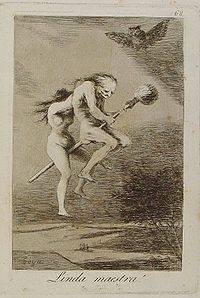
Linda maestra by Francisco de Goya, 1799.
The film’s plot orbits around a psychological conflict, using a repressive, patriarchal portrayal of Puritan society and the dark, murderous liberation of the witches. The main female character, Thomasin, harbors worldly desires that differ from those of her conventionally Christian family, yearning for independence, sexuality, acceptance and power. However, while her father and the Christian God fail to fulfill her needs, Satan instead speaks personally to her, offering her earthly satisfaction. Therefore, with the demise of her family and the rejection of the Puritan society, Thomasin joins Satan and the witches, her only alternative, in order to find her long desired control over her own life. Her nudity in the last scene reflects her act of casting out the bonds of her previous society.
The difference between both options, nevertheless, is rendered blurred in an evocation of equal religious extremism. This is first felt in the architecture of the family’s own home, which ironically resembles an archetypal witch’s cottage itself, hinting the gradual reveal that evil is already installed in them. On the opposite side, Satan’s temptation of Thomasin also acquires traits of ideological grooming, slowly alienating her from her family. At the end, despite her newfound cause and ecstatic laugh at the coven, Thomasin has not escaped her previous religiosity, but merely changed its direction, turning to murder in exchange for freedom.
The symbolic conflict between civilization and nature is also present in all the aspects of the film. The family lives next to a dark forest, a place tied to witchcraft in their culture, which underlines the conflict between their civilized, patriarchal religion and the Gothic, wild natural world that surrounds them. The state of nudity is associated to monstrosity, to the untamed wilderness where the forbidden sexuality emerges. Accordingly, Caleb returns nude after being seduced by the witch, the witches themselves perform their acts while naked, and Thomasin eventually adopts this code upon joining them. At the end of the film, nature triumphs over its adversary, with the Pan-like Black Phillip goring the axe-wielding William in a metaphor of man being consumed by the wild.
Release
The film had its world premiere at the 2015 Sundance Film Festival, on January 27, 2015. The film was also screened in the Special Presentations section of the 2015 Toronto International Film Festival, on September 18, 2015. A24 and DirecTV Cinema acquired distribution rights to the film. The film received very positive reactions in advance screenings, so the studios decided to give the film a wide theatrical release in the United States, on February 19, 2016.
The film was released on Blu-ray and digital HD on May 17, 2016, in the United States. The discs’ extras include outtakes, audio commentary, a documentary—The Witch: A Primal Folktale, which summarizes the cast and crew’s making of the film—and a 30-minute question-and-answer session filmed in Salem, Massachusetts featuring director Eggers, lead actress Anya Taylor-Joy, and historians Richard Trask and Brunonia Barry. A 4K Ultra HD Blu-ray was released on April 23, 2019.
Reception
Box office
The Witch grossed $25.1 million in the United States and Canada and $15.3 million in other territories for a worldwide total of $40.4 million.
In North America, pre-release tracking suggested that the film would gross $5–7 million from 2,046 theaters in its opening weekend, trailing fellow newcomer Risen ($7–12 million projection) but similar to opener Race ($4–7 million projection). The film grossed $3.3 million on its first day and $8.8 million in its opening weekend, finishing fourth at the box office behind Deadpool ($56.5 million), Kung Fu Panda 3 ($12.5 million) and Risen ($11.8 million).
Critical response
On Rotten Tomatoes, the film has an approval rating of 90% based on 328 reviews, with an average rating of 7.8/10. The website’s critical consensus reads, “As thought-provoking as it is visually compelling, The Witch delivers a deeply unsettling exercise in slow-building horror that suggests great things for debuting writer-director Robert Eggers.” Metacritic reports a weighted average score of 83 out of 100, based on 46 critics, indicating “universal acclaim”. Audiences polled by CinemaScore gave the film an average grade of “C–” on an A+ to F scale, while PostTrak reported filmgoers gave it a 55% overall positive score and a 41% “definite recommend”.
Writing in Variety, Justin Chang commented that “A fiercely committed ensemble and an exquisite sense of historical detail conspire to cast a highly atmospheric spell in The Witch, a strikingly achieved tale of a mid-17th-century New England family’s steady descent into religious hysteria and madness.” Yohana Desta of Mashable stated that The Witch is a “stunningly crafted experience that’ll have you seeking out a church as soon as you leave the theater”. Peter Travers, in his Rolling Stone review, gave the film 31⁄2 stars, and wrote of the film: “Building his film on the diabolical aftershocks of Puritan repression, Eggers raises The Witch far above the horror herd. He doesn’t need cheap tricks. Eggers merely directs us to look inside.” Stephanie Zacharek summarized the movie in Time as “a triumph of tone”, writing that “Although Eggers is extremely discreet—the things you don’t see are more horrifying than those you do—the picture’s relentlessness sometimes feels like torment.” Gregory Wakeman, writing for CinemaBlend, rated it five stars, writing that ” acting, lighting, music, writing, production design, cinematography, editing, and direction all immediately impress. While, at the same time, they combine to create an innately bewitching tale that keeps you on tenterhooks all the way up until its grandiose but enthralling finale.” Ann Hornaday wrote in The Washington Post that the film joins the ranks of horror films such as The Exorcist, The Omen, and Rosemary’s Baby, saying that The Witch “comports itself less like an imitator of those classics than their progenitor… a tribute to a filmmaker who, despite his newcomer status, seems to have arrived in the full throes of maturity, in full control of his prodigious powers.” Jay Bauman of RedLetterMedia named the film his favorite film of 2016, labelling it “a masterpiece”.
However, some critics as well as audiences were less pleased with the film; Ethan Sacks, of the New York Daily News, wrote that while the film does not suffer from the cinematography, acting, or setting, early on it “seems that The Witch is tapping a higher metaphor for coming of age…or religious intolerance…or man’s uneasy balance with nature…or something. It doesn’t take long into the film’s hour and a half running time, however, to break that spell.” Critics have noted that the film has received backlash from audiences regarding the film’s themes and slow approach to horror; Lesley Coffin criticized A24, saying it was “a huge mistake” to market The Witch as a terrifying horror film:
Not because it doesn’t fit into the genre of horror, but because of the power of expectations. The less you know about this movie the better your experience will be, but everyone who saw it opening weekend probably walked in with too much knowledge and hype to really get as much out of it as they could have if the film had the veil of mystery.
HitFix writer Chris Eggertson was critical of mainstream Hollywood; he said that The Witch “got under skin profoundly”, though he argued that it “did not have the moment-to-moment, audience-pleasing shocks that moviegoers have become accustomed to thanks to movies like Sinister and The Purge and Paranormal Activity and every other Blumhouse and Platinum Dunes title in the canon.”
Horror authors Stephen King and Brian Keene both reacted positively towards the film; King tweeted significant praise for the film, stating, “The Witch scared the hell out of me. And it’s a real movie, tense and thought-provoking as well as visceral”, while Keene, on social media, stated, “The Witch is a gorgeous, thoughtful, scary horror film that 90% of the people in the theater with you will be too stupid to understand.” Jason Coffman expressed his “frustration” toward viewers who felt The Witch was “boring”, saying:
hese detractors have targeted films that work within the genre but are also examples of how genre cinema can explore concepts and themes in ways that less fantastic stories cannot. In short, the rejection of these films appears to people outside of horror fandom as a rejection of cinema as an art form.
Religious
Julia Alexander of Polygon states that The Witch “asks people to try and understand what life would have been like for a family of devout Christians living in solitude, terrified of what may happen if they go against the word of God”. In The Atlantic, Alissa Wilkinson stated that many films featured at the 2015 Sundance Film Festival—The Witch, along with Last Days in the Desert, Don Verdean, and I Am Michael—reveal a “resurgence of interest in the religious” and described The Witch as “a chilling circa-1600 story of the devil taking over a devout, Scripture-quoting family”. Eve Tushnet commented in an article in TAC, which was also published in First Things, that The Witch‘s view of witchcraft is “not revisionist” and further states that the film is “pervaded by the fear of God. There are occasional references to His mercy but only as something to beg for, not something to trust in”.
A review by Adam R. Holz on Plugged In, a publication of the conservative Christian organisation Focus on the Family, heavily criticised the film, stating that:
William is absolutely devoted to leading his family in holiness and the ways of the Lord, which should be a good thing. But the fruit of William’s rigorous focus on dogmatic piety isn’t a lifting of burdens, which we’re told should happen in Matthew 11:30, or a joyful celebration of living life to the fullest, as is referenced in John 10:10; rather it is deep fear and morbid meditations on hell, damnation and the forces of spiritual darkness.
Josh Larsen of Think Christian, however, offered a Christian explanation of the conclusion of the film, stating that in “encountering evil, the family in the film veers wildly back and forth between ‘triumphalism’ and ‘defeatism,’ two theological extremes” and “in refusing to allow for grace, they become easy pickings for the witch”.
Emily VanDerWerff of Vox stated that:
A24 could have just as easily courted the approval of, say, theologians who have a fondness for Calvinism. The VVitch takes place in Colonial America, and it unfolds from the perspective of period Christians who genuinely believe the woods around their tiny farm contain some sort of evil, supernatural being—and are ultimately proved correct.
Accolades
| List of awards and nominations | |||||
|---|---|---|---|---|---|
| Award | Date of ceremony | Category | Recipient(s) | Result | Ref(s) |
| Austin Film Critics Association | December 28, 2016 | Best First Film | The Witch | Won | |
| Breakthrough Artist Award | Anya Taylor-Joy | Nominated | |||
| Boston Society of Film Critics | December 11, 2016 | Best New Filmmaker | Robert Eggers | Won | |
| Bram Stoker Awards | April 29, 2017 | Superior Achievement in a Screenplay | Robert Eggers | Won | |
| Chicago Film Critics Association | December 15, 2016 | Best Art Direction | The Witch | Nominated | |
| Most Promising Filmmaker | Robert Eggers | Won | |||
| Critics Choice Awards | December 11, 2016 | Best Sci-Fi/Horror Movie | The Witch | Nominated | |
| Empire Awards | March 19, 2017 | Best Horror | The Witch | Won | |
| Best Female Newcomer | Anya Taylor-Joy | Won | |||
| Fangoria Chainsaw Awards | October 2, 2017 | Best Film | The Witch | Won | |
| Best Actress | Anya Taylor-Joy | Won | |||
| Best Supporting Actor | Ralph Ineson | Nominated | |||
| Best Score | Mark Korven | Nominated | |||
| Golden Tomato Awards | January 12, 2017 | Best Horror Movie 2016 | The Witch | Won | |
| Golden Trailer Awards | May 4, 2016 | Best Horror | “Family” | Won | |
| Best Horror TV Spot | “Life” | Nominated | |||
| Best Sound Editing in a TV Spot | “Paranoia” | Won | |||
| Gotham Awards | November 28, 2016 | Breakthrough Actor | Anya Taylor-Joy | Won | |
| Bingham Ray Breakthrough Director Award | Robert Eggers | Nominated | |||
| Independent Spirit Awards | February 25, 2017 | Best First Screenplay | Robert Eggers | Won | |
| Best First Feature | Robert Eggers, Daniel Bekerman, Jay Van Hoy, Lars Knudsen, Jodi Redmond and Rodrigo Teixeira | ||||
| London Film Critics’ Circle | January 22, 2017 | Young British/Irish Performer of the Year | Anya Taylor-Joy (also for Morgan and Split) | Nominated | |
| London Film Festival | October 18, 2015 | Sutherland Award | Robert Eggers | Won | |
| Festival international du film fantastique de Gérardmer | January 31, 2016 | Prix du jury SyFy | The Witch | Won | |
| New York Film Critics Online | December 11, 2016 | Best Debut Director | Robert Eggers | Won | |
| Online Film Critics Society | January 3, 2017 | Best Picture | The Witch | Nominated | |
| San Diego Film Critics Society | December 12, 2016 | Breakthrough Artist | Anya Taylor-Joy | Nominated | |
| San Francisco Film Critics Circle | December 11, 2016 | Best Production Design | Craig Lathrop | Nominated | |
| Saturn Awards | June 28, 2017 | Best Horror Film | The Witch | Nominated | |
| Best Performance by a Younger Actor | Anya Taylor-Joy | Nominated | |||
| Seattle Film Critics Society | January 5, 2017 | Best Picture of the Year | The Witch | Nominated | |
| Best Director | Robert Eggers | Nominated | |||
| Best Cinematography | Jarin Blaschke | Nominated | |||
| Best Costume Design | Linda Muir | Nominated | |||
| Best Youth Performance | Anya Taylor-Joy | Won | |||
| Harvey Scrimshaw | Nominated | ||||
| Best Villain | Charlie and Wahab Chaudary (as Black Phillip) | Nominated | |||
| St. Louis Gateway Film Critics Association | December 18, 2016 | Best Horror/Science-Fiction Film | The Witch | Won | |
| Sundance Film Festival | February 1, 2015 | Directing Award | Robert Eggers | Won | |
| Grand Jury Prize | Robert Eggers | Nominated | |||
| Toronto Film Critics Association | December 11, 2016 | Best First Feature | The Witch | Won | |
| Washington D.C. Area Film Critics Association | December 5, 2016 | Best Youth Performance | Anya Taylor-Joy | Nominated | |
| Best Art Direction | Craig Lathrop | Nominated | |||