
The Bengal Renaissance, also known as the Bengali Renaissance, was a cultural, social, intellectual, and artistic movement that took place in the Bengal region of the British Raj, from the late 18th century to the early 20th century. Historians have traced the beginnings of the movement to the victory of the British East India Company at the 1757 Battle of Plassey, as well as the works of reformer Raja Rammohun Roy, considered the “Father of the Bengal Renaissance,” born in 1772. Nitish Sengupta stated that the movement “can be said to have … ended with Rabindranath Tagore,” Asia’s first Nobel laureate.
For almost two centuries, the Bengal renaissance saw the radical transformation of Indian society, and its ideas have been attributed to the rise of Indian anticolonialist and nationalist thought and activity during this period. The philosophical basis of the movement was its unique version of liberalism and modernity. According to Sumit Sarkar, the pioneers and works of this period were revered and regarded with nostalgia throughout the 19th and 20th centuries, however, due to a new focus on its colonialist origins, a more critical view emerged in the 1970s.
The Bengal renaissance was predominantly led by upper caste Bengali Hindus under the patronage of the Crown. According to Sengupta, though the Bengal renaissance was a “culmination of the process of emergence of the cultural characteristics of the Bengali people that started in the age of Hussein Shah, it remained predominantly Hindu and only partially Muslim.” There were, nevertheless, Muslim figures who had major influence on the movement, including Kazi Nazrul Islam and Rokeya Sakhawat Hussain.
Background
The renaissance period after the Indian Rebellion of 1857 saw a magnificent outburst of Bengali intelligentsia. While Ram Mohan Roy and Iswar Chandra Vidyasagar were the pioneers, others like Bankim Chandra Chatterjee, Pramatha Chaudhuri, Upendrakishore Ray Chowdhury, Dwarkanath Ganguly widened it and built upon it.
The Tagore family, including Rabindranath Tagore, Dwarkanath Tagore,were leaders of this period and had a particular interest in educational reform. Their contribution to the Bengal Renaissance was multi-faceted. Several members of the family, including Rabindranath, Abanindranath, Gaganendranath, Jyotirindranath Tagore and Jnanadanandini Devihave been associated with the movement.
Education
- Chittagong College
- Indian Statistical Institute
- Hindu School, Kolkata
- Jadavpur University
- Presidency University, Kolkata
- University of Calcutta
- University of Dhaka
- Visva-Bharati University
Science
During the Bengal Renaissance science was also advanced by several Bengali scientists such as Satyendra Nath Bose, Anil Kumar Gain, Prasanta Chandra Mahalanobis, Prafulla Chandra Ray, Debendra Mohan Bose, Jagadish Chandra Bose, Jnan Chandra Ghosh, Gopal Chandra Bhattacharya, Kishori Mohan Bandyopadhyay, Jnanendra Nath Mukherjee, Sisir Kumar Mitra, Upendranath Brahmachari and Meghnad Saha. Jagadish Chandra Bose (1858–1937) was a polymath: a physicist, biologist, botanist, archaeologist, and writer of science fiction. He pioneered the investigation of radio and microwave optics, made very significant contributions to botany, and laid the foundations of experimental science in the Indian subcontinent. He is considered one of the fathers of radio science, and is also considered the father of Bengali science fiction. He also invented the crescograph.
-

Jagadish Chandra Bose was one of the fathers of radio science.
-

Satyendra Nath Bose was one of the pioneers of quantum mechanics.
Arts

Satyajit Ray
The Bengal School of Art was an art movement and a style of Indian painting that originated in Bengal and flourished throughout British India in the early 20th century. Also known as ‘Indian style of painting’ in its early days, it was associated with Indian nationalism (swadeshi) and led by Abanindranath Tagore.
Following the influence of Indian spiritual ideas in the West, the British art teacher Ernest Binfield Havell attempted to reform the teaching methods at the Calcutta School of Art by encouraging students to imitate Mughal miniatures. This caused controversy, leading to a strike by students and complaints from the local press, including from nationalists who considered it to be a retrogressive move. Havell was supported by the artist Abanindranath Tagore.
Literature
According to historian Romesh Chunder Dutt:
The conquest of Bengal by the English was not only a political revolution, but ushered in a greater revolution in thoughts and ideas, in religion and society … From the stories of gods and goddesses, kings and queens, princes and princesses, we have learnt to descend to the humble walks of life, to sympathise with the common citizen or even common peasant … Every revolution is attended with vigour, and the present one is no exception to the rule. Nowhere in the annals of Bengali literature are so many or so bright names found crowded together in the limited space of one century as those of Ram Mohan Roy, Akshay Kumar Dutt, Isvar Chandra Vidyasagar, Isvar Chandra Gupta, Michael Madhusudan Dutt, Hem Chandra Banerjee, Bankim Chandra Chatterjee and Dina Bandhu Mitra. Within the three quarters of the present century, prose, blank verse, historical fiction and drama have been introduced for the first time in the Bengali literature.
-

Rabindranath Tagorewas a poet and artist. Awarded the Nobel Prize in Literature in 1913
-
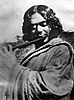
Kazi Nazrul Islam, the national poet of Bangladesh
Religion

Swami Vivekananda
The Renaissance also embraced the religious sphere, bringing forward spiritual figures such as Ram Mohan Roy, Debendranath Tagore, Ramakrishna, Swami Vivekananda, Aurobindo, Paramahansa Yogananda, Mahanambrata Brahmachari, as well as related new reformated movements and organization.
- Brahmoism (Brahmo Samaj)
- Adi Brahmo Samaj
- Sadharan Brahmo Samaj
- Gaudiya Math
- Mahanam Sampraday
- Ramakrishna Mission
- Ramakrishna Math
- Sri Aurobindo Ashram
- Yogoda Satsanga Society of India
- Self-Realization Fellowship