
Jodhpur (/ˈdʒɒdpʊər/; pronounced  pronunciation (help·info)) is the second-largest city in the Indian state of Rajasthanand officially the second metropolitan city of the state. It was formerly the seat of the princely state of Jodhpur State. Jodhpur was historically the capital of the Kingdom of Marwar, which is now part of Rajasthan. Jodhpur is a popular tourist destination, featuring many palaces, forts, and temples, set in the stark landscape of the Thar Desert. It is popularly known as the “Blue City” among people of Rajasthan and all over India. It serves as the administrative headquarters of the Jodhpur district and Jodhpur division.
The old city circles the Mehrangarh Fort and is bounded by a wall with several gates. The city has expanded greatly outside the wall, though, over the past several decades. Jodhpur lies near the geographic centre of the Rajasthan state, which makes it a convenient base for travel in a region much frequented by tourists. The city featured in The New York Times’ 52 Best Places of 2020.
The city is also home to several educational institutions, the most prominent being All India Institute of Medical Sciences, Jodhpur, Indian Institute of Technology Jodhpur, Dr. Sampurnanand Medical College, DSRRAU Jodhpur, and National Law University, Jodhpur, and many research institutes, such as Indian Space Research Organisation, Defence Research and Development Organisation, Central Arid Zone Research Institute, Arid Forest Research Institute, and Desert Medicine Research Centre are also located in the city.
History
Early history
According to the Rajasthan district Gazetteer, Abhiras were the inhabitants of Marwar and later on the Rajputs established their rule in Marwar. There may have been small settlements before Rathore rule.
The Jodhpur city was founded in 1459 by Rao Jodha, a Rajput chief of the Rathore clan. Jodha succeeded in conquering the surrounding territory and thus founded a kingdom which came to be known as Marwar. As Jodha hailed from the nearby town of Mandore, that town initially served as the capital of this state; however, Jodhpur soon took over that role, even during the lifetime of Jodha. The city was located on the strategic road linking Delhi to Gujarat. This enabled it to profit from a flourishing trade in opium, copper, silk, sandalwood, dates, and other tradeable goods.
Early Modern period
After the death of Rao Chandrasen Rathore in 1581, the kingdom annexed by the Mughal Emperor Akbar, Marwar thus became a Mughal vassal owing fealty to them while enjoying internal autonomy. Jodhpur and its people benefited from this exposure to the wider world as new styles of art and architecture made their appearance and opportunities opened up for local tradesmen to make their mark across northern India.
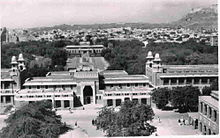
View of the Rajasthan High Court, Sardar Museum in Umaid Park and upper right is Jodhpur fort in 1960.
Aurangzeb briefly sequestrated the state (circa 1679) after the death of Maharaja Jaswant Singh, but the prior ruler Maharaja Ajit Singh was restored to the throne by Veer Durgadas Rathore after Aurangzeb died in 1707 and a great struggle of 30 years. The Mughal empire declined gradually after 1707, but the Jodhpur court was beset by intrigue; rather than benefiting from circumstances, Marwar descended into strife and invited the intervention of the Marathas, who soon supplanted the Mughals as overlords of the region. This did not make for stability or peace, however; 50 years of wars and treaties dissipated the wealth of the state, which sought the help of the British and entered into a subsidiary alliance with them. A major revolt occurred in 1857 by some Rathore nobles of Pali led by Thakur Kushal Singh of Auwa, but the rebels were defeated by the British Army under colonel Holmes and peace was restored.
British Colonial period

Street Scene of Jodhpur in 1906
During the British Raj, the state of Jodhpur had the largest land area of any in the Rajputana. Jodhpur prospered under the peace and stability that was a hallmark of this era. The land area of the state was 93,424 km2 (36,071 sq mi) its population in 1901 was 44,73,759. It enjoyed an estimated revenue of £3,529,000. Its merchants, the Marwaris, flourished and came to occupy a position of dominance in trade across India.
After independence
In 1947, when India became independent, the state merged into the union and Jodhpur became the second-largest city of Rajasthan. At the time of division, the ruler of Jodhpur, Hanwant Singh, did not want to join India, but finally, due to the effective persuasion of Sardar Vallabhbhai Patel, the Home Minister at the time, the state of Jodhpur was included in the Indian Republic. Later after the State Reorganisation Act, 1956, it was included within the state of Rajasthan.
Demographics
As per provisional reports of Census India, Jodhpur had a population of 1,033,918 in 2011, consisting of approximately 52.62 males and approximately 47.38 percent females. The average literacy rate is 80.56 percent, approximately 88.42 percent for males and 73.93 percent for females. Approximately 12.24 percent of the population is under six years of age. Jodhpur city is governed by a Municipal Corporation which comes under Jodhpur Urban Agglomeration. The Jodhpur Urban/Metropolitan area includes Jodhpur, Kuri Bhagtasani, Mandore Industrial Area, Nandri, Pal Village and Sangariya. Its urban/metropolitan population is 1,137,815 of which 599,332 are males and 538,483 are females. With the inclusion of 395 villages in Jodhpur city in the month of February 2021 by JoDA, the new population count for the city is 2,330,000 and is expected to grow by 33.04% over the next decade. In the year 2031 population of Jodhpur city is expected to be more than 3.1 million. The population of Jodhpur city after expansion of city borders is 2,330,000.
| hidePopulation Growth of Jodhpur City | |||
|---|---|---|---|
| Census | Population | %± | |
| 1881 | 142,600 |
—
|
|
| 1891 | 61,800 | −56.7% | |
| 1901 | 60,400 | −2.3% | |
| 1911 | 59,300 | −1.8% | |
| 1921 | 73,500 | 23.9% | |
| 1931 | 94,700 | 28.8% | |
| 1941 | 126,900 | 34.0% | |
| 1951 | 180,700 | 42.4% | |
| 1961 | 224,800 | 24.4% | |
| 1971 | 318,900 | 41.9% | |
| 1981 | 506,345 | 58.8% | |
| 1991 | 666,279 | 31.6% | |
| 2001 | 860,818 | 29.2% | |
| 2011 | 1,138,300 | 32.2% | |
| source: | |||
| Year | Population |
|---|---|
| 1891 |
61,800 |
| 1901 |
60,400 |
| 1911 |
59,300 |
| 1921 |
73,500 |
| 1931 |
94,700 |
| 1941 |
126,900 |
| 1951 |
180,700 |
| 1961 |
224,800 |
| 1971 |
318,900 |
| 1981 |
506,345 |
| 1991 |
666,279 |
| 2001 |
860,818 |
| 2011 |
1,138,300 |
| 2021 |
2,330,000 |
| 2031 |
3,101,056 |
Climate

Jodhpur in a hot sunny day.
The climate of Jodhpur is hot and semiarid during its nearly year-long dry season, but contains a brief rainy season from late June to September (Köppen BSh). Although the average rainfall is around 362 mm (14.3 in), it fluctuates greatly. In the famine year of 1899, Jodhpur received only 24 mm (0.94 in), but in the flood year of 1917, it received as much as 1,178 mm (46.4 in).
Temperatures are extreme from March to October, except when the monsoonal rain produces thick clouds to lower it slightly. In April, May, and June, high temperatures routinely exceed 40°C. During the monsoon season, average temperatures decrease slightly, but the city’s generally low humidity rises, which adds to the perception of the heat. The highest temperature recorded in Jodhpur was on 25 May 1932, when it rose to 48.9°C.
| hideClimate data for Jodhpur (1971–2000, extremes 1968–1996) | |||||||||||||
|---|---|---|---|---|---|---|---|---|---|---|---|---|---|
| Month | Jan | Feb | Mar | Apr | May | Jun | Jul | Aug | Sep | Oct | Nov | Dec | Year |
| Record high °C (°F) | 31.2 (88.2) |
36.0 (96.8) |
41.6 (106.9) |
45.0 (113.0) |
48.9 (120.0) |
47.8 (118.0) |
42.6 (108.7) |
40.3 (104.5) |
42.5 (108.5) |
40.6 (105.1) |
37.5 (99.5) |
32.3 (90.1) |
48.9 (120.0) |
| Average high °C (°F) | 24.5 (76.1) |
27.4 (81.3) |
33.4 (92.1) |
38.4 (101.1) |
41.2 (106.2) |
40.0 (104.0) |
35.2 (95.4) |
33.5 (92.3) |
34.9 (94.8) |
35.8 (96.4) |
31.2 (88.2) |
26.9 (80.4) |
33.5 (92.3) |
| Average low °C (°F) | 9.6 (49.3) |
11.7 (53.1) |
17.3 (63.1) |
22.6 (72.7) |
26.5 (79.7) |
27.8 (82.0) |
26.4 (79.5) |
25.4 (77.7) |
23.9 (75.0) |
20.1 (68.2) |
14.7 (58.5) |
11.2 (52.2) |
19.8 (67.6) |
| Record low °C (°F) | 1.8 (35.2) |
0.7 (33.3) |
4.4 (39.9) |
15.6 (60.1) |
15.4 (59.7) |
20.0 (68.0) |
21.0 (69.8) |
21.2 (70.2) |
18.4 (65.1) |
12.5 (54.5) |
5.8 (42.4) |
1.7 (35.1) |
0.7 (33.3) |
| Average rainfall mm (inches) | 4.0 (0.16) |
4.0 (0.16) |
1.3 (0.05) |
4.8 (0.19) |
17.4 (0.69) |
40.0 (1.57) |
120.5 (4.74) |
111.8 (4.40) |
49.9 (1.96) |
6.9 (0.27) |
1.9 (0.07) |
0.5 (0.02) |
362.9 (14.29) |
| Average rainy days | 0.3 | 0.6 | 0.3 | 0.6 | 1.2 | 2.1 | 6.5 | 5.9 | 2.6 | 0.6 | 0.2 | 0.0 | 21.0 |
| Average relative humidity (%) (at 17:30 IST) | 27 | 24 | 22 | 19 | 20 | 33 | 52 | 58 | 45 | 29 | 32 | 33 | 32 |
| Mean monthly sunshine hours | 303.8 | 291.0 | 288.3 | 279.0 | 285.2 | 132.0 | 96.1 | 120.9 | 180.0 | 232.5 | 270.0 | 294.5 | 2,773.3 |
| Mean daily sunshine hours | 9.8 | 10.3 | 9.3 | 9.3 | 9.2 | 4.4 | 3.1 | 3.9 | 6.0 | 7.5 | 9.0 | 9.5 | 7.6 |
| Source: India Meteorological Department (sun 1971–2000) | |||||||||||||
Economy
Jodhpur’s contributes $4 billion (approx) to Rajasthan’s economy through different Industries. Jodhpur is the Handicraft Hub of India of $200 million industry. Tourism comes next where Jodhpur is one of the most popular tourist destination through many portals with top heritage hotels of India.

View of PWD Road and Mehrangarh from veer durgadas bridge, Jodhpur
Jodhpur also has the largest Education Industry in western Rajasthan with top Coaching institutes of IIT-JEE, NEET and Civil Service Exams.
The upcoming 9 MMTPA Refinery and Petrochemical complex to be set up by Hindustan Petroleum Corporation Limited (HPCL) in Pachpadra, Barmer district will transform the industrial scene of the city drastically. Pachpadra lies just 60 kilometres from the industrial area of Boranada in Jodhpur. Around 120 by-products that are produced by the refinery are going to provide huge opportunities for new industries to be set up in and around Jodhpur.
India’s most ambitious industrial development project, the over USD 100 dollars Delhi-Mumbai Industrial Corridor Project is also going to impact the industrial scenario in Jodhpur in a big way. Marwar Junction which is located about 100 kilometres from Jodhpur will be one of the nine freight loading points along the DMIC route. Jodhpur and Pali districts fall under the region that is going to be developed as a manufacturing hub for the DMIC.
Elected representatives
The present Member of Parliament from Jodhpur is Gajendra Singh Shekhawat of the BJP.
Strategic location
Jodhpur is a significant city of western Rajasthan and lies about 250 km from the border with Pakistan. This location makes it a key base for the Indian Army, Indian Air Force (IAF), and Border Security Force. Jodhpur’s South Western Air Command is one of Asia’s largest and one of the most critical and strategically located airbases of the IAF (The Jodhpur Airport played the crucial role during the Indo-Pakistani wars of 1965 and 1971) deployed fighter jets and advanced light helicopters.

Panorama view of Jodhpur, with the Mehrangarh Fort to the right, and the city centre below
Culture
Jodhpur has culturally been known by the name of Jodhana by the locals. The city is famous for its food and its popularity can be judged by the fact that one can find sweet shops named “Jodhpur Sweets” in many cities throughout India. Being at the onshore of Thar Desert, life has been influenced by ways of select nomadic tribes (so-called “gypsy” groups – Banjare in Hindi – have settled in some parts of the city). Jodhpur has distinct cultural identity through its food and is famous for its Mirchi Bada and Mawa Kachori.
Tourism

Jaswant Thada

Kaylana Lake


Jodhpur’s most notable attractions are Mehrangarh Fort which overlooks upon the city, the blue bylanes of the old city are also an attraction, Umaid Bhawan Palace, Jaswant Thada, and the Ghanta Ghar, or Clock Tower. Tourists are also within proximity to Mandore Garden, Kaylana Lake and Garden, Balsamand Lake, Rao Jodha Desert Rock Park, Ratanada Ganesh Temple, Toorji Ka Jhalra, Sardar Samand Lake and Palace, Masooria Hills, Veer Durgadas Smarak (monument, park, and museum) and Bhim Bhadak Cave. Other attractions of people are at markets of food, antique items, traditional clothes and traditional shoes (also called Jodhpuri Mojari) held in Jodhpur.
Motion-picture industry
The city is famous for its charming locations and is often featured in various films, advertisements, music videos, and soaps. The historic buildings and landscapes of the city were featured in a number of movies, including The Dark Knight Rises directed by Christopher Nolan;Baadshaho starring Ajay Devgn and Emraan Hashmi, The Darjeeling Limited starring Owen Wilson, Adrien Brody, and Jason Schwartzman; The Fall directed by Tarsem Singh; Hum Saath-Saath Hain directed by Sooraj Barjatya; Veer directed by Anil Sharma; Shuddh Desi Romance directed by Maneesh Sharma; I directed by S. Shankar, Kung Fu Yoga starring Jackie Chan, Sonu Sood, and Disha Patani; Loafer starring Varun Tej and Disha Patani; Supreme starring Sai Dharam Tej and Rashi Khanna; and Airlift featuring Akshay Kumarand Nimrat Kaur. Many foreign-language films and series have also been shot in Jodhpur, such as Buddies in India, which was produced in Mandarin and was launched in China in 2017 featuring some Indian actors, and even the songs were in Hindi.
Cuisine

Rajasthani thali
A number of dishes from Indian cuisine originated in Jodhpur. The city savours a number of food items, but the specialities of the city are Pyaaj Kachori, Mirchi Bada and Mawa Kachori.
Education and research

Footwear Design and Development Institute, Jodhpur

National Law University Jodhpur
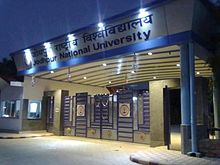
Jodhpur National University
Educational facilities include:
- Indian Institute of Technology Jodhpur is a technical education institute in India, one of the new IITs.
- All India Institute of Medical Sciences Jodhpur
- National Law University, Jodhpur, is one of the 17 universities imparting law education (established in 1999).
- National Institute of Fashion Technology Jodhpur is a fashion-design institute (started in 2010).
- Dr. Sarvepalli Radhakrishnan Rajasthan Ayurved University is a university in the field of Ayurveda. The second university of its kind in India, it was started in 2003.
- Jai Narain Vyas University (JNVU), formerly known as University of Jodhpur, is run by the state government of Rajasthan (established in 1962).
- Dr. S.N. Medical College, Jodhpur (established in 1965).
- MBM Engineering College: the oldest engineering institution in Rajasthan, it is now a faculty of engineering and architecture, under JNVU (established in 1951).
- Footwear Design and Development Institute Jodhpur is an institute established by the government of India, Ministry of Commerce and Industry for the design and development of footwear, fashion, and leather (started in 2012).
- Indian Institute of Handloom Technology is one of the five institutes nationwide to provide research, development, and technical education to the handloom industry.
- Sardar Patel University of Police, Security and Criminal Justice, started in 2013, is a university for research and education in the field of security, policing, and criminal justice.
Research
Major research institutes and organizations have been established in the city for promoting research:
- Arid Forest Research Institute is one of the institutes of the Indian Council of Forestry Research and Education working under the Ministry of Environment and Forests, for carrying out scientific research in forestry to provide technologies to increase the vegetative cover and to conserve the biodiversity in the hot arid and semiarid region of Rajasthan, Gujarat, and Dadara union, and Nagar Haveli union territory. The campus covers 66 hectares on the New Pali Road.
- Central Arid Zone Research Institute is a premier organisation of the Indian Council of Agricultural Research, an autonomous organization under the Department of Agricultural Research and Education, Ministry of Agriculture, government of India.
- National Institute for Implementation Research on Non-Communicable Diseases is one of the 33 permanent institutes of Indian Council of Medical Research, which is an autonomous body for the formulation, coordination, and promotion of biomedical research in the country.
- Desert Regional Centre, Zoological Survey of India is the regional arm of the only taxonomic organization in the country involved in the study of all kinds of animals to promote survey, exploration, and research leading to the advancement of zoological study.
- Botanical Survey of India is the nodal research organization under Ministry of Environment and Forests for research, exploration, and survey of the flora of India.
- Defence Research and Development Organisation is an organization working under the Department of Defence Research and Development of Ministry of Defence for design and development leading to the production of world-class weapons systems and equipment.
- Regional Remote Sensing Centre is one of the five centres established under National Natural Resources Management System by Department of Space for remote sensing tasks at regional and national levels.
- MBM Engineering College conducts research and has masters and PhD programs in branches of engineering by highly experienced faculty. In civil and chemical engineering, national and state projects are performed by this college.
Judiciary

New building of Rajasthan High Court in Jodhpur.
Rajasthan High Court is the High Court of the state of Rajasthan. It was established on 21 June 1949 under the Rajasthan High Court Ordinance, 1949.
The High Court of Rajasthan was founded in 1949 in Jodhpur and was inaugurated by the Rajpramukh, Maharaja Sawai Man Singh on 29 August 1949. The first Chief Justice was Kamala Kant Verma and the current Chief Justice of the Rajasthan High Court is the Honorable Justice Indrajit mohanty. A bench was formed at Jaipur which was dissolved in 1958 and was again formed on 31 January 1977. Currently, there are forty sanctioned judges.
Civic administration
| Jodhpur City officials | |
|---|---|
| Mayor | Kunti Deora Parihar (Jodhpur North) Vanita Seth (Jodhpur South) |
| Collector | Indrajeet Singh IAS, IAS |
| Police Commissioner | Jos Mohan, IPS |
| Chief Justice of the Rajasthan High Court | Hon’ble Justice Mr. Indrajit Mahanty |
| Chairman, Jodhpur Development Authority | Dr. Samit Sharma |
Till 2020, the city was administered by a single municipal body, Jodhpur Nagar Nigam with a mayor. In 2019, the Rajasthan government decided to form two municipal corporation in Jaipur, Jodhpur and Kota for better administration. For administrative purposes, the city is divided into wards, from which the members of the corporation council are elected for five years. The municipal corporation has elected members known as councilors, or parshad in Hindi, representing their respective wards (geographical units of the city). The ward members are elected by direct voting by electorate for a period of 5 years. In addition to these directly elected members, the corporation has four ex-officio members (one member of parliament, three members of legislative assembly, namely Sardarpura, Soorsagar, City), and three nominated members. Currently, the city has two civic bodies – Jodhpur North and Jodhpur South each headed by a mayor. Each municipal corporation has 80 wards, making a total of 160 wards in the city. The Jodhpur Development Authority (JDA) executes and supervises plans and schemes for the development of the urban region.
Transportation
The city has well-established rail, road, and air networks connecting it to other major cities of the country.
Railways

Jodhpur junction railway station
Jodhpur railway station (JU) is the divisional headquarters of the North Western Railways (NWR). It is well connected with railways to major Indian cities, such as Alwar, Delhi, Mumbai, Kolkata, Chennai, Bangalore, Thiruvanathapuram, Kochi, Pune, Kota, Kanpur, Bareilly, Hyderabad, Ahmedabad, Indore, Bhopal, Dhanbad, Patna, Guwahati, Nagpur, Lucknow, Gwalior, and Jaipur. To decongest the main Jodhpur station, the suburban station Bhagat ki Kothi is being developed as the second main station for passenger trains. At present, 106 trains serve both the stations. Some of the important trains originating from Jodhpur railway station are Ranthambore Express (Jodhpur to Indore), Mandore Express (Jodhpur to Delhi), Suryanagri Express (Jodhpur to Mumbai), Marudhar Express (Jodhpur to Varanasi), and Howrah Superfast (from Jodhpur to Howrah).
For experiencing the true magnificence and royal opulence of Rajasthan, luxury trains Palace on Wheels, Royal Rajasthan on Wheels, and Maharaja Express are run jointly by Rajasthan Tourism Development Corporation and Indian Railways. Jodhpur is one of the destinations of both of the trains. In 2013, a plan to start metro train service in Jodhpur was proposed by then Rajasthan Government to decongest the city traffic. However, this proposal is still pending with the state government for its approval. But in 2021, Jodhpur Development Authority and Municipal Corporations made a Future Mobility Plan where a 35-km Metro Line is proposed from IIT Jodhpur to Jaisalmer Bypass after Year 2030. With another proposed 11 more BRTS Corridors in Jodhpur between 2021-2030 to provide public transport to the increasing population before starting Metro.
Suburban stations around Jodhpur:

| No. | Suburban Station Name | Distance (in km) |
|---|---|---|
| 1 | Raikabagh Palace Junction | 02 |
| 2 | Bhagat Ki Kothi railway station | 03 |
| 3 | Mahamandir Railway Station | 05 |
| 4 | Basni Railway Station | 06 |
| 5 | Jodhpur Cantt Railway Station | 08 |
| 6 | Mandor Railway Station | 10 |
| 7 | Banar Railway Station | 14 |
| 8 | Salawas Railway Station | 16 |
Air

Jodhpur Airport
Jodhpur Airport is one of the prominent airports of Rajasthan. It is primarily a military airbase with a civilian enclosure to allow for civilian air traffic. Due to Jodhpur’s strategic location, this airport is regarded as one of the most important ones for the Indian Air Force.
At present, daily flights from Delhi and Mumbai to the city are operated Air India Indigo, SpiceJet, and Vistara. Also, daily flights to Ahmedabad are operated by Indigo and SpiceJet, as well as to Bengaluru by IndiGo. The bill and basic formalities for the long-awaited expansion of the airport were cleared by all the concerned authorities in June 2016, clearing the way for the expansion of the airport in two phases beginning February 2016. After the expansion, morning and evening flights are expected from the city to more cities than presently available, in addition to more airlines coming to and from the city.
Road
Jodhpur is connected by road to all major cities in Rajasthan and neighboring states, such as Delhi, Ahmedabad, Surat, Ujjain, and Agra. Apart from deluxe and express bus services to cities within the state, Rajasthan Roadways provides Volvo and Mercedes Benz bus service to Delhi, Ahmedabad, Jaipur, Udaipur, and Jaisalmer. In 2016, Bus Rapid Transit System Jodhpur was launched in the city with low-floor and semi-low-floor buses plying on major routes. Jodhpur is connected to the National Highway network with three national highways and to the Rajasthan State Highway network with 10 state highways. National highways passing through Jodhpur include:
- NH-62, Ambala-Kaithal-Hissar-Fatehpur-Jodhpur-Pali; total length = 690 km
- NH-112, Junction with NH-14 near Bar connecting Jaitaran-Bilara-Kaparda-Jodhpur-Kalyanpur-Pachpadra-Baloootra-Tilwara-Kher-Bagundi-Dhudhwa-Madhasar-Kawas and terminating at its junction with NH 15 near Barmer; total length= 343 km
- NH-114, Junction with NH-65 near Jodhpur connecting Balesar – Dechhu and terminating at its junction with NH-15 near Pokaran; total length= 180 km
State highways passing through Jodhpur are:
- SH-19, Phalodi (NH 15) to Needar via Ahu, Chadi, Pachudi, Nagaur, Tarneu, Khatu Kalan, Khatu khurd, Toshina, Kuchaman City, Bhuni, Maroth, Deoli Minda, Renwal Crossing, Kaladera; total length = 368 km
- SH-21, Dantiweara to Merta City via Pipar City, Borunda; total length = 97 km
- SH-28, Phalodi (NH 15) to Ramji ki Gol via Deeechu, Shergarh, Pachpadra, Balotra, Sindri, Guda Malani; total length = 259 km
- SH-58, Jodhpur to Bheem up to NH 8 via Vinakiya, Rajola Sojat, Rendiri, Bhaisana, Sojat Road, Kantalia, Baban; total length = 142 km
- SH-61, Phalodi (NH 15) to Mandal via Osian, Mathania, Jodhpur, Khejrali, Bhatenda, Saradasamand, Jadan, Marwar Junction, Auwa, Jojawar, Kamalighat, Devgarh, Rajaji ka kareda; total length = 349 km
- SH-62, Bilara to Pindwara via Sojat, Sireeyari, Jojawar, Bagol, Desuri, Sadri, Sewari; total length = 187 km
- SH-63, Banar to Kuchera via Bhopalgarh Asop; total length = 129 km
- SH-65, Sheo (NH 15) to Shergarh via Bhiyad, Barnawa Jagger, Patodi, Phalsoond; total length = 155 km
- SH-66, Siwana to Dhandhaniya (NH 114) via Samdari, Kalyanpur, Mandli Rodhawa Kalan; total length = 90 km
- SH-68, Dangiyawas (NH 112) to Balotra via Kakelao, Khejarli, Guda Kakani, Luni, Dhundhara, Rampura, Samdari; total length = 131 km
Sports
Jodhpur has two outdoor stadiums and one indoor stadium complex. Barkatullah Khan Stadium has hosted two cricket one day internationals. Maharaja Umed Singh Stadium and Gaushala Maidan Sports Complex are also among other sports facilities. The city has a well developed polo ground where tournaments are held occasionally.
| S No | Team (A) | Team (B) | Winner | Margin | Year |
|---|---|---|---|---|---|
| 1 |  India |
 Zimbabwe |
By 1 wicket | 2000 |
| 2 |  West Indies |
India |
India |
By 3 wickets | 2002 |
Media
Newspapers
Hindi newapapers
- Rajasthan Patrika
- Dainik Bhaskar
- Dainik Navjyoti
- Dainik Jalte Deep
English newspapers
- The Times of India
- The Hindustan Times
- The Indian Express
Radio
Jodhpur has these FM stations:
- Big FM
- Red FM
- My FM
- Vividh Bharti
- Radio Mirchi
- All India Radio
Notable people
- Maharaja Gaj Singh
- Ashok Gehlot
- Justice Dalveer Bhandari
- Chitrangada Singh
- Gajendra Singh Shekhawat
- Shailesh Lodha
- Kiku Sharda