
The Bahmani Sultanate (also called the Bahmanid Empire or Bahmani Kingdom) was a Persianate Muslim empire of the Deccanin South India. It was the first independent Muslim kingdom of the Deccan, and was known for its perpetual wars with its Hindu rivals of Vijayanagara, which would outlast the Sultanate. The Kingdom later split into five successor states that were collectively known as the Deccan sultanates, that would eventually sack the Vijayanagar capital after the Battle of Talikota.
History
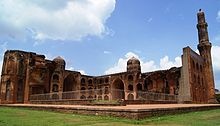
Mahmud Gawan Madrasa was built by Mahmud Gawan, the Wazir of the Bahmani Sultanate as the centre of religious as well as secular education.
According to an unverified founding myth, Zafar Khan the founder, had earlier been a servant or slave of a Brahmin ruler named Gangu(hence the name Hasan Gangu) Before the establishment of his kingdom, he was Governor of deccan and a commander on behalf of Tughlaq’s. On 3 August 1347 Nazir Uddin Ismail Shah who had revolted against the Delhi Sultanate stepped down on that day in favour of Bahman Shah, a native of Delhi. His revolt was successful, and he established an independent state on the Deccan within the Delhi Sultanate’s southern provinces with its headquarters at Hasanabad(Gulbarga) and titled himself with “Alauddin Bahman Shah Sultan – Founder of the Bahmani Dynasty”. all his coins were minted at Hasanabad too.
Alauddin was succeeded by his son Mohammed Shah I. Bidar was made capital of the sultanate in 1429.The eldest sons of Humayun Shah, Nizam-Ud-Din Ahmad III and Muhammad Shah III Lashkari ascended the throne successively, while they were young boys. The vizier Mahmud Gawan ruled as regent during this period, until Muhammad Shah reached of age. Mahmud Gawan is known for setting up the Mahmud Gawan Madrasa, a center of religious as well as secular education. Gawan was considered a great statesman, and a poet of repute. However, Gawan was executed by Muhammad Shah III, an act that the latter regretted until his death in 1482.
Later rulers and Decline
Muhammad Shah II was succeeded by his son Mahmood Shah Bahmani II, the last Bahmani ruler to have real power.
The last Bahmani Sultans were puppet monarchs under their Barid Shahi Prime Ministers, who were de facto rulers. After 1518 the sultanate broke up into five states: Nizamshahi of Ahmednagar, Qutb Shahi of Golconda (Hyderabad), Barid Shahi of Bidar, Imad Shahiof Berar, Adil Shahi of Bijapur. They are collectively known as the “Deccan Sultanates”.
The south Indian Emperor Krishnadevaraya of the Vijayanagara Empire defeated the last remnant of Bahmani Sultanate power after which the Bahmani Sultanate collapsed.
Historiography
Modern scholars have based their accounts of the Bahmani dynasty mainly upon the medieval chronicles of Firishta, Syed Ali Tabatabai, etc. Other contemporary works were Sivatatva Chintamani and Guru Charitra. Athanasius Nikitin traveled this kingdom. He contrasts the huge “wealth of the nobility with the wretchedness of the peasantry and the frugality of the Hindus”.
Culture
Rulers of the dynasty believed that they descended from Bahman, the mythological figure of Greater Iranian legend and lore. The Bahamani Sultans were patrons of the Persian language, culture and literature, and some members of the dynasty became well-versed in that language and composed its literature in that language.

Bahamani Tombs in Bidar district
The first sultan, Alauddin Bahman Shah is noted to have captured 1,000 singing and dancing girls from Hindu temples after he battled the northern Carnatic chieftains. The later Bahmanis also enslaved civilian women and children in wars; many of them were converted to Islam in captivity. The craftspersons of Bidar were so famed for their inlay work on copper and silver that it came to be known as Bidri.
Architecture
The Persianate Indo-Islamic style of architecture developed during this period was later adopted by the Deccan Sultanates as well.
The Gulbarga Fort and Jama Masjid in Gulbarga, Bidar Fort and Madrasa Mahmud Gawan in Bidar, are the major architectural contributions.
The rulers are buried in an elaborate tomb complex, known as the Bahmani Tombs. The exterior of one of the tombs is decorated with coloured tiles. Persian poetry and Quranic verses are inscribed inside the tombs.
The Bahmani rulers made some beautiful tombs and mosques in Bidar and Gulbarga. They also built many forts at Daulatabad, Golconda and Raichur. The architecture was highly influenced by Persian architecture. They invited architects from Persia, Turkey and Arabia. Some of the magnificent structures built by the Bahmanis were the Jami Masjid at Gulbarga, Chandand Minar andthe Mahmud Gawan Madrasa at Bidar. The Gol Gumbaz in Bijapur is a beautiful specimen of Bahmani architecture. It is the tomb or mausoleum of Muhammad Adil Shah II who ruled the Sultanate of Bijapur. The dome of Gol Gumbaz is circular in shape and is supported by the eight intersecting arcs. The acoustics here are so good that even a whisper echoes
List of Bahmani Shahs
| Titular Name | Personal Name | Reign | |
|---|---|---|---|
| Independence from Sultan of Delhi, Muhammad bin Tughlaq. | |||
| Shah شاہ Ala-ud-Din Bahman Shah علاء الدین حسن بہمن شاہ |
Ala-ud-Din Bahman Shah I حسن گنگو |
3 August 1347 – 11 February 1358 | |
| Shah شاہ |
Mohammad Shah I محمد شاہ بہمنی |
11 February 1358 – 21 April 1375 | |
| Shah شاہ Ala-ud-Din Mujahid Shah علاء الدین مجاہد شاہ |
Mujahid Shah | 21 April 1375 – 16 April 1378 | |
| Shah شاہ |
Dawood Shah داود شاہ بہمنی |
16 April 1378 – 22 May 1378 | |
| Shah شاہ |
Mohammad Shah II محمود شاہ بہمنی |
21 May 1378 – 20 April 1397 | |
| Shah شاہ |
Ghiyath-ad-din Shah عیاث الدین شاہ بہمنی |
20 April 1397 – 14 June 1397 | |
| Shah شاہ |
Shams-ad-din Shah شمس الدین شاہ بہمنی Puppet King Under Lachin Khan Turk |
14 June 1397 – 15 November 1397 | |
| Shah شاہ Taj-ud-Din Feroze Shah تاج الدین فیروز شاہ |
Feroze Shah فیروز خان |
24 November 1397 – 1 October 1422 | |
| Shah شاہ |
Ahmed Shah Wali Bahmani احمد شاہ ولی بہمنی |
1 October 1422 – 17 April 1436 | |
| Shah شاہ Ala-ud-Din Ahmed Shah علاء الدین احمد شاہ |
Ala-ud-Din Ahmed Shah Bahmani علاء الدین احمد شاہ بہمنی |
17 April 1436 – 6 May 1458 | |
| Shah شاہ Ala-ud-Din Humayun Shah علاء الدین ھمایوں شاہ |
Humayun Shah Zalim Bahmani ھمایوں شاہ ظالم بہمنی |
7 May 1458 – 4 September 1461 | |
| Shah شاہ |
Nizam Shah Bahmani نظام شاہ بہمنی |
4 September 1461 – 30 July 1463 | |
| Shah شاہ Muhammad Shah Lashkari محمد شاہ لشکری |
Muhammad Shah Bahmani III محمد شاہ بہمنی دوئم |
30 July 1463 – 26 March 1482 | |
| Vira Shah ویرا شاہ |
Mahmood Shah Bahmani II محمود شاہ بہمنی دوئم |
26 March 1482 – 27 December 1518 | |
| Shah شاہ |
Ahmed Shah Bahmani II احمد شاہ بہمنی دوئم Puppet King Under Amir Barid I |
27 December 1518 – 15 December 1520 | |
| Shah شاہ Ala-ud-Din Shah علاء الدین شاہ |
Ala-ud-Din Shah Bahmani II علاء الدین شاہ بہمنی دوئم Puppet King Under Amir Barid I |
28 December 1520 – 5 March 1523 | |
| Shah شاہ |
Waliullah Shah Bahmani ولی اللہ شاہ بہمنی Puppet King Under Amir Barid I |
5 March 1522 – 1526 | |
| Shah شاہ |
Kaleemullah Shah Bahmani کلیم اللہ شاہ بہمنی Puppet King Under Amir Barid I |
1525–1527 | |
| Dissolution of the Sultanate into 5 Kingdoms namely; Bidar Sultanate; Ahmednagar Sultanate; Bijapur Sultanate; Golconda Sultanate and Berar Sultanate. | |||

Great Mosque in Gulbarga Fort
-

Taj ud-Din Firuz Shah of the Bahmani Sultanate’s Firman.
-
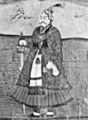
Ahmad Shah I Wali.
-

Tomb of Ahmad Shah I Wali.