
The Battle of Talikota (23 January 1565) was a watershed battle fought between the Vijayanagara Empire and an alliance of the Deccan sultanates. The defeat of Aliya Rama Raya led to the eventual collapse of the polity and reconfigured Deccan politics.
The specific details of the battle and its immediate aftermath are notoriously difficult to reconstruct in light of the distinctly contrarian narratives present across primary sources. Defeat is usually blamed on the gap in relative military prowess.Orientalist and nationalist historians asserted of the battle to be a civilization-clash between Hindus and Muslims; this view has since penetrated into the Hindutva discourse. Modern scholars unanimously reject such characterizations as fatally flawed.
Background
Rama Raya, after his installation of a patrimonial state and emerging as the ruler, adopted a political strategy of benefiting from the internecine warfare among the multiple successors of the Bahmani Sultanate, and it worked well for about twenty years of his reign.
However, after a series of aggressive efforts to maintain hold over Kalyan and diplomatic dealings with the Sultanates laden with insulting gestures, the four Muslim Sultanates – Hussain Nizam Shah I and Ali Adil Shah I of Ahmadnagar and Bijapur to the west, Ali Barid Shah I of Bidar in the center, and Ibrahim Quli Qutb Shah Wali of Golkonda to the east – united in the wake of shrewd marital diplomacy and convened to attack Aliya Rama Raya, in late January 1565.
Battle

Battle of Talikota.
Sources
There exists multiple contemporary chronicles (literary as well as historical) documenting the war:–
- Burhan-i Maasir by Sayyid Ali Bin Abdullah Tabataba, the court historian of Ahmadnagar Sultanate.
- Gulshan-i Ibrahimi by Ferishta, the court historian of Bijapur Sultanate.
- Taḏkerat al-molūk by Rafi-ud-Din Shirazi, another court historian of Bijapur Sultanate.
- Décadas da Ásia by official Portuguese record-keeper Diogo do Couto.
- Letters by Goa governor Dom Antão de Noronha.
- Fath-Nama-i Nizam Shah by Hasan Shauqi, a Dakhni poet.
- Tarif-i Husayn Shah by Aftabi, a poet at Ahmadnagar court.
Notwithstanding their obvious biases and exaggerations, the details of the battle and immediate aftermath are often distinctly contrarian and reconstruction is difficult, if not impossible. Error-ridden translations remain an issue, as well.
Description
The exact venue of clash has been variously mentioned as Talikota, Rakkasagi-Tangadigi and Bannihatti — all on the banks of river Krishna. There exists debate as to the precise dates. Span-lengths vary from hours to days; descriptions of battle formations and maneuvers vary widely, as well.
Outcome
Rama Raya was eventually beheaded by Sultan Nizam Hussain himself (or on his behest); Adil Shah who had friendly relations with Rama Raya intended against. Rama Raya’s death created confusion and havoc. His brother Tirumala deserted the battlefield with the entire army and tried to temporally regroup in Vijaynagara, before quickly moving on to the outskirts of their empire. His other brother was blinded and was probably a battle-casualty.
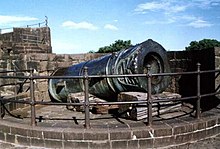
The “Malik-i-Maidan” (Master of the Field) cannon, stated to be the largest piece of cast bronze ordnance in the world, was utilized by the Deccan Sultanates during the Battle of Talikota. It was provided by Ali Adil Shah I(Bijapur Sultanate)
The Sultanates’ armies went on to plunder Vijaynagara, unopposed. Popular accounts (and older scholarship) describes of Vijaynagara being since reduced to rubble, in light of the widespread desecration of sacred topography; however, this view has been contested.Historians and archaeologists warn against conflating the state with the town, in that little evidence exists about any damage beyond the Royal Center of Vijaynagara and further emphasize about the politically strategic nature of destruction and arson, in that specific sites associated with sovereignty, royal power and authority were subject to more wanton destruction.
Analysis of defeat
Vijayanagara side was winning the war, state Hermann Kulke and Dietmar Rothermund in a survey of Indian history, until two Muslim generals of the Vijayanagara army switched sides and turned their loyalty to the Sultanates. Many scholars however reject this account of treachery as a post-battle speculation by Venetian merchant Cesare de Federici in Viaggi, which was taken up by a section of nationalist historians in their quest to identify traitors upon whom the responsibility of any and all Hindu defeats can be entrusted; a gulf of difference in military prowess (primarily stemming from a failure to incorporate gunpowder technology) is instead noted as the primary factor.
Legacy
The battle caused a political rupture for the state of Vijaynagara and permanently reconfigured Deccan politics. Patronage of monuments and temples ceased, the Vaishnava cult perished, and Vijaynagara was never rebuilt.
The Bijapur Sultanate reaped maximum gains of the battle but the alliance did not last long. Tirumala went on to establish the Aravidu dynasty, which held sway over different fragments of the erstwhile empire and even operated out of Vijaynagara for two years, before shifting to Pengonda. But faced with internal feuds about succession, multiple local chieftains (primarily Telegu Nayak houses) growing increasingly assertive of their independence who did not wish for the reemergence of a central Vijayanagar authority, and continuous conflicts with the Bijapur Sultanate (who might have been invited by Rama Raya’s son), it moved southwards before disintegrating in the late 1640s.
Clash of civilizations
Colonial era historians (Robert Sewell, Jonathan Scott et al) drawing from the accounts of Firishta and later, nationalist historians (Aluru Venkata Rao, B. A. Saletore, S. Krishnaswami Aiyangar, K. A. Nilakanta Sastri et al) lensed the battle as a Clash of Civilizations wherein the “Ramrajya” of Vijayanagara, a “Hindu bulwark” state fell to “Muhammedan” conquests driven by religious bigotry.
Richard M. Eaton rejects that there were any religious motives behind the battle and described of the civilization-hypothesis as orientalist scholarship, which ignored the multiple alliances of Rama Raya with different Muslim rulers at different spans of time (in tune to his political strategy), the thorough perfusion of Persian Islamate culture with Vijaynagara Kingdom, as evident from court-sanctioned art, architecture and culture, and strategic alliances of Rama Raya’s heirs (Aravidus) with heirs of the Deccan Sultans. Romila Thapar, Burton Stein, Sanjay Subrahmanyam, Muzaffar Alam, Stewart N. Gordon and other scholars agree on the basis of similar analyses; additional arguments include that the Berar Sultanate did not join the battle and that the Sultanate-alliance dissipated soon enough. Harmonious Hindu-Muslim relations in the empire has been documented and there were high placed Muslims in Vijaynagara Court.
A report in Frontline states that this debunked argument has been weaponized by the Hindu right in its bid to demonize (and other) the Muslim in contemporary India.
Popular culture
The battle has been adopted into a play by Girish Karnad, who based it on Eaton’s analysis.