
Rajput painting, also called Rajasthan painting, evolved and flourished in the royal courts of Rajputana in northern India, mainly during the 17th and 18th centuries. Artists trained in the tradition of the Mughal miniature were dispersed from the imperial Mughal court, and developed styles also drawing from local traditions of painting, especially those illustrating the Hindu religious epics, the Mahabharata and Ramayana.
Subjects varied, but portraits of the ruling family, often engaged in hunting or their daily activities, were generally popular, as were narrative scenes from the epics or Hindu mythology, as well as some genre scenes of unnamed people.
The colors were extracted from certain minerals, plant sources, conch shells, and were even derived by processing precious stones. Gold and silver were used. The preparation of desired colors was a lengthy process, sometimes taking 2 weeks. Brushes used were very fine.
Content
While there exist a plethora of themes in Rajput paintings, a common motif found throughout Rajput works is the purposeful manipulation of space. In particular, the inclusion of fuller spaces is meant to emphasize the lack of boundaries and inseparability of characters and landscapes. In this way, the individuality of physical characters is almost rejected, allowing both the depicted backgrounds and human figures to be equally expressive.
Outside of a purely artistic standpoint, Rajput paintings were often politically charged and commented on social values of the time. Mewars rulers wanted these painting to portray their ambitions and establish their legacy. Therefore, paintings were often indicative of a ruler’s legacy or their changes made to better society.
Both of these factors clearly distinguish Rajput paintings from Mughal works. While, from a chronological standpoint, both of these cultures clashed with one another, Rajput paintings only superficially adopted Mughal fashion and cultural standards. Elements, such as precise likenesses in portraiture, utilized by popular Mughal artists (Govhardhan, Hashim, etc.) are not found in Rajput works. Likewise, Rajput techniques are not predominantly seen in Mughal paintings: “At the opening of the eighteenth century, therefore, Rajput painting remains recognizably different in intent from traditional Mughal attitudes”
Schools
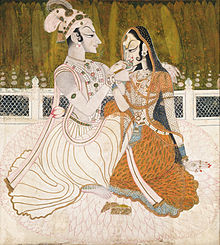
Krishna and Radha, might be the work of Nihâl Chand, a master of the Kishangarh school trained at the imperial court in Delhi.
In the late 16th Century, Rajput art schools began to develop distinctive styles, combining indigenous as well as foreign influences such as Persian, Mughal, Chinese and European. Rajasthani painting consists of four principal schools that have within them several artistic styles and substyles that can be traced to the various princely states that patronised these artists. The four principal schools are:
- The Mewar school that contains the Chavand, Nathdwara, Devgarh, Udaipur and Sawar styles of painting
- The Marwar school comprising the Kishangarh, Bikaner style of painting from Bikaner, Jodhpur, Nagaur, Pali and Ghanerao styles
- The Hadoti school with the Kota, Bundi and Jhalawar styles and
- The Dhundar school of Amber, Jaipur, Shekhawati painting and Uniara styles of painting.