
Hyderabadi biryani, also known as Hyderabadi dum biryani, is a style of biryani from Hyderabad, India made with basmati rice and goat meat and cooked with the dum pukht method. Originating in the kitchens of the Nizam of Hyderabad, it combines elements of Hyderabadi and Mughlai cuisines. Hyderabad biryani is a key dish in Hyderabadi cuisine.
History
Hyderabad was conquered by the Mughals in the 1630s, and ruled by its Nizams. Mughlai culinary traditions joined with local traditions to create Hyderabadi cuisine. :92 Local folklore attributes the creation of Hyderabadi biryani to the chef of the first Nizam, Nizam-ul-Mulk, Asaf Jah I, in the mid 18th century, during a hunting expedition. In 1857, when the Mughal Empire declined in Delhi, Hyderabad emerged as the center of South Asian culture, resulting into mix of innovations in Hyderabadi biryani.:viii
Origin
The exact origin of the dish is uncertain. Despite legends attributing it to the Nizam’s chef, the biryani is of South Indian origin, derived from pilaf varieties brought to South Asia by Arab traders. Pulao may have been an army dish in medieval India. Armies would prepare a one-pot dish of rice with whichever meat was available. The distinction between “pulao” and “biryani” is arbitrary. Until later found Biryani was originated in Persia; the word comes from Persian language “birian” which means “fried before cooking.” Mughals introduced biryani to Indian people during the reign of Mughal empire. India has various cultures and cooking styles; Mughlai cooking has influenced the Indian style of cooking. For example, slow cooking, marination, and use of butter-based curries. Even though, the dish was originated in Persia, Indians has revolutionized the recipe and the history. During the reign of Asif Jah, the Nizam of Hyderabad, his cooks would marinate the meat overnight.
Ingredients
-

Hyderabadi biryani (on the left) served with other Indian dishes.
-
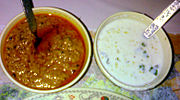
Two biryani accompaniments: mirchi ka salan and Raitha/dahi chutney.
Base ingredients are basmati rice, goat meat or (sometime chicken or beef), dahi, fried onion and ghee. Spices include; cinnamon, cloves, cardamom (elaichi), bay leaves, nutmeg, papaya paste, Caraway (shahi jeera), mace flower (javitri), star anise (biryani flower), lemon, and saffron. Coriander leaves and garnish.
Types

Chef Asma Khan about to open a dum biryani
Hyderabadi biryani is of two types: the kachchi (raw) biryani, and the pakki (cooked) biryani.
Kachch-e-gosht ki biryani
The kachchi biryani is prepared with kachchi gosht (raw meat) marinated with spices overnight and then soaked in curd (dahi) before cooking. The meat is sandwiched between layers of fragrant basmati rice and cooked “in dum” after sealing the handi (vessel) with dough. This is a challenging process as it requires meticulous attention to time and temperature to avoid over- or under-cooking the meat.
Praise
Various critics have praised Hyderabadi biryani:
- “the origin of the Biryani is hazy but among all the biryanis, the thoroughbreds are from Hyderabad.
- “Hyderabad’s take on the classic (biryani) is the finest you’ll find anywhere in the world”.
- “Hyderabadi biryani as the best best biryani in United Arab Emirates”.
Accompaniments
A biryani is usually served with dahi chutney and mirchi ka salan. Baghaar-e-baingan is a common side dish. The salad includes onion, carrot, cucumber, and lemon wedges.