
The Persian language in the Indian subcontinent (Persian: زبان فارسی در شبه قاره هند), before the British colonisation, was the region’s lingua franca and a widely used official language in North India. The language was brought into South Asia by various Turkicand Afghan dynasties, in particular the Turko-Afghan Ghaznavids, Delhi Sultanate and the Mughal Dynasty. Persian held official status in the court and the administration within these empires. It largely replaced Sanskrit as the language of politics, literature, education, and social status in the subcontinent.
The spread of Persian closely followed the political and religious growth of Islam in the Indian subcontinent. However Persian historically played the role of an overarching, often non-sectarian language connecting the diverse people of the region. It also helped construct a Persian identity, incorporating the Indian subcontinent into the transnational world of Greater Iran, or Ajam. Persian’s historical role and functions in the subcontinent have caused the language to be compared to English in the modern-day region.
Persian’s official status was replaced with English in 1835 by the British East India Company. After 1843, Hindi/Urdu and English gradually replaced Persian in importance in the Indian subcontinent as the British had full suzerainty over it.
Persian’s linguistic legacy in the region is apparent through its impact on the Indo-Aryan languages. It played a formative role in the emergence of Hindi and Urdu(Hindustani), and had a relatively strong influence on Punjabi, Sindhi, and Kashmiri. Other languages like Gujarati, Marathi, Bengali, Rajasthani, and Odia also have a considerable amount of loan words from Persian.
Background
Persian’s arrival in the Indian subcontinent was the result of a larger trend in Greater Iran. In the aftermath of the Muslim conquest of Persia, new Iranian-Islamic empires were emerging, reviving Persian culture in a new Islamic context. This period is known as the Iranian Intermezzo, spanning the 9th to 10th centuries, and reestablished in the Persian language the refinement and prestige that Arabic had laid claim to. In the process, Persian adopted Arabic’s script and incorporated many Arabic words into its vocabulary, evolving into a new form known as New Persian.
These empires were affecting Turkic peoples in and around the region in two primary ways:
- They inherited the Abbasid tradition of employing Turkic slave warriors in their military, which assimilated them into a Persianate culture. These warriors were able to rise up the ranks and gain political power, effectively creating a class of Turko-Persian conquerors.
- Their rule extended over the Turkic peoples of Transoxiana. This began to Persianise them, and some were absorbed into the courts.
This assimilation of Turkic culture led to the synthesis of what is called the Turko-Persian tradition. The warrior class that emerged from this had Persian tastes; for example, Mahmud of Ghazni was a great patron of Persian writers such as Farrukhi. For these reasons, it was Persian that spread widely in India into a secular, common language, rather than Turkic, or even Arabic which was so prevalent farther west.
Immediately adjacent to the lands of the Persians and Turks, the Indian subcontinent became a target for these new conquerors looking to establish themselves, and this New Persian was carried along with them.
History
Indo-Persian synthesis
The Ghaznavid conquests of the 11th century introduced Persian to the Indian subcontinent. As Mahmud of Ghazni established a power base in India, the centre of Persian literary patronage shifted from Ghazna to the Punjab, especially at the empire’s second capital Lahore. This began a steady influx of Persian-speaking soldiers, settlers and literati from Iran, Khorasan, and other places of the Persianate world. This flow would stay largely uninterrupted for the next few centuries. Notable Persian poets of this early period include Abu-al-Faraj Runi and Masud Sa’d Salman, both born in the Indian subcontinent. The Ghurids expanded this territory, shifting Perso-Islamic influence further into the subcontinent and claiming Delhi.
Virtually every Islamic power thereafter followed the Ghaznavids’ practice of using Persian as a courtly language. Delhi became a major centre of Persian literary culture in Hindustan from the 13th century onwards, with the establishment of the Delhi Sultanate by the post-Ghurid Mamluks. The successive Khiljis and Tughluqs sponsored many pieces of literature in the language; celebrated poet Amir Khusrow produced much of his Persian work under their patronage. From the 13th to 15th century, the Turkic rulers of the Sultanate encouraged the flow of eminent Persian-speaking personalities (such as poets, scribes, and holy people) into the subcontinent, granting them land to settle in rural areas. This flow was increased by the Mongol conquests of the Perso-Islamic world, as many Persian elite sought refuge in North India. Hence the Persian language established itself in court and literature, but also through a sizeable population often associated with Islamic nobility. The Delhi Sultanate was largely the impetus for the spread of Persian as a prestige language, since its borders stretched deep into the subcontinent. In the wake of its gradual disintegration, the various outgrowths of the empire in regions as far as the Deccan and Bengal adopted Persian as a result.
The language had a brief dormant period in the late 15th to early 16th century, after the Delhi Sultanate was sacked by Timur. Afghan dynasties such as the Suris and Lodisgained control in the north of the subcontinent, and although Afghans at the time were a part of the Persianate world, these rulers were not well-acquainted with the language (but they promoted it to some degree). In this era, empires all over the subcontinent began to employ Hindustani’s emerging predecessor Hindavi (also known as Dehlavi or Deccani) as a language of the court. Work in Persian was however still produced. Notably, the Delhi Sultanate’s official language was declared as Persian by Sikandar Lodi, which began a diffusion process outside Islamic nobility; Hindus for the first time began to learn the language for purposes of employment, and there is evidence of them even teaching the language in this period.
Persian experienced a revival with the advent of the Mughal emperors (1526–1857), under whom the language reached its zenith. This was not only because of the Mughals’ Timurid roots: Humayun’s reconquest of India was with the aid of Safavid Iran, and ushered many Iranians into India. His successor Akbar developed these ties by attracting many Persian literati from Iran. Akbar’s heavy patronage of Persian effectively transitioned the Mughal royals from Central Asian to Persian court culture, leading to a “golden age” of Persian literature in India for the next 200 years. Additionally, Akbar’s secular and pluralist rule resulted in many Hindus becoming more open to learning the language, and he introduced educational reforms that emphasised Persian learning. He declared Persian the official language of the Mughal Empire, a policy it would retain till its demise. Akbar’s patronage of Persian continued with his successors; the literary environment created under them led one poet to comment,
|
nīst dar irān zamīn sāmāne tahsile kamāl |
There is not in the Persian land the requisite material for the perfection of art, |

A firman issued under Mughal Emperor Aurangzeb, written in Persian. Hindus employed in the Mughal finance department were known to excel at writing these documents, which were used as examples in educational institutions.
Under the Mughals, Persian took prominence as the language of culture, education, and prestige. Their policies resulted in a process of “Persianisation” by which many Indian communities increasingly adopted the language for social purposes. In this way, Persian became a second language to many across North India; Alam contends that it neared the status of a first language. By the 18th century, many Indians in the north of the subcontinent had a “native speaker’s competence in Persian”.
Apart from courtly influence, Persian also spread through religion, particularly the Islamic faith of Sufism. Many Sufi missionaries to the subcontinent had Persian roots, and although they used local Indic languages to reach their followers, they used Persian to converse amongst each other and write literature. This resulted in a diffusion process into the local followers of the faith. Sufi centres (Khanqah) served as focal points for this cultural interaction. Sufism also interacted with Hinduism through the Bhakti movement; Abidi and Gargesh speculate that this could have further introduced Persian to locals.
Following Aurangzeb’s death, Persian began to fall into decline, being displaced by Hindustani (Hindi-Urdu). Beginning in 1843, English accompanied Hindustani in phasing out Persian’s importance on the subcontinent. Famed poet Mirza Ghalib lived during the region’s transition period into British sovereignty, producing many works in the language. Colonial-era poet Muhammad Iqbal’s Persian literature is considered the last great instance of the Indo-Persian tradition.
Punjab
As the primary entry point and frontier region of the Indian subcontinent, the Punjab region has had a long association with the Persian language. Following the defeat of the Hindu Shahi dynasty, classical Persian was established as a courtly language in the region during the late 10th century under Ghaznavid rule. After Lahore was made the second capital of the Ghaznavids, it played host to great poets in the court, and was settled by many Persian-speakers from the West. The first Indian-born Persian poet was from Lahore.
In the 13th century, Nasiruddin Qabacha declared himself independent of the Ghurids. His dominion, the Sindh, was conducive to Persian literary activity at the centers of Multan and Uch, where Muhammad Aufi wrote the Lubab ul-Albab.
Employed by Punjabis in literature, Persian achieved prominence in the region during the following centuries, as the region came under the Delhi Sultanate and the Mughals. The language of the Sikh gurus (Sant Bhasha) incorporated Persian, and some of their works were done entirely in the language; examples are the Zafarnama and the Hikāyatān.
Persian continued to act as a courtly language for various empires in Punjab through the early 19th century, and dominated most literary spheres. It served finally as the official state language of the Sikh Empire, under which Persian literature such as Zafarnamah-e-Ranjit Singh was produced, preceding British conquest and the decline of Persian in South Asia. Muhammad Iqbal, a Punjabi, was one of the last prolific writers of Persian in the subcontinent.
Kashmir
Kashmir was another region impacted heavily by Persian. Though it had long been a centre of Sanskrit literature, the language was in decline from the 13th century, due to internal social factors. Persian was introduced to the region in the 14th century, spreading through the Islamisation of Kashmir by early Sufi saints such as Mir Sayyid Ali Hamadani. The emergence of the native Shah Mir dynasty shortly after saw Persian become the official language of administration. Some of its members, chiefly Zain-ul-Abidin, patronised various kinds of literature.
The historical prevalence of Persian in the region is illustrated by the case of the Kashmiri Pandits, who adopted Persian in place of their ancestral language Sanskrit, in order to make Hindu teachings more accessible to the population. They translated texts such as the Ramayana and Shivapurana, even composing hymns in praise of Shivathrough the medium of ghazal. Some of the earliest Persian literature of the region in fact constituted such translations of Sanskrit works; under the Shah Mirs the monumental Sanskrit history of Kashmir Rajatarangini was translated into Bahr al-asmar, and the efforts of the Pandits added Hindu astronomical and medical treatises to the literature.
Hence Persian enjoyed a superior position in the valley as prestige language from its early days. It retained its political and literary status for the next 500 years under the Mughals, Afghans, and Sikhs. Poetry, histories and biographies were among some of the works produced over these years, and many Kashmiris received an education in Persian for careers as accountants and scribes in government. Iranians often migrated to Kashmir, and the region was known in the Persianate world as Iran-e-saghir, or “Little Iran”.
The advent of the Dogra dynasty (under British suzerainty) in 1849 led to the decline of Persian. Although they inherited and used a Persian administrative system, social changes brought by them led to Urdu being instituted as the language of administration in 1889.
Bengal

A Sharaf-Nama manuscript that was owned by the Sultan of BengalNasiruddin Nasrat Shah. It shows Alexander sharing his throne with Queen Nushabah.
Persian was introduced into Bengal through the Bengal Sultanate, established by the Ilyas Shahi dynasty in the 14th century. During their rule, the language was spoken in the court as well as in administration. It was used primarily in urban centres such as Gaur, Pandua, and Sonargaon, having diffused into the elite population (Muslim and non-Muslim) through the administration. However, Persian was not the sole language of governance; the majority of official documents were written in Arabic, as were most inscriptions. Coins were minted with Arabic text. Notably, there is no evidence of significant Persian literary patronage under the Bengal Sultans; court poetry and creative texts were composed in the Bengali language instead. Persian literature mostly came from outside the court, such as the works of Sufism and the “popular literature” created by Bengali Muslims.
Nonetheless, the courtly usage of Persian indicates some degree of influence, and Persian literary tradition did impact the region. The spread of the language among Muslims and upper-class Hindus meant an appreciation of Persian literature, indicated by famed Persian poet Hafez, who referenced Bengal in a verse from his Diwan:
|
Šakkar-šakan šavand hama tūtīyān-e Hend |
All the parrots of India started crushing sugar |
| —This verse is often partially attributed to Sultan Ghiyasuddin Azam Shah, but doubt has been cast on the historical accuracy of such a claim. |
In the 16th century, the Bengal region came under the Mughals to form the Bengal Subah, and in this era Persian’s impact was much more profound. Mughal rule brought a highly Persianised court and administration to Bengal, as well as an influx of Iranians and northern Indians. This established Persian as a language of public affairs and courtly circles, and an indispensable tool of social mobility. The Persian language became entrenched in the Bengali Hindu upper class, remaining even into the 19th century. The imposition of Mughal administration on the region also meant that the general populace came into contact with officers that did not know Bengali. This led to a diffusion process, as locals learned the Persian language in order to communicate with them.
Deccan

A Persian poem produced in the Deccan. 17th century.
Although considerably distanced from North India, the Deccan was also a recipient of Persian’s linguistic impact. Persianate culture was brought to the Deccan fleetingly through the efforts of the Delhi Sultanate in the early 14th century. Persian finally gained a foothold in the region with the establishment of the Bahmani Sultanate in 1347, which used the language for official purposes. The dynasty had a great interest in Persian culture (they claimed descent from Persian mythological figure Bahman), and several members were proficient in the language, producing their own literature. Literati from Northern India found themselves welcome at the court, and scholars from Iran were invited as well. Madrasas were built over the expanse of the kingdom, most notably the Mahmud Gawan Madrasa at Bidar, where Persian was taught.
During the turn of the 16th century, the Bahmani Sultanate splintered into the Deccan Sultanates, which were also Persianate in culture. They too adopted Persian as an official language, and patronised Persian literature. However, they also promoted regional languages such as Telugu, Marathi, and Deccani, at times even using it in administration. This was in contrast to the near-contemporary Mughals of the north, who solely pursued Persian. Deccani, rather than Persian, became a lingua franca in the south.
The reign of the Deccan Sultanates lasted until the late 17th century, when Aurangzeb brought the region into the Mughal Empire and established Aurangabad as the Deccan’s capital. As was Mughal practice, Persian was used in many levels of administration.
Major cities of this region that served as centers of Persian patronage included Gulbarga, Bidar, Bijapur, and Golconda. Notable Persian literature produced includes Futuh-us-Salatin, and the Bahmannamāh.
Parsi community
A minor, but parallel vehicle for the Persian language was the arrival of ZoroastrianPersians in the subcontinent, fleeing from the Muslim conquest of Persia in the 7th century. Their language was Middle Persian; however, their assimilation into Indic cultures has led to the disappearance of this language.
Influence on Indic languages
As a prestige language and lingua franca over a period of 800 years in the Indian subcontinent, Persian exerted a vast influence over numerous Indic languages. Generally speaking, the degree of impact is seen to increase the more one moves towards the north-west of the subcontinent, i.e. the Indo-Iranian frontier. For example, the Indo-Aryan languages have the most impact from Persian; this ranges from a high appearance in Punjabi, Sindhi, Kashmiri, and Gujarati, to more moderate representation in Bengali and Marathi. The largest foreign element in the Indo-Aryan languages is Persian. Conversely, the Dravidian languages have seen a relatively low level of influence from Persian. They still feature many loans from the language, some of which are direct, and some through Deccani (the southern variety of Hindustani), due to the Islamic rulers of the Deccan. Telugu is a good example of this (see Telangana Baasha for the Telugu dialect accentuated with these features).
Hindustani is a notable exception to this geographic trend. It is a lingua franca spoken widely across the Hindi Belt and Pakistan, best described as an amalgamation of a Khariboli linguistic base with Persian elements. It has two formal registers, the Persianised Urdu and the de-Persianised, Sanskritised Hindi. Even in its vernacular form, Hindustani contains the most Persian influence of all the Indo-Aryan languages, and many Persian words are used commonly in speech by those identifying as “Hindi” and “Urdu” speakers alike. These words have been assimilated into the language to the extent they are not recognised as “foreign” influences. This is due to the fact that its emergence was characterised by a Persianisation process, through patronage at Islamic courts over the centuries. Hindustani’s Persian register Urdu in particular has an even greater degree of influence, since it freely uses its historical Persian elements and actively looks towards the language for neologisms.
The following Persian features are hence shared by many Indic languages but vary in the manner described above, with Hindustani and particularly its register Urdu bearing Persian’s mark the most. It is also worth noting that due to the politicisation of language in the subcontinent, Persian features make an even stronger appearance among the Muslim speakers of the above languages.
Vocabulary
Loanwords
One of the most significant impacts of Persian was the transfer of vocabulary, which entered most spheres of usage. Nouns make up the largest portion of these loanwords. Many Persian loans are used commonly in everyday speech; dukān, hazār, shehar, āinā, chehrā, bāzār, and dōst are a few examples. A categorised list is provided below, which is far from exhaustive. Note that many of these words have an altered pronunciation depending on the recipient language due to nativisation.
| Loan category | Examples |
|---|---|
| Nouns | |
| Proper names | Muslim names: Akhtar, Nawaz, Aftab, Dilshad, Feroz, Shah Bano, ZarinaNon-Muslim names: Bahadur Shah, Chaman, Iqbal, Roshan. |
| Titles | Bahadur Shah, Mirza, Khan, Begum (these survive as surnames) |
| Parts of the body | jism (body), khūn (blood), nākhūn (nail, of fingers and toes), sīnā(chest),dil, (heart), gardan (neck), zabān (tongue), halaq (throat) |
| Place names(Suffixes) | –ābād, -stan –ganj, –bagh, –sarāi (Hyderabad, Pakistan, Hazratganj, Mughalsarai) |
| Kinship terms | dāmād (son-in-law), bābā (father), shauhar (husband), birādar(brother) |
| Food | sabzī (vegetables), nān (bread), kormā (curry), gōsht (meat), kīmā (minced meat), tandūri (roasted) |
| Clothing | paushāk (dress), pajāmā (pyjamas), kamīz (shirt), jeb (pocket), astar (inner, lining) |
| House | gusalkhānā (bathroom), pākhānā (toilet), bāwarchīkhānā(kitchen), darwāzā (door), diwār (wall) |
| Ornaments | zewar (ornaments), gulband (necklace), dastband (bracelet), pazeb (anklet) |
| Fruits | seb (apple), anār (pomegranate), angūr (grapes), nārangī(tangerine), bādām (almond) |
| Fauna | sher (lion), khargosh (rabbit), bulbul (nightingle), bāz (falcon), kabutar (pigeon) |
| Vegetables | shalgam (turnip), qaddū (pumpkin), sakarqand (sweet potato) |
| Flora | cinār (plane tree), hinā (henna), banafshā (pansy), gulāb (rose), nīlofar (water lily), yāsmīn (jasmine) |
| Professions | darzī (tailor), hajjām (barber), sabzī–farosh (greengrocer), khānsāmā (cook) |
| Agriculture | fasl (crop), rabi (spring), khārīf (autumn), ābpashī (watering), nahar (canal), zamīn (land) |
| Law | adālat (court), qānūn (law), muddai (plaintiff), vakīl (lawyer), muakil (client) |
| Administration | darbār (court), pādshah (emperor), tehsīldār (tax collector), zila(district) |
| Writing | qalam (pen), dawāt (inkpot), syāhi (ink), kāgaz (paper) |
| Religion (non-Arabic terms) | rōza (fasting), namāz (ritual prayer), khudā (God), dargāh (Sufi shrine), pīr (Sufi master) |
| Measurement | gaz (yard), mīl (a mile), man (a mound), ser (a seer), murabbā(square) |
| Military | sipāhī (soldier), top (gun/cannon), topchī (gunner), topkhānā(artillery) |
| Other | |
| Modifiers: | bilkul (surely/definitely), garm (hot), tāzā (fresh) |
| Function words:(conjuctions, interjections etc.) | magar (but), lekin (but), afsōs (alas), shabāsh (well done), zabardast (forceful, awesome) |
| Sources in order of importance: | |
The majority of Arabic words present in Indic languages entered through Persian; for example, the terms listed under “law” above are Arabic, as are miscellaneous words like “lekin” and “qalam”. The largest impact of Arabic in the Indic lexicon is religious terminology (not listed), and many of even these are through Persian. This is evident in words such as Ramazān and azān in the Indic languages, as opposed to Arabic Ramadan and adhan, where the difference is due to Persian’s transformation of Arabic letter ض (Ḍād) to z. For these reasons Persian influence is often termed “Perso-Arabic”.
To a lesser extent, Turkic words also entered through Persian. The terms under “titles” and “military” are largely Turkic, due to the rulers’ ethnic roots and the prevalence of Turkic soldiers in their armies.
Compounds
Persian has also contributed compound formations in Indic languages, using words and affixes:
| Compound formations | |
|---|---|
| Word/Affix | Examples |
| -khānā (house) | jelkhānā (jail), dākkhānā (post office) |
| -kār (doer) | kalākār (artist), patrakār (journalist), jānkār (one who knows) |
| -dār (having) | phaldār (fruitbearing), māldār (rich), dendār (debtor), bhāgīdār (partner) |
| -bāz (with the quality of) | cālbāz (schemer), patangbāz (kite-flier), daghābāz(deceiver) |
| be- (without, original Persian bī) | befikr (care-free), bechara (helpless), besharam(shameless) |
| nā- (non) | nāsamajh (without understanding), nākārā (jobless) |
| Sources: | |
Phonetics
Through loanwords, Persian has introduced the sounds q, kh, gh, z, f into many Indic languages. These have been nativised to k, kh, g, j, ph respectively (e.g. khud → khud, ghulām → gulām). However, the original sounds are considered valid in these languages, with the original forms of z and f occurring very commonly. Scripts have also accommodated these sounds; Devanagari adds a dot (nuqta) under the native letters to indicate the Persian loan (क़, ख़, ग़, ज़, फ़). Urdu retains q, kh, gh to a greater degree, regarding them as proper pronunciation (talaffuz). The same is seen in formal contexts among those speakers of Punjabi, Bengali etc that draw from Perso-Arabic elements, such as Muslims.
Grammar
A lesser but notable impact of Persian is the transfer of simple grammatical structures. These are the ezāfe (Salam-e-Ishq, Sher-e-Bangla) and -o- (roz-o-shab). They inherit the same meaning as Persian, but are generally used in more formal, literary contexts. They appear in multiple impacted languages, but to varying extents, with the most usage occurring in Urdu. Many Indic languages inherit the practice of pluralising nouns by suffixing -ān (chudiyān, ladkiyān) – but unlike in Persian, the n is nasalised (ṅ). Additionally, the conjunction ki/ke used extensively in these languages to mean “that” is drawn from Persian.
Writing systems
The prevalence of Persian also resulted in the Perso-Arabic script being adopted for several languages, such as Hindustani, Punjabi, and Kashmiri. Their alphabets differ slightly to accommodate unique sounds not found in Persian. Additionally, the Nastaliq calligraphy style popularised by Persian is almost universally used when writing these languages in their Perso-Arabic form.
Literature
A large corpus of Persian literature was produced by inhabitants of the Indian subcontinent. It consists of several kinds of works: poetry (such as rubaʿi, qasidah), panegyrics (often in praise of patron kings), epics, histories, biographies, and scientific treatises. These were written by members of all faiths, not just Muslims.
This extended presence and interaction with native elements led to the Persian prose and poetry of the region developing a distinct, Indian touch, referred to as sabk-e-Hindi(Indian style) among other names. It was characterised by multiple traits: the presence of many Indic loanwords, adopted to describe the language’s new environment; Indian phrases and themes; and an ornate, flowery poetic style. For example, the monsoon season was romanticised in Indo-Persian poetry, something that had no parallel in the native Irani style. Due to these differences, Iranian poets considered the style “alien” and often expressed a derisive attitude towards sabk-e-Hindi.
Translations from other languages greatly contributed to the Indo-Persian literary corpus. Arabic works made their way into Persian (e.g. Chach Nama). Turkic, the older language of Islamic nobility, also saw translations (such as that of Chagatai Turkic”Baburnama” into Persian). Notably, a vast number of Sanskrit works were rendered into Persian, in order to transfer indigenous knowledge; these included religious texts such as the Mahabharata (Razmnama), Ramayana and the four Vedas, but also more technical works on topics like medicine and astronomy, such as Zij-e-Mohammed-Shahi. This provided Hindus access to ancient texts that previously only Sanskritised, higher castes could read.
Contemporary
The Persian language is now largely defunct in the Indian subcontinent. Some colleges and universities in India, Pakistan, and Bangladesh offer Persian as a course of study. As a spoken language, it still lingers in some scholarly circles. It is linguistically the same as Iranian Farsi, but differs in pronunciation, since it has retained some archaisms and has also been nativised through contact with other languages.
Although Arabic has largely dominated the realm of Islamic liturgy and theology in the Indian subcontinent, Persian can be seen to this day in the dhikr sessions of Sufism, which often employ Persian poetry in song. The Sufi devotional music genre of qawwalialso uses Persian in parallel with local languages. Famed qawwali singer Nusrat Fateh Ali Khan sang sometimes in Persian.
The post-colonial era has seen Persian loanwords continue to move into regional languages through Hindustani, one of the lingua francas of the area. A notable example is that of Pakistan, where the imposition of Urdu as national language and its widespread use has led to a growing Perso-Arabic influence on Pakistan’s indigenous languages.
The Parsi community speaks a dialect of Gujarati which has been influenced by their ancestral language of Persian. In 1932, the first ever sound film in the Persian language, Dokhtar-e-Lor, was produced in Bombay by Parsi Indians. There is also a small population of Zoroastrian Iranis in India, who migrated in the 19th century to escape religious persecution in Qajar Iran and speak a Dari dialect.
See also
- Indo-Persian culture
- Lisan ud-Dawat, Perso-Arab-influenced Gujarati
- Persian Inscriptions on Indian Monuments (book)
Gallery
- Persian manuscripts
-

Firman issued under Mughal Prince Dara Shikoh, dated 1649-1650.
-

Marriage certificate of last Mughal emperor Bahadur Shah Zafar, 1840.
-
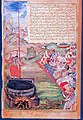
Scene from a Razmnama manuscript: Arjuna hits the fish-eye target, Draupadi’smarriage.
-

Page from a Persian translation of Harivamsa, describing Krishnaholding up Mount Govardhana.
-

Page from a copy of the Tutinama. While this copy was commissioned by Akbar, the Tutinamaitself was a 14th century translation to Persian drawing from the Sanskrit Śukasaptati.
-

Page from the Persian translation of Babur’s memoirs, Baburnama.
-
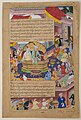
Page from Chingiz Nama(Book of Genghis), commissioned under Akbar.
-
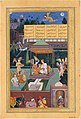
Folio from a copy of Amir Khusro’s Hasht-Bihisht, dated 1597–98.
-

Verses of the Beloved – love poetry by Munshi Ram, Bengal, 18th century.