
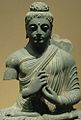
Buddhist symbolism is the method of Buddhist art to represent certain aspects of dharma, which began in the fourth century BCE. Anthropomorphic symbolism appeared from around the first century CE with the arts of Mathura the Greco-Buddhist art of Gandhara, and were combined with the previous symbols.
Each spiritual symbol contains underlying meaning and value in terms of the Buddha teaching.
- Sigālovāda Sutta
- Reflection of Buddhas nature
- Sukhavati realm
- Concept of Tri Kaya
- Four noble qualities
- Dhamma Wheel turning
- Awareness
- Equanimity concept
- Catumaharajika realm
Each symbol is additional proof that Buddhism teaching is flexible and harmonious amongst various cultures and people groups. These religious symbols reveal the adaptability of the Buddhas teachings that intertwine to other teachings and cultures as long as it remains relevant to its teachings.
Contents
- Mahayana symbolism
- Vajrayana iconography
- Tibetan Buddhist architecture
- Colour in Tibetan Buddhism
- Thangkas (paintings) and statues of buddhas and deities
- Symbolic physical attributes of Buddhism
- Ritual robes
- Ritual bells
- Bald monastics
- Prayer position
- Modern Pan-Buddhist symbolism
- Gallery
- See also
- References
- Bibliography
- External links
Mahayana symbolism

Lotus flower on a temple bell. The lotus represents purity of the body, speech, and mind as if floating above the muddy waters of attachment and desire.

Mahayana symbols: aṣṭamaṅgala
In the Mahayana schools, Buddhist figures and sacred objects leaned towards esoteric and symbolic meaning. Mudras are a series of symbolic hand gestures describing the actions of the characters represented in only the most interesting Buddhist art. Many images also function as mandalas.
Mahayana and Vajrayana Buddhist art frequently makes use of a particular set of “eight auspicious symbols” (Sanskrit aṣṭamaṅgala, Chinese: 八吉祥; pinyin: Bā jíxiáng), in domestic and public art. These symbols have spread with Buddhism to the art of many cultures, including Indian, Tibetan, Nepalese, and Chinese art.
These “Eight Auspicious Symbols” are:
- Lotus flower. Representing purity and enlightenment.
- Endless knot, or, the mandala. Representing eternal harmony.
- goldenfish. Representing conjugal happiness and freedom.
- Victory banner. Representing] victorious teachings.
- Wheel of the Dharma. Representing knowledge.
- Treasure vase. Representing inexhaustible treasure and wealth.
- Parasol. Representing the crown, Royalty (the Buddha) and protection from the elements.
- Conch shell. Representing spreading the teachings of the Buddha far and wide.
The “Three Main Symbols” of Buddhism would be 1) The Buddha 2) The Dharma (the Buddha’s teachings) 3) The Sangha (the united group of the Buddha’s followers, which include monastics and laymen and women
In East Asian Buddhism, the swastika is a widely used symbol of eternity. It is used to mark Buddhist temples on maps and in the beginning of Buddhist texts. It is known in Classical Tibetan as yungdrung (Wylie: g.Yung drung) in ancient Tibet, it was a graphical representation of eternity.
In Zen, a widely used symbol is the ensō, a hand-drawn circle.
Mahayana Buddhist tradition implements the use of symbols that cannot be interpreted by visitors who are not members of the temple. Each symbol is deliberately used to remind the followers of both cultural and spiritual values that are difficult to understand strictly through language and verbal practices.
The value of these cultural symbols in Vihara Lotus are found through the scope of statues and alters of Mahayana importance.
These include:
- Thian Kong Altar. The terminology of the name itself means “Heaven” or “Jade Emperor”, representing the residence of this Deity. Traditionally, facing forward to the sky is considered respectful to God almighty.

Hio Lo for Thian Kong: Burning incenses is a medium for communication with God Almighty
- Chinese Generals Altar. These generals symbolize merits to wide community and represent a positive implication towards persecution and being defied for your merits. According to the abbot, these were great Chinese generals like Lord Guanand Yue Fei who were defied because of their great qualities and merits.
- Earth Gods. Upon this altar, there are three Gods/Goddesses. Two of which stand under the table and one which is placed on top. Each God symbolized a different position.
- Tu Di Gong, a man who committed a lot of good deeds and was highly regarded a contributing member of his community. Every place has its own shrine dedicated to Tu Di Gong.
- Zhang Fu De. He was responsible for the minister of royal tax affairs. He always acted wisely and honestly. When he died at age 102, a greedy and evil man replaced his position, Wei Chao. The suffering under Wei Chao was so significant, people left their home town searching for a wise man like Zhang Fu De, which they praised and worshipped as Earth Deity called “Fu De Zheng Shen”.
- Earth God, a symbol of sustenance, growth, and agriculture. Responsible for keeping people safe and happy.

The four of them are Indra’s body guards, who serve outside the heaven.
4. Horse Statues. The horses symbolize enthusiasm, loyalty, courage, and energy. They are also considered to be the bearer of success. In Chinese, horse is “Mao Kung”, which when broken down from a figurative perspective translates to “instant success”.
Vajrayana iconography
Tibetan Buddhist architecture

Eight types of Tibetan stupas

A viśvavajra or “double vajra” appears in the emblem of Bhutan
A central Vajrayana symbol is the vajra, a sacred indestructible weapon of the god Indra, associated with lightning and the hardness of diamonds. It symbolizes emptiness (śūnyatā) and therefore indestructible nature of reality.
Other Vajrayana symbols include the ghanta (ritual bell), the bhavacakra, mandalas, the number 108 and the Buddha eyes commonly seen on Nepalese stupas such as at Boudhanath. There are various mythical creatures used in Vajrayana as well: Snow Lion, Wind Horse, dragon, garudaand tiger.
The popular mantra “om mani padme hum” is widely used to symbolize compassion and is commonly seen inscribed on rocks, prayer wheels, stupas and art.
Tibetan Buddhist architecture is centered on the stupa, called in Tibetan Wylie: mchod rten, THL: chörten. The chörten consists of five parts that represent the Mahābhūta(five elements). The base is square which represents the earth element, above that sits a dome representing water, on that is a cone representing fire, on the tip of the cone is a crescent representing air, inside the crescent is a flame representing ether. The tapering of the flame to a point can also be said to represent consciousness as a sixth element. The chörten presents these elements of the body in the order of the process of dissolution at death.
Tibetan temples are often three-storied. The three can represent many aspects such as the Trikaya (three aspects) of a buddha. The ground story may have a statue of the historical buddha Gautama and depictions of Earth and so represent the nirmāṇakāya. The first story may have Buddha and elaborate ornamentation representing rising above the human condition and the sambhogakāya. The second story may have a primordial Adi-Buddha in Yab-Yum (sexual union with his female counterpart) and be otherwise unadorned representing a return to the absolute reality and the dharmakāya “truth body”.
Colour in Tibetan Buddhism
| Colour | Symbolises | Buddha | Direction | Element | Transforming effect | Syllable |
|---|---|---|---|---|---|---|
| White | Purity, primordial being | Vairocana | East (or, in alternate system, North) | Water | Ignorance → Awareness of reality | Om |
| Green | Peace, protection from harm | Amoghasiddhi | North (or n/a) | Sky | jealousy → Accomplishing pristine awareness | Ma |
| Yellow | Wealth, beauty | Ratnasaṃbhava | South (or West) | Earth | Pride → Awareness of sameness | Ni |
| Blue (light and dark) | Knowledge, dark blue also awakening/enlightenment | Akṣobhya | Centre (or n/a) | Air | Anger → “Mirror-like” awareness | Pad |
| Red | Love, compassion | Amitābha | West (or South) | Fire | Attachment → Discernment/ discrimination | Me |
| Black | Death, death of ignorance, awakening/enlightenment | – | n/a (or East) | Air | Hum |
Table sources
The five colors (Sanskrit pañcavarṇa – white, green, yellow, blue, red) are supplemented by several other colors including black and orange and gold (which is commonly associated with yellow). They are commonly used for prayer flags as well as for visualizing deities and spiritual energy, construction of mandalas and the painting of religions icons.
Thangkas (paintings) and statues of buddhas and deities

A prayer wheel and a Mongol lama.
The art is used to represent different figures and meanings. Tibetan Buddhist deities may often assume different roles and be drawn, sculpted and visualizing differently according to these roles, for example, Green Tara and White Tara which are different aspects of Tarathat have different meanings. For example, the green tara ( known as a female buddha) is associated with protecting people from fear while the white tara is associated with the meaning of longevity.
Aside from these vivid colors, figures may also be colored more naturalistically such as skin in shades of pink or brown. Gold colored leaf and gold paint are also common. These colors help distinguish many deities that are less easily distinguished in other branches of Buddhism. For instance while ShakyamuniBuddha may be seen in (pale) yellow or orange and Amitabha Buddha is typically red in Vajrayana thangkas, in Chinese Buddhism it is often only the hand pose that distinguishes the two who are otherwise drawn with the same attributes.
Depictions of “wrathful deities” are often depicted very fearsomely, crushing their foes, with monstrous visages and wearing memento mori in the form of skulls or bodily parts. Such deities are depicted in this way as sometimes great wrath is required to overcome great ignorance and adharma.
As is common in Buddhism, the lotus is used in Vajrayana. A lotus may appear fully blossomed, starting to open or still a bud to represent the teachings that have gone, are current or are yet to come.
Avalokiteśvara is often depicted with one thousand (or, at least, many) arms to represent the many methods he uses to help all sentient beings and often has eleven heads to symbolise his compassion is directed to all sentient beings.
Vajrayana Buddhism often specifies the number of feet of a buddha or bodhisattva. While two is common there may also be ten, sixteen, or twenty-four feet. The position of the feet/legs may also have a specific meaning such as in Green Tara who is typically depicted as seated partly cross-legged but with one leg down symbolising “immersion within in the absolute, in meditation” and readiness to step forth and help sentient beings by “engagement without in the world through compassion”.
Symbolic physical attributes of Buddhism
Ritual robes
Buddhism has other symbolism that are physical and needed for ritual such as their robes. The robes for example in the sect of Theravada are noticeably different than the robes of the other sects of Buddhism. Since Theravada is the orthodox or the oldest of the three sects, they have a different traditional layout of their Theravada robes. They carry their robes over their shoulders, most often showing their arm and the color their sect represents. Theravada, for example is Saffron, while other sects of Buddhism (and in different countries) will have it as a different color as well as different styles or ways on how they wear it. Once Buddhism spread throughout China back in sixth century BCE, it was seen wrong to show that much skin, and that’s when robes to cover both arms with long sleeves came in to play. Other parts of China such as Tibet, have changed over time and they show both their shoulders as well as having a two piece attire rather than one. Shortly thereafter, Japan integrated a bib along with their long sleeve robe called a koromo. This was a clothing piece made specifically for their school of Zen which they practice in Takahatsu that involves the monks of Japan wearing a straw hat.
Ritual bells
In all sects of Buddhism, there is a ringing of a bell where a Buddhist monk rings the large bronze bell signifying the start of the evening rituals. There are different names of each and every bell but some examples include The Tzar Bell and The Bell of Good Luck. They use the bell to detain away the bad spirits and have the Buddha protect them at the time of their ritual. Some sects call this a part of the “Mystic Law” which is the beginning of a Buddhist ritual.
Bald monastics
Shaving ones head is another act of ritual for which you need to complete before being a part of Monastic Buddhism to ultimately reach nirvana. To shave ones head merely signifies ones readiness into this sect of Buddhism. Another mention of the symbolism of one shaving their hair is simply that it is one of the rules the Buddha gave to his disciples to be kept away from ordinary life and be fully involved.
Prayer position
Another form of symbolism of the Buddhist is the joining of your hands together at prayer or at the time of the ritual. Buddhist compare their fingers with the petals of the lotus flower. Bowing down is another form of symbolic position in the act of the ritual, when Buddhist bow in front of the Buddha or to another person they aren’t bowing at the physical (the human or the statue) but they are bowing at the Buddha inside of them (the human) or it (the statue).
Modern Pan-Buddhist symbolism

Buddhist flag
At its founding in 1952, the World Fellowship of Buddhists adopted two symbols. These were a traditional eight-spoked Dhamma Wheel and the five-colored flag which had been designed in Sri Lanka in the 1880s with the assistance of Henry Steel Olcott. {{Citation|Wayman, Alex. “The Mirror as a Pan-Buddhist Metaphor-Simile.” History of Religions 13, no. 4 (1974): 251-269. The six vertical bands of the flag represent the six colors of the aura which Buddhists believe emanated from the body of the Buddhawhen he attained Enlightenment:
Gallery
-
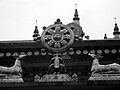
Dharma wheel with two deer
-
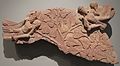
Bodhi tree showing distinctive heart shaped leaves
-
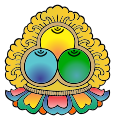
Triratna, three jewels
-
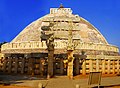
Sanchi stupa.
-
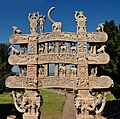
Carved decorations on the doorway of Sanchi stupa, note the dharmacakra, animals and trisula
-

Shanti stupa with lion statues
-

Empty throne and bodhi tree
-

Swastika on a Buddhist temple in Seoul
-

Zen Ensō (circle).
-
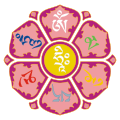
Om mani padme hum in Tibetan script
-
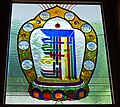
Symbol of Kalachakra
-

Mandala of Vajradhatu
-

Kila dagger
-
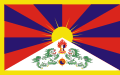
The Flag of Tibet, in use between 1912 and 1950, with two snow lions and the three jewels.
-

Tibetan bronze statue of a windhorse
-

Statues of Garudas and nagas Wat Phra Kaeotemple, Bangkok
-

In Tibetan Dzogchenthought, rigpa is symbolized by the white A inside of a circular rainbow.
-

Thai dhamma wheel
-

Gankyil, wheel of joy
-
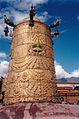
Dhvaja, victory banner
-

Bumpa ritual vase used in Tibetan empowerments. The peacock feather and the gemstone symbolize Dzogchen practices of Trekcho and Thogal.
-

State emblem of Mongolia with windhorse, three jewels and dharma wheel
-

Bodhidharma is widely depicted in Zen, the moon symbolizes enlightenment
-

Ritual bell and vajra
-

White elephant
-
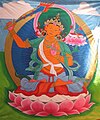
Manjushri with the flaming sword symbolizing prajna(wisdom).
-

Kartika, a ritual implement associated with dakinis
-

Tibetan ritual conch shell trumpet with Dragon
-
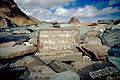
Mani stones
-
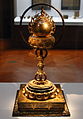
Container for Buddhist Relics in Shape of Flaming Sacred Jewel
-
Vajra Mudra
-

The kanji for Wu (emptiness) widely used in Zen calligraphy