
A tandoor (/tænˈdʊər/ or /tɑːnˈdʊər/) also known as tannour is predominantly a cylindrical clay or metal oven used in cooking and baking. The tandoor is used for cooking in Southern, Central, and Western Asia, as well as in the South Caucasus.
The heat for a tandoor was traditionally generated by a charcoal or wood fire, burning within the tandoor itself, thus exposing the food to live fire, radiant heat cooking, and hot-air, convection cooking, and smoking in the fat and food juices that drip on to the charcoal. Temperatures in a tandoor can approach 480 °C (900 °F; 750 K), and it is common for tandoors to remain lit for long periods to maintain the high cooking temperature. The tandoor design is something of a transitional form between a makeshift earth oven and the horizontal-plane masonry oven. Tandoors are typically used in restaurants whilst smaller tandoors and electric tandoors are making their way into homes.
Etymology

A coal-fired tandoor with a mild steel drum
The English word comes from Hindi / Urdu tandūr (तन्दूर / تندور), which came from Persian tanūr (تنور), which all mean (clay) oven. According to the Dehkhoda Persian Dictionary, the Persian word ultimately came from the Akkadian word tinūru (𒋾𒂟), which consists of the parts tin “mud” and nuro/nura “fire” and is mentioned as early as in the Akkadian Epic of Gilgamesh, c.f. also Avestan tanûra and Middle Persian tanûr. So tandoor originated from Semitic. (In Sanskrit, the tandoor was referred to as kandu.)
Words related and similar to tandoor are used in various languages, for example the Dari Persian words tandūr and tannūr, Arabic tannūr (تنّور), Armenian t’onir (Թոնիր), Assyrian tanūra (ܬܢܘܪܐ), Azerbaijani təndir, Georgian, tone (თონე), Hebrew tanúr (תנור) e.g. in Leviticus 2:4 Kurdish tenûr, Turkish tandır, Turkmen tamdyr, Uzbek tandir and Luganda ttanuulu.
Operation

Charcoal-fired stainless-steel tandoor, with ash tray and thermometer
The first time a tandoor is used, the temperature must be gradually increased to condition the interior of the oven. This step is crucial in ensuring the longevity of the tandoor. Conditioning can be done by starting a very small fire and slowly adding fuel to gradually increase the amount of heat inside the tandoor. Hairline cracks might form during conditioning; this is normal and will not interfere with the performance of the tandoor oven. When the oven cools off, the hairline cracks will barely be noticeable. They are essential in allowing the clay body of the tandoor to breathe (thermal expansion and contraction). The slower the temperature inside the tandoor is increased during its first use, the fewer hairline cracks will develop.
Types
Afghan tandoor
The Afghan tandoor sits above the ground and is made of bricks.
Punjabi tandoor
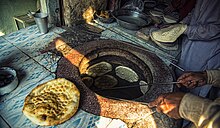
A Pakistani Tandoor
The Punjabi tandoor from the Indian Subcontinent is traditionally made of clay and is a bell-shaped oven, which can either be set into the earth and fired with wood or charcoal reaching temperatures of about 480 °C (900 °F; 750 K), or rest above the ground. Tandoor cooking is a traditional aspect of Punjabi cuisine in undivided Punjab.
In India and Pakistan, tandoori cooking was traditionally associated with the Punjab, as Punjabis embraced the tandoor on a regional level, and became popular in the mainstream after the 1947 partition when Punjabi Sikhs and Hindus resettled in places such as Delhi. In rural Punjab, it was common to have communal tandoors. Some villages still have a communal tandoor, which was a common sight prior to 1947.
Armenian tonir
In ancient times, the tonir was worshiped by the Armenians as a symbol of the sun in the ground. Armenians made tonirs in resemblance with the setting sun “going into the ground” (the Sun being the main deity). The underground tonir, made of clay, is one of the first tools in Armenian cuisine, as an oven and as a thermal treatment tool. Armenians are said to have originated underground tonirs.
Azerbaijani tandir

Azerbaijani tendir
In ancient times people used it to cook bread and various dishes.
Tandir bread (təndir çörəyi, tandoori bread) is widespread bread type in Azerbaijan. Tandir bread is baked from the heat of the tandir’s walls, which ensures very fast baking.
One of the world’s biggest tandoors was built in Azerbaijan’s southern city of Astara in 2015. The height of the tandoor is 6.5 m (21 feet) and the diameter is 12 m (39 feet). The tandoor consists of 3 parts.
Turkmen tamdyr

Baking çörek and somsa in the Turkmen tamdyr
Baking a traditional, white bread called çörek in Turkmen, is an ancient and honored culinary ritual in Turkmenistan. It is made in the traditional clay oven, known as tamdyr in Turkmenistan.
Most Turkmen families living in the rural area have tamdyrs in their household. Occasionally, housewives get together and bake çörek for several families. One of most famous kinds of çörek baked in the Turkmen tamdyr is etli çörek (bread with meat), made during traditional holidays. Turkmens bake not only bread in the tamdyr, but also several dishes, the most famous of which is somsa (an independent dish, similar to a pie, of any shape with a filling, usually beef).

A Turkmen tamdyr
Various spices can be added to the Turkmen bread: cumin, cinnamon, olives, mustard, sunflower seeds and other flavoring ingredients.

A Turkmen çörek, baked in Tamdyr
To prepare tamdyr for baking, first, fire is made directly inside the tamdyr, usually using dried cotton stalks. The bread-maker then watches the color of the tamdyr’s inner walls. When they turn white, the ashes are shoveled into the center of the tamdyr and the lower ash-pit is closed.
The bread must be thrown into the oven very carefully, but deftly, so that it does not lose its shape and neatly stick to the wall.
Dishes

Yemeni modern tandoor (tannour) used for making flatbread known as Mulawah

Chicken wings, onions and potato slices with pork fat in between roasted in tonir in Armenia.
A tandoor may be used to bake many different types of flatbread. Some of the most common are tandoori roti, tandoori naan, tandoori laccha paratha, missi roti, and tandoori kulcha.
Peshawari Khar is roasted cashews, and cottage cheese paste marinated in spiced thick cream grilled in a tandoor.
Balochs and aloos are potatoes stuffed with cottage cheese, vegetables and cashew nuts, roasted in a tandoor.
Tandoori chicken is a roasted chicken delicacy that originated in Punjab region of the Indian subcontinent. The chicken is marinated in yogurt seasoned with garam masala, garlic, ginger, cumin, cayenne pepper, and other spices depending on the recipe. In hot versions of the dish, cayenne, red chili powder, or other spices give the typical red color; in milder versions, food coloring is used. Turmeric produces a yellow-orange color. It is traditionally cooked at high temperatures in a tandoor, but can also be prepared on a traditional grill.
Chicken tikka (Urdu: مرغ تکہ; Hindi: मुर्ग़ टिक्का; murgh tikka) is a dish from Mughlai cuisine made by grilling small pieces of boneless chicken which have been marinated in spices and yogurt. It is traditionally cooked on skewers in a tandoor and is usually boneless. It is normally served and eaten with a green coriander chutney, or used in preparing the curry chicken tikka masala.
Tangdi kabab, a popular snack in cuisine from the Indian subcontinent, is made by marinating chicken drumsticks and placing them in a tandoor. Various freshly ground spices are added to the yogurt to form a marinade for the chicken. Traditionally, the marinaded chicken is given 12 hours at the least. When prepared, the drumsticks are usually garnished with mint leaves and served with laccha (finely sliced half moons, with a squeeze of lemon and a pinch of salt) onions.
Samosa is a stuffed snack consisting of a fried or baked triangular, semilunar or tetrahedral pastry shell with a savory filling, which may include spiced potatoes, onions, peas, coriander, and lentils, or ground lamb or chicken. The size and shape of a samosa, as well as the consistency of the pastry used, can vary considerably. In some regions of Central Asia (i.e. Kazakhstan, Kyrgyzstan, Tajikistan, Turkmenistan and Uzbekistan), samosas are typically baked in a tandoor, while they are usually fried elsewhere.