
Bon, also spelled Bön (Tibetan: བོན་, Wylie: bon, Lhasa dialect: ) is considered to be the native pre-Buddhist religious tradition of Tibet. A distinction is sometimes made between:
- the Old Bon or Bön nying (Wylie: bon rnying), dating back to the pre-dynastic era;
- the Eternal Bon or Yungdrung Bön (Wylie: g.yung drung bon), the classical Bon tradition (which emerged in the tenth to the eleventh century); and
- the New Bon or Bonsar (Wylie: bon gsar), a late syncretic movement dating back to the fourteenth century and active in eastern Tibet.
The relationship between Bon and Tibetan Buddhism has been a subject of debate. Followers of Bon, known as Bonpos (Wylie: bon po), believe that the religion originated in a land called Tazig (Wylie: stag gzig), identified by scholars variously as Persia, Central Asia, or the area around Mount Kailash in the west of the Tibetan Plateau. Bonpos identify Shenrab Miwo (Wylie: gshen rab mi bo) as Bon’s founder, although there are no available sources to establish this figure’s historicity. From Tazig, Bon was brought first to Zhang Zhung, a kingdom to the west of the Tibetan Plateau, and then to Tibet. Western scholars have posited several origins for Bon, and have used the term Bon in many ways.
Tibetan Buddhist scholarship tends to cast Bon in a negative, adversarial light, with derogatory stories about Bon appearing in a number of Buddhist histories.The Rimé movement within Tibetan religion encouraged more ecumenical attitudes between Bonpos and Buddhists. Western scholars began to take Bon seriously as a religious tradition worthy of study in the 1960s, in large part inspired by English scholar David Snellgrove’s work. Following the Chinese invasion of Tibet in 1959, Bonpo scholars began to arrive in Europe and North America, encouraging interest in Bon in the West. Today, Bon is practiced by Tibetans both in Tibet and in the Tibetan diaspora, and there are Bonpo centers in cities around the world.
Contents
- Definition and historiography
- Gods and spirits
- Doctrine
- The Four Portals and the Fifth, the Treasury
- The Nine Ways of Bon
- The Bon canon
- History
- Rediscovery
- A Cavern of Treasures (mdzod phug)
- 18th century
- 19th century
- Present situation
- Recognition
- See also
- References
- Sources
- Further reading
- External links
Definition and historiography
Early Western studies of Bon relied heavily on Buddhist sources, and used the word to refer to the pre-Buddhist religion over which it was thought Buddhism triumphed. Helmut Hoffmann’s 1950 study of Bon characterized this religion as “animism” and “shamanism”; these characterizations have been controversial.Hoffmann contrasted this animistic-shamanistic folk religion with the organized priesthood of Bonpos which developed later, according to Hoffmann with influence from Gnosticism, Shaivism, and Buddhist tantras. Hoffmann’s study was foundational for Western understandings of Bon, but was challenged by a later generation of scholars influenced by David Snellgrove, who collaborated with Bonpo masters and translated Bonpo canonical texts. These scholars tended to view Bon as a heterodox form of Buddhism, transmitted separately from the two transmissions from India to Tibet that formed the Tibetan Buddhist tradition.With the translation of Bonpo histories into Western languages as well as increased engagement between Bonpos and Western scholars, a shift took place in Bon studies towards engaging more thoroughly Bonpos’ own histories and self-identification, recognizing Bon as an independent religious tradition worthy of academic study.
The term Bon has been used to refer to several different phenomena. Drawing from Buddhist sources, early Western commentators on Bon used the term for the pre-Buddhist religious practices of Tibet. These include folk religious practices, cults surrounding royalty, and divination practices. However, scholars have debated whether the term Bon should be used for all of these practices, and what their relationship is to the modern Bon religion. In an influential article, R. A. Stein used the term “the nameless religion” to refer to folk religious practices, distinguishing them from Bon. Per Kvaerne uses Bon solely to refer to a tradition he dates from tenth and eleventh centuries CE, the tradition which developed into the modern Bon religion. Kvaerne identifies this tradition as “an unorthodox form of Buddhism,” but other scholars such as Samten G. Karmay take seriously Bonpo narratives which define Bon as a separate tradition with an origin in the land of ‘Ol-mo lung-ring, part of Tazig, identified variously with Persia, Central Asia, or the area around Mount Kailash in the west of the Tibetan Plateau. The term Yungdrung Bon (Wylie: g.yung drung bon) is sometimes used to describe this tradition. “Yungdrung” refers to the left-facing swastika, a symbol which occupies in Bon a similar place as the vajra (Wylie: rdo rje) in Tibetan Buddhism, symbolizing indestructibility and eternity. Yungdrung Bon is a universal religion, although it is mainly limited to Tibetans, with some non-Tibetan converts.
Gods and spirits
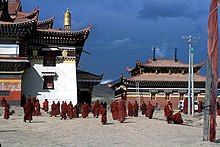
The Bon monastery of Nangzhik Gompa at Ngawa Town, in Sichuan.
Bonpos cultivate household gods in addition to other deities:
Traditionally in Tibet divine presences or deities would be incorporated into the very construction of the house making it in effect a castle (dzong) against the malevolent forces outside it. The average Tibetan house would have a number of houses or seats (poe-khang) for the male god (pho-lha) that protects the house. Everyday the man of the house would invoke this god and burn juniper wood and leaves to placate him. In addition the woman of the house would also have a protecting deity (phuk-lha) whose seat could be found within the kitchen usually at the top of the pole that supported the roof.
Another set of deities are the White Old Man, a sky god, and his consort. They are known by a few different names, such as the Gyalpo Pehar called “King Pehar” (Wylie: pe har rgyal po). Pehar is featured as a protecting deity of Zhangzhung, the center of the Bon religion. Reportedly, Pehar is related to celestial heavens and the sky in general. In early Buddhist times, Pehar transmogrified into a shamanic bird to adapt to the bird motifs of shamanism. Pehar’s consort is a female deity known by one of her names as Düza Minkar (Wylie: bdud gza smin dkar, Stein 1954 in Hummel 1962).
Chinese influence is also seen is some of the deities worshipped in Bon. For example, Confucius is worshipped in Bon as a holy king and master of magic, divination and astrology. He is also seen as being a reincartnation of Tonpa Shenrab Miwoche, the legendary founder of Bon. In balti version of Bon the follower used to follow Hla(god), Hlu(evil sprite)and hlamo (godness) still many stories about these deities exist in belief system of local population.
Doctrine
The doctrines taught by Tönpa Shenrab are generally classified variously, two being most common.
The Four Portals and the Fifth, the Treasury
The first classification, The Four Portals and the Fifth, the Treasury (sgo bzhi mdzod lnga), is as follows:
- White Water (chab dkar) relates esoteric matters;
- Black Water (chab nag) concerns narratives, magic, funeral rites and ransom rituals;
- Land of Phan (‘phan yul) codifies monastic rules and philosophical expositions;
- Divine Guide (dpon gsas) enshrines the Dzogchen teachings; and finally
- Treasury (mtho thog) which serves as an anthology of the salient items of the Four Portals.
The Nine Ways of Bon
The second classification, the Nine Ways of Bon (bon theg pa rim dgu) is as follows:
- Way of Prediction (phyva gshen theg pa) codifies ritual, prognostication, sortilege and astrology;
- Way of the Visual World (snang shen theg pa) details the psychophysical Universe;
- Way of Illusion (‘phrul gshen theg pa) explains the rites for the dispersal of adverse tulpas, entities and energies;
- Way of Existence (srid gshen theg pa) details funeral and death rituals;
- Way of a Lay Follower (dge bsnyen theg pa) contains the ten principles for wholesome activity;
- Way of a Monk (drang srong theg pa) codifies monastic rules and regulations;
- Way of Primordial Sound (a dkar theg pa) charts the integration of an exalted practitioner into the mandala of highest enlightenment;
- Way of Primordial Shen, (ye gshen theg pa) renders the guidelines for seeking a true tantric master and the commitments (dam tshigs, parallel to the Sanskrit samaya) that bind a disciple to his tantric master; and finally,
- Way of Supreme Natural Condition (bla med theg pa), or The Way of Dzogchen.
The nine ways can also be classified into three groups, the:
- Causal Ways (rgyu’i theg pa) comprises the first four of the above;
- Resultant Ways (‘bras bu’i theg pa) includes the fifth through eighth; and
- Unsurpassable Way or the Way of Dzogchen (khyad par chen po’i theg pa or rdzogs pa chen po, abbreviated rdzogs chen) is the ninth.
The Bon canon
The Bon canon comprises more than two hundred volumes, classified in four categories: the Sutras (mdo), the Perfection of Wisdom Teachings (‘bum), the Tantras (rgyud) and Knowledge (mdzod). Besides these, the Bon canon includes material on rituals, arts and crafts, logic, medicine, poetry and narrative. The “Knowledge” section concerning cosmogony and cosmology, though in some respects unique to Bon, shares a more than passing resemblance to Nyingma(rnying ma) doctrines.
History

A thangka depicting the lineage lamas of the Aural Tradition of Zhangzhung.
Rediscovery
Three Bon scriptures—mdo ‘dus, gzer mig, and gzi brjid—relate the mythos of Tonpa Shenrab Miwoche. The Bonpos regard the first two as gter marediscovered around the tenth and eleventh centuries and the last as nyan brgyud (oral transmission) dictated by Loden Nyingpo, who lived in the fourteenth century. In the fourteenth century, Loden Nyingpo revealed a terma known as The Brilliance (Wylie: gzi brjid), which contained the story of Tonpa Shenrab. He was not the first Bonpo tertön, but his terma became one of the definitive scriptures of Bon religion. It states that Shenrab established the Bon religion while searching for a horse stolen by a demon. Tradition also tells that he was born in the land of Tagzig Olmo Lung Ring (considered an axis mundi) which is traditionally identified as Mount Yung-drung Gu-tzeg (“Edifice of Nine Sauwastikas”), possibly Mount Kailash, in western Tibet. Due to the sacredness of Tagzig Olmo Lungting and Mount Kailash, the Bonpo regard both the swastika and the number nine as auspicious and as of great significance.
Tonpa Shenrab Miwoche visited Kongpo and found people whose practice involved spiritual appeasement with animal sacrifice. He taught them to substitute offerings with symbolic animal forms made from barley flour. He only taught according to the student’s capability with lower shamanic vehicles to prepare; until with prayer, diligence, devotion and application they could incarnate to achieve sutra, tantra and Dzogchen.
Bon teachings feature Nine Vehicles, which are pathway-teaching categories with distinct characteristics, views, practices and results. Medicine, astrology, and divination are in the lower vehicles; then sutra and tantra, with Dzogchen (“great perfection”) being the highest. Traditionally, the Nine Vehicles are taught in three versions: as Central, Northern and Southern treasures. The Central treasure is closest to Nyingma Nine Yānas teaching and the Northern treasure is lost. Tenzin Wangyal Rinpoche elaborated the Southern treasure with shamanism.
A Cavern of Treasures (mdzod phug)
A Cavern of Treasures (Tibetan: མཛོད་ཕུག, Wylie: mdzod phug) is a Bon termauncovered by Shenchen Luga (Tibetan: གཤེན་ཆེན་ཀླུ་དགའ, Wylie: gshen chen klu dga’) in the early 11th century. Martin identifies the importance of this scripture for studies of the Zhang-Zhung language:
For students of Tibetan culture in general, the mDzod phug is one of the most intriguing of all Bon scriptures, since it is the only lengthy bilingual work in Zhang-zhung and Tibetan. (Some of the shorter but still significant sources for Zhang-zhung are signalled in Orofino 1990.)
18th century
The Dzungar people invaded Tibet in 1717 and deposed a pretender to the position of Dalai Lama who had been promoted by Lhabzang, the titular King of Tibet. This was met with widespread approval. However, they soon began to loot the holy places of Lhasa, which brought a swift response from the Kangxi Emperor in 1718, but his military expedition was annihilated by the Dzungars not far from Lhasa.
Many Nyingmapas and Bonpos were executed and Tibetans visiting Dzungar officials were forced to stick their tongues out so the Dzungars could tell if the person recited constant mantras, which was said to make the tongue black or brown. This allowed them to pick the Nyingmapas and Bonpos, who recited many magic-mantras. A habit of sticking one’s tongue out as a mark of respect on greeting someone has remained a Tibetan custom into modern times.
19th century
In the 19th century, Shardza Tashi Gyaltsen, a Bon master whose collected writings comprise eighteen volumes significantly rejuvenated the tradition. His disciple Kagya Khyungtrul Jigmey Namkha trained many practitioners to be learned in not only the Bon religion, but in all Tibetan schools.
According to the Bonpo, eighteen enlightened entities will manifest in this aeonand Tönpa Shenrab Miwoche, the founder of Bon, is considered the enlightened Buddha of this age (compare yuga and kalpa). The 33rd lineage holder of Menri Monastery, Menri Trizin Lungtog Tenpei Nyima and Lopön Tenzin Namdak are important current lineage holders of Bon.
More than three hundred Bon monasteries had been established in Tibet before Chinese annexation. Of these, Menri Monastery and Shurishing Yungdrung Dungdrakling Monastery were the two principal monastic universities for the study and practice of Bon knowledge and science-arts.

Lopön Tenzin Namdak, abbot of a Bon monastery in Nepal
Present situation
According to a recent Chinese census, an estimated 10 percent of Tibetans follow Bon. When Tibet was annexed into the People’s Republic of China, there were approximately 300 Bon monasteries in Tibet and the rest of western China. According to a recent survey, there are 264 active Bon monasteries, convents, and hermitages.
The present spiritual head of the Bon is Menri Trizin Rinpoché, successor of Lungtok Tenpai Nyima (1929–2017), the thirty-fourth Abbot of Menri Monastery (destroyed in the Cultural Revolution, but now rebuilt), who now presides over Pal Shen-ten Menri Ling in Dolanji in Himachal Pradesh, India.
A number of Bon establishments also exist in Nepal; Triten Norbutse Bonpo Monastery is one on the western outskirts of Kathmandu. Bon’s leading monastery is the refounded Menri Monastery in Dolanji, Himachal Pradesh, India.
The Dongba (东巴) practices of the Nakhi people and the Hangui (韩规) religion of the Pumi people are both believed to have originated from Bon.
Recognition
Lobsang Yeshe, recognized as the 5th Panchen Lama by the 5th Dalai Lama, was a member of the Dru family, an important family of the Bon religion. Under Lozang Gyatso, Bon became respected both philosophically and politically.However, the Bonpo remained stigmatized and marginalized until 1977, when they sent representatives to Dharamshala and the 14th Dalai Lama, who advised the Parliament of the Central Tibetan Administration to accept Bon members.
Since then, Bon has had official recognition of its status as a religious group, with the same rights as the Buddhist schools. This was re-stated in 1987 by the Dalai Lama, who also forbade discrimination against the Bonpos, stating that it was both undemocratic and self-defeating. He even donned Bon ritual paraphernalia, emphasizing “the religious equality of the Bon faith”.
However, Tibetans still differentiate between Bon and Buddhism, referring to members of the Nyingma, Shakya, Kagyu and Gelug schools as nangpa, meaning “insiders”, but to practitioners of Bon as “Bonpo”, or even chipa(“outsiders”).