
Ali ibn Abi Talib (Arabic: عَلِيّ ٱبْن أَبِي طَالِب, ʿAlīy ibn ʾAbī Ṭālib; 13 September 601 – 29 January 661) was a cousin, son-in-law and companion of the Islamic prophet Muhammad, who ruled as the fourth caliph from 656 until his assassination in 661. He is one of the central figures in Shia Islam and is regarded as the rightful immediate successor to Muhammad as an Imam by Shia Muslims.
Ali was born inside the Kaaba in Mecca, the holiest place in Islam, to Abu Talib and Fatimah bint Asad. He was the first male who accepted Islam under Muhammad’s watch. Ali protected Muhammad from an early age, and took part in almost all the battles fought by the nascent Muslim community. After migrating to Medina, he married Muhammad’s youngest daughter Fatimah, and after her death, he had other wives, including Muhammad’s granddaughter Umamah bint Zaynab. He was appointed caliph by Muhammad’s companions in 656, after Caliph Uthman ibn Affan was assassinated. Ali’s reign saw civil wars and on 27 January 661, he was attacked and assassinated by a Kharijite while praying in the Great Mosque of Kufa, dying two days later on 29 January.
Ali is important to both Shias and Sunnis, politically and spiritually.The numerous biographical sources about Ali are often biased according to sectarian lines, but they agree that he was a pious Muslim, devoted to the cause of Islam and a just ruler in accordance with the Qur’an and the Sunnah. While Sunnis consider Ali the fourth Rashidun Caliph, Shia Muslims regard Ali as the first Caliph and Imamafter Muhammad. Shia Muslims also believe that Ali and the other Shia Imams, all of whom are from the House of Muhammad, known as the Ahl al-Bayt, are the rightful successors to Muhammad.
Contents
- Birth and lineage
- Birth in the Kaaba
- During the life of Muhammad
- In Mecca
- Early life
- Acceptance of Islam
- Feast of Dhul-Asheera
- During the oppression of Muslims
- Migration to Medina
- In Medina
- Marriage with Fatima
- Event of Mubahalah
- Missions for Islam
- Military career
- Conquest of Mecca
- Ghadir Khumm
- In Mecca
- From the death of Muhammad to the caliphate
- Succession to Muhammad
- Caliphate of Abu Bakr
- Caliphate of Umar
- Election of the third caliph
- Caliphate of Uthman
- Caliphate
- Election
- The beginning of the caliphate
- Ruling style
- Battle of the Camel
- Battle of Siffin
- Advent of Kharijites
- Arbitration
- Battle of Nahrawan
- The last year of the caliphate
- Death and burial
- Succession
- Wives and children
- Position in Islamic thought
- Prophetic knowledge
- Theosophy
- Eloquence
- The sermons without dots and alephs
- Compassion
- Works
- Nahj al-Balagha
- Ghurar al-Hikam wa Durar al-Kalim
- Mus’haf of Ali
- Other works
- Appearance and morality
- Names and titles
- Views
- In the Quran
- In Hadiths
- Sunni
- Shia
- Ghulat
- Sufism
- Historiography
- See also
- Footnotes
- References
- Bibliography
- Original sources
- Secondary sources
- Further reading
- External links
Birth and lineage
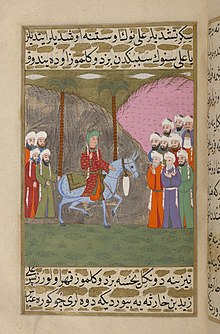
Ali, mounted on a blue mule, is approached by a delegation from the Quraysh tribe.
Ali’s father, Abu Talib ibn Abd al-Muttalib, was the custodian of the Ka’bah and a sheikh of Banu Hashim, an important branch of the powerful Qurayshtribe. He was also an uncle of Muhammad, and had raised Muhammad after Abd al-Muttalib (Abu Talib’s father and Muhammad’s grandfather) died. Ali’s mother, Fatima bint Asad, also belonged to Banu Hashim, making Ali a descendant of Isma’īl(Ishmael), the firstborn son of Ibrahim (Abraham).
Birth in the Kaaba
Many sources, especially Shia ones, attest that Ali was born inside the Ka’bah in the city of Mecca, where he stayed with his mother for three days. His mother reportedly felt the beginning of her labour pain while visiting the Kaaba and entered it where her son was born. Some Shia sources contain miraculous descriptions of the entrance of Ali’s mother into the Kaaba. Ali’s birth in the Kaaba is regarded as a unique event proving his “high spiritual station” among Shia, while Sunni scholars consider it a great, if not unique, distinction.
During the life of Muhammad
In Mecca
Early life
According to a tradition, Muhammad was the first person whom Ali saw as he took the newborn in his hands and Muhammad named him Ali, meaning “the exalted one”. Muhammad had a close relationship with Ali’s parents. When Muhammad was orphaned and later lost his grandfather Abd al-Muttalib, Ali’s father took him into his house. Ali was born two or three years after Muhammad married Khadijah bint Khuwaylid. When Ali was five years old, Muhammad took Ali into his home to raise him. Some historians say that this was because there was a famine in Mecca at the time and that Ali’s father had a large family to support; however, others point out that feeding Ali would not have been a burden on his father, as Ali was five years old at the time and, despite the famine, Ali’s father, who was financially well-off, was known for giving food to strangers if they were hungry. While it is not disputed that Muhammad raised Ali, it was not due to any financial stress that Ali’s father was going through.
Acceptance of Islam
When Ali was nine or ten, Muhammad announced that he had received a divine revelation, and Ali believed him and professed to Islam. According to Laura Veccia Vaglieri, Ali was one of the first believers, whether the second (after Khadijah) or the third (after Khadijah and Abu Bakr), to be disputed by Shiites and Sunnis. This dispute, according to Gleave, is affected by (or perhaps originate in) sectarian interests, though the earliest sources seem to place Ali before Abu Bakr. According to Muslim historians like Ibn Ishaq and Ibn Hazm and scholars like W. Montgomery Watt Ali was the first male to profess to Islam. Encyclopedia of Britannica and John Espositoconsider him the second Muslim, after Khadija, to accept Islam. Al-Tabari narrates different narrations, each introduce one of Ali, Abu Bakr, or Zayd ibn Harithah as the first male who accepted Islam. According to Watt, some sources (Ibn Sa’d, The Book of the Major Classes, History of the Prophets and Kings) consider Abu Bakr as the first male to accept Islam, however they hold the same opinion about Ali.
Feast of Dhul-Asheera
Muhammad’s call to Islam in Mecca lasted 13 years, from which 3 years was in secret. According to Al-Tabari, by the beginning of the public call, and after the revelation of the Quranic verse, “Warn your closest relatives“(26:214), Muhammad was commanded to invite his relatives to a feast. Thus he invited 40 of his close relatives from Banu Hashim clan to the feast. According to History of the Prophets and Kings, Ali ibn al-Athir, and Abulfeda, in this feast, Muhammad asked his relatives; who is willing to assist him in mission. And he declared that whoever helped him, would be his brother, trustee and successor. None of the relatives gave an affirmative answer except Ali. Muhammad repeated his request for the second and third time. Still Ali was the only volunteer. After the third time, according to al-Tabari, Muhammad put his arm around Ali’s neck and said “this is my brother, my trustee and my successor among you, so listen to him and obey”, while Ali was 13 or 14 years old at the time. “And so the people arose and they were joking saying to Abu Talib:He has ordered you to listen to your son and obey him!“
Sir Richard Burton writes about the banquet in his 1898 book, saying, “It won for a proselyte worth a thousand sabers in the person of Ali, son of Abu Talib.”
During the oppression of Muslims
During the persecution of Muslims and boycott of the Banu Hashim in Mecca, Ali stood firmly in support of Muhammad.
According to Nasr, During the period (610-622 AD) when Muhammad received his first revelations, Ali along with Zayd ibn Harithah, Abu Bakr; And Khadijeh was one of Muhammad’s loyal companions. He helped form the nucleus of the first Islamic society. During these years, he spent most of his time providing for the needs of the believers in Mecca, especially the poor, by distributing his wealth among them and helping with their daily affairs.
Migration to Medina
In the year 622, which is known as the migration year, Muhmammad’s enemies were plotting to kill him, thus he asked Ali to sleep in his bed, so that he could escape to Yathrib. Ali risked his life by sleeping in Muhammad’s bed to impersonate him, in a night called Laylat al-Mabit. In the same night, Muhammad and Abu Bakr secretly left Mecca and arrived to Yathrib (now Medina), a few days later. This migration became the beginning of the Islamic calendar.When the enemies entered Muhammad’s house with drawn daggers, they were surprised to see Ali, however, did not harm him. According to Tabatabaei’s exegesis, Tafsir al-Mizan, the verse (2:207) refers to this event:”And among men is he who sells his nafs (self) in exchange for the pleasure of Allah.” Ali stayed with Muhammad’s family for a few more days, to carry out Muhammad’s instructions: to restore to their owners all the goods and properties that had been entrusted to Muhammad for safekeeping. Ali then went to Medina with Fatimah bint Asad (his mother), Fatimah bint Muhammad (Muhammad’s daughter), and two other women. At Muhammad’s command, Ali went to Quba on the outskirts of Medina. According to some sources, Ali was one of the first emigrants to Medina. He was 22 or 23 at the time.
In Medina
Marriage with Fatima
Shortly after migration to Medina, In 623, Muhammad told Ali that God ordered him to give his daughter Fatimah Zahra to Ali in marriage.This marriage is viewed by Muslims as a union between the most important holy figures of Muhammad’s relatives. Muhammad, who visited his daughter almost every day, got closer to Ali with this marriage and once told him that you are my brother in this world and the hereafter. It is also narrated from Muhammad who said to Fatimah: “I have married you to the dearest of my family to me.” Ali’s family was frequently praised by Muhammad, as Muhammad mentioned ALi, Fatimah and their sons al-Hasan and al-Husain, as his Ahl al-Bayt in events such as Mubahala and Hadith of the Event of the Cloak. They were also glorified in the Qur’an in cases such as “the verse of purification”. Although polygamy was allowed, Ali did not marry another woman while Fatimah was alive. After Fatima’s death, Ali married other women and had many other children.
Event of Mubahalah
According to hadith collections, in 631, an Arab Christian envoy from Najran (currently in northern Yemen and partly in Saudi Arabia) came to Muhammad to argue which of the two parties erred in its doctrine concerning ‘Isa (Jesus). After likening Jesus’ miraculous birth to Adam’s creation, Muhammad called them to mubahala (conversation), where each party should bring their knowledgeable men, women and children, and ask God to curse the lying party and their followers. Muhammad, to prove to them that he was a prophet, brought his daughter Fatimah, ‘Ali and his grandchildren Hasan and Husayn. He went to the Christians and said “this is my family” and covered himself and his family with a cloak. According to Muslim sources, when one of the Christian monks saw their faces, he advised his companions to withdraw from Mubahala for the sake of their lives and families. Thus the Christian monks vanished from Mubahala. According to Allameh Tabatabaei’s Tafsir al-Mizan, the word “Our selves” in this verse refers to Muhammad and Ali. Then he narrates that Imam Ali al-Rida, eighth Shia Imam, in discussion with Al-Ma’mun, Abbasid caliph, referred to this verse to prove the superiority of Muhammad’s progeny over the rest of the Muslim community, and considered it proof of Ali’s right to the caliphate due to God having made Ali like the self of Muhammad.
Missions for Islam
Ali undertook several important missions on behalf of Muhammad. Muhammad designated Ali as one of the scribes who would write down the text of the Quran, which had been revealed to Muhammad during the previous two decades. After migration, when Muhammad was creating bonds of brotherhood among his companions, he selected Ali as his brother, claiming that “Ali and I belong to the same tree, while people belong to different trees.” In 628 AD, Ali was instructed to write down the Treaty of Hudaybiyyah, the peace treaty between Muhammad and the Quraysh. In 630 AD, the year before the Conquest of Mecca, when Abu Bakr was leading the Hajj, Muhammad recited Surah Bara’ah Min al-Mushrikin (declaring that Muhammad and the Islamic community no longer bound by agreements made earlier with Arab polytheists.) by Ali to the people of Mecca. One year later, in 631, Ali was sent to Yemen to spread the teachings of Islam there which is known as Expedition of Ali ibn Abi Talib. Ali was chosen to break the idols inside the Kaaba and other idols worshiped by the Aws, Khazraj and Tayy tribes. He was also known for settling several disputes and putting down the uprisings of various tribes.
Military career

Arabic calligraphy which means “There is no brave youth except Ali and there is no sword which renders service except Zulfiqar”
Ali took part in nearly all expeditions (with the exception of the Battle of Tabouk) during the life of Muhammad, often as standard-bearer; and two times as commander, namely Expedition of Fadak and Expedition of Yemen. Ali’s bravery became legendary later. Along with Hamza, Abu Dajana, and Zubayr, he is known for his attacks on the enemy. It is said that he alone killed more than a third of the enemy in the Battle of Badr, along with the Meccan champion Walid ibn Utba. In the year 5 AH, he executed the enemies who had been sentenced to death by Muhammad, and together with Zubayr, supervised the killing of the Banu Qurayza tribe.
He vigorously defended Muhammad in the battles of Battle of Uhudwhen most of the Muslim army fled from the battle, and in the Battle of Hunayn. The victory of the Muslims in the Battle of Khaybar is attributed to his courage. Ali used the iron and heavy gate of Khyber fort as a shield.
According to a narration, Gabriel referred to the battle of Ali and his sword of Zulfiqar, which he had taken from Muhammad, and told Muhammad, “There is no sword but the Zulfiqar, and there is no Hero but Ali”. Ali fought the great Quraysh warrior Talha ibn Abi Talha. Talha constantly boasted that he defeats any Muslim who comes his way. When Talha was defeated by Ali, he asked for mercy by saying the phrase Karram-Allah-u Wajhahu. According to Nasr, this prayer of goodness became one of the titles of Ali that is mostly used by Sunnis. This phrase, which is usually accompanied by other words, is used to send greetings and good prayers.
Muhammad made Ali commander at the Battle of the Trench, claiming that “I will hand the standard to a man who loves Allah and His Messenger and is loved by Allah and His Messenger. He will come back with conquest.”, then Ali defeated the legendary Arab warrior Amr ibn Abd al-Wud. Following this battle Muhammad gave Ali the name Asadullah (Lion of God) and reportedly praised him, saying “Ali’s strike on Amr ibn Abd al-Wud is greater than the worship of both mankind and jinn until the Day of Judgement.”
Sherira Gaon (c. 906–c. 1006) describes in a responsum how that the head of the Jewish community in Peroz-Shapur (now al-ʾAnbār), a community numbering some 90,000, warmly welcomed Ali ibn Abi Talib when he marched with his army into the country and conquered it, and how that he received them with a friendly disposition.

Zulfiqar with, and without the shield. The Fatimid depiction of Ali’s sword as carved on the Gates of Old Islamic Cairo, namely Bab al-Nasr

Ali’s Sword and shield carved on Bab al-Nasr gate wall, Cairo
Conquest of Mecca
During the Conquest of Meccain 630, Muhammad asked Ali to guarantee that the conquest would be bloodless. He ordered Ali to purify Kaaba from idols after its defilement by the polytheism of old times.

The Investiture of Ali, at Ghadir Khumm (MS Arab 161, fol. 162r, 1307/8 Ilkhanid manuscript illustration)
As Muhammad was returning from his last pilgrimage in 632, he made statements about Ali that are interpreted very differently by Sunnis and Shias. He halted the caravan at Ghadir Khumm, gathered the returning pilgrims for communal prayer and began to address them.
According to the Encyclopedia of Islam:
Taking Ali by the hand, he asked of his faithful followers whether he, Muhammad, was not closer (awlā) to the Believers than they were to themselves; the crowd cried out: “It is so, O Apostle of God!”; he then declared: “He of whom I am the mawla, of him Ali is also the mawla (man kuntu mawlāhu fa-ʿAlī mawlāhu)”.
Shias regard these statements as constituting the designation of Ali as the successor of Muhammad and as the first Imam; by contrast, Sunnis take them only as an expression of close spiritual relationship between Muhammad and Ali, and of his wish that Ali, as his cousin and son-in-law, inherit his family responsibilities upon his death, but not necessarily a designation of political authority. According to Madelung, Ali during his caliphate in Kufa, citing this event, emphasized the superiority of his position over the previous caliphs. Many Sufis also interpret the episode as the transfer of Muhammad’s spiritual power and authority to Ali, whom they regard as the wali par excellence.
Sources, among them both Shia and Sunni, state that, after the sermon, Abu Bakr, Umar, and Uthman pledged allegiance to Ali.However, there have been doubts regarding the veracity of the tradition due to evidence that Ali may not have been present during the sermon, instead being in Yemen at the time—a view held by the historian Ibn Kathir.
From the death of Muhammad to the caliphate
The next phase of Ali’s life started in 632, after the death of Muhammad, and lasted until the assassination of Uthman ibn Affan, the third caliph, in 656. During those 24 years, Ali took no part in battle or conquest.
Succession to Muhammad

Ambigram depicting Muhammad (right) and Ali (left) written in a single word. The 180-degree inverted form shows both words.
While Ali was preparing Muhammad’s body for burial and performing his funeral rites, a small group of approximately fourteen Muslims met at Saqifah. There, Umar ibn al-Khattab pledged allegiance to Abu Bakr, who subsequently assumed political power. The gathering at Saqifah was disputed by some of Muhammad’s companions, who held that Ali had been designated his successor by Muhammad himself.
Nevertheless, the issue of succession to Muhammad caused the Muslims to split into two groups, Sunni and Shia. Sunnis assert that even though Muhammad never appointed a successor, Abu Bakr was elected first caliph by the Muslim community. The Sunnis recognize the first four caliphs as Muhammad’s rightful successors. Shias believe that Muhammad explicitly named Ali as his successor at Ghadir Khumm and Muslim leadership belonged to him by dint of divine order.
According to ], whether Ali hoped he could take the position of Caliphate after Muhammad, is doubtful, since he made no effort to take control of community, in spite of being advised by al-Abbas and Abu Sufyan to do so. According to Wilferd Madelung, Ali himself was firmly convinced of his legitimacy for the caliphate based on his close kinship with Muhammad, his knowledge of Islam, and his merits in serving its cause. He told Abu Bakr that his delay in pledging allegiance (bay’ah) to him was based on his belief in his own claim to the caliphate. Ali did not change his mind when he finally pledged allegiance to Abu Bakr and then to Umar and to Uthman but had done so for the sake of the unity of Islam, at a time when it was clear that the Muslims had turned away from him. Ali also believed that he could fulfill the role of Imam without fighting.
Caliphate of Abu Bakr
Relations between Abu Bakr and Ali may have become strained after this. Following the gathering at Saqifa, Umar and his supporters were allegedly sent by the new Caliph to Ali’s house where Ali, Fatimah, and some of their allies were gathered. Several scholars, such as Al-Tabari and Ibn Qutaybah, relate that Umar threatened to burn the building down if Ali refused to acknowledge Abu Bakr’s authority. While the historian Al-Baladhuri states that the altercation never became violent and ended with Ali’s compliance,some traditions add that Umar and his supporters forcibly entered the house, resulting in Fatimah’s miscarriage of their unborn son Muhsin.The Kitab Sulaym ibn Qays (attributed to Sulaym ibn Qays, but possibly a much later creation) concludes the incident with Ali being dragged out of the house with a rope tied around his neck. These events have been disputed, with several early historical sources arguing that Fatimah’s child Muhsin had died in early childhood rather than being miscarried. Other sources add that Ali later willingly offered Abu Bakr his oath of allegiance and gave a praise-filled oration during his funeral. Professor Coeli Fitzpatrick surmises that the story of the altercation reflects the political agendas of the period and should therefore be treated with caution.
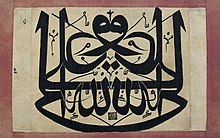
18th century mirror writing in Ottoman calligraphy. Depicts the phrase ‘Ali is the vicegerent of God’ in both directions.
Ali compiled a complete version of the Quran, mus’haf, six months after the death of Muhammad. The volume was completed and carried by camel to show to other people in Medina. The order of this mus’haf differed from that which was gathered later during the Uthmanic era. This book was rejected by several people when he showed it to them. Despite this, Ali made no resistance against the standardised mus’haf.
At the beginning of Abu Bakr’s caliphate, there was a controversy about Muhammad’s endowment to his daughter, especially the oasis of Fadak, between Fatimah and Ali on one side and Abu Bakr on the other side. Fatimah asked Abu Bakr to turn over their property, the lands of Fadak and Khaybar, but Abu Bakr refused and told her that prophetsdid not have any legacy and that Fadak belonged to the Muslim community. Abu Bakr said to her, “Allah’s Apostle said, we do not have heirs, whatever we leave is Sadaqa.” Together with Umm Ayman, Ali testified to the fact that Muhammad granted it to Fatimah Zahra, when Abu Bakr requested her to summon witnesses for her claim. Fatimah became angry and stopped speaking to Abu Bakr, and continued assuming that attitude until she died. According to some sources, ‘Ali did not give his oath of allegiance to Abu Bakr until some time after the death of his wife, Fatimah, in the year 633.
Caliphate of Umar
Ali pledged allegiance to the second caliph, ‘Umar ibn Khattab, and helped him as a trusted advisor. ‘Umar particularly relied upon Ali as the chief judge of Medina. He also advised Umar to set Hijra as the beginning of the Islamic calendar. ‘Umar followed ‘Ali’s suggestions in political matters as well as religious ones. According to Vaglieri, however, while it is probable that Umar asked Ali’s advice on legal issues, due to his great knowledge of Quran and Sunnah, it is not certain whether his advice was accepted on political matters. As an example, Al-Baladhuri names Ali’s view on Diwani revenue, which was opposite to that of Umar. Since, Ali believed the whole income should be distributed, without holding anything in stock. During the Caliphate of Umar (and Uthman) Ali held no position, except, according to Tabari, the lieutenancy of Madina, during Umar’s journey to Syria and Palestine.
Election of the third caliph
Ali was one of the electoral council to choose the third caliph which was appointed by ‘Umar. Although ‘Ali was one of the two major candidates, the council was inclined against him. Sa’d ibn Abi Waqqas and Abdur Rahman bin Awf, who were cousins, were naturally inclined to support Uthman, who was Abdur Rahman’s brother-in-law. In addition, Umar gave the deciding vote to Abdur Rahman, who offered the caliphate to Ali on the condition that he should rule in accordance with the Quran, the example set by Muhammad, and the precedents established by the first two caliphs. Ali rejected the third condition while Uthman accepted it. According to Ibn Abi al-Hadid’s Comments on the Peak of EloquenceAli insisted on his prominence there, but most of the electors supported Uthman and Ali was reluctantly urged to accept him.
Caliphate of Uthman
There is controversy among historians about the relationship between Ali and Uthman. Although pledging allegiance to Uthman, Ali disagreed with some of his policies. In particular, he clashed with Uthman on the question of religious law. He insisted that religious punishment had to be meted out in several cases, such as those of Ubayd Allah ibn Umarand Walid ibn Uqba. Walid, being accused of drinking, got his legal punishment of whipping, according to some accounts, by the hand of Ali. In 650, during the pilgrimage, he reproached Uthman for his change of the prayer ritual. When Uthman declared that he would take whatever he needed from the fey’, Ali exclaimed that in that case the caliph would be prevented by force. Ali endeavoured to protect companions such as Ibn Mas’ud from maltreatment by the caliph. Ali had publicly shown sympathy for Abu Dharr al-Ghifari (who was exiled from Medina, due to his preaches against the misdeeds of the powerful) and had spoken strongly in the defence of Ammar ibn Yasir. He conveyed to Uthman the criticisms of other Companions and acted on Uthman’s behalf as negotiator with the provincial opposition who had come to Medina.
According to Vaglieri, the rebels asked Ali to be their head, and although he refused and should be excluded from the bloody conclusion of their act, but, Vaglieri says, there are reasons that Ali was in agreement with rebels that Uthman should abdicate. Wilferd Madelung believes that, due to the fact that Ali did not have the Quraysh’s support to be elected as a caliph, he could not be considered as a opposition. According to him, there is not even evidence that Ali had close relations with rebels who supported his caliphate, much less directed their actions. Some other sources say Ali had acted as a restraining influence on Uthman without directly opposing him. Finally, he tried to mitigate the severity of the siege by his insistence that Uthman should be allowed water. It is reported from al-Tabari that Ali tried to detach himself from the besiegers of the house of Uthman and their partisans, as soon as circumstances allowed him. Madelung relates that Marwan told Zayn al-Abidin, the grandson of Ali, that “No one was more temperate toward our master than your master.”
Caliphate
| Caliphate خِلافة |
|---|
 |
 Islam portal Islam portal |
The First Fitna, 656–661, followed the assassination of Uthman, continued during the caliphate of Ali, and was ended by Muawiyah’s assumption of the caliphate. This civil war is regretted as the end of the early unity of the Islamic ummah (nation). circumstances, led to this civil war in Muslim history, wived differently by different Muslims. Some, known as Uthmanis, consider Uthman a rightful and just caliph till the end, who had been unlawfully killed. Some others, known as the party of Ali, believed Uthman had fallen into error, had forfeited the caliphate, and been lawfully executed for his refusal to mend his ways or step down; thus, Ali was the just and true Imam and his opponents were infidels. This was not the position of Ali himself. This civil war created permanent divisions within the Muslim community regarding who had the legitimate right to occupy the caliphate.
Election
Uthman’s assassination meant that rebels had to select a new caliph. This met with difficulties since the rebels were divided into several groups: the Muhajirun, Ansar, Egyptians, Kufans and Basrites. There were three candidates: Ali, Talhah and Al-Zubayr. First the rebels approached Ali and offered him the caliphate. Some of Muhammad’s companions tried to persuade Ali to accept the office, but he turned down the offer, requesting he be made a counsellor instead of a chief. Talhah, Zubayr and other companions also refused the rebels’ offer as well. Therefore, the rebels warned the inhabitants of Medina to select a caliph within one day, or they would take drastic action. In order to resolve the deadlock, the Muslims gathered in the Prophet’s Mosque on 18 June 656, to appoint the caliph. Initially, ‘Ali refused to accept the office, simply because his most vigorous supporters were rebels. However, when some notable companions of Muhammad, in addition to the residents of Medina, urged him to accept the offer, he finally agreed. According to Veccia Vaglieri, Ali, allowing himself to be nominated by rebels, was an error which “exposed him to accusations of complicity” in rebels’ crime, in spit of his vain effort to detach himself from them.
According to Abu Mekhnaf’s narration, Talhah was the first prominent companion who gave his pledge to ‘Ali, but other accounts claimed otherwise, stating they were forced to give their pledge. Also, Talhah and Al-Zubayr later claimed they supported him only reluctantly. Regardless, Ali refuted these claims, insisting they recognised him as caliph voluntarily. Wilferd Madelung believes that coercion was not a factor and that they pledged publicly in the mosque. While the overwhelming majority of Medina’s population as well as many of the rebels gave their pledge, some important figures or tribes did not do so. The Umayyads, kinsmen of Uthman, fled to the Levant, or remained in their houses, later refusing ‘Ali’s legitimacy. Sa’ad ibn Abi Waqqas was absent and ‘Abdullah ibn ‘Umar abstained from offering his allegiance, but both of them assured ‘Ali that they would not act against him.
The beginning of the caliphate
Ali thus inherited the Rashidun caliphate – which extended from Egypt in the west to the Iranian highlands in the east—while the situation in the Hejaz and the other provinces on the eve of his election was unsettled.
Uthman had appointed his family members as governors and in other positions of power, and public dissatisfaction with this nepotism was one of the factors that had caused a rebellion against him. In addition, Uthman’s governors were widely known for their corruption and plundering. Soon after Ali became caliph, he dismissed Uthman’s governors immediately, against the counsel of his advisers that it would not be politically wise to do so, as he refused to be complicit in their injustice and corruption. According to Madelung, Ali was deeply convinced of his right and his religious mission, unwilling to compromise his principles for the sake of political expediency, and ready to fight against overwhelming odds. Some of Uthman’s governors were replaced, but others, such as Muawiyah I (a relative of Uthman and governor of the Levant), refused to submit to Ali’s orders.
When he was appointed caliph, Ali stated to the citizens of Medina that Muslim polity had come to be plagued by dissension and discord; he desired to purge Islam of any evil. He advised the populace to behave as true Muslims, warning that he would tolerate no sedition and those who were found guilty of subversive activities would be dealt with harshly.
Ruling style
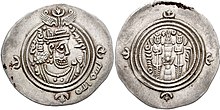
Coin minted under Ali’s Caliphate in Bishapur, 36 AH/656CE
On becoming Caliph, Ali distributed all the sums collected in Bayt al-mal. According to Vaglieri, this action is not to be regarded as an act of demagogic, since Ali previously provoked Umar to do so. ‘Ali recovered the land granted by ‘Uthman and swore to recover anything that elites had acquired before his election. Ali opposed the centralisation of capital control over provincial revenues, favouring an equal distribution of taxes and booty amongst the Muslim citizens; he distributed the entire revenue of the treasuryamong them. ‘Ali refrained from nepotism, including with his brother ‘Aqeel ibn Abu Talib. This reflected his policy of offering equality to Muslims who served Islam in its early years and to those Muslims who played a role in the later conquests.
Ali is said to have vowed an uncompromising campaign against financial corruption and unfair privileges after he assumed the caliphate following the death of Uthman. Shias argue that his determination in pushing these reforms aroused the ire of the wealthy and the privileged former companions of the Prophet.
Ali succeeded in forming a broad coalition, especially after the Battle of the Camel. His policy of equal distribution of taxes and booty gained the support of Muhammad’s companions, especially the Ansar who were subordinated by the Quraysh leadership after Muhammad, the traditional tribal leaders, and the Qurra or Qur’anic reciters that sought pious Islamic leadership. The successful formation of this diverse coalition seems to be due to Ali’s charisma. This diverse coalition became known as Shia Ali, “adherents of Ali” or “followers of Ali”. However, according to Shia, as well as non-Shia reports, the majority of those who supported ‘Ali after his election as caliph were Shia politically, not religiously. Although at this time there were many who were counted as political Shia, few of them believed in Ali’s religious leadership.
His policies and ideas of governing are manifested in the letter he sent to Malik al-Ashtar after appointing him governor of Egypt. This instruction, which has historically been viewed as the ideal constitution for Islamic governance, alongside the Constitution of Medina, involved detailed descriptions of the duties and rights of the ruler, the various functionaries of the state, and the main classes of society at that time. Ali wrote:
Infuse your heart with mercy, love and kindness for your subjects. Be not in face of them a voracious animal, counting them as easy prey, for they are of two kinds: either they are your brothers in faith or in creation. Error catches them unaware, deficiencies overcome them, (evil deeds) are committed by them intentionally and by mistake. So grant them your pardon and your forgiveness to the same extent that you hope God will grant you His pardon and His forgiveness. For you are above them, and he who appointed you is above you, and God is above him who appointed you. God has sought from you the fulfillment of their requirements and He is trying you with them.
Since the majority of ‘Ali’s subjects were nomads and peasants, he was concerned with agriculture. He instructed Malik to give more attention to land development than to the tax collection, because tax can only be obtained by the development of the land and whoever demands tax without developing the land ruins the country and destroys the people.
Battle of the Camel

Map of the First Fitna. The areas shaded in green and pink respectively represent the territories under Caliph Ali’s and Mu’awiya’s control in 658.
According to Laura Veccia Vaglieri, although A’ishah had supported opposition against Uthman, she had gone on pilgrimage to Mecca when they killed Uthman. On her way back to Medina, when she learned about this, and specially on hearing that the new Caliph was Ali, she returned to Mecca and engaged in an active propaganda against Ali. Later on Talhah and Al-Zubayr joined her and together they marched towards Iraq to gain more supporters against Ali. They wanted ‘Ali to punish the rioters who had killed Uthman. The rebels maintained that Uthman had been justly killed, for not governing according to the Quran and Sunnah; hence, no vengeance was to be invoked. According to Vaglieri, since these three leaders (A’isha, Talaha, Zubayr) were in part responsible for the fate of Uthman, their reason for rising is not clear. However, Vaglieri writes, “social and economic motives, inspired by fear of the possible influence of the extremists on Ali, seem to provide a more convincing explanation”.
Troops encamped close to Basra. The talks lasted for many days. The two parties agreed on a peace agreement, however, according to Vaglieri, the rebels did not like the conclusion of the treaty. A brawl provoked, which expanded into a battle. The Battle of the Camelstarted in 656, where Ali emerged victorious.
Some say the caliphate was a gift of the rebels and Ali did not have enough force to control or punish them, while others say Ali accepted the rebels’ argument or at least did not consider Uthman a just ruler. Ali himself writes, in the Nahj al-Balagha, that he was blamed by the Umayyads for the assassination of Uthman.
The Umayyads knowledge of me did not restrain them from accusing me, nor did my precedence in accepting Islam keep these ignorant people from blaming me. Allah’s admonitions are more eloquent than my tongue. I am the contester against those who break away from Faith and the opposer of those who entertain doubts. Uncertainties should be placed before Qur’an, the Book of Allah (for clarification). Certainly, people will be recompensed according to what they have in their hearts. – Nahj al-Balagha: Sermon 75
Battle of Siffin
Ali appointed ‘Abd Allah ibn al’-Abbas governor of Basra. Later, Muawiyah I, governor of the Levant and cousin of Uthman, refused Ali’s demands for allegiance. Ali opened negotiations, but Muawiyah insisted on Levantine autonomy under his rule. Muawiyah mobilised an army and refused to pay homage to Ali on the pretext that his contingent had not participated in the election. Ali then moved his armies north and the two sides encamped at Siffin for more than one hundred days, most of the time being spent in negotiations. Although Ali exchanged several letters with Muawiyah, he was unable to dismiss the latter, nor persuade him to pledge allegiance. Skirmishes between the parties led to the Battle of Siffin in 657.
A week of combat was followed by a violent battle known as laylat al-harir (the night of clamour). Muawiyah’s army was on the point of being routed when Amr ibn al-As advised Muawiyah to have his soldiers hoist mus’haf (either parchments inscribed with verses of the Quran, or complete copies of it) on their spearheads in order to cause disagreement and confusion in Ali’s army. This gesture implied that two sides should put down their swords and settle their dispute referring to Quran. Ali saw through the stratagem, but only a minority wanted to pursue the fight. The two armies finally agreed to settle the matter of who should be caliph by arbitration. The refusal of the largest bloc in Ali’s army to fight was the decisive factor in his acceptance of the arbitration. The question as to whether the arbiter would represent Ali or the Kufans caused a further split in Ali’s army. Ash’ath ibn Qays and some others rejected Ali’s nominees, ‘Abd Allah ibn ‘Abbas and Malik al-Ashtar, and insisted on Abu Musa Ash’ari, for his neutrality. Finally, Ali was urged to accept Abu Musa. Amr ibn al-Aswas appointed by Muawiyah as an arbitrator.
They agreed on a settlement, according which two arbitrators should meet seven months later at a place halfway between Syria and Iraq. According to Vaglieri, the matters to be examined by the two were not determined in details. However, whether Uthman’s murder should be regarded as an act of justice or not, was among the issues to be determined. Since if the murder was unjust, then Muawiya would have the right to revenge. According to Vaglieri, “this was not all, for a decision in favour of Muawiya would inevitably involve, for Ali, the loss of the caliphate.”
Advent of Kharijites
The most vociferous opponents in Ali’s camp were the very same people who had forced Ali into the ceasefire. They broke away from Ali’s force, rallying under the slogan “arbitration belongs to God alone.” This group came to be known as the Kharijites (“those who leave”). They asserted that according to Quran(8:9)the rebel(Muawiya), should be fought and overcome. And since there is such an explicit verdict in Quran, leaving the case to judgment of human was a sin. They camped at a place near Kufa, called Harura, and proclaimed their repentance (because they themselves first forced ALi to ceasefire which led to arbitration). Ali made a visit to the camp and managed to reconcile with them. According to Vaglieri, Ali had appealed to the same verse in fighting against Aiysha, Talah, Zubayr and now Muawiya. When Ali came back to Kufa, he denied that he intended to step back from Seffin treaty. When Kharijites learned that he had sent Abu Musa to the meeting with Amr, they secretly left Kufa and gathered in a place called al-Nahrawan.
Arbitration
Seven months after the battle of Siffin, in February 658, the two arbitrators met at Dumat al-Jandal. Amr ibn al-As convinced Abu Musa Ash’ari that both Ali and Muawiyah should step down and give the Muslims the right to elect the caliph. Abu Musa al-Ashari also concurred. Ali and his supporters were stunned by the decision, which had lowered the caliph to the status of the rebellious Muawiyah.
According to Poonawala, in a second arbitration meeting, it seems that the arbiters and other eminent persons, with the exclusion of Ali’s representatives. According to Madelung, since Ali no longer considered Abu Musa as his representative, and did not appoint anyone in replace, he did not participate in the second arbitration. But, the religious leaders of Medina, who did not participate in the first arbitration, tried to resolve the crisis of the Caliphate in this way.The two sides met in January 659 to discuss the selection of the new caliph. Amr supported Muawiyah, while Abu Musa preferred his son-in-law, Abdullah ibn Umar, but the latter refused to stand for election in default of unanimity. Abu Musa then proposed, and Amr agreed, to depose both Ali and Muawiyah and submit the selection of the new caliph to a Shura. In the public declaration that followed Abu Musa observed his part of the agreement, but Amr declared Ali deposed and confirmed Muawiya as caliph. According to Vaglieri, this was judged in later time, as a treacherous trick and disloyal act.
Ali refused to accept this state of affairs and found himself technically in breach of his pledge to abide by the arbitration. ‘Ali protested that it was contrary to the Qur’an and the Sunnah and hence not binding. Then he tried to organise a new army, but only the Ansar, the remnants of the Qurra led by Malik Ashtar, and a few of their clansmen remained loyal. This put Ali in a weak position even amongst his own supporters. The arbitration resulted in the dissolution of ‘Ali’s coalition, and some have opined that this was Muawiyah’s intention. Still he assembled his forces and mobilized them toward Syria to engage in war with Mu’awia again, however, on reaching to al-Anbar, he realized that he should move toward al-Nahrawan, to handle Kharejits’ riot first.
Battle of Nahrawan
After the first arbitration, when Ali learned that Muawiya let people to pledge allegiance to him, he tried to gather a new army, and to enlist Kharijites too, by assertion that he is going, as Kharijites wished, to fight against Muawiya. The Kharijites, however, asserted that Ali should first confess himself guilty of infidel (the sin they believed Ali committed, by acceptance of arbitration), which he angrily refused.
Ali was in his way to Syria, when Kharigites started killing Ali’s supporters and other Muslims. Since they considered anyone who was not part of their group as an unbeliever. Thus Ali’s forces asked him to return to Naharawan and deal with Kharigites first. Ali asked Kharigites to hand over the killers, but they asserted that they did it together; and that it was permissible to shed the blood of Ali’s followers(Shias). Then Ali announced that those who leave Nahrawan, and have not committed murder, are safe. Thus, hundreds of Kharijites separated from their army, except for 1500 or 1800 out of about 4000, who were killed or injured afterward in the Battle of Nahrawan.
Although ‘Ali won the battle by a huge margin, the constant conflict had begun to affect his standing. While dealing with the Iraqis, ‘Ali found it hard to build a disciplined army and effective state institutions. As a result, ‘Ali found it hard to expand the state on its eastern front.
The last year of the caliphate
Ali continued to be regarded as Caliph by his followers in the last year of his life, however the number of his partisan were reducing. At about the same time, unrest was brewing in Egypt. The governor of Egypt, Qais, was recalled, and Ali had him replaced with Muhammad ibn Abi Bakr (the brother of Aisha and the son of Islam’s first caliph Abu Bakr). Muawiyah allowed ‘Amr ibn al-‘As to move against Egypt and ‘Amr eventually conquered it for the second time in his career. Amr had first taken Egypt eighteen years earlier from the Romans but had been dismissed by Uthman. Muhammad ibn Abi Bakr had no popular support in Egypt and managed to muster 2000 men but they dispersed without a fight. Muawiyah’s army occupied many cities of Iraq, which Ali’s governors could not prevent, and the people offered no support for a defense. So Muawiyah overpowered Egypt, Hijaz, Yemen and other areas. In the same time, revolts took place in Khorasan and the East Arab rules were overthrown, but the riot in Fars was put down by Caliph’s governor.
In the last year of Ali’s caliphate, the mood in Kufa and Basra changed in Ali’s favour as the people became disillusioned with Muawiyah’s reign and policies. However, the people’s attitude toward Ali differed deeply. Just a small minority of them believed that Ali was the best Muslim after Muhammad and the only one entitled to rule them, while the majority supported him due to their distrust and opposition to Muawiyah.
Death and burial
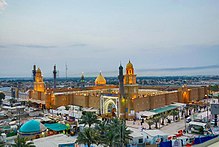
The Great Mosque of Kufa, where Ali was fatally attacked
On 19 Ramadan AH 40, which would correspond to 26 January 661, while praying in the Great Mosque of Kufa, Ali was attacked by the Kharijite Abd-al-Rahman ibn Muljam. He was wounded by ibn Muljam’s poison-coated sword while prostrating in the Fajr prayer. ‘Ali ordered his sons not to attack the Kharijites, instead stipulating that if he survived, ibn Muljam would be pardoned whereas if he died, ibn Muljam should be given only one equal hit (regardless of whether or not he died from the hit). ‘Ali died two days later on 29 January 661 (21 Ramadan AH 40). Al-Hasan fulfilled Qisas and gave equal punishment to ibn Muljam upon Ali’s death.


According to Al-Shaykh Al-Mufid, Ali did not want his grave to be exhumed and profaned by his enemies and consequently asked his friends and family to bury him secretly. This secret gravesite was revealed later during the Abbasid caliphate by Ja’far al-Sadiq, that the grave was some miles from Kufa, where a sanctuary arose later and the city Najaf was built around it. Most Shias accept that Ali is buried at the Tomb of Imam Ali in the Imam Ali Mosque at what is now the city of Najaf, which grew around the mosque and shrine called Masjid Ali.
However, another story, usually maintained by some Afghans, notes that his body was taken and buried in the Afghan city of Mazar-E-Sharif at the famous Blue Mosque or Rawze-e-Sharif.
Shia pilgrims usually go to Mashad Ali in Najaf for Ziyarat, pray there and read “Ziyarat Amin Allah” or other Ziyaratnamehs. Under the Safavid Empire, his grave became the focus of much devoted attention, exemplified in the pilgrimage made by Shah Ismail I to Najaf and Karbala.

Ali’s name representation as Imam
Many Shia Muslims also celebrate Imam Ali’s birth anniversary (13th day of Rajab) as Father’s Day in Iran.The Gregorian date for this changes every year:
| Year | Gregorian date |
|---|---|
| 2019 | 21 March |
| 2020 | 8 March |
| 2021 | 25 February |
Succession
After Ali’s death, Kufi Muslims pledged allegiance to his eldest son Hasan, as Ali on many occasions had declared that just People of the House of Muhammad were entitled to rule the Muslim community.At this time, Muawiyah held both the Levant and Egypt and declared himself caliph and marched his army into Iraq, the seat of Hasan’s caliphate. War ensued during which Muawiyah gradually subverted the generals and commanders of Hasan’s army until the army rebelled against him. Hasan was forced to give the caliphate to Muawiyah, according to a Hasan–Muawiya treaty. Umayyads placed pressure upon Ali’s family and his Shia. Regular public cursing of Imam Ali in the congregational prayers remained a vital institution until Umar ibn Abd al-Aziz abolished the practice, 60 years later. According to Ibn Abi’l-Hadid the Umayyads “prevented people from reporting any narration that might refer to any of his accolades. Finally, they even prevented people from calling their newborns by his name.” According to Madelung, “Umayyad highhandedness, misrule and repression were gradually to turn the minority of Ali’s admirers into a majority. In the memory of later generations Ali became the ideal Commander of the Faithful.”
Wives and children
Ali had fourteen sons and nineteen daughters from nine wives and several concubines, among them Al-Hasan, Al-Husayn and Muhammad ibn al-Hanafiyyah played a historical role, and only five of them left descendants. Ali had four children from Muhammad’s youngest daughter, Fatimah: Al-Hasan, Al-Husayn, Zaynab and Umm Kulthum. After Fatimah’s death, he married Umamah the daughter of Zaynab the elder daughter of Muhammad, and had two sons with her: Hilal (also known as “Muhammad al-Awsat or Muhammad the Middle”), and ‘Awn. His other well-known sons were Al-Abbas ibn Ali, born to Umm al-Banin Fatimah binte Hizam, and Muhammad ibn al-Hanafiyyah, from Khawlah bint Ja’far, another wife from the central Arabian tribe of Banu Hanifah, whom Ali had also married after Fatimah’s death.
Hasan, born in 625, was the second Shia Imam and he also assumed the role of caliph for several months after Ali’s death. In the year AH 50 he died after being poisoned by a member of his own household who, according to historians, had been motivated by Mu’awiyah. Husayn, born in 626, was the third Shia Imam, whom Mu’awiyah persecuted severely. On the tenth day of Muharram, of the year 680, Husayn lined up before the army of the caliph with his small band of followers and nearly all of them were killed in the Battle of Karbala. The anniversary of his death is called the Day of Ashura and it is a day of mourning and religious observance for Shia Muslims.
Position in Islamic thought
Ali is respected not only as a warrior and leader, but as a writer and religious authority. A wide range of disciplines from theology and exegesis to calligraphy and numerology, from law and mysticism to Arabic grammar and rhetoric are regarded as having been first adumbrated by Ali.
Prophetic knowledge
According to a hadith which is narrated by Shia and Sufis, Muhammad said “I’m the city of knowledge and Ali is its gate …”Muslims regard Ali as a major authority on Islam. According to the Shia, Ali himself gave this testimony:
Not a single verse of the Quran descended upon (was revealed to) the Messenger of God which he did not proceed to dictate to me and make me recite. I would write it with my own hand, and he would instruct me as to its tafsir (the literal explanation) and the ta’wil (the spiritual exegesis), the nasikh(the verse which abrogates) and the mansukh (the abrogated verse), the muhkam and the mutashabih (the fixed and the ambiguous), the particular and the general …
It has been narrated that when Abbas was a baby, Ali placed him on his lap, kissed his hands and began to weep. He foretold the tragedy of Abbas and the inevitable fate of his hands which caused his wife, Umm ul-Banin, to also weep. However, he goes on to describe Abbas’s future position and great status with God, and this relieves her.
Theosophy
According to Seyyed Hossein Nasr, Ali is credited with having established Islamic theology, and his quotations contain the first rational proofs among Muslims of the Unity of God. Ibn Abi al-Hadid has quoted
As for theosophy and dealing with matters of divinity, it was not an Arab art. Nothing of the sort had been circulated among their distinguished figures or those of lower ranks. This art was the exclusive preserve of Greece, whose sages were its only expounders. The first one among Arabs to deal with it was Ali.
In later Islamic philosophy, especially in the teachings of Mulla Sadraand his followers, like Allameh Tabatabaei, Ali’s sayings and sermons were increasingly regarded as central sources of metaphysical knowledge, or divine philosophy. Members of Sadra’s school regard Ali as the supreme metaphysician of Islam. According to Henry Corbin, the Nahj al-Balagha may be regarded as one of the most important sources of doctrines professed by Shia thinkers, especially after 1500. Its influence can be sensed in the logical co-ordination of terms, the deduction of correct conclusions, and the creation of certain technical terms in Arabic which entered the literary and philosophical languageindependently of the translation into Arabic of Greek texts.
In addition, some hidden or occult sciences such as jafr, Islamic numerology, and the science of the symbolic significance of the letters of the Arabic alphabet, are said to have been established by Alithrough his having studied the texts of al-Jafr and al-Jamia.
Eloquence
According to Vaglieri, Ali’s position as an orator is not disputed, however, the same cannot be said of his poetic art. Still, Vaglieri, names a Diwan and prose works, attributed to him, which may be authentic.
Ali was also a great scholar of Arabic literature and pioneered in the field of Arabic grammar and rhetoric. Numerous short sayings of Ali have become part of general Islamic culture and are quoted as aphorisms and proverbs in daily life. They have also become the basis of literary works or have been integrated into poetic verse in many languages. Already in the 8th century, literary authorities such as ‘Abd al-Hamid ibn Yahya al-‘Amiri pointed to the unparalleled eloquence of Ali’s sermons and sayings, as did al-Jahiz in the following century.Even staffs in the Divan of Umayyad recited Ali’s sermons to improve their eloquence. The most famous selection of Ali’s utterances and writings has been gathered in a book called Nahj al-Balagha (Peak of Eloquence) by a 10th-century Shia scholar, Al-Sharif al-Radi, who selected them for their singular rhetorical beauty.
The sermons without dots and alephs
Of note among sermons quoted in the book is the undotted sermon as well as the sermon without Aleph. According to narrations, some companions of Muhammad had gathered somewhere discussing the role of letters in speaking. They concluded that Aleph had the greatest contribution in speaking and that dotted letters were also important. Meanwhile, Ali read two long impromptu sermons, one without using Aleph and the other without dotted letters, containing deep and eloquent concepts, according to Langroudi, a Shia author. George Jordac, a Christian author, said that sermons without Aleph and dot had to be regarded as literary masterpieces.
Compassion
Ali is revered for the deep sympathy and support he showed for the poor and orphans, and the egalitarian policies he pursued during his caliphate with the aim of achieving social justice. It is narrated in Kitab al-Kafi that Amir al-Mu’minin Ali ibn Abi Talib was presented with honey and figs from locations near Baghdad. Upon receiving the gifts, he ordered his officers to bring the orphans so that they could lick the honey from the containers while he distributed the rest himself among the people.
Works
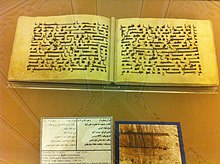
One of the first copies of the Qur’anever transcribed in the Islamic world by ‘Ali ibn Abi Talib.
The works attributed to Ali, first delivered to his followers in the form of sermons and speeches, then were written by his companions. There were also supplications such as Du’a Kumayl which were taught to his companions.
Nahj al-Balagha
Nahj al-Balagha (The Peak of Eloquence) contains eloquent sermons, letters and quotations attributed to Ali, compiled by ash-Sharif ar-Radi. Reza Shah Kazemi states: “Despite ongoing questions about the authenticity of the text, recent scholarship suggests that most of the material in it can in fact be attributed to Ali” and in support of this he makes reference to an article by Mokhtar Jebli. This book has a prominent position in Arabic literature. It is also considered an important intellectual, political and religious work in Islam. According to Gleave, Nahj al-Balagha’s third sermon, Shaqshaqiya Sermon, in which Ali reveals his claim to Caliphate and his superiority over Abu bakr, Umar and Uthman, is the most controversial section of the book. Also Letter of Ali ibn Abi Talib to Malik al-Ashtar, in which Ali “outlines his conception of legitimate and righteous rule”, is an important part of this book and got much attention.
Ghurar al-Hikam wa Durar al-Kalim
Ghurar al-Hikam wa Durar al-Kalim (Exalted aphorisms and Pearls of Speech) which is compiled by Abd al-Wahid Amidi, who according to Gleave, was either a Shafiʽi jurist or a Twelver. This book consists of over ten thousand short sayings of Ali.
These pietistic and ethical statements, are taken from different works, including Nahj al-Balagha and Mi’a kalima (“100 sayings” of Ali) of Jāhiẓ.
Mus’haf of Ali
Other works
Du’a Kumayl is a supplication by Ali, which been taught to his companion, Kumayl ibn Ziyad. This supplication is still used by Muslims as a supplicatory prayer. See also Supplications (Du’a), translated by William Chittick. Divan-i Ali ibn Abu Talib, is a poetry, attributed to Ali, which allegedly, is written by Ali himself. According to Robert M Gleave, some secondary sources, attribute some other works to Ali such as Ṣaḥīfat al-farāʾiḍ (a short piece on inheritance law) and Kitāb al-zakāt (on alms tax) on legal matters as well as a Tafsir. These works are not extant nowadays. Ali’s other attributed works are compiled in Kitab al-Kafi by Muhammad ibn Ya’qub al-Kulayni and many works of Al-Shaykh al-Saduq.
Appearance and morality
Ali is described as being bald, heavy built, short legged, with broad shoulders, a hairy body, a long white beard; and was affected by a form of eye inflammation. In manner, it is said, he was rough, brusque, and unsociable. According to Madelung and Vaglieri, Ali has been a subject of controversy in the writings of later writers; since the conflicts in which he was involved, were perpetuated in polemical sectarian historiography, biographical and history materials is often biased. Vaglieri names Lammens’s writings as an example of hostile judgment towards Ali’s behavior, and Caetani’s as a milder one, however neither Lammens nor Caetani, Vaglieri says, took into consideration Ali’s religiosity; and its impact on his policy. According to Vaglieri, much has been said about Ali’s “austerity, his rigorous observance of religious rites, his detachment from worldly goods, his scruples in regard to booty and retaliation; and there is no reason to suppose all these details invented or exaggerated, since all his actions were dominated by this religious spirit. Without attempting to decide whether his devotion to Islam was always wholly unmixed with other motives, this aspect of his personality cannot be disregarded for the understanding that it affords of his psychology.” Authors have noted that Ali stood firmly by his principles and would not compromise them for political self-gain.
Vaglieri is quoting Al-Baladhuri’s view on Ali’s war against “erring” Muslims as a duty “to sustain the Faith and to make the right way (al-huda) triumphant”, then mentions Battle of the Camel as an example in which Ali, who had won the war, tried to relieve the defeated by preventing their women and children to be taken captive; in spite of being protested by a group of his partisans. After the battle, he “wept for the dead, and even prayed over his enemies.”
According to Leone Caetani, the “half-divine aureole which soon encircled the figure of Ali”, aside from his closeness to the prophet Muhammad, was a result of his own impression on the people of his time. According to Vaglieri, the quality which caused this impression was a “programme of social and economic reforms”(based on his religious spirit) which Ali supported it by his own authority.
According to Madelung, “In face of the fake Umayyad claim to legitimate sovereignty in Islam as God’s Vice-regents on earth, and in view of Umayyad treachery, arbitrary and divisive government, and vindictive retribution, they came to appreciate his honesty, his unbending devotion to the reign of Islam, his deep personal loyalties, his equal treatment of all his supporters, and his generosity in forgiving his defeated enemies.” It is reported from Al-Baladhuri that Ali wished to distribute the Sawad, (like what he did about Bayt al-mal), which is viewed as Ali’s only act of extremism, by Laura Veccia Vaglieri.
Names and titles
Ali is known by various titles, some given due to his personal qualities and others due to events in his life:
- Al-Murtaza (Arabic: ٱلْمُرْتَضَىٰ, “The Chosen One”)
- Amir al-Mu’minin (Arabic: أَمِير ٱلْمُؤْمِنِين, “Commander of the Faithful Ones”)
- Bab-e Madinatul-‘Ilm (Arabic: بَابِ مَديْنَةُ ٱلْعِلْم, “Door of City of the Knowledge”)
- Abu Turab (Arabic: أَبُو تُرَاب, “Father of the Soil”)
- Asad Allah (Arabic: أَسَد ٱلله, “Lion of God”)
- Haydar (Arabic: حَيْدَر, “Braveheart” or “Lion”)
- Walad al-Kaʿbah (Arabic: وَلَد ٱلْکَعْبَة, “Son of the Kaaba”)
Views

The name of Ali with Islamic calligraphy in Hagia Sophia, (present-day Turkey)
Except for Muhammad, there is no one in Islamic history about whom as much has been written in Islamic languages as Ali. In Muslim culture, Ali is respected for his courage, knowledge, belief, honesty, unbending devotion to Islam, deep loyalty to Muhammad, equal treatment of all Muslims and generosity in forgiving his defeated enemies, and therefore is central to mystical traditions in Islam such as Sufism. Ali retains his stature as an authority on Quranic exegesis, Islamic jurisprudenceand religious thought. Ali holds a high position in almost all Sufi orders which trace their lineage through him to Muhammad. Ali’s influence has been important throughout Islamic history. Sunni and Shia scholars agree that The Verse of Wilayah was narrated in honour of Ali, but there are differing interpretations of wilayah and the Imamate. The Sunni scholars believe that the verse is about Ali but does not recognise him as an Imam while, in the Shia Muslim view, Ali had been chosen by God as successor of Muhammad.
In the Quran
There are many verses interpreted by Shia scholars as referring to Ali or other Shia Imams. In answering question of why the names of the Imams are not expressly mentioned in the Quran Muhammad al-Baqirresponds: “Allah revealed Salat to his Prophet but never said of three or four Rakats, revealed Zakat but did not mention to its details, revealed Hajj but did not count its Tawaf and the Prophet interpreted their details. Allah revealed this verse and Prophet said this verse is about Ali, Hasan, Husayn and the other twelve Imams.”According to Ali, one quarter of Qur’anic verses are stating the station of Imams. Momen has listed many of these verses in his An Introduction to Shi’i Islam. However, there are few verses that some Sunni commentators interpret as referring to Ali, among which are The verse of Wilayah (Quran, 5:55) that Sunni and Shia scholars believe refers to the incident where Ali gave his ring to a beggar who asked for alms while performing ritual prayers in the mosque. The verse of Mawadda (Quran, 42:23) is another verse in which Shia scholars, along with Sunni ones like Al-Baydawiand Al-Zamakhshari and Fakhr ad-Din ar-Razi, believe that the phrase Kinship refers to Ali, Fatimah and their sons, Hasan and Husayn.
The verse of purification (Quran, 33:33) is also among the verses in which both Sunnis and Shia conjoined the name of Ali along with some other names. The aforementioned verse of Mubahala, and also Quran 2:269, in which Ali is honoured with unique wisdom by both Shia and Sunni commentators, are other verses of this kind.
In Hadiths
Ja’far al-Sadiq narrates in hadith that whatever virtue found in Muhammad was found in Ali, and that turning away from his guidance would be akin to turning away from Allah and his Prophet. Ali himself narrates that he is the gateway and supervisor to reach Allah.According to Shia, Muhammad suggested on various occasions during his lifetime that Ali should be the leader of Muslims after his death. This is supported by numerous hadiths which have been narrated by Shias, including Hadith of the pond of Khumm, Hadith of the two weighty things, Hadith of the pen and paper, Hadith of the Cloak, Hadith of position, Hadith of the invitation of the close families, and Hadith of the Twelve Successors.
Sunni
According to Gleave, since Ali was one of Rightly-Guided Caliphs , and one of Muhammad’s close companions, he has a high position in Sunni thought. However, this was not the case from the beginning. The title of Rightly-Guided for Ali was considered legitimate by the Sunni doctrine, only after Ahmad ibn Hanbal accepted Ali, as one of the Rashiduncaliphs. Later on Sunni authors regularly reported Ali’s legal, theological, and historical views in their works, among them some sought to use Ali’s sayings to disprove Shi’i position, or depict him as a supporter of Sunni doctrine.
Among Sunnis, Ali has the same position as the other three caliphs; however, according to Sunni doctrine of sābiqa (according which, greater religious authority is given on the basis of the order of the caliphs), Ali is in a lower position than the other Rashidun Caliphs. The most troubling element of this view, is the apparent elevation of Ali’s position in Muhammad’s sayings, such as “I am from Ali and Ali is from me“, and “Whoever counts me as his patron (mawla), then Ali is also his patron“, which accordingly been interpreted so that solve the problem. (see mawla and Event of Ghadir Khumm) Some Sunni writers, on the other hand, acknowledge the preeminence of Ali’s knowledge in the Sharia, and his importance in the hadiths of the Prophet, however, do not consider these as a reason to determine Ali’s political designation by the Prophet.
Shia
In Shia belief, Ali holds a high position, and the belief in his legitimacy in leading the Muslims is the definite belief of the Shias. His statements are a reference for Shia legal system, and most importantly, Shiasbelieve that Ali was superior to the rest of the Companions and was appointed by Muhammad as his successor. Ali’s piety and morality initiated a kind of mysticism among the Shias that brought them close to the Sunni Sufis. Among the shias Imamate of Ali is one of the principles of the religion, according which, although Ali was not the recipient of a divine revelation, he had a close relationship with God, through which God guides him, and the Imam in turn guides the people. His words and deeds are a guide and model for the community to follow; as a result it is a source of sharia law.
Musta’lis consider Ali’s position superior to that of the Imam. Both Twelvers and Isma’ilis believe in infallibility, the knowledge of the unseen, and the intercession of Ali. A large volume of Shiite religious literature in various languages such as Arabic, Persian, Urdu, and Turkish is dedicated to Ali.
Ghulat
Shia extremists believed that Ali had access to God’s will; for example, the Nuṣayrīs believed that Ali appears as an incarnation of God, some of them(Khaṭṭābiyya), considered Ali higher than Muhammad. Nowadays, Alawites and Bektashis are viewed with suspicion by Shias and Sunnis. The Ahl al-Haq Kurds also hold a similar views mixed with reincarnation about Ali.
Saba’iyya, the followers of Abdullah ibn Saba’, who praised Ali beyond measures, were another Ghulat sect, which, according to Veccia Vaglieri, Ali dissociated himself from them. Also, there is Ali-Illahism, a syncretic religion, which centres on the belief that there have been successive incarnations of their Deity throughout history, and reserves particular reverence for ‘Ali, the son-in-law of Muhammad, who is considered one such incarnation. These groups have, according to traditionalist Muslims, left Islam due to their exaggeration of a human being’s praiseworthy traits. Studies carried out by Aryeh Kofsky and Meir M.Bar Asher support the claim that the Alawites do not deify Ali but rather identify him as the unique “wasīī”, meaning a “guard of Islam” chosen by God Ali is recorded in some traditions as having forbidden those who sought to worship him in his own lifetime.
Sufism
Almost all Sufi orders trace their lineage to Muhammad through Ali, an exception being Naqshbandi, who go through Abu Bakr. Even in this order, there is Ja’far al-Sadiq, the great great grandson of Ali.According to Gleave, even Naqshbandi include him into their spiritual hierarchy by depicting how Muhammad taught him special ritual principle of Ṣūfī practice, through which, believers may reach certain stages on the Sufi path.
Sufis believe that Ali inherited from Muhammad the saintly power wilayah that enable Sufis in their spiritual journey to God. Ali’s position as a prominent narrator of Muhammad’s esoteric knowledge, made him popular among Sufi writers. Ali is therefor, considered as an ascetic follower of Muhammad, by Sufis, as well as Sunnis and Shias.
Early sufi Hasan Al Basri was disciple of Ali. Eminent Sufis such as Ali Hujwiri claim that the tradition began with Ali and Junayd of Baghdadregarded Ali as the Sheikh of the principles and practices of Sufism.
Sufis recite Manqabat Ali in the praise of Ali.
Historiography
The primary sources for scholarship on the life of Ali are the Qur’an and ahadith, as well as other texts of early Islamic history. The extensive secondary sources include, in addition to works by Sunni and Shia Muslims, writings by Christian Arabs, Hindus, and other non-Muslims from the Middle East and Asia and a few works by modern western scholars. However, many of the early Islamic sources are coloured to some extent by a positive or negative bias towards Ali.
There had been a common tendency among the earlier western scholars to consider narrations and reports gathered in later periods as fabrications, due to their tendency towards later Sunni and Shia partisan positions. This led these scholars to regard certain reported events as inauthentic or irrelevant. For example, Leone Caetaniconsidered the attribution of historical reports to Ibn Abbas and Aisha as mostly fictitious while proffering accounts reported without isnad by the early compilers of history like Ibn Ishaq. Wilferd Madelung has rejected the stance of indiscriminately dismissing everything not included in “early sources” and in this approach tendentiousness alone is no evidence for late origin. According to him, Caetani’s approach is inconsistent. Madelung and some later historians do not reject the narrations which have been compiled in later periods and try to judge them in the context of history and on the basis of their compatibility with the events and figures.
Until the rise of the Abbasid Caliphate, few books were written and most of the reports had been oral. The most notable work prior to this period is The Book of Sulaym ibn Qays, written by Sulaym ibn Qays, a companion of Ali who lived before the Abbasids. When paper was introduced to Muslim society, numerous monographs were written between 750 and 950. According to Robinson, at least twenty-one separate monographs have been composed on the Battle of Siffin. Abi Mikhnaf is one of the most renowned writers of this period who tried to gather all of the reports. Ninth- and tenth-century historians collected, selected and arranged the available narrations. However, most of these monographs do not exist any more except for a few which have been used in later works such as History of the Prophets and Kings by Muhammad ibn Jarir al-Tabari (d.923).
Shia of Iraq actively participated in writing monographs but most of those works have been lost. On the other hand, in the 8th and 9th century Ali’s descendants such as Muhammad al-Baqir and Jafar al-Sadiq narrated his quotations and reports which have been gathered in Shia hadith books. The later Shia works written after the 10th century are about biographies of The Fourteen Infallibles and Twelve Imams. The earliest surviving work and one of the most important works in this field is Kitab al-Irshad by Shaykh Mufid (d. 1022). The author has dedicated the first part of his book to a detailed account of Ali. There are also some books known as Manāqib which describe Ali’s character from a religious viewpoint. Such works also constitute a kind of historiography.