
Nachinola is a small, landlocked village in North Goa district, Goa, India. It is situated between Moiraand Aldona, lying in the Bardez sub-district or taluka. It is divided into three vadde(village sub-divisions). These are the vadde of Vainguinn, Zoidar, and Borvonn. For administrative purposes, Panarim, a vaddo of Aldona, is also considered to be a part of Nachinola. The scenic village is mostly tucked in, away from the main road that passes through it and connects Mapusa to Aldona.
Contents
- Population
- Church
- Temples
- Institutions
- Origins of the name
- In the news
- Gallery
- References
Population

A Catholic funeral in Nachinola
In 2011, Nachinola had a population of 2725 and a literacy rate of 88.6%.

Farmers at work.
It also had a 645 households with a population of 2,725 people. Of these, 1,360 were male and 1,365 female. In the age group of 0-6 years, it had 252 children, comprising 144 male and 108 female. Of its population, 2,191 were literate — comprising 1,105 males and 1,086 females. Census of India also showed Nachinola to cover an area of 244.05 hectares.

Comunidade of Nachinola Office
The Nachinola comunidade, or ancestral village community, is considered to be one of the twelve Brahmin comunidades of Bardez.
Church

Church of Bom Jesu at Nachinola, Bardez, Goa
The church in Nachinola was built in 1676, is dedicated to Bom Jesus, and celebrates the feasts of Santissimo Sacramento e Bom Jesus (1 January) and Sta. Ana (June).
The Jesuit Fr. Moreno De Souza wrote that the small church lies tucked away in a corner and doesn’t get noticed much. The reason for its naming as Bom Jesus could not be found by him. The church was initially probably known only as Jesus or the Church of Jesus, as is noticed from a sign near the left of the entry which simply says: Esta Igreja de Iesus. Subsequently, its name seems to have been changed to Bom Jesus. Franciscans were the parish priests there. The last Franciscan priest served here in 1776-77, and between 1724 and 1767, there were a total of 26 priests listed by writer Leopoldo Rocha.
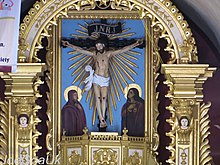
Inside altars.
Souza quotes Clement de S. Iria as writing that the church was established in 1676 and opened for services on 26 July, when Pedro de Purificação was the head of the parish. The church was small and in 1720 had a total of only 615 parishioners. Souza presumes that with the small village being “squeezed” between Aldona and Moira, Christianity arrived here around the same time as it arrived at the other two villages.
Souza describes the inscriptions which mark the building of the church in 1676, another date from 1729, and its tricentennial in 1978. Souza also describes the main and side altars with Jesus, Mary, St. John, St Sebastian, St. Anthony and Our Lady of the Rosary. A small kind of chapel is devoted to Our Lady of Piety on the left.
Engineer-author José Lourenço describes its architecture as Mannerist Neo-Roman in style. It is of large size with three bays and three storeys. Its main door has a bracketed arch. The frontispiece has Rococo curves flanking a broken pediment which frames a relief of the Sacred Heart. Spear finials top the frontispiece. Twin bell towers with bausters and finials are of urn type. Earlier, Nachinola fell under the Aldona parish. Aldona’s church was set up in 1569 and Moira’s in 1636; prior to this Moira was under the Mapusa church, set up in 1594.
Nachinola and its neighbouring Ucassaim village have a unique relationship in participating in each other’s feasts. Nachinola celebrates its Bom Jesus feast on January 1 each year, and Ucassaim celebrates the feast of Saude Saibinn (Our Lady of Good Health) on the first Sunday of February, the confaria (a church local body) of each village invites neighbouring confraria, parishioners and parish priest for the feast of the other. The high mass at Nachinola begins only after the team from their neighbouring village arrives. It appears that there was some connection between these two villages in the past, according to Souza.
The cemetery was expanded and blessed by Goa Archbishop Filipe Neri Ferrão on June 20, 1998.
Temples
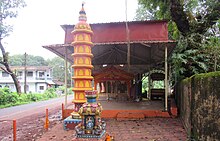
Ganapati Devasthan

Ravalgaddi Temple, in or en route to Nachinola
According to Rui Gomes Pereira, prior to conversions, the area had temples devoted to Ramanatha, Malkumi (Mahalakshimi), Gram-purusha, Ravalnatha, Vetall and Gopinatha.
Deities Vetall, Ramanatha, Mahalakshimi and Ravalnatha were shifted to Advalpale of Bicholim, due to religious intolerance in colonial Goa. Vetall was the main deity and the others, affiliates. There are believed to have been other deities in the temple too.
The comunidade (traditional village body) consists of twelve vangors (clans). Its members, known as gaunkars, are of Brahmins ancestry. Mahajans at the Advalpale temple use the common surname Nashnodkar, tracing to their villageof origin. They belong to castes of Gaud Saraswat Brahmins, Daivadna Brahmins, ironsmiths, Marathas and Bhandaris. Earlier, according to Gomes Pereira, the village had as its gaunkarspeople with the surname of Porobo (Prabhu).
Institutions

Bom Jesus Home for the Aged, Nachinola, Goa
Nachinola has its own panchayat. Nachinola also has a home for the aged, called the Bom Jesus Home for the Aged. It is run by the Missionary Sisters of the Queen of the Apostles (SRA Sisters). A local youth organisation, linked to the parish, is called the Bom Jesus Parish Youth.

OPM (Caritas’ Obra de Protecao a Mulher) Nachinola, Goa
A not so well known but important charity is situated at Nachinola. Caritas’ Obra de Proteção a Mulher (OPM) one of the only two homes Goa that have been designated as specialised adoption agencies for the purpose of placing children for adoption. It is a creche for children under seven years of age and is managed by the Sisters Adorers. It is run by the Congregation of Sisters Adorers Handmaids of the Blessed Sacrament and of Charity (AASC).
Origins of the name
One version of how the village got its name points to the belief that a talented dancer called Nola would be egged on to dance, with pleas of “Nach go Nola, nach go Nola” (Do dance, Nola). This saw it name thus grow from Nachnola to Nachinola.
In the news
During the 2020 lockdown, Nachinola was in the news during the Covidpandemic, when some of its villagers took to helping those in need.In August 2020, farmers from Nachinola complained that waterlogging in their fields was destroying cultirvated crops as the drains had not been de-silted and the problem was being for two years. They had approached the Bardez Zonal Agricultural Office over this issue and sought an inspection. Village youth have also undertaken clean-up drives.
Gallery
-

Our Lady of Immaculate Conception Chapel.
-

Holy Cross Chapel.
-

Holy Cross Chapel.
-

Mae de Deus Chapel.
-

Main entrance of Bom Jesus Church, Nachinola.
-

Bom Jesus Church.
-

Holy Cross Chapel.
-

Ravalgaddi Temple.
-

Bom Jesus Church.
-
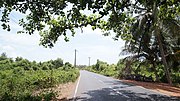
Along the road to Moira and Nachinola.
-

Protest sign at the road.
-

Village cemetery.
-

Funeral at the village church.
-

Farmers at work.
-

Scene near the church.