
xThe National Museum in New Delhi, also known as the National Museum of India, is one of the largest museums in India. Established in 1949, it holds a variety of articles ranging from pre-historic era to modern works of art. It functions under the Ministry of Culture, Government of India. The museum is situated on Janpath. The blue–print of the National Museum had been prepared by the Gwyer Committee set up by the Government of India in 1946. The museum has around 200,000 works of art, mostly Indian, but some of foreign origin, covering over 5,000 years.
It also houses the National Museum Institute of History of Art, Conservation and Museology on the first floor which was established in 1983 and has been to be a university since 1989, and runs Masters and Doctoral level courses in art history, conservation and museology.
History
In 1946, the idea of building a National Museum for India was proposed by the Gwyer Committee. Sir Maurice Gwyer, the former Chief Justice of India and Vice Chancellor of Delhi University, headed the Committee. One of the members of the Committee was Sir Mortimer Wheeler, then heading the Archaeological Survey of India (ASI), who is often cited as chief initiators of the National Museum as he advocated for the museum’s development although reports indicate that he was concerned with unifying ASI site museums under the umbrella of a Museum’s branch rather than setting up a new museum.
The roots of the National Museum begin with an exhibition of Indian art and artefacts organized by the Royal Academy of Arts, London. The Exhibition went on display in the galleries of Burlington House during the winter months of 1947-48. This Exhibition of The Art of India and Pakistan in London was arguably the first exhibition sponsored by the British government which gave Indian artefacts the status of high art. Before its return to India, with Jawaharlal Nehru’s support, it was decided that these important collections should be showcased here upon their return so that they could be enjoyed and appreciated by the people of India. At the close of the exhibit, requests were released to the loaning museums and collectors, urging them to surrender object ownership to what was to become the National Museum. When the decision was taken to make a permanent National Museum, the exhibits were first displayed in the State Rooms of the Rashtrapati Bhavan (then called the Government House) on August 15, 1949 and the rooms were formally inaugurated by C. Rajgopalachari, Governor General of India. Until the mid-1950s, it essentially remained a permanent version of the temporary exhibit – consisting of the same pieces, and remaining in the state rooms. In 1955 building began on the new current location of the National Museum at Janpath. However, when the National Museum was ready in 1960, the statue of Buddha and the Rampurva Bull were retained at the Rashtrapati Bhavan on the request of Jawaharlal Nehru.
Since its inception, the National Museum owed much of its original structure and organization to example of the Indian Museum, Kolkata as some of its first curators were former employees of the Indian Museum, such as C. Sivaramamurti even though the National Museum aspired to displace the historic position the Indian Museum had come to acquire as the largest and grandest museum in India. The National Museum encouraged the scholars and the public to think differently about the objects on display by placing the objects within a broad historical context and allowing the objects to speak for a larger representation outside of itself.
Grace Morley was the first Director of the National Museum, New Delhi who earlier played instrumental role of the founding director (1935–58) of the San Francisco Museum of Art (now San Francisco Museum of Modern Art). She joined the National Museum on the 8th of August, 1960 and continued to hold its charge for six more years. She was one of the advocates of cultural democracy who believed that art should be available to everyone—and held firm convictions about the crucial role that museums could play in this endeavour. In her installations for the National Museum, this desire for secularisation and democratisation was effected through the presentation of sculptures in classic white-cube spaces with minimal contextual information. It was her ‘visual storage’ display system, minimalist teak pedestals, air-conditioning vents, track-lighting, and large glass cases with staggered risers for visual variety which led to the museum acquiring international recognition and the museum in its working still reflects her image. She instructed carpenters to build display cases and Eamesian-type couches, cabinets and cases that reflected modernist, uncluttered lines. Such elements produced the perfect streamlined stage for a performance of the modern by viewing audiences. Harmonious colour schemes, dramatic, dim lighting, cushions of space around eye-level objects, and the occasional leafy plant for a visual pause, all contributed to the creation of a modern museum.
Departments and collections

Reception of Museum

The Entrance Corridor of the National Museum housing artefacts on both the sides
Presently, there are several departments in the National Museum.
- Pre-History Archaeology
- Archaeology
- Manuscripts
- Numismatics & Epigraphy
- Paintings
- Arms & Armour
- Decorative Arts
- Central Asian Antiquities
- Pre-Columbian Art
- Jewellery
- Anthropology
- Anubhav
- Education
- Public Relations
- Publication
- Conservation
- Display
The collections of the National Museum represents almost all disciplines of art: archaeology (sculptures in stone, bronze and terracota), arms, armour, decorative arts, jewellery, manuscripts, miniatures and Tanjore paintings, textiles, numismatics, epigraphy, Central Asian antiquities, anthropology, Pre-Columbian American and Western Art Collections.
The museum has in its possession over 200,000 works of art, of both Indian and foreign origin. While the National Museum has over 200,000 exhibits, it currently displays six to seven percent of its collection. The remaining is exhibited on a rotational basis or in temporary exhibitions. The final phase of expansion will allow it to display another three to four percent of the treasures. The national museum of India is beautiful, and is worth a visit
Building
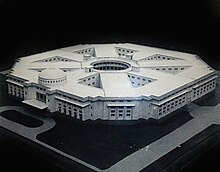
National Museum, Building Plan Outlay
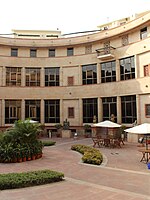 The current building of the National Museum was designed by the architect Ganesh Bikaji Deolalikar and the foundation stone was laid by Prime Minister Jawaharlal Nehru on May 12, 1955. Once the building was ready, the new museum was inaugurated by Dr. Sarvepalli Radhakrishnan, Vice-President of India on December 18, 1960. It stands today on the plot of land earmarked in Edwin L. Lutyens’ plan for the Imperial Museum and was occupied by a small Museum of Central Asian Antiquities that housed the important collection of the explorer Sir Aurel Stein.
The National Museum building was planned to be built in phases to finally give it an octagonal shape. Its first phase was inaugurated in 1960 and the second was completed in 1989. For the third and final phase, a foundation stone was laid on December 18, 2017 and involves razing down of Archaeological Survey of India (ASI) building which has been moved to Dharohar Bhawan. As maps of the original plan suggest, roughly a quarter portion remains to be added for the completion of the building. The National Museum building has three floors with galleries radiating from a central garden court. The National Museum Institute, which is on the first floor of the museum and has a “deemed to be university” status, will be shifting to a new campus in Noida.
Collections
Harappan Gallery

A view of the Harappan Gallery
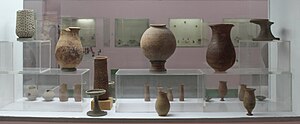
A view of the pottery from the Harappan gallery
The museum has various artefacts from the Harappan Civilization also known as Indus Valley Civilization. It has the world’s most representative collection of antiquities of the Harappan Civilization – over 3500 objects that are on permanent loan from the Archaeological Survey of India to the Museum. Most famous among the objects is the Dancing Girl made in Bronze which belongs to the early Harappan period, Skeleton excavated from Rakhigarhi in Haryana, Terracotta images of Mother Goddess and Clay Pottery. Apart from these the gallery has Sculptures in Bronzes & Terracotta, Bone Objects, Ivory, Steatite, Semi-Precious Stones, Painted Pottery and Jewellery items. Many seals are also on display which has been discovered during numerous excavations and were probably used for trading purposes. These seals depict bulls, elephants, unicorns, tigers, crocodiles, unknown symbols. On one of the seal, there is the depiction of Pasupati that has been interpreted as proto-Shiva. The gallery attempts to present the vibrancy of human civilization in India at par with the contemporary civilizations of Mesopotamia, Egypt and China.
When one of the major sites of the Harappan civilization, Mohenjo Daro was excavated in the 1920s, archaeologists deposited its important finds first in the Lahore Museum, and then these were moved to Delhi by Mortimer Wheeler in anticipation of the construction of a Central Imperial Museum there. At the time of Partition, the issue of ownership of these objects arose and eventually the two countries agreed to share all the collections equally, although this was sometimes interpreted in literal sense, with several necklaces and girdles taken apart with half the beads sent to Pakistan and half retained in India. In the words of Nayanjot Lahiri, ‘the integrity of these objects were compromised in the name of equitable division’. Of the two most celebrated sculpted figures found in Mohenjo Daro, Pakistan asked for and received the steatite figure of a bearded male, dubbed the ‘Priest King’, while the National Museum of India retained the bronze statuette of the ‘Dancing Girl’, a nude bejeweled female. Considering that the major sites like Mohenjo Daro and Harappa belonged to Pakistan post- Partition, the collections in this gallery also grew out of the discoveries of the excavations made after the Indian independence in 1947 such as Daimabad, Rakhigarhi, Dholavira etc.
Key highlights of the collection include:
- Mother Goddess (2700–2100 BC)
- Toy Cart (2700–2100 BC)
- Bull (2700–2100 BC)
- Pasupati Seal (2700–2100 BC)
- Climbing Monkey (2700–2100 BC)
- Dancing Girl (2700–2100 BC)
-

Dancing Girl
-
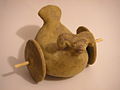
Toy cart from Mohenjo-daro
-

Perforated Jar
-

Mother Goddess
-
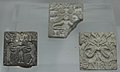
Seals
-
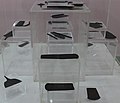
Arms from Harappan Civilization
-

Bowl
-

One of 11 skeletons found from Rakhigarhi
Maurya, Shunga and Satvahana Arts Gallery

Maurya, Shunga and Satvahana Arts Gallery Artefacts
The gallery has objects from the 4th century BCE to the 1st century BCE. It has objects spanning three major dynasties; The Mauryas, the Shungas and the Satvahanas. Objects in the gallery have Greek influence characterized by mirror like finishing. The gallery also houses fragments of railings from various ancient Stupas that are carved on with episodes from Buddha’s Life. A major object is the one showing Sage Asita’s visit to baby Siddharta and the Bharhut railings that depicts the story related to the Relics associated with Buddha by the sage Drona. A typical feature of the period to which objects in the gallery belongs to is that the sculpture do not depict Buddha in the physical form. He is always shown using symbols like the Dharmachakra, the Bodhi tree, empty throne, footprints, etc.
-

Male Heads (Maurya Period)
-

A Child Learning Brahmi Script, Srughna, 2nd century BCE
-

Woman in Grief (Shunga Period)
-

Railig from Barhut Stupa showing the Last Episode of Buddha’s Life
-

Asita visiting King Suddhodana (Satvahana Period)
-
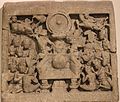
Different Symbols of Buddha
Kushana Gallery

Kushana Gallery Artefacts

Amaravati Maha Stupa relief at National Museum, Delhii, India, 1st-2nd century CE. 2004
This gallery has art objects from the Kushan period (1st – 3rd century CE). The major school of arts were the Gandhara School of Art and the Mathura School of Art. The Gandhara school had huge influence of Greek Iconography and the themes were mainly Buddhist. Most prominent among the objects is the Standing Buddha, made in Grey schist stone in Gandhara School of Arts and it belongs to the 2nd century CE. This period was the first time when Buddha was shown in physical form. The Mathura school of arts had primary themes of Buddhism, Jainism and Brahmanism while the Gandhara Arts were primarily of Buddhist themes. Other sculptures include the Kuber (Hindu god of Fortune) from Ahichchhatra, the Chattramukhi Shivlinga, the Bodhisattva, and the Jain votive plaques.
-

Buddha (Human Figure)
-

Kuber (God of Wealth)
-
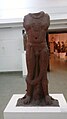
Boddhisatva
-

Ayagapata, Jain Votive Plaque
-
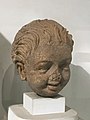
Laughing boy, stucco from Gandhara, 2nd-3rd century CE
Gupta Gallery

Gupta Gallery Artefacts
As the name suggests, this gallery exhibits artefacts from the Gupta Dynasty (4th-6th centuries CE). The art of the Gupta period presents a high watermark in Indian art. Mathura and Sarnath were the main centres of artistic activity. Under the patronage of Gupta rulers, sculptures attained a perfection of form that set the standard for artistic beauty for the coming centuries. Major developments in iconography took place during this period as the Kushan sculptures seem to be further perfected and some of the sculptures of this period are considered unsurpassed for the proportioned figures with clear features.
- Sculptures depicting scenes from the epics of Ramayana and Mahabharata
-

Scenes from Mahabharata
-

Rama redeeming Ahilya (Ramayana)
-

Laxman cutting the nose of Surpanakha (Ramayana)
- Sculptures
-

Vishnu
-

Mother Goddess
-
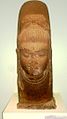
Mukhalinga of Shiva, 5th century CE
Medieval Arts Gallery
The sculptures from the Medieval Period are divided into two categories: Early and Late. The artefacts from the respective periods are divided into two galleries.
Early Medieval Artefacts

Early Medieval artefacts
This gallery has sculptures ranging from the 7th to 10th centuries. After the fall of the Gupta empire, the Indian subcontinent was divided and it was controlled by different dynasties in different parts of India like
- Palas in the East
- Maitrakas in the West
- Vardhanas and Pratiharas in the North
- Pallavas, Cholas and Chalukyas in the South
There was a general decline in the artistic quality because of the limited number of master craftsmen and the large number of temples being built.
-

Yogini (Mother Goddess)
-

Vishnu (Pallava Dynasty)
Late Medieval Artefacts

Late Medieval Artefacts
This gallery has sculptures ranging from the 10th to 13th centuries. The country was further sub divided into a number of separate principalities during this period.
- Hoysalas and Nayakas in the South
- Paramars and Chandelas in the North
- Gajapatis and Senas in the East
- Chahamanas (Chauhans) in the West
The main artefacts in this gallery are:
- Sun God
- Saraswati, the Goddess of Music, Learning and Intelligence. Carved in Marble, the statue from Pallu, Rajasthan is a highly sophisticated and delicate work.
-

Surya (From Sun Temple, Konarak)
-

Neminatha (22nd Jain Tirthankar), 11th Century
-

Parsvanatha (23rd Tirthankar), 10th Century
-

Saraswati (Chauhan Dynasty)
-

Goddess Ambika, 10th Century
-

Jain Chaumukha Sculpture, 12th century
-

Parsvanatha (23rd Tirthankar), Chola Dynasty, 11th Century
Decorative Arts Gallery
The Decorative Arts collection at the National Museum is a reflection of lifestyles of the Indian people from the 16th to the 20th century. Decorative Arts refer to Arts concerned with the design and decoration of objects that are prized for their utility, rather than for their purely aesthetic qualities These include both utilitarian and decorative objects hand crafted by master-craftsmen. They help in understanding the social, religious, economical, commercial and technological development of Indian society. Ceramics, Pottery, Furniture, Textiles, Glassware, Metalware and Jewellery are a few included under Decorative Arts. The Decorative Arts section is divided into 2 galleries.
Decorative Arts Gallery 1

Decorative Arts gallery 1
This gallery gives a glimpses of three collections of the museum – Ivory, Jade and Ceramics. The Ivory group has several Hindu and Christian religious figures. The Jade section showcases the utilitarian objects, while the glazed tiles and blue-white pottery are in the Ceramic group. The Gallery also has two interesting themes – Thrones of India, and Games and Leisure in the Past. The theme of thrones shows the evolution of the seat of power. From the low flat seats of antiquity to the modern armed chair, the journey of the throne is a fascinating story. An intricately carved Home Shrine and some metal Hindu and Jain pitikas (small seats for keeping idols for home shrines) are also present. The Jewel studded throne of the King of Varanasi is one of the best examples to show Power. The Games section has Rattles, Yo-Yo, Gamesman of Chess and Chaupar. Tops made of different materials with different designs are also exhibited. These artifacts combine the aesthetic and artistic elements to everyday objects used for games. The Jade Collection of the museum has interesting objects from the Mughal period.
-

Main Article: Ivory Carved Dashavatara Shrine.
-

Jahangir’s Jade hookah.
-
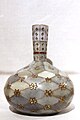
Jade Surahi (flask) from Mughal era
-

Gyan Chauper.
-

Throne of the Raja of Varanasi
Decorative Arts Gallery 2

Decorative Arts gallery 2
This gallery has artifacts from the proto-historic period to the present day. The variety, quality and media did increase with the taste and status of different generations and the process is on even today. This gallery exhibits Metalware, Jewellery and Wooden objects. Most notable among the wooden objects are the Vahana on display.
-

Wooden Garuda Vahana (mount) from Tamil Nadu
-

Wooden Horse (Vahana from Tanjore)
-

Dwarpala
Miniature Paintings Gallery

View of the Mughal Miniature paintings section
Miniature paintings, on paper, cloth, bark, wood and ivory, forms one of the National Museum’s most prestigious collections, and the world’s largest. There are over 17,000 paintings in the Department of Painting in the National Museum, spanning 900 years and most stylistic formats to be found in India: Pala, early Jain style, Sultanate, the indigenous styles of Malwa, Mewar, Bundelkhand, Raghogarh, Mughal, Deccani, later Rajasthani, Pahari, Sikh, Jammu, Tanjore and Mysore, and the Company School paintings.
Mughal Miniature Paintings
Miniature painting flourished during Mughal rule. Emperor Jahangir and Shahjahan were great patrons of art. In their courts, the painters adopted themes ranging from portraitures to landses, durbar scenes and processions for their works. The Deccani style was a fusion of Islamic idiom with indigenous art styles and of local classical traditions with elements of Persian and European Renaissance.
-

Marriage procession of Dara Shikoh
-

Babur inspecting Gwalior fort.
-

Portrait of Akbar
-

Nature Study (Early Mughal)
-
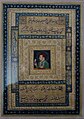
Jahangir holding a picture of Madonna
Central India Miniature Paintings

A view of the Central India Paintings Sections
Paintings from Central India include miniatures from Malwa and Bundelkhand.
Rajasthan Miniature Paintings

A view of the Rajasthani Paintings Sections
Rajasthani Miniatures flourished mainly in Mewar, Bundi, Kota, Kishangarh, Jaipur, Jodhpur and Bikaner.
Mewar Miniatures are illustrating Hindu mythological themes. Bundi and Kota Miniatures excel in composition compactness. Hunting scenes are Kota’s speciality. Bikaner excels in Portraiture. Kishangarh is known for its Bani Thani, which portrays the model of an idealised and elegant woman.
Pahari Miniature Paintings
Pahari schools flourished mainly at Basohli, Chamba, Guler and Kangra. Under the patronage of Maharaja Sansar Chand in the late 18th and early 19th centuries, Kangra became the most prominent centre for the Pahari style.
-
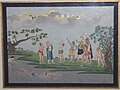
Nanda and other Cowherds moving to Vrindavana (Based on the story of the Bhagvata-Purana)
-
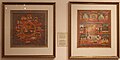
Illustration of Guru Granth Sahib
Buddhist Artefacts Gallery

Buddha’s relics in the Museum
The Buddhist Art Section is mostly known for the Sacred Relics of Buddha (5th-4th century BC) unearthed from Piprahwa, Siddharthnagar district in Uttar Pradesh, which yielded caskets with fragments of bone, along with ornaments, figures and precious stones. The inscription on a casket speaks of the relics of Buddha. The Archaeological Survey of India conducted further excavations at the site from 1971 to 1977, resulting in the discovery of two more caskets in soapstone, containing more sacred bone relics. The site has been identified with ancient Kapilavastu, the home town of Buddha Sakyamuni. Outstanding specimens of Buddhist Art is illustrated through exhibits in Stone, Bronze, Terracota, Stucco, Wooden Sculptures & Painted Scrolls or Thangkas from Nepal, Tibet, Central Asia, Myanmar, Java and Cambodia which represents the three principal Buddhist forms – Hinayana, Mahayana and Vajrayana. These objects stimulate a sense of Devotion, Dedication and Love for Humanity.
Key highlights of the collection include:
- Adoration of Stupa, Nagarjunkonda, Pale Green Limestone, 3rd Century AD
- Standing Buddha, Kushana, Dark grey schist stone, 2nd–3rd century AD
- Laughing Boy Head, Kushana, Stucco, 3rd–4th century AD
- Scenes from Buddha’s Life, Gupta, Sarnath, Chunar sandstone, 5th century AD
- Buddha Head, Gupta, Sarnath, Buff Chunar sandstone, 5th century AD
- Standing Buddha, Pala, Nalanda, Bronze, 10th century AD
- Elephants carrying Buddha’s Relics, Sunga, Bharhut, Red sandstone, 2nd century BC
- Sacred Relics from Kapilavastu, Piprahwa, Spotted red sandstone, 5th–4th century BC
-

Head of Buddha
-

Buddha’s relics, from a stupa built by Emperor Ashoka in the 3rd century BCE.
Evolution of Indian Scripts & Coins Gallery
In this gallery, there are many large sized well-lit transparencies on show which are narrating the development of various Indian Scripts and Coins.
