
A dependent territory, dependent area, or dependency (sometimes referred as an external territory) is a territory that does not possess full political independence or sovereignty as a sovereign state, yet remains politically outside the controlling state’s integral area.
A dependent territory is commonly distinguished from a country subdivision by being considered not to be a constituent part of a sovereign state. An administrative subdivision, instead, is understood to be a division of a state proper. A dependent territory, conversely, often maintains a great degree of autonomy from its controlling state. Historically, most colonies were considered to be dependent territories. The dependent territories that currently remain in the world today generally maintain a very high degree of political autonomy. Not all autonomous entities, though, are considered to be dependent territories, and not all dependent territories are autonomous. Most inhabited dependent territories have their own ISO 3166 country codes.
Some political entities inhabit a special position guaranteed by an international treaty or another agreement, thereby creating a certain level of autonomy (e.g., a difference in immigration rules). Those entities are sometimes considered to be, or are at least grouped with, dependent territories, but are officially considered by their governing states to be an integral part of those states. Examples are Åland (a part of Finland) and Hong Kong (a part of China).
Summary
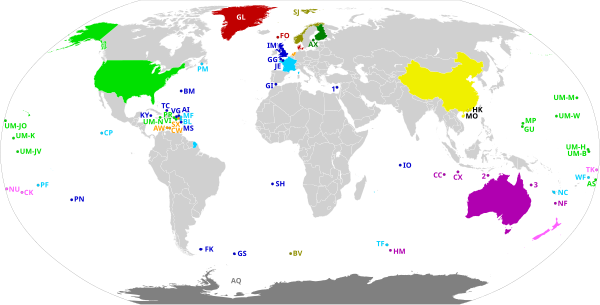
Dependent territories and their sovereign states. All territories are labeled according to ISO 3166-1 or with numbers. Colored areas without labels are integral parts of their respective countries. Antarctica is shown as a condominium instead of individual claims.
The lists below include the following:
Dependent territories
- Two states in free association, one territory and one Antarctic claim in the listing for New Zealand;
- One uninhabited territory and two Antarctic claims in the listing for Norway;
- 13 overseas territories (10 autonomous, two used primarily as military bases, and one uninhabited), three Crown dependencies, and one Antarctic claim in the listing for the United Kingdom;
- 13 unincorporated territories (five inhabited, eight uninhabited) and two claimed but uncontrolled territories in the listing for the United States.
Similar entities
- Six external territories (three inhabited, three uninhabited) and one Antarctic claim in the listing for Australia;
- Two special administrative regions in the listing for China;
- Two self-governing territories with autonomy in internal affairs in the listing for Denmark;
- One autonomous territory governed according to an act and international treaties in the listing for Finland;
- Six autonomous collectivities and two uninhabited territories (one of which includes an Antarctic claim) in the listing for France;
- Three constituent countries with autonomy in internal affairs in the listing for the Netherlands;
- One internal territory with limited sovereignty in the Arctic listing for Norway.
Lists of dependent territories
This list includes all territories that have not been legally incorporated into their governing state, including several territories that are not on the list of non-self-governing territories of the General Assembly of the United Nations. All claims in Antarctica are listed in italics.
New Zealand
Summary: New Zealand has two self-governing associated states, one dependent territory, and a territorial claim in Antarctica.
| States in free association | Administration | ISO 3166 country codes |
|---|---|---|
 Cook Islands |
Self-governing state in free association with New Zealand since 1965. Cook Islands’ status is considered to be equivalent to independence for international law purposes, and the country exercises full sovereignty over its internal and external affairs. Under the terms of the free association agreement, however, New Zealand retains some responsibility for the foreign relations and defence of the Cook Islands. These responsibilities confer no rights of control and are exercised only at the request of the Cook Islands Government. The government of New Zealand does not consider it appropriate for the Cook Islands to have a separate seat at the United Nations, due to its continued use of the right of Cook Islanders to have New Zealand citizenship. | CK |
 Niue |
Self-governing state in free association with New Zealand since 1974. Niue’s status is considered to be equivalent to independence for international law purposes, and the country exercises full sovereignty over its internal and external affairs. Under the terms of the free association agreement, however, New Zealand retains some responsibility for the foreign relations and defence of Niue. These responsibilities confer no rights of control and are exercised only at the request of the Government of Niue. The government of New Zealand does not consider Niue to be sovereign due to its continued use of New Zealand citizenship. | NU |
| Dependent territory | Administration | ISO 3166 country codes |
 Tokelau |
Territory of New Zealand. A UN-sponsored referendum on self-governance in February 2006 did not produce the two-thirds supermajority necessary for changing the current political status. Another one was in October 2007, which failed to reach the two-thirds margin. | TK |
| Dependent territory (uninhabited, claimed) |
Administration | ISO 3166 country codes |
 Ross Dependency |
This is New Zealand’s Antarctic claim. Unlike Tokelau and the associated states (Cook Islands and Niue), the Ross Dependency is, according to the New Zealand government, constitutionally part of New Zealand. |
Norway
Summary: Norway has one dependent territory and two Antarctic claims. Norway also possesses the inhabited islands of Svalbard where Norwegian sovereignty is limited (see below).
| Dependent territory (uninhabited) |
Administration | ISO 3166 country codes |
|---|---|---|
 Bouvet Island |
Dependency administered from Oslo by the Polar Affairs Department of the Ministry of Justice and the Police. | BV |
| Dependent territories (uninhabited, claimed) |
Administration | ISO 3166 country codes |
| Peter I Island |
Dependencies (subject to the Antarctic Treaty System) administered from Oslo by the Polar Affairs Department of the Ministry of Justice and the Police. | |
| Queen Maud Land |
United Kingdom
Summary: The United Kingdom has three “Crown Dependencies”, thirteen “Overseas Territories” (ten autonomous, two used primarily as military bases, and one uninhabited), and one Antarctic claim.
| Crown Dependencies | Administration | ISO 3166 country codes |
|---|---|---|
 Bailiwick of Guernsey |
Responsibility for defence, international representation, and good government rests with the United Kingdom. The Parliament of the United Kingdom cannot legislate on their behalf unless explicit consent is provided. | GG |
 Bailiwick of Jersey |
JE | |
 Isle of Man |
IM | |
| Overseas Territories | Administration | ISO 3166 country codes |
 Anguilla |
House of Assembly of Anguilla handles domestic affairs. Appears on the United Nations list of Non-Self-Governing Territories. | AI |
 Bermuda |
Parliament of Bermuda handles domestic affairs and the territory is defined by the U.K. as self-governing. Appears on the United Nations list of Non-Self-Governing Territories. | BM |
 British Virgin Islands |
House of Assembly of the British Virgin Islands handles domestic affairs. Appears on the United Nations list of Non-Self-Governing Territories | VG |
 Cayman Islands |
Legislative Assembly of the Cayman Islands handles domestic affairs. Appears on the United Nations list of Non-Self-Governing Territories. | KY |
 Falkland Islands |
Legislative Assembly of the Falkland Islands handles domestic affairs. Appears on the United Nations list of Non-Self-Governing Territories. Also claimed by Argentina. | FK |
 Gibraltar |
Gibraltar Parliament handles domestic affairs. Almost complete internal self-government. Appears on the United Nations list of Non-Self-Governing Territories. | GI |
 Montserrat |
Legislative Council of Montserrat handles domestic affairs. Appears on the United Nations list of Non-Self-Governing Territories. | MS |
 Pitcairn Islands |
Island Council of the Pitcairn Islands handles some domestic affairs, however decisions are subject to approval by the Governor of the Pitcairn Islands, reporting to the Foreign and Commonwealth Office. Appears on the United Nations list of Non-Self-Governing Territories. | PN |
 Saint Helena, Ascension and Tristan da Cunha |
Legislative Council of Saint Helena, Ascension Island Council and Tristan da Cunha Island Council handle domestic affairs. Appears on the United Nations list of Non-Self-Governing Territories. | SH |
 Turks and Caicos Islands |
House of Assembly of the Turks and Caicos Islands handles some domestic affairs. Appears on the United Nations list of Non-Self-Governing Territories. | TC |
| Overseas Territory (Sovereign Base Areas) |
Administration | ISO 3166 country codes |
| Akrotiri and Dhekelia |
Two sovereign base areas administered as a single British overseas territory by the Commander of British Forces Cyprus, reporting to the Ministry of Defence. Permanent Cypriot population, as well as British military personnel and their families. | |
| Overseas Territories (uninhabited) |
Administration | ISO 3166 country codes |
 British Indian Ocean Territory |
Administered by the Commissioner of the British Indian Ocean Territory, reporting to the Foreign and Commonwealth Office. The indigenous Chagossian population was removed between 1967 and 1973. Presently the territory is restricted to military personnel, principally at the joint U.K.-U.S. naval base on the atoll of Diego Garcia. Also claimed by Mauritius. | IO |
 South Georgia and the South Sandwich Islands |
Administered by the Commissioner of South Georgia and the South Sandwich Islands (who is also the Governor of the Falkland Islands), reporting to the Foreign and Commonwealth Office. Also claimed by Argentina. | GS |
| Overseas Territory (uninhabited, claimed) |
Administration | ISO 3166 country codes |
 British Antarctic Territory |
Administered by the Commissioner of the British Antarctic Territory, reporting to the Foreign and Commonwealth Office. The UK’s Antarctic claim. |
United States
Summary: the United States has 13 “unincorporated” dependent territories under its control and two claimed territories outside its control. The uninhabited Palmyra Atoll is administered similarly to some of these territories, and is usually included on lists of U.S. overseas territories, but it is excluded from this list because it is classified in U.S. law as an incorporated territory. The US Constitution does not apply in full to the insular areas.
| Unincorporated organized territories | Administration | ISO 3166 country codes |
|---|---|---|
 Guam |
Unincorporated organized territory of the U.S.; policy relations conducted through Office of Insular Affairs, Department of the Interior. Appears on the United Nations list of Non-Self-Governing Territories. | GU orUS-GU |
 Northern Mariana Islands |
Commonwealth in political union with the U.S.; federal funding administered by the Office of Insular Affairs, Department of the Interior. | MP orUS-MP |
 Puerto Rico |
Unincorporated organized territory of the U.S. with commonwealth status; policy relations conducted through the Executive Office of the President. | PR orUS-PR |
 United States Virgin Islands |
Unincorporated organized territory of the U.S. Policy relations conducted by the Office of Insular Affairs, Department of the Interior. Appears on the United Nations list of Non-Self-Governing Territories. | VI orUS-VI |
| Unincorporated unorganized territories | Administration | ISO 3166 country codes |
 American Samoa |
Unincorporated unorganized territory administered by the Office of Insular Affairs, U.S. Department of the Interior. Appears on the United Nations list of Non-Self-Governing Territories. | AS orUS-AS |
| Unincorporated unorganized territories (uninhabited) |
Administration | ISO 3166 country codes |
 Baker Island |
Unincorporated unorganized territories of the U.S. administered by the Fish and Wildlife Service of the Department of the Interior. | UM-81 |
| Howland Island |
UM-84 | |
| Jarvis Island |
UM-86 | |
| Johnston Atoll |
UM-67 | |
| Kingman Reef |
UM-89 | |
| Midway Atoll |
UM-71 | |
| Navassa Island |
Unincorporated unorganized territory of the U.S. administered by the Fish and Wildlife Service of the Department of the Interior from the Cabo Rojo National Wildlife Refuge in Cabo Rojo, Puerto Rico. Claimed by Haiti and privately via the Guano Islands Act. | UM-76 |
| Wake Atoll |
Unincorporated unorganized territory of the U.S. administered by the U.S. Air Force under an agreement with the Department of the Interior. Claimed by the Marshall Islands. | UM-79 |
| Unincorporated unorganized territories (uninhabited, claimed) |
Administration | ISO 3166 country codes |
| Bajo Nuevo Bank | Administered by Colombia. Claimed by the U.S. (under the Guano Islands Act) and Jamaica. A claim by Nicaragua was resolved in 2012 in favor of Colombia by the International Court of Justice (U.S. not a party nor recognizes the court’s jurisdiction). | |
| Serranilla Bank | Administered by Colombia. Site of a naval garrison. Claimed by the U.S. (since 1879 under the Guano Islands Act), Honduras, and Jamaica. A claim by Nicaragua was resolved in 2012 in favor of Colombia by the International Court of Justice (U.S. not a party nor recognizes the court’s jurisdiction). |
Lists of similar entities
The following entities are, according to the law of their state, integral parts of the state but exhibit many characteristics of dependent territories. This list is generally limited to entities that are either subject to an international treaty on their status, uninhabited, or have a unique level of autonomy and are largely self-governing in matters other than international affairs. It generally does not include entities with no unique autonomy, such as the overseas regions of France, the BES islands of the Netherlands, Jan Mayen of Norway, and Palmyra Atoll of the United States. However, the Australian external territories are included as they are often found in lists of dependent territories, despite having no autonomy. Entities with only limited unique autonomy, such as the autonomous regions of Portugal, the Canary Islands and the autonomous cities of Spain, and Zanzibar of Tanzania are also not included. All claims in Antarctica are listed in italics.
Australia
Summary: Australia has six external territories in its administration and one Antarctic claim.
Although all territories of Australia are considered to be fully integrated in its federal system, and the official status of an external territory does not differ largely from that of a mainland territory (except in regards to immigration law), debate remains as to whether the external territories are integral parts of Australia, due to their not being part of Australia in 1901, when its constituent states federated (with the exception of the Coral Sea Islands, which was a part of Queensland). Norfolk Island was self-governing from 1979 to 2016. The external territories are often grouped separately from Australia proper for statistical purposes.
| External territories | Administration | ISO 3166 country codes |
|---|---|---|
 Christmas Island |
Administered from Canberra by the Department of Infrastructure, Transport, Regional Development, and Communications. | CX |
 Cocos (Keeling) Islands |
CC | |
 Norfolk Island |
NF | |
| External territories (uninhabited) |
Administration | ISO 3166 country codes |
 Ashmore and Cartier Islands |
Administered from Canberra by the Department of Infrastructure, Transport, Regional Development and Communications. | no unique ISO 3166 country codes |
| Coral Sea Islands |
||
| Heard Island and McDonald Islands |
Administered from Canberra by the Department of Agriculture, Water and the Environment. | HM |
| External territory (uninhabited, claimed) |
Administration | ISO 3166 country codes |
| Australian Antarctic Territory |
Administered from Canberra by the Department of Agriculture, Water and the Environment. |
China
Summary: China has two special administrative regions (SARs) that are governed according to the constitution and respective basic laws. The SARs greatly differ from mainland China in administrative, economic, legislative and judicial terms, including by currency, left-hand versus right-hand traffic, official languages and immigration control. Although China does claim sovereignty over Taiwan, it is important to know that Taiwan is not listed here as the Chinese government does not have control of the territory.
| Special administrative regions | Administration | ISO 3166 country codes |
|---|---|---|
 Hong Kong |
Former British colony. Special Administrative Region of the People’s Republic of China since 1997 according to the Sino-British Joint Declaration, an international treaty registered with the United Nations. The Hong Kong Basic Law provides for the territory to enjoy a high degree of autonomy per the “one country, two systems” model under the central government of China. Although the territory is not part of Mainland China, it is officially considered an integral part of the People’s Republic of China. | HK orCN-HK |
 Macao |
Former Portuguese colony. Special Administrative Region of the People’s Republic of China since 1999 according to the Sino-Portuguese Joint Declaration, an international treaty registered with the United Nations. The Macao Basic Law provides for the territory to enjoy a high degree of autonomy per the “one country, two systems” model under the central government of China. Although the territory is not part of Mainland China, it is officially considered an integral part of the People’s Republic of China. | MO orCN-MO |
Denmark
The Kingdom of Denmark contains two autonomous territories with their own governments and legislatures, and input into foreign affairs.
| Self-governing territories | Administration | ISO 3166 country codes |
|---|---|---|
 Faroe Islands |
Autonomous since 1948. A constituent part of the Kingdom of Denmark, but not of the European Union. | FO |
 Greenland |
Autonomous since 1979. A constituent part of the Kingdom of Denmark, but withdrew from the European Economic Community in 1985. | GL |
Finland
Summary: Finland has one autonomous region that is also subject to international treaties.
| Autonomous region | Administration | ISO 3166 country codes |
|---|---|---|
 Åland |
Åland is governed according to the Act on the Autonomy of Åland and international treaties. These laws guarantee the islands’ autonomy in Finland, which has ultimate sovereignty over them, as well as a demilitarized status. | AX orFI-01 |
France
Summary: France has overseas six autonomous collectivities and two uninhabited territories (one of which includes an Antarctic claim). This does not include its “standard” overseas regions (which are also overseas departments) of French Guiana, Guadeloupe, Martinique, Mayotte, and Réunion. Although also located overseas, they have the same status as the regions of metropolitan France. Nonetheless, all of France’s overseas territory is considered an integral part of the French Republic.
| Overseas collectivities | Administration | ISO 3166 country codes |
|---|---|---|
 French Polynesia |
Overseas collectivity since 2003; overseas country since 2004. Appears on the United Nations list of Non-Self-Governing Territories. | PF orFR-PF |
 Saint Barthélemy |
Seceded from Guadeloupe to become an overseas collectivity in 2007. | BL orFR-BL |
 Saint Martin |
Seceded from Guadeloupe to become an overseas collectivity in 2007. It is the only overseas collectivity that is fully part of the European Union. | MF orFR-MF |
 Saint Pierre and Miquelon |
Territorial collectivity since 1985. Overseas collectivity since 2003. | PM orFR-PM |
 Wallis and Futuna |
Overseas territory since 1961. Overseas collectivity since 2003. | WF orFR-WF |
| Sui generis collectivity | Administration | ISO 3166 country codes |
 New Caledonia |
“Sui generis” collectivity since 1998. Appears on the United Nations list of Non-Self-Governing Territories. | NC orFR-NC |
| Overseas state private property (uninhabited) |
Administration | ISO 3166 country codes |
| Clipperton Island |
The island is administered under the direct authority of the French government by the French Minister of the Overseas. | FR-CP |
| Overseas territory (uninhabited) |
Administration | ISO 3166 country codes |
 French Southern and Antarctic Lands |
TAAF (Terres australes et antartiques françaises) is an overseas territory since 1955, administered from Paris by an Administrateur Supérieur. The territory includes the Antarctic claim of Adélie Land. |
TF orFR-TF |
Netherlands
Summary: The Kingdom of the Netherlands comprises three autonomous “constituent countries” in the Caribbean (listed below) and one constituent country, the Netherlands, with most of its area in Europe but also encompassing three overseas Caribbean municipalities—Bonaire, Sint Eustatius, and Saba. (Those three Caribbean municipalities are excluded here because they are directly administered by the Government of the Netherlands.) All Kingdom citizens share the same nationality and are thus citizens of the European Union, but only the European portion of the Netherlands is part of the territory of the Union, the Customs Union and the Eurozone (overseas countries and territory status).
| Constituent countries | Administration | ISO 3166 country codes |
|---|---|---|
 Aruba |
Defined as a “country” (“land“) within the Kingdom by the Statute of the Kingdom of the Netherlands, Aruba obtained full autonomy in internal affairs upon separation from the Netherlands Antilles in 1986. Part of the Kingdom but not in Europe, its citizenship nonetheless includes status as Citizens of the European Union (the Kingdom government coincides almost exactly with the Government of the Netherlands, and is responsible for defense, foreign affairs, and nationality law). | AW orNL-AW |
 Curaçao |
Defined as a “country” (“land“) within the Kingdom by the Statute of the Kingdom of the Netherlands, Curaçao and Sint Maarten were part of the Netherlands Antilles until it was dissolved in October 2010. Part of the Kingdom but not in Europe, their citizenship nonetheless includes status as Citizens of the European Union (the Kingdom government coincides almost exactly with the Government of the Netherlands, and is responsible for defense, foreign affairs, and nationality law). | CW orNL-CW |
 Sint Maarten |
SX orNL-SX |
Norway
Summary: Norway has, in the Arctic, one inhabited archipelago with restrictions placed on Norwegian sovereignty — Svalbard. Unlike the country’s dependent territory (Bouvet Island) and Antarctic claims (see above), Svalbard is a part of the Kingdom of Norway.
| Territory | Administration | ISO 3166 country codes |
|---|---|---|
| Svalbard |
This Arctic archipelago is the northernmost permanent civilian settlement in the world. Not incorporated into any county, it is administered by a governor appointed by the Norwegian government. Since 2002, its main settlement of Longyearbyen has elected a local government. Other settlements include the Russian mining community of Barentsburg, the research station of Ny-Ålesund, and the mining outpost of Sveagruva. The Svalbard Treaty of 1920 recognizes Norwegian sovereignty (administered since 1925 as a sovereign part of the Kingdom of Norway) but established Svalbard as a free economic zone and a demilitarized zone. | SJ or NO-21 |
Description

Bora Bora Island, French Polynesia
Three Crown Dependencies are in a form of association with the United Kingdom. They are independently administrated jurisdictions, although the British Government is solely responsible for defense and international representation and has ultimate responsibility for ensuring good government. They do not have diplomatic recognition as independent states, but neither are they integrated into the U.K. (nor the European Union). The U.K. Parliament retains the ability to legislate for the crown dependencies even without the agreement of their legislatures. No crown dependency has representation in the U.K. Parliament.
Although they are British Overseas Territories, Bermuda and Gibraltar have similar relationships to the U.K. as do the Crown dependencies. While Britain is officially responsible for their defense and international representation, these jurisdictions maintain their own militaries and have been granted limited diplomatic powers, in addition to having internal self-government.
New Zealand and its dependencies share the same governor-general and constitute one monarchic realm. The Cook Islands and Niue are officially termed associated states.
Puerto Rico (since 1952) and the Northern Mariana Islands (since 1986) are non-independent states freely associated with the United States. The mutually negotiated Covenant to Establish a Commonwealth of the Northern Mariana Islands (CNMI) in Political Union with the United States was approved in 1976. The covenant was fully implemented on November 3, 1986, under Presidential Proclamation no. 5564, which conferred United States citizenship on legally qualified CNMI residents. Under the Constitution of Puerto Rico, Puerto Rico is described as a Commonwealth and Puerto Ricans have a degree of administrative autonomy similar to that of a citizen of a U.S. state. Puerto Ricans “were collectively made U.S. citizens” in 1917, as a result of the Jones-Shafroth Act. The commonly used name in Spanish of the Commonwealth of Puerto Rico, Estado Libre Asociado de Puerto Rico, literally “Associated Free State of Puerto Rico”, which sounds similar to “free association” particularly when loosely used in Spanish, is sometimes erroneously interpreted to mean that Puerto Rico’s relationship with United States is based on a Compact of Free Association and at other times is erroneously held to mean that Puerto Rico’s relationship with United States is based on an Interstate compact. This is a constant source of ambiguity and confusion when trying to define, understand, and explain Puerto Rico’s political relationship with the United States. For various reasons Puerto Rico’s political status differs from that of the Pacific Islands that entered into Compacts of Free Association with the United States. As sovereign states, these islands have the full right to conduct their foreign relations, while the Commonwealth of Puerto Rico has territorial status subject to United States congressional authority under the Constitution’s Territory Clause, “to dispose of and make all needful Rules and Regulations respecting the Territory… belonging to the United States.” Puerto Rico does not have the right to unilaterally declare independence, and at the last referendum (1998), the narrow majority voted for “none of the above”, which was a formally undefined alternative used by commonwealth supporters to express their desire for an “enhanced commonwealth” option.
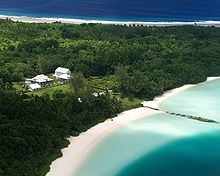
Diego Garcia Island, British Indian Ocean Territory
This kind of relationship can also be found in the Kingdom of the Netherlands, which is termed a federacy. The European continental part is organized like a unitary state. However, the status of its “constituent countries” in the Caribbean (Aruba, Curaçao, and Sint Maarten) can be considered akin to dependencies or “associated non-independent states.”
The Kingdom of Denmark also operates similarly, akin to another federacy. The Faroe Islands and Greenland are two self-governing territories or regions within the Kingdom. The relationship between Denmark proper and these two territories is semi-officially termed the Rigsfællesskabet (“Unity of the Realm”).
Overview of inhabited dependent territories

Åland, an autonomous region of Finland
| Name | Population (2016) | Area (km2) | Area (mi2) | Continent | Sovereign state | Legal status |
|---|---|---|---|---|---|---|
| Akrotiri and Dhekelia |
15,700 | 254 | 98 | Europe | United Kingdom |
Overseas territory (sovereign base areas) |
| Åland |
29,013 | 1,580 | 610 | Europe |  Finland |
Autonomous region |
| American Samoa |
54,194 | 199 | 77 | Oceania | United States |
Unincorporated territory |
| Anguilla |
15,100 | 91 | 35 | North America | United Kingdom |
Overseas territory |
| Aruba |
113,648 | 178.91 | 69.08 | North America |  Netherlands |
Constituent country |
| Bermuda |
70,537 | 53.2 | 20.5 | North America | United Kingdom |
Overseas territory |
| British Virgin Islands |
34,232 | 153 | 59 | North America | United Kingdom |
Overseas territory |
| Cayman Islands |
57,268 | 264 | 101.9 | North America | United Kingdom |
Overseas territory |
| Christmas Island |
2,205 | 135 | 52 | Asia | Australia |
External territory |
| Cocos (Keeling) Islands |
596 | 14 | 5.4 | Asia | Australia |
External territory |
| Cook Islands |
18,100 | 240 | 93 | Oceania | New Zealand |
Free association |
| Curaçao |
158,986 | 444 | 171 | North America | Netherlands |
Constituent country |
| Falkland Islands |
2,931 | 12,173 | 4,700 | South America | United Kingdom |
Overseas territory |
| Faroe Islands |
49,188 | 4,167 | 540 | Europe |  Denmark |
Constituent country |
| French Polynesia |
285,735 | 1,399 | 1,609 | Oceania | France |
Overseas country |
| Gibraltar |
29,328 | 6.5 | 2.5 | Europe | United Kingdom |
Overseas territory |
| Greenland |
56,483 | 2,166,086 | 836,330 | North America | Denmark |
Constituent country |
| Guam |
162,742 | 544 | 210 | Oceania | United States |
Unincorporated territory |
| Guernsey |
63,026 | 65 | 25 | Europe | United Kingdom |
Crown dependency |
| Hong Kong |
7,374,000 | 2,755 | 1,064 | Asia |  China |
Special administrative region |
| Isle of Man |
88,195 | 572 | 221 | Europe | United Kingdom |
Crown dependency |
| Jersey |
98,069 | 118.2 | 45.6 | Europe | United Kingdom |
Crown dependency |
| Macao |
650,900 | 115.3 | 44.5 | Asia | China |
Special administrative region |
| Montserrat |
5,267 | 101 | 39 | North America | United Kingdom |
Overseas territory |
| New Caledonia |
275,355 | 18,576 | 7,172 | Oceania | France |
Sui generis collectivity |