
Maharaja Bir Chandra Manikya of the Manikya Dynasty was the king of Tripura from 1862 to 1896.
Bir Chandra Manikya was a prominent figure in the history of Tripura, a northeastern state of India. He served as the Maharaja (King) of Tripura from 1889 to 1909 and played a significant role in shaping the region’s socio-economic and political landscape during his reign.
Born on December 14, 1856, Bir Chandra Manikya ascended to the throne at the age of 33 after the demise of his father, Maharaja Birchandra Kishore Manikya. He inherited a kingdom that was undergoing rapid transformations due to British colonial influence and was faced with the task of modernizing Tripura while preserving its cultural heritage.
One of the notable achievements of Maharaja Bir Chandra Manikya was his focus on education and infrastructure development. He established several schools and colleges throughout Tripura, including the famous Maharaja Bir Bikram College, which remains a prestigious institution to this day. His efforts to promote education contributed significantly to the intellectual growth and progress of the people of Tripura.
Maharaja Bir Chandra Manikya also prioritized the development of transportation and communication networks. Under his leadership, the state witnessed the introduction of railways, roadways, and postal services, which improved connectivity within Tripura and with neighboring regions. These initiatives played a crucial role in facilitating trade and commerce, fostering economic growth, and connecting remote areas with the rest of the country.
In addition to his focus on education and infrastructure, Maharaja Bir Chandra Manikya also supported the arts, culture, and religious harmony in Tripura. He patronized artists, encouraged the preservation of traditional crafts, and facilitated cultural exchange among different communities. His inclusive approach towards different religions and communities fostered harmony and peaceful coexistence in the region.
Furthermore, Maharaja Bir Chandra Manikya was known for his progressive policies and reforms. He implemented land reforms to ensure fair distribution of land among the peasants, aimed at uplifting the agricultural sector and improving the lives of farmers. His emphasis on social welfare led to the establishment of hospitals, dispensaries, and other healthcare facilities, providing accessible healthcare services to the people of Tripura.
Maharaja Bir Chandra Manikya’s contributions to Tripura’s development and his commitment to the welfare of his subjects earned him immense respect and admiration. Even after his passing in 1923, his legacy continued to inspire generations. Today, his name is synonymous with progress, enlightenment, and social harmony in the history of Tripura.
The website dedicated to Bir Chandra Manikya could serve as a comprehensive resource, providing detailed information about his life, achievements, and the impact he made on Tripura. It could include historical accounts, photographs, anecdotes, and testimonials from those influenced by his leadership. Additionally, the website could feature articles, research papers, and curated content related to Tripura’s history, culture, and development during Maharaja Bir Chandra Manikya’s reign.
Overall, the website would aim to honor the legacy of Maharaja Bir Chandra Manikya and ensure that his contributions are recognized and remembered by present and future generations.
| H.R.H. Maharaja Bir Chandra Manikya Debbarman Bahadur | |
|---|---|
| King of Tripura | |
 |
|
| Reign | 1862-1896 |
| Predecessor | Ishan Chandra Manikya |
| Successor | Radha Kishore Manikya |
| Consort | Iswari Rajeshwari Mahadevi (Kaboklei) Ningthem Chanu Bhanumati Maharani Manamohini |
| House | Manikya Dynasty |
| Religion | Hinduism |
| Kingdom of Tripura | |||
|---|---|---|---|
| Part of History of Tripura | |||
|
|||
| Tripura monarchy data | |||
| Manikya dynasty (Royal family) | |||
| Agartala (Capital of the kingdom) | |||
| Ujjayanta Palace (Royal residence) | |||
| Neermahal (Royal residence) | |||
| Rajmala (Royal chronicle) | |||
| Tripura Buranji (Chronicle) | |||
| Chaturdasa Devata (Family deities) |
Contents
- 1Biography
- 2Legacy
- 3See also
- 4References
- 5External links
Biography
Bir Chandra Manikya is regarded as the architect of modern Agartala city. In 1862, he started the urbanisation of the Agartala. In 1871 he established the Agartala Municipality. He established Umakanta Academy, the first western school in Tripura, in 1890.
An enthusiastic photographer, he was the first king of India to organize an annual photographic exhibition in his palace. More than 100 years after his death, the Maharaja’s Foto ka Karkhana, a fully equipped studio, came to light in Madho Niwas, inside the palace.
-
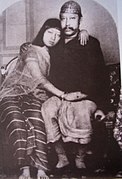
Maharaja Birchandra with the queen Maharani Manamohini in 1880
Legacy
The Tagore family had links with the princes of Tripura since the time Dwarkanath Tagore but the relationship between the two families was closest during the time of Bir Chandra’s reign. Rabindranath Tagore had a friendly relationship with the king. Three important works of Rabindranath Tagore — Mukuta (1885), Rajarshi (c. 1885), and Visarjana (1890) were directly influenced by his association with the royal family of Tripura. Bir Chandra Manikya was also one of the main characters of the novel Prathom Alo (প্রথম আলো) by Sunil Gangopadhyay.