
A demon is a supernatural entity, typically associated with evil, prevalent historically in religion, occultism, literature, fiction, mythology, and folklore; as well as in media such as comics, video games, movies, anime, and television series.
In ancient near eastern religions and in the Abrahamic religions, including ancient and medieval Christian demonology, a demon is considered a harmful spiritual entity which may cause demonic possession, calling for an exorcism. Large portions of the Jewish demonology, a key influence on Christianity and Islam, originated from a later form of Zoroastrianism, and was transferred to Judaism during the Persian era.
In Western occultism and Renaissance magic, which grew out of an amalgamation of Greco-Roman magic, Jewish Aggadah and Christian demonology, a demon is believed to be a spiritual entity that may be conjured and controlled. The supposed existence of demons remains an important concept in many modern religions and occultist traditions. Demons are still feared largely due to their alleged power to possess living creatures. In the contemporary Western occultist tradition (perhaps epitomized by the work of Aleister Crowley), a demon (such as Choronzon, which is Crowley’s interpretation of the so-called “Demon of the Abyss”) is a useful metaphor for certain inner psychological processes (inner demons), though some may also regard it as an objectively real phenomenon.
The original Greek word daimon did not carry negative connotations. The Ancient Greek word δαίμων daimōn denotes a spirit or divine power. The Greek conception of a daimōn notably appears in the works of Plato, where it describes the divine inspiration of Socrates. In Christianity, morally ambivalent daimons were replaced by demons, forces of evil only striving for corruption. Such demons are not the Greek intermediary spirits, but hostile entities, already known in Iranian beliefs.
Etymology
The Ancient Greek word δαίμων daemon denotes a spirit or divine power, much like the Latin genius or numen. Daimōn most likely came from the Greek verb daiesthai (to divide, distribute). The Greek conception of a daimōn notably appears in the works of Plato, where it describes the divine inspiration of Socrates. The original Greek word daimon does not carry the negative connotation initially understood by implementation of the Koine δαιμόνιον (daimonion), and later ascribed to any cognate words sharing the root.
The Greek terms do not have any connotations of evil or malevolence. In fact, εὐδαιμονία eudaimonia, (literally good-spiritedness) means happiness. By the early Roman Empire, cult statues were seen, by pagans and their Christian neighbors alike, as inhabited by the numinous presence of the gods: “Like pagans, Christians still sensed and saw the gods and their power, and as something, they had to assume, lay behind it, by an easy traditional shift of opinion they turned these pagan daimones into malevolent ‘demons’, the troupe of Satan. Far into the Byzantine period Christians eyed their cities’ old pagan statuary as a seat of the demons’ presence. It was no longer beautiful, it was infested.” The term had first acquired its negative connotations in the Septuagint translation of the Hebrew Bible into Greek, which drew on the mythology of ancient Semitic religions. This was then inherited by the Koine text of the New Testament. The Western medieval and neo-medieval conception of a demon derives seamlessly from the ambient popular culture of Late Antiquity.
The English use of demon as synonym for devils goes back at least as far as about 825. The German word (Dämon), however, is different from devil (Teufel) and demons as evil spirits, and akin to the original meaning of a Daimon.
Ancient Egypt
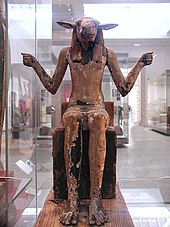
Ram-headed demon. The hands probably outstretch to hold two snakes. From a royal tomb in the Valley of the Kings, Thebes, Egypt. End of the 18th Dynasty, around 1325 BCE
Both deities and demons can act as intermediaries to deliver messages to humans. Thus they share some resemblance to the Greek daimonion. The exact definition of “demon” in Egyptology posed a major problem for modern scholarship, since the borders between a deity and a demon are sometimes blurred and the ancient Egyptian language lacks a term for the modern English “demon”. However, magical writings indicate that ancient Egyptians acknowledged the existence of malevolent demons by highlighting the demon names with red ink. Demons in this culture appeared to be subordinative and related to a specific deity, yet they may have occasionally acted independently of the divine will. The existence of demons can be related to the realm of chaos, beyond the created world. But even this negative connotation cannot be denied in light of the magical texts. The role of demons in relation to the human world remains ambivalent and largely depends on context.
Ancient Egyptian demons can be divided into two classes: “guardians” and “wanderers.” “Guardians” are tied to a specific place; their demonic activity is topographically defined and their function can be benevolent towards those who have the secret knowledge to face them. Demons protecting the underworld may prevent human souls from entering paradise. Only by knowing right charms is the deceased able to enter the Halls of Osiris. Here, the aggressive nature of the guardian demons is motivated by the need to protect their abodes and not by their evil essence. Accordingly, demons guarded sacred places or the gates to the netherworld. During the Ptolemaic and Roman period, the guardians shifted towards the role of Genius loci and they were the focus of local and private cults.
The “wanderers” are associated with possession, mental illness, death and plagues. Many of them serve as executioners for the major deities, such as Ra or Osiris, when ordered to punish humans on earth or in the netherworld. Wanderers can also be agents of chaos, arising from the world beyond creation to bring about misfortune and suffering without any divine instructions, led only by evil motivations. The influences of the wanderers can be warded off and kept at the borders on the human world by the use of magic, but they can never be destroyed. A sub-category of “wanderers” are nightmare demons, which were believed to cause nightmares by entering a human body.
Mesopotamia

Ancient Sumerian cylinder seal impression showing the god Dumuzid being tortured in the Underworld by galla demons
The ancient Mesopotamians believed that the underworld was home to many demons, which are sometimes referred to as “offspring of arali“. These demons could sometimes leave the underworld and terrorize mortals on earth. One class of demons that were believed to reside in the underworld were known as galla; their primary purpose appears to have been to drag unfortunate mortals back to Kur. They are frequently referenced in magical texts, and some texts describe them as being seven in number. Several extant poems describe the galla dragging the god Dumuzid into the underworld. Like other demons, however, galla could also be benevolent and, in a hymn from King Gudea of Lagash (c. 2144 – 2124 BCE), a minor god named Ig-alima is described as “the great galla of Girsu”.
Lamashtu was a demonic goddess with the “head of a lion, the teeth of a donkey, naked breasts, a hairy body, hands stained (with blood?), long fingers and fingernails, and the feet of Anzû.” She was believed to feed on the blood of human infants and was widely blamed as the cause of miscarriages and cot deaths. Although Lamashtu has traditionally been identified as a demoness, the fact that she could cause evil on her own without the permission of other deities strongly indicates that she was seen as a goddess in her own right. Mesopotamian peoples protected against her using amulets and talismans. She was believed to ride in her boat on the river of the underworld and she was associated with donkeys. She was believed to be the daughter of An.
Pazuzu is a demonic god who was well known to the Babylonians and Assyrians throughout the first millennium BCE. He is shown with “a rather canine face with abnormally bulging eyes, a scaly body, a snake-headed penis, the talons of a bird and usually wings.” He was believed to be the son of the god Hanbi. He was usually regarded as evil, but he could also sometimes be a beneficent entity who protected against winds bearing pestilence and he was thought to be able to force Lamashtu back to the underworld. Amulets bearing his image were positioned in dwellings to protect infants from Lamashtu and pregnant women frequently wore amulets with his head on them as protection from her.
Šul-pa-e’s name means “youthful brilliance”, but he was not envisioned as youthful god. According to one tradition, he was the consort of Ninhursag, a tradition which contradicts the usual portrayal of Enki as Ninhursag’s consort. In one Sumerian poem, offerings made to Šhul-pa-e in the underworld and, in later mythology, he was one of the demons of the underworld.
According to The Jewish Encyclopedia, originally published in 12 volumes from 1901 to 1906, “In Chaldean mythology the seven evil deities were known as shedu, storm-demons, represented in ox-like form.” They were represented as winged bulls, derived from the colossal bulls used as protective jinn of royal palaces.
Judaism
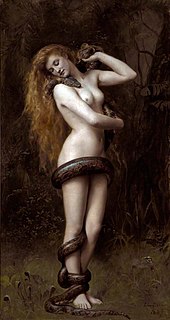
In Lilith by John Collier (1892), the female demon Lilith is shown personified within the Garden of Eden
There are differing opinions in Judaism about the existence or non-existence of demons (shedim or se’irim). There are “practically nil” roles assigned to demons in the Hebrew Bible. Not all Jews believe in the existence of demons, and some famous authors, such as Maimonides, denied their reality, regarding them as mere images which people ascribe divinity to. Jews are not obligated to believe in the existence of shedim, as posek rabbi David Bar-Hayim points out. Some Rabbinic scholars assert that demons have existed in Talmudic times, but don’t exist regularly in present. When prophecy, Divine intuition and Divine inspiration gradually decreased, the demonic powers of impurity have become correspondingly weak, too.(p190–191)
Hebrew Bible
The Hebrew Bible mentions two classes of demonic spirits, the se’irim and the shedim. The word shedim (sing shed or sheyd) appears in two places in the Hebrew Bible. The se’irim (sing. sa’ir, “male goat”) are mentioned once in Leviticus 17:7, probably a recollection of Assyrian demons in the shape of goats. The shedim, however, are not pagan demigods, but the foreign gods themselves. Both entities appear in a scriptural context of animal or child sacrifice to non-existent false gods.
From Chaldea, the term shedu traveled to the Israelites. The writers of the Tanach applied the word as a dialogism to Canaanite deities.
There are indications that demons in popular Hebrew mythology were believed to come from the nether world. Various diseases and ailments were ascribed to them, particularly those affecting the brain and those of internal nature. Examples include catalepsy, headache, epilepsy and nightmares. There also existed a demon of blindness, “Shabriri” (lit. “dazzling glare”) who rested on uncovered water at night and blinded those who drank from it.
Demons supposedly entered the body and caused the disease while overwhelming or “seizing” the victim. To cure such diseases, it was necessary to draw out the evil demons by certain incantations and talismanic performances, at which the Essenes excelled. Josephus, who spoke of demons as “spirits of the wicked which enter into men that are alive and kill them”, but which could be driven out by a certain root, witnessed such a performance in the presence of the Emperor Vespasian and ascribed its origin to King Solomon. In mythology, there were few defences against Babylonian demons. The mythical mace Sharur had the power to slay demons such as Asag, a legendary gallu or edimmu of hideous strength.
Talmudic tradition and Midrashim
In the Jerusalem Talmud, notions of shedim (“demons” or “spirits”) are almost unknown or occur only very rarely, whereas in the Babylonian Talmud there are many references to shedim and magical incantations. The existence of shedim in general was not questioned by most of the Babylonian Talmudists. As a consequence of the rise of influence of the Babylonian Talmud over that of the Jerusalem Talmud, late rabbis, in general, took as fact the existence of shedim, nor did most of the medieval thinkers question their reality. However, rationalists like Maimonides and Saadia Gaon and others explicitly denied their existence, and completely rejected concepts of demons, evil spirits, negative spiritual influences, attaching and possessing spirits. They thought the essential teaching about shedim and similar spirits is, that they should not be an object of worship, not a reality to be acknowledged or feared. Their point of view eventually became mainstream Jewish understanding.
The opinion of some authors is not clear. Abraham ibn Ezra states that insane people can see the image of se’irim, when they go astray and ascribe to them powers independent from God. It is not clear from his work, if he considered these images of se’irim as manifestations of actual spirits (shedim) or merely delusions. Despite academic consensus, Rabbis disputed that Maimonies denied the existence of demons entirely. He would only dispute the existence of demons in his own life time, but not that demons had existed once.(p185–188)
Occasionally an angel is called satan in the Babylon Talmud. But satans do not refer to demons as they remain at the service of God: “Stand not in the way of an ox when coming from the pasture, for Satan dances between his horns”.
Aggadic tales from the Persian tradition describe the shedim, the mazziḳim (“harmers”), and the ruḥin (“spirits”). There were also lilin (“night spirits”), ṭelane (“shade”, or “evening spirits”), ṭiharire (“midday spirits”), and ẓafrire (“morning spirits”), as well as the “demons that bring famine” and “such as cause storm and earthquake”. According to some aggadic stories, demons were under the dominion of a king or chief, usually Asmodai.
Kabbalah
In Kabbalah, demons are regarded a necessary part of the divine emanation in the material world and a byproduct of human sin (Qliphoth). After they are created, they assume an existence on their own. Demons would attach themselves to the sinner and start to multiply as an act of self-preservation.(p185) Medieval Kabbalists characterize such demons as punishing angels of destruction. They are subject to the Divine will, and do not act independently.(p182)
Other demonic entities, such as the shedim, might be considered benevolent. The Zohar classifies them as those who are like humans and submit to the Torah, and those who have no fear of God and are like animals.(p184)
Second Temple Judaism
The sources of demonic influence were thought to originate from the Watchers or Nephilim, who are first mentioned in Genesis 6 and are the focus of 1 Enoch Chapters 1–16, and also in Jubilees 10. The Nephilim were seen as the source of the sin and evil on Earth because they are referenced in Genesis 6:4 before the story of the Flood. In Genesis 6:5, God sees evil in the hearts of men. Ethiopic Enoch refers to Genesis 6:4–5, and provides further description of the story connecting the Nephilim to the corruption of humans. According to the Book of Enoch, sin originates when angels descend from heaven and fornicate with women, birthing giants. The Book of Enoch shows that these fallen angels can lead humans to sin through direct interaction or through providing forbidden knowledge. Most scholars understand the text, that demons originate from the evil spirits of the deceased giants, cursed by God to wander the Earth. Dale Martin disagrees with this interpretation, arguing that the ghosts of the Nephilim are distinct. The evil spirits would make the people sacrifice to the demons, but they were not demons themselves. The spirits are stated in Enoch to “corrupt, fall, be excited, and fall upon the earth, and cause sorrow.”
The Book of Jubilees conveys that sin occurs when Cainan accidentally transcribes astrological knowledge used by the Watchers. This differs from Enoch in that it does not place blame on the angels. However, in Jubilees 10:4 the evil spirits of the Watchers are discussed as evil and still remain on Earth to corrupt humans. God binds only 90% of the Watchers and destroys them, leaving 10% to be ruled by Mastema. Because the evil in humans is great, only 10% would be needed to corrupt and lead humans astray. These spirits of the giants are also referred to as “the bastards” in the apotropaic prayer Songs of the Sage, which lists the names of demons the narrator hopes to expel.
To the Qumran community during the Second Temple period, this apotropaic prayer was assigned, stating: “And, I the Sage, declare the grandeur of his radiance in order to frighten and terri all the spirits of the ravaging angels and the bastard spirits, demons, Liliths, owls” (Dead Sea Scrolls, “Songs of the Sage,” Lines 4–5).
Hinduism
 |
hideThis section has multiple issues. Please help improve it or discuss these issues on the talk page. (Learn how and when to remove these template messages)
|
Hindu beliefs include numerous varieties of creatures with materialistic or non-material form such as Vetalas, Bhutas and Pishachas. Rakshasas and Asuras are demons.
Asuras
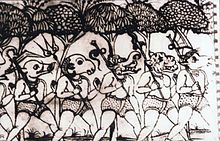
The Army of Super Creatures – from The Saugandhika Parinaya Manuscript (1821 CE)
Asura, in the earliest hymns of the Rigveda, originally meant any supernatural spirit, either good or bad. Since the /s/ of the Indic linguistic branch is cognate with the /h/ of the Early Iranian languages, the word Asura, representing a category of celestial beings, is a cognate with Old Persian Ahura. Ancient Hinduism tells that Devas (also called suras) and Asuras are half-brothers, sons of the same father Kashyapa; although some of the Devas, such as Varuna, are also called Asuras. Later, during Puranic age, Asura and Rakshasa came to exclusively mean any of a race of anthropomorphic, powerful, possibly evil beings. Daitya (lit. sons of the mother “Diti”), Maya Danava, Rakshasa (lit. from “harm to be guarded against”), and Asura are incorrectly translated into English as “demon”.
In post-Vedic Hindu scriptures, pious, highly enlightened Asuras, such as Prahlada and Vibhishana, are not uncommon. The Asura are not fundamentally against the gods, nor do they tempt humans to fall. Many people metaphorically interpret the Asura as manifestations of the ignoble passions in the human mind and as symbolic devices. There were also cases of power-hungry Asuras challenging various aspects of the gods, but only to be defeated eventually and seek forgiveness.
Evil spirits
Hinduism advocates the reincarnation and transmigration of souls according to one’s karma. Souls (Atman) of the dead are adjudged by the Yama and are accorded various purging punishments before being reborn. Humans that have committed extraordinary wrongs are condemned to roam as lonely, often mischief mongers, spirits for a length of time before being reborn. Many kinds of such spirits (Vetalas, Pishachas, Bhūta) are recognized in the later Hindu texts.
Iranian demons
Zoroastrianism
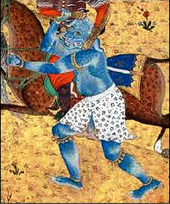
Arzhang (The Shahnama of Shah Tahmasp)

Black Div (The Shahnama of Shah Tahmasp)

Rostam carried by Akwan-Diwa (cropped)
The Zorastrian belief in demons (Daeva, later div) had strong influence on the Abrahamic religions, especially Christianity and Islam. The daevas seem to be a Zorastrian interpretation of the Hindu pantheon. Particularly Indra, one of the most eminent individual deities of Vedic texts, is portrayed as a malicious force only next to Ahriman, the principle of evil (devil).
But daevas are not merely the false gods of a past religion, but also embodiment of vices and fierce side of nature. Thraotona slays the daeva Azhi Dahāka, a serpentine or dragon-like creature with three heads. Thraotona’s victory over a serpentine or dragon-like creature with three heads, is not the victory of a great warrior, but to show that people who live in accordance with Asha can overcome evil. Aeshma, a demon of wrath and destruction, appears to be the direct forerunner of Asmodeus (Sakhr in Islam) from Abrahamic religion. Winter too became associated with one of the daeva. Demons assault the souls when passing the Chinvat Bridge. While virtuous people ward them off and succeed on entering heaven, wicked souls fail and are seized by the demons. In hell, demons continue to torment the damned.
In Zarathustra’s personal revelation, there are no individual daevas. They are always referred to as in a group and their worshippers are associated with violence and destruction:
but ye Daevas are all spawned from Evil Thought/ as is the grandee who worships you, and from wrong and contempt… ever since you have been enjoiing those worst of things that mortals are to do/ to wax to the daevas’ favor retreating from Good Thought/ losing the way from the Mindful Lord’s wisdom and from Right.
- — Yasna 32.3-4
In their state of wickedness, they lead mankind into sin and death:
So ye lure the mortal from good living and security from death/as the Evil Will does you who are daevas, by evil thought/ and that evil speech with which he assigns the deed to the wrongfil one’s control.
- — Yasna 32.5
Demons are subordinate to the absolute power of evil, the Evil Will, embodied in Ahriman/Angra Manyu. They are both corrupted and evil themselves. Demons possess no substance on their own and can only attach themselves to material agents. People who worship demons are blamed to give them power. In the Gathas, the primary way for demons to corrupt humans and cause suffering, manifests through their worshippers. The Vendidad (Law against Daeva) is mainly concerned to ward off demons by offering laws for ritual purity. However, demons would not increase their power only through acts in their favor but also by every act against Ahura Mazda (supreme good). Everyday actions might be considered a form of demon-worship. For example, cutting one’s hair or nails and keeping them on the ground is understood as a sacrifice to the demons. Just like the demons’ power increase by acts of wickedness, they are weakened by good deeds. Performaning invocations of Ahura Mazda are considered especially helpful. The Vendidad further explores the possibility for humans to turn into demons. A human who performs sexual immoralities or worships demons becomes a demon after death. A wicked person might be considered a demon in his lifetime, but only turns completely into one after death.