
Jagannath (Odia: ଜଗନ୍ନାଥ, romanized: Jagannātha, lit. ‘Lord of the Universe’; formerly English: Juggernaut) is a deity worshipped in regional Hindu traditions in India and Bangladesh as part of a triad along with his brother Balabhadra and sister, devi Subhadra. Jagannath within Odia Hinduism is the supreme god, Purushottama, Para Brahman. To most Vaishnava Hindus, particularly the Krishnaites, Jagannath is an abstract representation of Krishna, or Vishnu, sometimes as the avatar of Krishna or Vishnu. To some Shaiva and Shakta Hindus, he is a symmetry-filled tantric form of Bhairava, a fierce manifestation of Shiva associated with annihilation.
The Jagannathism (a.k.a. Odia Vaishnavism) — the particular sector of Jagannath as a major deity — emerged in the Early Middle Ages and later became an independent state regional temple-centered tradition of Krishnaism/Vaishnavism.
The idol of Jagannath is a carved and decorated wooden stump with large round eyes and a symmetric face, and the idol has a conspicuous absence of hands or legs. The worship procedures, sacraments and rituals associated with Jagannath are syncretic and include rites that are uncommon in Hinduism. Unusually, the icon is made of wood and replaced with a new one at regular intervals.
The origin and evolution of Jagannath worship is unclear. Some scholars interpret hymn 10.155.3 of the Rigveda as a possible origin, but others disagree and state that it is a syncretic/synthetic deity with tribal roots. The English word juggernaut comes from the negative image of the deity presented by Christian missionaries in the 18th and 19th centuries.
Jagannath is considered a non-sectarian deity. He is significant regionally in the Indian states of Odisha, Chhattisgarh, West Bengal, Jharkhand, Bihar, Gujarat, Assam, Manipur and Tripura. He is also significant to the Hindus of Bangladesh. The Jagannath temple in Puri, Odisha is particularly significant in Vaishnavism, and is regarded as one of the Char Dham pilgrimage sites in India. The Jagannath temple is massive, over 61 metres (200 ft) high in the Nagara Hindu temple style, and one of the best surviving specimens of Kalinga architecture, namely Odisha art and architecture. It has been one of the major pilgrimage destinations for Hindus since about 800 CE.
The annual festival called the Ratha yatra celebrated in June or July every year in eastern states of India is dedicated to Jagannath. His image, along with the other two associated deities, is ceremoniously brought out of the sacrosanctum (Garbhagriha) of his chief temple in Puri (ଶ୍ରୀ ମନ୍ଦିର, Śrī Mandir). They are placed in a chariot which is then pulled by numerous volunteers to the Gundicha Temple, (located at a distance of nearly 3 km or 1.9 mi). They stay there for a few days, after which they are returned to the main temple. Coinciding with the Ratha Yatra festival at Puri, similar processions are organized at Jagannath temples throughout the world. During the festive public procession of Jagannath in Puri lakhs of devotees visit Puri to see Lord Jagganath in chariot.
Etymology
Jagannath is a Sanskrit word, compounded of jagat meaning “universe” and nātha meaning “Master” or “Lord”. Thus, Jagannath means “lord of the universe”.
Jagannatha, according to them is a generic term, not unique, as much as Lokanatha or Avalokiteswara. ln fact, the name Jagannatha could be applied to any Deity which is considered supreme.
— Surendra Mohanty, Lord Jagannatha: the microcosm of Indian spiritual culture
In the Odia language, Jagannath is linked to other names, such as Jagā (ଜଗା) or Jagabandhu (ଜଗବନ୍ଧୁ) (“Friend of the Universe”). Both names derive from Jagannath. Further, on the basis of the physical appearance of the deity, names like Kalia (କାଳିଆ) (“The Black-coloured Lord”, but which can also mean “the Timely One”), Darubrahman (ଦାରୁବ୍ରହ୍ମ) (“The Sacred Wood-Riddle”), Dāruēdebatā (ଦାରୁ ଦେବତା “The wooden god”), Chakā ākhi (ଚକା ଆଖି) or Chakānayan (ଚକା ନୟନ “With round eyes”), Cakāḍōḷā (ଚକା ଡୋଳା “with round pupils”) are also in vogue.
According to Dina Krishna Joshi, the word may have origins in the tribal word Kittung of the Sora people (Savaras). This hypothesis states that the Vedic people as they settled into tribal regions adopted the tribal words and called the deity Jagannath. According to O.M. Starza, this is unlikely because Kittung is phonetically unrelated, and the Kittung tribal deity is produced from burnt wood and looks very different from Jagannath.
Iconography
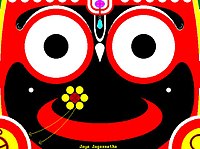
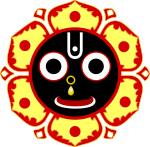
The icon of Jagannath in his temples is a brightly painted, rough-hewn log of neem wood. The image consists of a square flat head, a pillar that represents his face merging with the chest. The icon lacks a neck, ears, and limbs, is identified by a large circular face symbolizing someone who is anadi (without beginning) and ananta (without end). Within this face are two big symmetric circular eyes with no eyelids, one eye symbolizing the sun and the other the moon, features traceable in 17th-century paintings. He is shown with an Urdhva Pundra, the Vaishnava U-shaped mark on his forehead. His dark color and other facial features are an abstraction of the cosmic form of the Hindu god Krishna, states Starza. In some contemporary Jagannath temples, two stumps pointing forward in hug-giving position represent his hands. In some exceptional medieval and modern era paintings in museums outside India, such as in Berlin states Starza, Jagannath is shown “fully anthropomorphised” but with the traditional abstract mask face.
The typical icon of Jagannath is unlike other deities found in Hinduism who are predominantly anthropomorphic. However, aniconic forms of Hindu deities are not uncommon. For example, Shiva is often represented in the form of a Shiva linga. In most Jagannath temples in the eastern states of India, and all his major temples such as the Puri, Odisha, Jagannath is included with his brother Balabhadra and sister Subhadra. Apart from the principal companion deities, Jagannath icon shows a Sudarshana Chakra and sometimes under the umbrella cover of multiheaded Sesha Naga, both linking him to Vishnu. He was one of the introduction to Hinduism to early European explorers and merchants who sailed into Calcutta and ports of the Bay of Bengal. The Italian Odoric of Pordenone who was a Franciscan friar, visited his temple and procession in 1321 CE, and described him in the language of the Church. William Burton, visited his temple at Puri in 1633, spelled him as Jagarnat and described him to be “in a shape like a serpent, with seven hoods”.

Jagannath icons are produced from wood. They are replaced every 8 or 12 or 19 years. Above: logs in transport to prepare the Jagannath icon.
When shown with Balabhadra and Subhadra, he is identifiable from his circular eyes compared to the oval or almond shape of the other two abstract icons. Further, his icon is dark, while Balabhadra’s face is white, and Subhadra’s icon is yellow. The third difference is the flat head of Jagannath icon, compared to semi-circular carved heads of the other two. They are accompanied by the Sudarshana Chakra, the iconic weapon of Vishnu. It is approximately the same height as Balabhadra, is red in colour, carved from a wooden pillar and clothed, unlike its traditional representation as a chakra in other Vishnu temples. Jagannath iconography, when he is depicted without companions, shows only his face, neither arms nor torso. This form is sometimes called Patita Pavana, or Dadhi Vaman.
The murtis of Jagannath, Balabhadra, Subhadra and Sudarshana Chakra are made of neem wood. Neem wood is chosen because the Bhavishya Purana declares it to be the most auspicious wood from which to make Vishnu murtis. The idol of Shri Jagannatha, Shree Balabhadra, Maa Subhadra and Sri Sudarshana is re-painted every week in the Shri Mandira or Shree Jagannatha Temple,Puri.It is replaced with a newly carved image every 12 or 19 years approximately, or more precisely according to the luni-solar Hindu calendar when its month of Asadha occurs twice in the same year.
Attributes
In the Jagannath tradition (Odia Vaishnavism), Lord Jagannath is most frequently identified with an abstract form of Krishna as the supreme deity.
Jagannath is considered as equivalent to the Hindu metaphysical concepts of Brahman/Para Brahman and Purushottama/Shunya Purusha, wherein he then is the Avatarī, i.e., the cause and equivalence of all avatars and the infinite existence in space and time. According to author Dipti Ray in Prataparudra Deva, the Suryavamsi King of Odisha:
In Prataparudradeva’s time Odia poets accepted Sarala Dasa’s idea and expressed in their literary works as all the Avataras of Vishnu (Jagannath) manifest from him and after their cosmic play dissolute (bilaya) in him (Jagannath). According to them Jagannath is Sunnya Purusa, Nirakar and Niranjan who is ever present in Nilachala to do cosmic play … The five Vaishnavite Sakhas of Orissa during Prataparudradeva’s time expounded in their works the idea that Jagannath (Purushottama) is Purna Brahman from whom other Avataras like Rama, Krishna, etc., took their birth for lilas in this universe and at the end would merge in the self of Purna Brahman.
— Dipti Ray
In the Jagannath tradition, he has the attributes of all the avatars of Krishna/Vishnu. This belief is celebrated by dressing him and worshipping him as different avatars on special occasions. The Puranas relate that the Narasimha Avatar of Vishnu appeared from a wooden pillar. It is therefore believed that Jagannath is worshipped as a wooden murti or Daru Brahma with the Shri Narasimha hymn dedicated to the Narasimha Avatar. Every year in the month of Bhadra, Jagannath is dressed and decorated in the form of the Vamana avatar of Vishnu. Jagannath appeared in the form of Rama, another avatar of Vishnu, to Tulsidas, who worshipped him as Rama and called him Raghunath during his visit to Puri in the 16th century.
Sometimes one regards him as one of the avatars (incarnations) of Krishna (i.e., Buddha-Jagannath) or Vishnu (i.e., Vamana). His name does not appear in the traditional Dashavatara (ten avatars) of Vishnu, though in certain Odia literature, Jagannath has been treated as the avatar of Krishna, as a substitute for or the equivalent of the avatar Buddha from Dashavatara.{
Tantric deity
Outside of Vaishnava tradition, Jagannath is considered the epitome of Tantric worship. The symmetry in iconography, the use of mandalas and geometric patterns in its rites support the tantric connection proposal.
Jagannath is venerated as Bhairava or Lord Shiva, the consort of Goddess Vimala, by Shaivites and Shakta sects. The priests of Jagannath Temple at Puri belong to the Shakta sect, although the Vaishnava sect’s influence predominates. As part of the triad, Balabhadra is also considered to be Shiva and Subhadra, a manifestation of Durga. In the Markandeya Purana the sage Markandeya declared that Purushottama Jagannath and Shiva are one. Jagannath in his Hathi Besha or Gaja Besha (elephant form) has been venerated by devotees like Ganapati Bhatta of Maharashtra as the God Ganesh.
Origins: alternative theories
Vedic origin of Jagannath
In hymn 10.155 of the Rig veda, there is mention of a Daru (wooden log) floating in the ocean as apurusham. Acharya Sayana interpreted the term apurusham as same as Purushottama and this Dara wood log being an inspiration for Jagannath, thus placing the origin of Jagannath in 2nd millennium BCE. Other scholars refute this interpretation stating that the correct context of the hymn is “Alaxmi Stava” of Arayi.
According to Bijoy Misra, Puri natives do call Jagannatha as Purushottama, consider driftwood a savior symbol, and later Hindu texts of the region describe the Supreme Being as ever present in everything, pervasive in all animate and inanimate things. Therefore, while the Vedic connection is subject to interpretation, the overlap in the ideas exist.
Buddhist origins

The Jagannath festivities in Puri attract crowds with no class or caste barriers. Some 19th-century writers saw this as one evidence for Buddhist origins, now a discredited theory.
The Buddhist origins of Jagannatha stems from the reliquary worship associated with Jagannatha, a concept integral to Buddhism but alien to Hinduism. For example, there exists an unexamined relic in the Jagannath shrine in Puri, and the local legends state that the shrine relic contains a tooth of the Gautama Buddha – a feature common to many cherished Theravada Buddhist shrines in and outside of India. Other legends state that the shrine also contains bones of the human incarnation of the Hindu god Krishna, after he was accidentally killed by a deer hunter. However, in the Hindu tradition, a dead body is cremated, ashes returned to nature, and the mortal remains or bones are not preserved or adored. In Buddhism, preserving skeletal parts such as “Buddha’s tooth” or relics of dead saints is a thriving tradition. The existence of these legends, state some scholars such as Stevenson, suggests that Jagannath may have a Buddhist origin. However, this is a weak justification because some other traditions such as those in Jainism and tribal folk religions too have had instances of preserving and venerating relics of the dead.
Another evidence that links Jagannath deity to Buddhism is the Ratha-Yatra festival for Jagannath, the stupa-like shape of the temple and a dharmachakra-like discus (chakra) at the top of the spire. The major annual procession festival has many features found in the Mahayana Buddhism traditions. Faxian (c. 400 CE), the ancient Chinese pilgrim and visitor to India wrote about a Buddhist procession in his memoir, and this has very close resemblances with the Jagannath festivities. Further the season in which the Ratha-Yatra festival is observed is about the same time when the historic public processions welcomed Buddhist monks for their temporary, annual monsoon-season retirement.
Another basis for this theory has been the observed mixing of people of Jagannath Hindu tradition contrary to the caste segregation theories popular with colonial era missionaries and Indologists. Since caste barriers never existed among devotees in Jagannath’s temple, and Buddhism was believed to have been a religion that rejected caste system, colonial era Indologists and Christian missionaries such as Verrier Elwin suggested that Jagannath must have been a Buddhist deity and the devotees were a caste-rejecting Buddhist community. According to Starza, this theory is refuted by the fact that other Indic traditions did not support caste distinctions, such as the Hindu Smarta tradition founded by Adi Shankara, and the traditional feeding of the Hindus together in the region regardless of class, caste or economic condition in the memory of Codaganga. This reconciliation is also weak because Jagannath is venerated by all Hindu sects, not just Vaishnavas or a regional group of Hindus, and Jagannath has a pan-Indian influence. The Jagannath temple of Puri has been one of the major pilgrimage destination for Hindus across the Indian subcontinent since about 800 CE.
Yet another evidence is that Jagannath is sometimes identified with or substituted for Shakyamuni Buddha, as the ninth avatar of Vishnu by Hindus, when it could have been substituted for any other avatar. Jagannath was worshipped in Puri by the Odias as a form of Shakyamuni Buddha from a long time. Jayadeva, in Gita Govinda also has described Buddha as one among the Dasavatara. Indrabhuti, the ancient Buddhist king, describes Jagannath as a Buddhist deity in Jnanasidhi. Further, as a Buddhist king, Indrabhuti worshipped Jagannath. This is not unique to the coastal state of Odisha, but possibly also influenced Buddhism in Nepal and Tibet. Shakyamuni Buddha is also worshipped as Jagannath in Nepal. This circumstantial evidence has been questioned because the reverent mention of Jagannath in the Indrabhuti text may merely be a coincidental homonym, may indeed refer to Shakyamuni Buddha, because the same name may refer to two different persons or things.
Some scholars argue that evidences of Jagannatha’s Buddhist nature are found from Medieval Odia Literature. Many medieval Odia poets conceptualized Jagannatha as Shunya Brahman, which is similar to the great void found in Mahayana Buddhist philosophies. Odia poet Sarala Dasa of 15th century in his Mahabharata describes Jagannatha as Buddha.
Deul Bhitore Sinmhasane Bije Hoi, Bouddha Rupare Prabhu Sankha Chakra Bahi.
He remains in the throne inside the temple, holding the Conch and Discuss in the form of Buddha.
— Mahabharata of Sarala Dasa.
Later poets such as Darika Dasa and Magunia Dasa mentioned Buddha as an incarnation of Jagannatha instead of Vishnu. However, in some these references Buddha is mentioned as incarnation of Vishnu or Jagannath, not vice versa, therefore Jagannath is considered as the source of all incarnations. Furthermore, the mention of Buddha as part of ten avatara was prevalent across many Hindu sects other than Jagannath cult and was a broader movement in Vaishnavism to incorporate Buddha as one of the ten main avatara of Vishnu between fifth and the sixth century, who was in turn linked with Jagannath as a source of all avataras starting from Jayadeva of 12th century. So, the mention of Buddha as Jagannath does not proof the Buddhist origin of Jagannath, rather assimilation of Buddha in Hinduism.
Jain origins
Pandit Nilakantha Das suggested that Jagannath was a deity of Jain origin because of the appending of Nath to many Jain Tirthankars. He felt Jagannath meant the ‘World personified’ in the Jain context and was derived from Jinanath. Evidence of the Jain terminology such as of Kaivalya, which means moksha or salvation, is found in the Jagannath tradition. Similarly, the twenty two steps leading to the temple, called the Baisi Pahacha, have been proposed as symbolic reverence for the first 22 of the 24 Tirthankaras of Jainism.
According to Annirudh Das, the original Jagannath deity was influenced by Jainism and is none other than the Jina of Kalinga taken to Magadha by Mahapadma Nanda. The theory of Jain origins is supported by the Jain Hathigumpha inscription. It mentions the worship of a relic memorial in Khandagiri-Udayagiri, on the Kumara hill. This location is stated to be same as the Jagannath temple site. However, states Starza, a Jain text mentions the Jagannath shrine was restored by Jains, but the authenticity and date of this text is unclear.
Another circumstantial evidence supporting the Jain origins proposal is the discovery of Jaina images inside as well as near the massive Puri temple complex, including those carved into the walls. However, this could also be a later addition, or suggestive of tolerance, mutual support or close relationship between the Jains and the Hindus. According to Starza, the Jain influence on the Jagannath tradition is difficult to assess given the sketchy uncertain evidence, but nothing establishes that the Jagannath tradition has a Jain origin.

An old Dadhivaman deity in Kendrapara, Odisha. Shrila Bhakti Vinod Thakur’s great forefather Krishnanada started worshipping this deity in mid-14th century AD.
The Vaishnava origin theories rely on the iconographic details and the typical presence of the triad of deities, something that Buddhist, Jaina and tribal origins theories have difficulty in coherently explaining. The colors, state the scholars of the Vaishnava origin theory, link to black-colored Krishna and white-colored Balarama. They add that the goddess originally was Ekanamsa (Durga of Shaiva-Shakti tradition, sister of Krishna through his foster family). She was later renamed to Shubhadra (Lakshmi) per Vaishnava terminology for the divine feminine.
The weakness of the Vaishnava origins theory is that it conflates two systems. While it is true that the Vaishnava Hindus in the eastern region of India worshipped the triad of Balarama, Ekanamsa and Krishna, it does not automatically prove that the Jagannath triad originated from the same. Some medieval texts, for example, present the Jagannath triad as Brahma (Subhadra), Shiva (Balarama) and Vishnu. The historic evidence and current practices suggest that the Jagannath tradition has a strong dedication to the Harihara (fusion Shiva-Vishnu) idea as well as tantric Shri Vidya practices, neither of which reconcile with the Vaishnava origins proposal. Further, in many Jagannath temples of central and eastern regions of India, the Shiva icons such as the Linga-yoni are reverentially incorporated, a fact that is difficult to explain given the assumed competition between the Shaivism and Vaishnavism traditions of Hinduism.
Tribal origins

Jagannath in the Narasimha or Nrusingha Besha in Koraput
The tribal origin theories rely on circumstantial evidence and inferences such as the Jagannath icon is non-anthropomorphic and non-zoomorphic. The hereditary priests in the Jagannath tradition of Hinduism include non-Brahmin servitors, called Daitas, which may be an adopted grandfathered practice with tribal roots. The use of wood as a construction material for the Jagannath icons may also be a tribal practice that continued when Hindus adopted prior practices and merged them with their Vedic abstractions. The practice of using wood for making murti is unusual, as Hindu texts on the design and construction of images recommend stone or metal. The Daitas are Hindu, but believed to have been the ancient tribe of Sabaras (also spelled Soras). They continue to have special privileges such as being the first to view the new replacement images of Jagannath carved from wood approximately every 12 years. Further, this group is traditionally accepted to have the exclusive privilege of serving the principal meals and offerings to Jagannath and his associate deities.
According to Verrier Elwin, a Christian missionary and colonial era historian, Jagannatha in a local legend was a tribal deity who was coopted by a Brahmin priest. The original tribal deity, states Elwin, was Kittung which too is made from wood. According to the Polish Indologist Olgierd M. Starza, this is an interesting parallel but a flawed one because the Kittung deity is produced by burning a piece of wood and too different in its specifics to be the origin of Jagannath. According to another proposal by Stella Kramrisch, log as a symbol of Anga pen deity is found in central Indian tribes and they have used it to represent features of the Hindu goddess Kali with it. However, states Starza, this theory is weak because the Anga pen features a bird or snake like attached head along with other details that make the tribal deity unlike the Jagannath.


Some scholars such as Kulke and Tripathi have proposed tribal deities such as Stambhesveri or Kambhesvari to be a possible contributor to the Jagannath triad. However, according to Starza, these are not really tribal deities, but Shaiva deities adopted by tribes in eastern states of India. Yet another proposal for tribal origins is through the medieval era cult of Lakshmi-Narasimha. This hypothesis relies on the unusual flat head, curved mouth and large eyes of Jagannath, which may be an attempt to abstract an image of a lion’s head ready to attack. While the tribal Narasimha theory is attractive states Starza, a weakness of this proposal is that the abstract Narasimha representation in the form does not appear similar to the images of Narasimha in nearby Konark and Kalinga temple artworks.
In contemporary Odisha, there are many Dadhivaman temples with a wooden pillar god, and this may be same as Jagannath.
Syncretic origins
According to H.S. Patnaik and others, Jagannath is a syncretic/synthetic deity that combined aspects of major faiths like Shaivism, Shaktism, Vaishnavism, Jainism, and Buddhism. Jagannath is worshipped as Purushottama form of Vishnu, Krishnaite sampradayas, as example, Gaudiya Vaishnavs, have identified him strongly with Krishna. In Gaudiya Vaishnav tradition, Balabhadra is the elder brother Balaram, Jagannath is the younger brother Krishna, and Subhadra is the youngest sister.
Balabhadra considered the elder brother of Jagannath is sometimes identified with and worshipped as Shiva. Subhadra now considered Jagannath’s sister has also been considered as a deity who used to be Brahma. Finally the fourth deity, Sudarsana Chakra symbolizes the wheel of Sun’s Chariot, a syncretic absorption of the Saura (Sun god) tradition of Hinduism. The conglomerate of Jagannath, Balabhadra, Subhadra and Sudarshan Chakra worshipped together on a common platform are called the Chaturdha Murty or the “Four-fold Form”.
O.M. Starza states that the Jagannath Ratha Yatra may have evolved from the syncretism of procession rituals for Siva lingas, Vaishnava pillars, and tribal folk festivities. The Shaiva element in the tradition of Jagannath overlap with the rites and doctrines of Tantrism and Shaktism. According to the Shaivas, Jagannath is Bhairava. Shiva Purana mentions Jagannatha as one of the 108 names of Shiva. The tantric literary texts identify Jagannath with Mahabhairav. Another evidence that supports syncretism thesis is the fact that Jagannath sits on the abstract tantric symbols of Shri Yantra. Further, his Shri Chakra (“holy wheel”) is worshipped in the Vijamantra ‘Klim’, which is also the Vijamantra of Kali or Shakti. The representation of Balaram as Sesanaga or Sankarsana bears testimony to the influence of Shaivism on the cult of Jagannath. The third deity, Devi Subhadra, who represents the Sakti element is still worshipped with the Bhuvaneshwari Mantra.
The Tantric texts claim Jagannath to their own, to be Bhairava, and his companion to be same as Goddess Vimala is the Shakti. The offerings of Jagannath becomes Mahaprasad only after it is re-offered to Goddess Vimala. Similarly, different tantric features of Yantras have been engraved on the Ratna vedi, where Jagannath, Balabhadra and Devi Subhadra are set up. The Kalika Purana depicts Jagannath as a Tantric deity. According to Avinash Patra, the rituals and special place accepted for non-Brahmin Daitas priests in Jagannath tradition, who co-exist and work together with Brahmin priests suggests that there was a synthesis of Tribal and Brahmanical traditions.
According to the Jain version, the image of Jagannath (Black colour) represents sunya, Subhadra symbolizes the creative energy and Balabhadra (White colour) represents the phenomenal universe. All these images have evolved from the Nila Madhava, the ancient Kalinga Jina. “Sudarshana Chakra” is contended to be the Hindu name of the Dharma Chakra of Jaina symbol.
In the words of the historian Jadunath Sarkar:
The diverse religions of Orissa in all ages have tended to gravitate towards and finally merged into the Jagannath worship, at least in theory.
Transformation from unitary icon to triad

Shri Jagannath with Shri Balabhadra and Devi Subhadra
The Madala Panji observes that Neela Madhav transformed into Jagannath and was worshipped alone as a unitary figure, not as the part of a triad. It is significant to note that the early epigraphic and literary sources refer only to a unitary deity Purushottama Jagannath. The Sanskrit play “Anargharaghava” composed by Murari mentioned only Purushottama Jagannath and his consort Lakshmi with no references to Blabhadra and Subhadra. The Dasgoba copper plated inscription dating to 1198 also mentions only Purushottama Jagannath in the context that the Puri temple had been originally built by Ganga king Anantavarman Chodaganga (1078–1147) for Vishnu and Lakshmi. These sources are silent on the existence of Balabhadra and Subhadra. Such state of affairs has led to arguments that Purushottama was the original deity and Balabhadra and Subhadra were subsequently drawn in as additions to a unitary figure and formed a triad.

Balarama, Subhadra and Jagannath in the temple at Puri, with many human and sacred figures, buildings and animals. Oil painting by a painter of Puri, Orissa, ca. 1880/1910.