
The Chogyal (“Dharma Kings”, Tibetan: ཆོས་རྒྱལ, Wylie: chos rgyal) were the monarchs of the former Kingdom of Sikkim, which belonged to the Namgyal dynasty. The Chogyal was the absolute monarch of Sikkim from 1642 to 1973, and the constitutional monarch from 1973 to 1975, when the monarchy was abolished and the Sikkimese people voted in a referendum to make Sikkim the 22nd state of India.
History

Statue of Padmasambhava or Guru Rinpoche
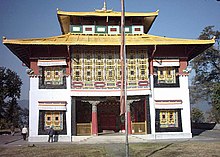
Tsuklakhang Palace
From 1642 to 1975, Sikkim was ruled by the Namgyal Monarchy (also called the Chogyal Monarchy), founded by Phuntsog Namgyal, the fifth-generation descendant of Guru Tashi, a prince of the Minyak House who came to Sikkim from the Kham province of Tibet. Chogyal means ‘righteous ruler’, and was the title conferred upon Sikkim’s Buddhist kings during the reign of the Namgyal Monarchy.
The reign of the Chogyal was foretold by the patron saint of Sikkim, Guru Rinpoche. The 8th-century saint had predicted the rule of the kings when he arrived in the state. In 1642, Phuntsog Namgyal was crowned as Sikkim’s first Chogyal in Yuksom. The crowning of the king was a great event and he was crowned by three revered lamas who arrived there from three different directions, namely the north, west, and south.
Chogyal kings of Sikkim
List of chogyals
| Name | Lifespan | Reign start | Reign end | Notes | Family | Image |
|---|---|---|---|---|---|---|
Phuntsog Namgyal
|
1604–1670 (aged 65–66) |
1642 | 1670 | Ascended the throne and was consecrated as the first Chogyal of Sikkim. Made the capital at Yuksom in West Sikkim. | Namgyal |  |
Tensung Namgyal
|
1644–1700 (aged 55–56) |
1670 | 1700 | Son of Phuntsog Namgyal.
Shifted capital from Yuksom to Rabdentse which was later destroyed by Gurkhas. |
Namgyal |  |
Chakdor Namgyal
|
1686–1717 (aged 30–31) |
1700 | 1717 | His half-sister Pendiongmu tried to dethrone Chakdor, who fled to Lhasa, but was reinstated as king with the help of Tibetans. | Namgyal | |
Gyurmed Namgyal
|
1707–1733 (aged 25–26) |
1717 | 1733 | Sikkim was attacked by Nepalis. | Namgyal | |
Phuntsog Namgyal II
|
1733–1780 (aged 46–47) |
1733 | 1780 | Nepalis raided Rabdentse, the then capital of Sikkim. | Namgyal | |
Tenzing Namgyal
|
1769–1793 (aged 23–24) |
1780 | 1793 | Fled to Tibet, and later died there in exile. | Namgyal | |
Tsugphud Namgyal
|
1785–1863 (aged 77–78) |
1793 | 1863 | Son of Tenzing Namgyal.
The longest-reigning Chogyal of Sikkim. Shifted the capital from Rabdentse to third capital Tumlong. Treaty of Titalia in 1817 between Sikkim and British India was signed in which territories lost to Nepal were appropriated to Sikkim. Darjeeling was gifted to British India in 1835. Two Britons, Dr. Campbell and Dr. Hooker were captured by the Sikkimese in 1849. Hostilities between Britain and Sikkim continued and led to the Treaty of Tumlong in 1861, making Sikkim a de facto British protectorate. |
Namgyal | |
Sidkeong Namgyal
|
1819–1874 (aged 54–55) |
1863 | 1874 | Son of Tsugphud Namgyal. | Namgyal | |
Thutob Namgyal
|
1860 – 11 February 1914 (aged 53–54) |
1874 | 11 February 1914 | Half-brother of Sidkeong Namgyal.
John Claude White appointed as the first political officer in Sikkim in 1889. Capital shifted from Tumlong to fourth and last capital at Gangtok in 1894. |
Namgyal | 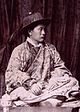 |
Sidkeong Tulku Namgyal
|
1879 – 5 December 1914 (aged 34–35) |
11 February 1914 | 5 December 1914 | Son of Thutob Namgyal.
The shortest-reigning Chogyal of Sikkim. Died of heart failure, in most suspicious circumstances. studied at oxford university |
Namgyal |  |
Tashi Namgyal
|
26 October 1893 – 2 December 1963 (aged 70) | 5 December 1914 | 2 December 1963 | Half-brother of Sidkeong Tulku Namgyal.
The second longest-reigning Chogyal of Sikkim. Treaty between India and Sikkim was signed in 1950, giving India suzerainty over Sikkim. |
Namgyal |  |
Palden Thondup Namgyal
|
23 May 1923 – 29 January 1982 (aged 58) | 2 December 1963 | 10 April 1975 | Son of Tashi Namgyal.
The last Chogyal of Sikkim. The country became a state of India, following the 1975 referendum. |
Namgyal |  |
Titular chogyals
The son from the first marriage of Palden Thondup Namgyal, Wangchuk Namgyal (Sikkimese: དབང་ཕྱུག་བསྟན་འཛིན་རྣམ་རྒྱལ་; born 1 April 1953), was named the 13th Chogyal after his father’s death on 29 January 1982, but the position no longer confers any official authority.
| Titular (1975–present) | |||||||||
| Name | Reign start | Reign end | Notes | ||||||
|---|---|---|---|---|---|---|---|---|---|
| Palden Thondup Namgyal | 10 April 1975 | 29 January 1982 | Son of Tashi Namgyal | ||||||
| Wangchuk Namgyal | 29 January 1982 | Incumbent | Son of Palden Thondup Namgyal | ||||||
-

Royal Flag of Sikkim 1877–1975.
Rulers of other Himalayan kingdoms
Druk Gyalpo of Bhutan
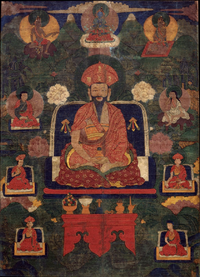
Painting of Shabdrung Ngawang Namgyal
In Bhutan, “dharmaraja” or “Righteous King” is a title which was also conferred upon a special class of temporal and spiritual rulers. In Bhutan, the Chogyal were given the respectful title Zhabdrung. In this context, the Chogyal was a recognised reincarnation (or succession of reincarnations) of Shabdrung Ngawang Namgyal, the 17th century Tibetan-born founder of Bhutan. A position of supreme importance, the Bhutanese Chogyal was above both the highest monastic authority, the Je Khenpo, and the highest temporal ruler, the Deb Raja or Druk Desi. There were two main lines of Zhabdrung incarnations in Bhutan.
Gyalpo of Ladakh
The region of Ladakh was ruled by a separate line of the Namgyal dynasty that lasted from 1460 to 1842 and were titled the Gyalpo of Ladakh.