
Chandrayaan-3 (pronounced /ˌtʃʌndɹəˈjɑːn/), is the third Indian lunar exploration mission under the Indian Space Research Organisation’s (ISRO) Chandrayaan programme. It consists of a lander named Vikram and a rover named Pragyan, similar to those of the Chandrayaan-2 mission. The propulsion module carried the lander and rover configuration to lunar orbit in preparation for a powered descent by the lander.
Chandrayaan-3 was launched on 14 July 2023. The spacecraft entered lunar orbit on 5 August, and the lander touched down in the lunar south pole region on 23 August 2023 at 12:32 UTC, making India the fourth country to successfully land on the Moon, and the first to do so near the lunar south pole.

Chandrayaan-3 Integrated Module in a cleanroom
|
|
| Mission type |
|
|---|---|
| Operator | ISRO |
| COSPAR ID | 2023-098B |
| SATCAT no. | 57320 |
| Website | www |
| Mission duration | 1 month and 14 days (elapsed)
|
| Spacecraft properties | |
| Bus | Chandrayaan |
| Manufacturer | ISRO |
| Launch mass | 3900 kg |
| Payload mass | Propulsion Module: 2148 kg Lander Module (Vikram): 1726 kg Rover (Pragyan) 26 kg Total: 3900 kg |
| Power | Propulsion Module: 758 W Lander Module: 738 W (WS with Bias) Rover: 50 W |
| Start of mission | |
| Launch date | 14 July 2023 09:05:17 UTC |
| Rocket | LVM3 M4 |
| Launch site | Satish Dhawan Space Centre |
| Contractor | ISRO |
| Moon orbiter | |
| Orbital insertion | 5 August 2023 |
| Orbital parameters | |
| Pericynthion altitude | 153 km (95 mi) |
| Apocynthion altitude | 163 km (101 mi) |
| Moon lander | |
| Spacecraft component | Vikram lander |
| Landing date | 23 August 2023 12:32 UTC |
| Landing site | Shiv Shakti point69.367621°S 32.348126°E
(between Manzinus C and Simpelius N craters) |
| Moon rover | |
| Landing date | 23 August 2023 |
 Mission Insignia Chandrayaan programme
|
|

Background
On 22 July 2019, ISRO launched Chandrayaan-2 on board a Launch Vehicle Mark-3 (LVM3) launch vehicle consisting of an orbiter, a lander and a rover. The lander was scheduled to touch down on the lunar surface on 6 September 2019 to deploy the Pragyan rover. The lander ultimately crashed when it lost contact with earth (ISRO) and deviated from its intended trajectory while attempting to land near the lunar south pole.
The lunar South Pole region holds particular interest for scientific exploration due to studies that show large amounts of ice there. Mountainous terrain and unpredictable lighting conditions not only protect the ice from melting, but also make landing scientific probes there a challenging undertaking. This ice could contain solid-state compounds that would normally melt under warmer conditions elsewhere on the Moon, compounds which could provide insight into lunar, Earth, and Solar System history. Ice could also be used as a source of drinking water and hydrogen for fuel and oxygen for future manned missions and outposts.
The European Space Tracking network (ESTRACK), operated by the European Space Agency (ESA), is supporting the mission. Under a new cross-support arrangement, ESA tracking support could be provided for upcoming ISRO missions such as those of India’s first human spaceflight programme, Gaganyaan, and the Aditya-L1 solar research mission. In return, future ESA missions will receive similar support from ISRO’s own tracking stations.
Objectives
ISRO’s mission objectives for the Chandrayaan-3 mission were:
- Getting a lander to land safely and softly on the surface of the Moon.
- Observing and demonstrating the rover’s driving capabilities on the Moon.
- Conducting and observing experiments on the materials available on the lunar surface to better understand the composition of the Moon.
Spacecraft
Design
Chandrayaan-3 comprises three main components:
- Propulsion module
- The propulsion module carries the lander and rover configuration to a 100 kilometres (62 mi) lunar orbit. It is a box-like structure with a large solar panel mounted on one side and a cylindrical mounting structure for the lander (the Intermodular Adapter Cone) on top.
- Lander
- The Vikram lander is responsible for the soft landing on the Moon. It is also box-shaped, with four landing legs and four landing thrusters capable of producing 800 newtons of thrust each. It carries the rover and various scientific instruments to perform on-site analysis.
- The lander for Chandrayaan-3 has four variable-thrust engines with slew rate changing capabilities, unlike Chandrayaan-2’s lander, which had five, with the fifth one being centrally mounted and capable only of fixed thrust. One of the main reasons for Chandrayaan-2’s landing failure was attitude increase during the camera coasting phase. This was removed by allowing the lander to control attitude and thrust during all phases of descent. Attitude correction rate is increased from Chandrayaan-2’s 10°/s to 25°/s with Chandrayaan-3. Additionally, the Chandrayaan-3 lander is equipped with a Laser Doppler Velocimeter (LDV) to allow measuring attitude in 3 directions. The impact legs have been made stronger compared to Chandrayaan-2 and instrumentation redundancy has been improved. It will target a more precise 4 km (2.5 mi) by 4 km (2.5 mi) landing region based on images previously provided by the Orbiter High-Resolution Camera (OHRC) onboard Chandrayaan-2’s orbiter. ISRO improved the structural rigidity, increased polling in instruments, increased data frequency and transmission, and added additional multiple contingency systems to improve lander survivability in the event of failures during descent and landing.
- Rover
- The Pragyan rover is a six-wheeled vehicle with a mass of 26 kilograms (57 pounds). It is 917 millimetres (3.009 ft) x 750 millimetres (2.46 ft) x 397 millimetres (1.302 ft) in size.
- The rover is expected to take multiple measurements to support research into the composition of the lunar surface, the presence of water ice in the lunar soil, the history of lunar impacts, and the evolution of the Moon’s atmosphere.
-

Integrated module
-
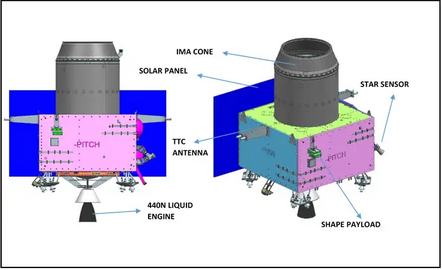
Propulsion module
-
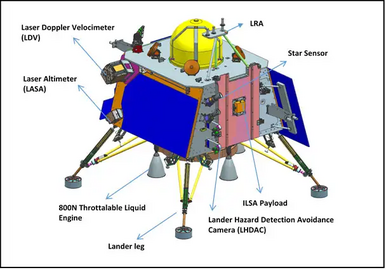
Lander
-
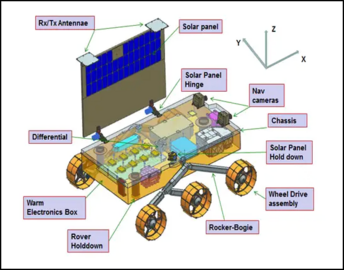
Pragyan rover
Payloads
Lander
- Chandra’s Surface Thermophysical Experiment (ChaSTE) will measure the thermal conductivity and temperature of the lunar surface.
- Instrument for Lunar Seismic Activity (ILSA) will measure the seismicity around the landing site.
- Langmuir Probe (LP) will estimate the near-surface plasma density over time.
Rover
- Alpha Particle X-Ray Spectrometer (APXS) will derive the chemical composition and infer the mineralogical composition of the lunar surface.
- Laser-Induced Breakdown Spectroscope (LIBS) will determine the elemental composition (Mg, Al, Si, K, Ca, Ti, Fe) of lunar soil and rocks around the lunar landing site.
Propulsion module
- Spectro-polarimetry of Habitable Planet Earth (SHAPE) will study spectral and polarimetric measurements of Earth from the lunar orbit in the near-infrared (NIR) wavelength range (1–1.7 μm ).
-

Alpha Particle X-Ray Spectrometer (APSX)
-
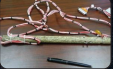
Chandra’s Surface Thermophysical Experiment (ChaSTE)
-
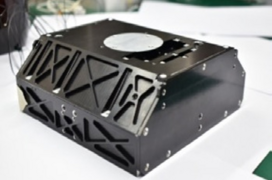
Instrument for Lunar Seismic Activity (ILSA)
-
Laser-Induced Breakdown Spectroscope (LIBS)
-

Langmuir Probe (RAMBHA-LP)
-

Spectro-polarimetry of Habitable Planet Earth (SHAPE)
Mission profile


Launch

Chandrayaan-3 was launched aboard an LVM3-M4 rocket on 14 July 2023, at 09:05 UTC from Satish Dhawan Space Centre Second Launch Pad in Sriharikota, Andhra Pradesh, India, entering an Earth parking orbit with a perigee of 170 km (106 mi) and an apogee of 36,500 km (22,680 mi).
Orbit
After a series of earth bound manoeuvres that placed Chandrayaan-3 in a trans-lunar injection orbit, ISRO performed a lunar-orbit insertion (LOI) on 5 August, successfully placing the Chandrayaan-3 spacecraft into an orbit around the Moon. The LOI operation was carried out from the ISRO Telemetry, Tracking, and Command Network (ISTRAC) in Bengaluru.
On 17 August, the Vikram lander separated from the propulsion module to begin the last phase of the mission.
Descent
On 23 August 2023, as the lander approached the low point of its orbit, its four engines fired as a braking manoeuvre at 30 kilometres (19 mi) above the Moon’s surface. After 11.5 minutes, the lander was 7.2 km (4.5 miles) above the surface; it maintained this altitude for about 10 seconds, then stabilized itself using eight smaller thrusters and rotated from a horizontal to a vertical position while continuing its descent.
It then used two of its four engines to slow its descent to roughly 150 metres (490 ft); it hovered there for about 30 seconds and located an optimal landing spot before continuing downward and touching down at 12:32 UTC.
| Stage and sequence | Date/ Time (UTC) |
LAM burn time | Orbit | Orbital period | References |
|---|---|---|---|---|---|
| Earth orbit: Launch | 14 July 2023 | — | 170 km × 36,500 km (110 mi × 22,680 mi) | — | |
| Earth bound maneuvers: 1 | 15 July 2023 | — | 173 km × 41,762 km (107 mi × 25,950 mi) | — | |
| Earth bound maneuvers: 2 | 17 July 2023 | — | 226 km × 41,603 km (140 mi × 25,851 mi) | — | |
| Earth bound maneuvers: 3 | 18 July 2023 | — | 228 km × 51,400 km (142 mi × 31,938 mi) | — | |
| Earth bound maneuvers: 4 | 20 July 2023 | — | 233 km × 71,351 km (145 mi × 44,335 mi) | — | |
| Earth bound maneuvers: 5 | 25 July 2023 | — | 236 km × 127,603 km (147 mi × 79,289 mi) | — | |
| Translunar injection | 31 July 2023 | — | 288 km × 369,328 km (179 mi × 229,490 mi) | — | |
| Lunar orbit injection | 5 August 2023 | 1,835 s (30.58 min) | 164 km × 18,074 km (102 mi × 11,231 mi) | Approx. 21 h (1,300 min) | |
| Lunar bound maneuvers: 2 | 6 August 2023 | — | 170 km × 4,313 km (106 mi × 2,680 mi) | — | |
| Lunar bound maneuvers:3 | 9 August 2023 | — | 174 km × 1,437 km (108 mi × 893 mi) | — | |
| Lunar bound maneuvers:4 | 14 August 2023 | — | 150 km × 177 km (93 mi × 110 mi) | — | |
| Lunar bound maneuvers:5 | 16 August 2023 | — | 153 km × 163 km (95 mi × 101 mi) | — | |
| Lander deorbit maneuvers: 1 | 18 August 2023 | — | 113 km × 157 km (70 mi × 98 mi) | — | |
| Lander deorbit maneuvers: 2 | 19 August 2023 | 60 s (1.0 min) | 25 km × 134 km (16 mi × 83 mi) | — | |
| Landing | 23 August 2023 12:32 |
TBC | — | — | |
| Rover deployment | 23 August 2023 | — | — | — |
-
Moon as captured by the Lander Position Detection Camera (LPDC) aboard Chandrayaan-3 lander on 15 August 2023
-
View from the Lander Imager Camera-1 (LI-1) on 17 August 2023 just after the separation of the Chandrayaan-3 Lander Module from the Propulsion Module
-

Chandrayaan-3 orbital manoeuvre
Mission life
- Propulsion module: Carries lander and rover to 100-by-100-kilometre (62 mi × 62 mi) orbit, with operation of experimental payload for up to six months.
- Lander module: 1 lunar daylight period (14 Earth days)
- Rover module: 1 lunar daylight period (14 Earth days)
Team
- ISRO Chairperson: S. Somanath
- Mission Director: S. Mohanakumar
- Associate Mission Director: G. Narayanan
- Project Director: P. Veeramuthuvel
- Deputy Project Director: Kalpana Kalahasti
- Vehicle Director: Biju C. Thomas
Funding
In December 2019, ISRO requested the initial funding of the project, amounting to ₹75 crore (US$9.4 million), out of which ₹60 crore (US$7.5 million) would be for meeting expenditure towards machinery, equipment, and other capital expenditure, while the remaining ₹15 crore (US$1.9 million) was sought for operating expenditure. Amit Sharma, CEO of an ISRO vendor, said, “With local sourcing of equipment and design elements, we are able to reduce the price considerably.”
Confirming the existence of the project, ISRO’s former chairman K. Sivan stated that the estimated cost would be around ₹615 crore (equivalent to ₹721 crore or US$90 million in 2023).
Domestic reaction
Congratulating the ISRO team behind the successful Chandrayaan-3 Moon Mission at ISRO Telemetry, Tracking and Command Network in Bengaluru, Prime Minister Narendra Modi announced that the touchdown point of the Vikram lander would henceforth be known as Shiv Shakti point. He further declared August 23, the day the Vikram lander landed on the moon, as National Space Day.