
The Indus Valley Civilisation, 3300-1300 BCE, also known as the Harappan Civilization, extended from modern-day northeast Afghanistan to Pakistan and northwest India. Over 1400 Indus Valley civilisation sites have been discovered, of which 925 sites are in India and 475 sites in Pakistan, while some sites in Afghanistan are believed to be trading colonies. Only 40 sites on the Indus valley were discovered in the pre-Partition era by archaeologists The centre of this civilization is Mohenjo-daro and Harappa , whereas Harappa is located in Punjab, Pakistan and Mohen Ji Daro in the Sindh, Pakistan Province. in British India, around 1,100 (80%) sites are located on the plains between the rivers Ganges and Indus. The oldest site of Indus Valley Civilization, Bhirrana and the largest site, Rakhigarhi, are located in the Indian state of Haryana. More than 90% of the inscribed objects and seals that were discovered were found at ancient urban centres along the Indus river in Pakistan, mainly Harappa (Punjab) and Mohenjo-daro (Sindh). More than 50 IVC burial sites have been found, main sites among those are Rakhigarhi (first site with genetic testing), Sanauli, Farmana, Kalibangan, Lothal, Dholavira, Mehrgarh, Harappa, Chanhudaro, and Mohenjo-daro.
List of Indus Valley sites discovered
 |
This list is incomplete; you can help by adding missing items. (July 2016)
|
| Site | District | Province/state | Country | Image | Excavations/findings |
|---|---|---|---|---|---|
| Alamgirpur | Meerut District | Uttar Pradesh | India | Impression of cloth on trough | |
| Allahdino | Karachi district | Sindh | Pakistan | Floor tiles of a house have been discovered at this site | |
| Amri, Sindh | Dadu District | Sindh | Pakistan | Remains of rhinoceros | |
| Babar Kot | Saurashtra, Rajula | Gujarat | India | A stone fortification wall, plant remains of millets & gram. | |
| Balu, Haryana | Kaithal | Haryana | India | Earliest evidence of garlic. Several plant remains were found here include various types of barley, wheat, rice, horse gram, green gram, various types of a pea, sesamum, melon, watermelon, grapes, dates, garlic, etc. (Saraswat and Pokharia – 2001-2) which is comparable to a nearby IVC site Kunal, Haryana revealed remains of rice (probably wild). | |
| Banawali | Fatehabad District | Haryana | India | Barley, terracotta figure of plough | |
| Bargaon | Saharanpur District | Uttar Pradesh | India | ||
| Baror | Sri Ganganagar district | Rajasthan | India | Human skeleton, ornaments, 5 meter long and 3 meter clay oven, a pitcher filled with 8000 pearls | |
| Bet Dwarka | Devbhoomi Dwarka district | Gujarat | India | Late Harappan seal, inscribed jar, the mould of coppersmith, a copper fishhook | |
| Bhagatrav | Bharuch District | Gujarat | India | ||
| Bhirrana | Fatehabad District | Haryana | India | Graffiti of a dancing girl on pottery, which resembles a dancing girl statue found at Mohenjo-Daro | |
| Chanhudaro | Nawabshah District | Sindh | Pakistan | Bead making factory, use of lipstick, only Indus site without a citadel | |
| Chapuwala | Cholistan | Punjab | Pakistan | unexcavated 9.6 hectares | |
| Daimabad | Ahmadnagar District | Maharashtra | India | 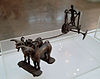 |
A sculpture of a bronze chariot, 45 cm long and 16 cm wide, yoked to two oxen, driven by a man 16 cm high standing in it; and three other bronze sculptures. Southernmost IVC site in India, Late Harappan Phase |
| Desalpur in Nakhtrana Taluka, | Kutch District | Gujarat | India | Massive stone fortification, Harappan pottery, three script bearing seals; one of steatite, one of copper and one of terracotta. | |
| Dholavira | Kutch District | Gujarat | India |  |
Figure of chariot tied to a pair of bullocks and driven by a nude human, Water harvesting and number of reservoirs, use of rocks for constructions, wooden “signboard” with Indus characters found in a gatehouse |
| Farmana | Rohtak District | Haryana | India | Largest burial site of IVC, with 65 burials,found in India | |
| Ganweriwala | Punjab | Pakistan | Equidistant from both Harappa and Mohenjodaro, it is near a dry bed of the former Ghaggar River. It is a site of almost the same size as Mahenjodaro. It may have been the third major center in the IVC as it is near to the copper-rich mines in Rajasthan. | ||
| Gola Dhoro | kutch district | Gujarat | India | Production of shell bangles, semi-precious beads, etc. | |
| Harappa | Sahiwal District | Punjab | Pakistan |  |
Granaries, coffin burial, lot of artifacts, important Indus Valley civilisation town, the first town which is excavated and studied in detail |
| Hisar mound inside Firoz Shah Palace | Hisar District | Haryana | India | Unexcavated site | |
| Hulas | Saharanpur District | Uttar Pradesh | India | ||
| Juni Kuran | Kutch District | Gujarat | India | fortified citadel, lower town, public gathering area | |
| Jognakhera | Kurukshetra | Haryana | India | Copper smelting furnaces with copper slag and pot shards | |
| Kaj | Gir Somnath District | Gujarat | India | Ceramic artifacts, including bowls. Ancient port. | |
| Kanjetar | Gir Somnath District | Gujarat | India | Single phase Harapppan site. | |
| Kalibangan | Hanumangarh District | Rajasthan | India | Baked/burnt bangles, fire altars, small circular pits containing large urns and accompanied by pottery, bones of camel | |
| Karanpura near Bhadra city | Hanumangarh district | Rajasthan | India |  |
Skeleton of child, terracotta like pottery, bangles, seals similar to other Harappan sites |
| Khirasara | Kutch district | Gujarat | India | Ware House, Industrial area, gold, copper, semi-precious stone, shell objects, and weight hoards | |
| Kerala-no-dhoro or Padri | Saurashtra | Gujarat | India | Salt production centre, by evaporating sea water | |
| Kot Bala (also, Balakot) | Lasbela District | Balochistan | Pakistan | Earliest evidence of furnace, seaport | |
| Kot Diji | Khairpur District | Sindh | Pakistan | ||
| Kotada Bhadli | Kutch District | Gujarat | India | Fortification bastion few houses foundations | |
| Kunal, Haryana | Fatehabad District | Haryana | India | Earliest Pre-Harappan site, Copper smelting. | |
| Kuntasi | Rajkot District | Gujarat | India | Small port | |
| Lakhan-jo-daro | Sukkur District | Sindh | Pakistan | major unexcavated site (greater than 300 hectares) | |
| Larkana | Larkana District | Sindh | Pakistan | ||
| Loteshwar | Patan District | Gujarat | India | Ancient archaeological site | |
| Lothal | Ahmedabad District | Gujarat | India |  |
Bead making factory, dockyard, button seal, fire altars, painted jar, earliest cultivation of rice (1800 BC) |
| Manda, Jammu | Jammu District | Jammu & Kashmir | India | northernmost Harappan site in Himalayan foothills | |
| Malwan | Surat District | Gujarat | India | Southernmost Harappan site in India | |
| Mandi | Muzaffarnagar district | Uttar Pradesh | India | ||
| Mehrgarh | Kachi District | Balochistan | Pakistan | Earliest agricultural community (7000-5000 BC) | |
| Mitathal | Bhiwani District | Haryana | India | ||
| Mohenjo-Daro | Larkana District | Sindh | Pakistan |  |
Great Bath (the biggest bath ghat), Great granary, Bronze dancing girl, Bearded man, terracotta toys, Bull seal, Pashupati seal, three cylindrical seals of the Mesopotamian type, a piece of woven cloth |
| Nageshwar | Kutch District | Gujarat | India | Shell working site | |
| Navinal | Kutch district | Gujarat | India | ||
| Nausharo near Dadhar | Kachi District | Balochistan | Pakistan | ||
| Ongar | Hyderabad | Sindh | Pakistan | ||
| Pabumath | Kutch District | Gujarat | India | A large building complex, unicorn seal, shell bangles, beads, copper bangles, needles, antimony rods, steatite micro beads; pottery include large and medium size jars, beaker, dishes, dish-on-stand, perforated jars etc.; fine red pottery with black painted designs etc. | |
| Pathani Damb | Makran | Balochistan | Pakistan | At 100 hectares, this has the potential to be another city | |
| Pir Shah Jurio | Karachi | Sindh | Pakistan | ||
| Pirak | Sibi | Balochistan | Pakistan | ||
| Rakhigarhi | Hisar District | Haryana | India | Terrecotta wheels, toys, figurines, pottery. Large site, partially excavated. | |
| Rangpur | Ahmedabad District | Gujarat | India | Seaport | |
| Rehman Dheri | Dera Ismail Khan | Khyber Pakhtunkhwa | Pakistan | ||
| Rojdi | Rajkot District | Gujarat | India | ||
| Rupar | Rupnagar District | Punjab | India | ||
| Sanauli | Baghpat District | Uttar Pradesh | India | Burial site with 125 burials found, copper antenna sword with a hilt and first time chariots were discovered. | |
| Sheri Khan Tarakai | Bannu District | Khyber-Pakhtunkhwa | Pakistan | pottery, lithic artifact | |
| Shikarpur, Gujarat | Kutch District | Gujarat | India | Food habit details of Harappans | |
| Shortugai | Darqad District | Takhar Province | Afghanistan | ||
| Siswal | Hisar (district) | Haryana | India | ||
| Sokhta Koh | Makran | Balochistan | Pakistan | Pottery | |
| Sothi near Baraut | Bagpat district | Uttar Pradesh | India | ||
| Surkotada | Kutch District | Gujarat | India | Bones of a horse (only site) | |
| Sutkagan Dor | Makran | Balochistan | Pakistan | Bangles of clay, Westernmost known site of IVC | |
| Tigrana | Bhiwani district | Haryana | India | Houses, pottery, terracotta, seals with script, semi-precious stones, evidence of crop cultivation and anima; domestication. | |
| Vejalka | Botad district | Gujarat | India | pottery |
Context of IVC sites and cultures
Wider context of the IVC includes the following:
- Meluhha
- Indus–Mesopotamia relations
- Conflict with the Akkadians and Neo-Sumerians
- List of inventions and discoveries of the Indus Valley Civilization
- Hydraulic engineering of the Indus Valley Civilization
- Sanitation of the Indus Valley civilisation
- Periodisation of the Indus Valley civilisation
- Pottery in the Indian subcontinent
- Bara culture, subtype of Late-Harappan Phase
- Cemetery H culture (2000-1400 BC), early Indo-Aryan pottery at IVC sites later evolved into Painted Grey Ware culture of Vedic period
- Black and red ware, belonging to neolithic and Early-Harappan phases
- Sothi-Siswal culture, subtype of Early-Harappan Phase