
Dakshina Kannada is a district of Karnataka state in India, with its headquarters in the port city of Mangalore. The district covers an area nestled in between the Western Ghats to its east and the Arabian Sea to its west. Dakshina Kannada receives abundant rainfall during the Indian monsoon. It is bordered by Udupi district ( formerly a part of this district) to the north, Chikmagalur district to the northeast, Hassan district to the east, Kodagu to the southeast and Kasaragod district of Kerala to the south. According to the 2011 census of India, Dakshina Kannada district had a population of 2,083,625. Dakshina Kannada district is the second major district of Karnataka in all aspects after Bangalore Urban. It is the only district in Karnataka state to have all modes of transport like road, rail, water and air due to the presence of a major hub, Mangalore. This financial district is also known as the Cradle of Indian banking.
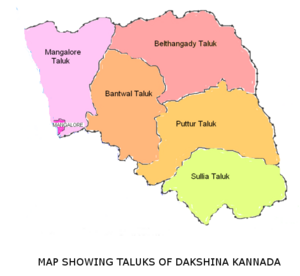
The district comprises seven talukas: Mangalore, Puttur, Sullia, Bantwal, Belthangady, Kadaba and Moodabidri. It used to include seven northern talukas (Udupi, Kundapur, Karkala, Hebri, Brahmavar, Kaup and Byndoor), but these were separated in August 1997 to form Udupi district.
Important cities and towns in Dakshina Kannada include Mangalore, Surathkal, Puttur, Sullia, Bantwal, Vittal, Moodabidri, Kinnigoli, Uppinangady, Nellyadi, Kadaba, Belthangady, Guruvayankere, Venur, Mulki, Dharmasthala, Ujire and Subramanya. The district is known for beaches, red clay roof tiles (Mangalore tiles), cashew nut and its products, banking, education, healthcare and cuisine. Mangalore being the second largest city of Karnataka and Puttur are the largest and the major cities of Dakshina Kannada.
Dakshina Kannada District has 1 City Corporation, 2 City Municipal Councils, 3 Town Municipal Councils, and 8 Town Panchayaths.
History
The Alupas (ಆಳುಪರು) ruled the erstwhile Dakshina Kannada region between the 8th and 14th century CE. An Old Malayalam inscription (Ramanthali inscriptions), dated to 1075 CE, mentioning king Kunda Alupa, the ruler of Alupa dynasty of Mangalore, can be found at Ezhimala (the former headquarters of Mushika dynasty) near Cannanore, in the North Malabar region of Kerala. It is one of the oldest inscriptions available about Alupa dynasty. Before 1860, Dakshina Kannada was part of a district called Kanara, which was under a single administration in the Madras Presidency. In 1860, the British split the area into South Canara and North Canara, the former being retained in the Madras Presidency, while the latter was made a part of Bombay Presidency in 1862. Kundapur Taluk was earlier included in North Kanara but was later re-included in South Kanara.
During the Reorganisation of States in 1956, Kasaragod was split and transferred to the newly created Kerala state and Dakshina Kannada was transferred to Mysore State (present day Karnataka).
South Canara was a district under the British empire which included the present Dakshina Kannada, Udupi, Kasaragod districts and Aminidivi islands. Canara district was bifurcated in 1859 to form North Canara and South Canara. Dakshina Kannada became a district of Mysore State in 1956 which later was renamed Karnataka in 1973. Kasaragod became a district of Kerala during the Re-organization of States and Aminidivi islands later became a part of Lakshadweep. The Udupi district was formed from the northern taluks of Dakshina Kannada in 1997. Later, the Karnataka Government, for the purpose of administration, split the greater Dakshina Kannada district into Udupi and present day Dakshina Kannada districts on 15 August 1997. Three taluks of the former district – Udupi, Karkala and Kundapura – formed the new Udupi district.
Demographics
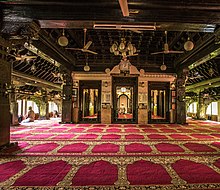
Masjid Zeenath Baksh is one of the oldest Masjids in the Indian subcontinent
According to the 2011 census, Dakshina Kannada has a population of 2,089,649, of which male and female were 1,034,714 and 1,054,935 respectively. roughly equal to the nation of North Macedonia. This gives it a ranking of 220th in India (out of a total of 640). The district has a population density of 457 inhabitants per square kilometre (1,180/sq mi). Its population growth rate over the decade 2001-2011 was 9.8%. Dakshina Kannada has a sex ratio of 1018 females for every 1000 males and a literacy rate of 88.62%. The literacy rate of Mangalore city is 94%. According to the 2011 Indian Census, the district ranks second in per capita income, second in HDI, first in literacy and third in sex ratio among all districts in Karnataka. 7.1% of the district’s population is Scheduled Castes and 3.9% Scheduled Tribes.
Tuluvas, distributed among the Billava, Mogaveera, Bunt, Kulala, Tulu Gowda and Devadiga communities, are the largest ethnic group in the district. The Konkani people, Brahmins, Holeyas, the hill-tribes (Koragas), Muslims, Mangalorean Catholics and Arebhashe Gowdas comprise rest of the population. The Brahmins belong chiefly to the Shivalli, Saraswat, Vishwakarma, Havyaka, Chitpavan, Daivadnya and Kota sub-sections. The major languages spoken in Dakshina Kannada are Tulu, Konkani, Kannada, Beary Bhashe, Malayalam, Are Bhashe, Deccani Urdu and Havyaka.
| Year | Pop. | ±% p.a. |
|---|---|---|
| 1901 | 485,304 | — |
| 1911 | 516,051 | +0.62% |
| 1921 | 546,146 | +0.57% |
| 1931 | 596,400 | +0.88% |
| 1941 | 666,222 | +1.11% |
| 1951 | 755,100 | +1.26% |
| 1961 | 915,039 | +1.94% |
| 1971 | 1,163,668 | +2.43% |
| 1981 | 1,428,028 | +2.07% |
| 1991 | 1,656,165 | +1.49% |
| 2001 | 1,897,730 | +1.37% |
| 2011 | 2,089,649 | +0.97% |
| source: | ||
Geography
-

Hilly region – Sullia Town
-

Coastal plain – Tannirbhavi Beach
The district geography consists of seashore in the west and Western Ghats in the east. The soil is mostly lateritic type, characterised by high iron and aluminium content.
The major rivers are Netravathi, Kumaradhara, Gurupura (Phalguni), Shambhavi, Nandini or Pavanje and Payaswini; all join the Arabian sea. At Uppinangadi, the Netravathi and Kumaradhara rivers rise during the monsoon and meet. This event is called “Sangam”, which in Sanskrit means confluence. Near Mangalore, an estuary is formed by the union of the rivers Netravathi and the Gurupura which merge into the Arabian Sea.
The topography of the district is plain up to 30 km (18.64 mi) inside the coast and changes to undulating hilly terrain sharply towards the east in the Western Ghats. Teak, bamboo and rosewood trees are found in the hilly areas towards the east. The Geological Survey of India has identified this district as a moderately earthquake-prone region and categorised it in the Seismic III Zone. In rural Dakshina Kannada, houses are in the midst of a farm field or plantations of coconut or arecanut, separated by a few hundred metres.
Shirlalu village (in the Kudremukh range of Belthangady taluk), with a maximum elevation of 1,115 m (3,658 ft), is the highest point in Dakshina Kannada.
Climate
Dakshina Kannada features a Tropical Monsoon climate (Am) according to the Köppen climate classification. The average annual rainfall in Dakshina Kannada is 4,030 millimetres (159 in). The rainfall varies from 3,774.1 millimetres (149 in) at the Mangalore coast, 4,530 millimetres (178 in) at Moodabidri and 4,329 millimetres (170 in) at Puttur near the Western Ghats. The average humidity is 75% and peaks in July at 89%.
| showClimate data for Mangalore (1961–1990, extremes 1901–1981) |
|---|
| showClimate data for Puttur, Karnataka, India |
|---|
Education and research

NITK Surathkal

Swami Vivekananda Planetarium at Pilikula in Mangalore, is the first and only 3D Planetarium in India
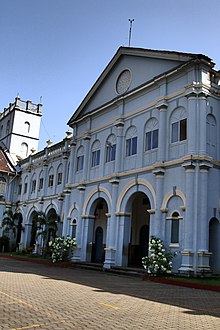
St Aloysius College, Mangalore
In Dakshina Kannada, primary and secondary education have reached every section of the society. Some of them are St Agnes CBSE school, St Theresa ICSE School and St Aloysius School A host of educational institutes offering courses in Medicine, Engineering, Pharmacy, Nursing, Hotel and Catering, Law and Management are in this district.
Dakshina Kannada is home to the National Institute of Technology Karnataka (NITK) Surathkal, one of India’s top engineering colleges. The College of Fisheries is located at Yekkur near Kankanady. Mangalore University is a public university in Konaje near Mangalore. It has jurisdiction over the districts of Dakshina Kannada, Udupi and Kodagu.
The district is home to research institutes such as the Directorate of Cashew Research at Puttur. The Central Plantation Crops Research Institute is in Vitla in the Bantwal taluk.
The engineering colleges in the district include St. Joseph Engineering College, KVG College of Engineering, Mangalore Institute of Technology & Engineering, Canara Engineering College, P A College of Engineering, Srinivas Institute of Technology, Srinivas School of Engineering, Vivekananda College of Engineering & Technology, Shree Devi Institute of Technology, Alvas Institute of Engineering & Technology, Karavali Institute of Technology, Sahyadri College of Engineering and Management, Yenepoya Institute of Technology, A J Institute of Engineering and Technology, SDM Institute of Technology, Bearys Institute of Technology and Prasanna College of Engineering & Technology.
The medical colleges in the district include A J Institute of Medical Science, Father Muller Medical College, KS Hegde Medical Academy, Kasturba Medical College, Srinivas Institute of Medical Sciences and Research Centre, Yenepoya Medical College & Research Institute and KVG Medical College. Manipal College of Dental Sciences Mangalore, A B Shetty Memorial Institute of Dental Sciences, A J Institute of Dental Sciences, Yenepoya Dental College & Research Institute and Srinivas Institute of Dental Sciences are some of the dental colleges.
Cultures, traditions and rituals
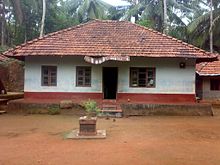
Traditional house in Puttur
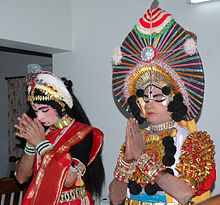
Yakshagana artists
Most people of this district follow traditions, customs and rituals. The district has many temples of Hindu gods and goddesses, which are ancient and have deep spiritualism attached to them. The people of Dakshina Kannada worship the Serpent God Subramanya. According to legend, the district was reclaimed by Parashurama from the sea. According to the 17th-century Malayalam work Keralolpathi, the lands of Kerala were recovered from the sea by the axe-wielding warrior sage Parasurama, the sixth avatar of Vishnu (hence, Kerala is also called Parasurama Kshetram ‘The Land of Parasurama’). Parasurama threw his axe across the sea, and the water receded as far as it reached. According to legend, this new area of land extended from Gokarna to Kanyakumari. The land which rose from sea was filled with salt and unsuitable for habitation; so Parasurama invoked the Snake King Vasuki, who spat holy poison and converted the soil into fertile lush green land. Out of respect, Vasuki and all snakes were appointed as protectors and guardians of the land. P. T. Srinivasa Iyengar theorised, that Senguttuvan may have been inspired by the Parasurama legend, which was brought by early Aryan settlers. Nagaradhane or snake worship is practiced according to the popular belief of the Naga Devatha to go underground and guard the species on the top. Rituals such as Bhuta Kola are performed to satisfy the spirits. Kambala, a form of buffalo race on muddy track in the paddy field is organised in 16 sites across the district. Cock fight (Kori Katta in Tulu) is another pastime of the rural agrarian people.
Yakshagana is the popular folk art of this district. The Yakshagana is a night-long dance and drama performance practiced in Tulu Nadu with great fanfare. Pilivesha (literally, tiger dance) is a unique form of folk dance in the region fascinating the young and the old alike, which is performed during Dasara and Krishna Janmashtami. Karadi Vesha (literally, bear dance) is another popular dance performed during Dasara. The people of Dakshina Kannada also celebrate traditional Hindu festivals like Bisu, Yugadi (Ugadi), Krishna Janmashtami, Ganesha Chaturthi, Navaratri (Dasara), Deepavali, Aati Hunime, etc.
According to Kerala Muslim tradition, the Masjid Zeenath Baksh at Mangalore is one of the oldest mosques in Indian subcontinent. According to the Legend of Cheraman Perumals, the first Indian mosque was built in 624 AD at Kodungallur with the mandate of the last the ruler (the Cheraman Perumal) of Chera dynasty, who left from Dharmadom to Mecca and converted to Islam during the lifetime of Prophet Muhammad (c. 570–632). According to Qissat Shakarwati Farmad, the Masjids at Kodungallur, Kollam, Madayi, Barkur, Mangalore, Kasaragod, Kannur, Dharmadam, Panthalayani (Koyilandy), and Chaliyam, were built during the era of Malik Dinar, and they are among the oldest Masjids in Indian Subcontinent. It is believed that Malik Dinar was died at Thalangara in Kasaragod town. Two of them, Mangalore and Barkur lie in Tulu Nadu.
The 16th century work Tuhfat Ul Mujahideen written by Zainuddin Makhdoom II appears to be the first historical work written in detail about the contemporary history of Mangalore. It is written in Arabic and contains pieces of information about the resistance put up by the navy of Kunjali Marakkar alongside the Zamorin of Calicut from 1498 to 1583 against Portuguese attempts to colonize Tulu Nadu and Malabar coast.
Transport

Jet Airways at the Mangalore International Airport
Bus services in this district are run by private players namely Dakshina Kannada Bus Operators’ Association (DKBOA) and the state-run KSRTC. The district had public limited (public listed) companies running transport business even before the independence of India in 1947.
The district has five national highways connecting parts of Karnataka and India. NH-66 connects the district with Udupi, Karwar, Mumbai, Goa, Kannur, Kozhikode, Kochi and Thiruvananthapuram. NH-169 connects Shimoga with Dakshina Kannada. NH-75 connects the district with Vellore, Kolar, Bangalore, Kunigal, Hassan and Sakleshpur. The NH-73 connects Mangalore to Tumkur via Charmadi, Mudigere, Belur and Tiptur. Major ghat sections in Dakshina Kannada include Shiradi Ghat (Nelyadi to Sakleshpura), Charmadi Ghat (Charmadi to Kottigehara), Sampaje Ghat (Sampaje to Madikeri) and Bisle Ghat (Subramanya to Sakleshpura, popularly known as Green Route by trekkers). NH-275 also connects Mangalore with Bangalore via Mysore. It starts at Bantwal near Mangalore city and passes through Puttur, Madikeri, Hunsur, Mysore, Mandya and Channapatna. It ends at Bangalore spanning a length of 378 kilometres (235 mi).
| Highway | Starting Point | Ending Point |
|---|---|---|
| National Highway 66 (previously NH 17) | Panvel, Maharashtra | Kanyakumari, Tamil Nadu |
| National Highway 75 (previously NH 48) | Mangalore | Vellore, Tamil Nadu |
| National Highway 275 | Mangalore | Bangalore |
| National Highway 169 (previously NH 13) | Mangalore | Shimoga |
| National Highway 73 | Mangalore | Tumkur |
In 1907, the Southern Railway connected Mangalore with Calicut (Kozhikode) along the coastline. This railway line helped connect the district with other places of the Madras presidency during the colonial rule. The Konkan Railway (1998) connects Dakshina Kannada with Maharashtra, Goa, Gujarat, Delhi, Rajasthan and Kerala by train. There are direct trains from Mangalore to Mumbai, Thane, Chennai, Margao and Trivandrum. Train services operate daily to Bangalore via Hassan and Kukke Subramanya after the conversion from metre gauge to broad gauge track.
The Dakshina Kannada district has a seaport at Panambur named New Mangalore Port. The seaport managed by New Mangalore Port Trust handles cargo, timber, petroleum and coffee exports. It is one of the major seaports of India.
The district is connected by air through the Mangalore International Airport at Bajpe. Airlines such as Air India, SpiceJet and IndiGo offer daily flights to national and international destinations near the Persian Gulf.
Historic sites and tourism
-
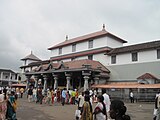
Sri Manjunatha Temple at Dharmasthala
-
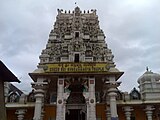
Kukke Subramanya Temple
-
Shree Durgaparameshwari Temple Kateel
-

Kudroli Temple in Mangalore
-

Mangaladevi Temple
The following are historic places to visit in Dakshina Kannada:
-
- Mangaladevi Temple: Mangalore was named after the Hindu deity Mangaladevi.
- Venur: Monolithic Bahubali statue.
- Kadri: Temple of Lord Sri Manjunatha.
- Shree Amrutheshwara Temple, Vamanjoor: Temple of Lord Shiva.
- Moodabidri: Site of the ancient Jain temples and the Bhattaraka seat.
- Krishnapura matha: One of the matha (monastery) belonging to ashta matha of Udupi.
- Dharmasthala: The temple of Lord Sri Manjunatheshwara is here.
- Kateel: Temple of Goddess Sri Durga Parameshwari.
- Kadeshivalaya: Kadeshivalaya temple at Bantwal
- Kudroli: Gokarnanatheshwars Temple.
- Mundkur: Sri Durga Parameshwari Temple.
- Karinjeshwara Temple: Temple of Lord Shiva Parvati on a huge rock.
- Ullal: Known for the Ullal beach and Someshwara beach.
- Kukke Subramanya: Temple of the serpent Lord Subramanya is here.
- Mulki: Durgaparameshwari Temple.
- St Aloysius Chapel, Mangalore.
- Milagres Church, Mangalore
- Sayyed Madani Mosque and Dargah, Ullal.