
Turkoman (Middle Turkic: تُركْمانْ, Ottoman Turkish: تركمن, romanized: Türkmen and Türkmân, Azerbaijani: Türkman and Türkmən, Turkish: Türkmen, Turkmen: Türkmen, Persian: sing. Turkamān, pl. Tarākimah, also called Turcoman and Turkman) is a term that was widely used during the Middle Ages for the people of Oghuz Turkic origin. According to medieval authors Al-Biruni and al-Marwazi, this term referred to the Oghuz who converted to Islam. There is evidence non-Oghuz Turks such as Karluks may also have been called Turkomans and Turkmens.
The term, which was originally an exonym, is thought to date from the high Middle Ages, along with the ancient and familiar name Turk(türk) and tribal names Bayat, Bayandur, Afshar, Kayi, and others. It started to be used as an ethnonym by Oguz tribes that settled in Anatolia, Azerbaijan, Iran, and Turkmenistan.
In Anatolia, since the late Middle Ages, “Turkoman” was supplanted by the term “Ottomans”, which came from the name of the Ottoman Empire and its ruling dynasty. The term “Turkoman” has not been used in Azerbaijan since the 17th century, but it remained as the self-name of the semi-nomadic tribes of the Terekeme, a sub-ethnic group of the Azerbaijani people.
In the early 21st century, this ethnonym is still used by the Turkmens of Central Asia—the main population of Turkmenistan—Iran, Afghanistan and Russia, as well as Iraqi and Syrian Turkmens, the other descendants of the Oghuz Turks. “Turkoman”, “Turkmen”, “Turkman” and “Torkaman” were—and continue to be—used interchangeably.
Etymology and history

Turkomania of the Ottoman Empire, as shown on the German map
The first-known mention of the term “Turkmen”, “(Turkman)” or “Turkoman” occurs in Chinese texts of the 8th and 9th centuries as Тö-kü-möng, presumably in Zhetisu. Use of the term “Turkoman” spread with the expansion of the area of residence of that part of the Oghuz that converted to Islam.
The greatest spread of the term “Turkoman” occurred in the era of the Seljuk conquests. Muslim Oghuz people rallied around the Kınık tribe that made up the core of the future Seljuk tribal union and the state they would create in the 11th century. Since the Seljuk era, the sultans of the dynasty created military settlements in parts of the Near and Middle East to strengthen their power; large Turkoman settlements were created in Syria, Iraq, and eastern Anatolia. After the Battle of Manzikert, the Oghuz extensively settled throughout Anatolia and Azerbaijan. In the 11th century, Turkomans densely populated Arran. The 12th-century Persian writer al-Marvazi wrote; “Turkomans settled in Islamic countries and showed great character. So much so that they rule most of these lands, becoming kings and sultans …. Those who live in deserts and steppes and lead a nomadic lifestyle in summer and winter, they are the strongest of people and the most persistent in battle and war.”
Towards the high Middle Ages, the eastern part of Anatolia became known as “Turkomania” in European texts and as “Turkmeneli” in Ottoman sources. The center of the Turkoman settlement in the territory of modern-day Iraq became Kirkuk. The Turkmens also included the Ive and Bayandur tribes, from which the ruling clans of the states of Kara Koyunlu and Aq Qoyunlu emerged. After the fall of Aq Qoyunlu, the Turkoman tribes—partly under their own name, for example Afshars, Hajilu, Pornak, Deger, and Mavsellu—united in a single tribe of Turkoman or Qizilbash tribal confederation.
Language

Territories where Oghuz languages are spoken today
Turkomans primarily spoke languages that belong or belonged to the Oghuz branch of Turkic languages, which included the languages and dialects Seljuk, Old Anatolian Turkish, Ottoman Turkish, and Afshar Turkic. One of the languages spoken by Medieval Turkomans was used in the Oghuz Turks literary text “the Book of Dede Korkut”. In the Gonbad manuscript—one of the earliest manuscripts that survive to this day— is of a mixed character and depicts vivid characteristics of the period of transition from later Old Oghuz Turkic to Early Modern Turkic of Iranian Azerbaijan. There are also orthographical, lexical and grammatical structures peculiar to Eastern Turkic.
The following sentences are few of many wise-sayings that appear in the Book of Dede Korkut:
|
|
Literature

The cover of the Gonbad manuscript of “the Book of Dede Korkut”
Turkoman literature includes the famous Book of Dede Korkut, which was UNESCO’s 2000 literary work of the year. It also includes the Oghuzname, Battalname, Danishmendname, Köroğlu epics, which are part of the literary history of Azerbaijanis, Turks of Turkey, and Turkmens. The modern and classical literature of Azerbaijan, Turkey, and Turkmenistan are also considered Oghuz literature because it was produced by their descendants.
The Book of Dede Korkut is a collection of epics and stories bearing witness to the language, the way of life, religions, traditions and social norms of the Oghuz Turks. Other notable literary works of the Turkoman era include Târîh-i Âli Selçûk (History of the House of Seljuk) by Yazıcıoğlu Ali, Şikâyetnâme (شکايت نامه; “Complaint”) by Fuzûlî, Dâstân-ı Leylî vü Mecnûn by Fuzûlî, Risâletü’n-Nushiyye by Yunus Emre, Mârifetnâme (معرفتنامه; “Book of Gnosis”) by İbrahim Hakkı Erzurumi.
Notable Turkoman dynasties and tribal confederations
Seljuq dynasty
Seljuqs were probably first to universally adopt a “Turkoman” ethnonym (Turkmen) and the quick spread of the term across the Islamic world is attested primarily to them. Seljuqs established both the Seljuk Empire and the Sultanate of Rum, which at their height stretched from Iran to Anatolia—the former being the first Turkic empire to link “the East and the West”.
Turkmen beyliks of Anatolia

Turkmen beyliks of Anatolia
Turkmen beyliks of Anatolia were small principalities in Anatolia governed by beys (rulers or lords), the first of which was founded at the end of the 11th century. A second, more extensive period of establishment of beyliks took place as a result of the decline of the Seljuq Sultanate of Rûm in the second half of the 1200s.
The basis of the organization of beyliks was the territorial and tribal principle. Unification took place around the chief of the tribe and his descendants. For this reason, the names of the beyliks were associated with the name of the dynasty rather than the territory; for example, Osmanoğullari, Dilmachoğullari, and Saruhanoğullari.
The beylik of the Osmanoğlu, from its capital in Bursa, completed its conquest of other Turkmen beyliks by the late 15th century, becoming a transcontinental empire and a great power known as the Ottoman Empire.
Kara Koyunlu

Kara Koyunlu helmet
Kara Koyunlu was the union and tribal confederation of Oguz Turkic nomadic tribes that were led by the Shia Turkmendynasty from the Oghuz tribe Yiva, which existed in Asia Minor in the 14th-15th centuries on the territory of modern-day Azerbaijan, Armenia, Iraq, northwestern Iran, and eastern Turkey.
The Kara Koyunlu tribal confederation included the Turkmen tribes Baharlu, Saadlu, Karamanlu, Alpaut, Duharlu, Jagirlu, Hajilu, Agacheri. The reign of Jahan Shah is generally considered as the most prosperous era of the Kara Koyunlu because it controlled vast and wealthy lands, becoming a formidable force in the region. Kara Koyunlu became one of the important Islamic states of that time, with a developed political, administrative, military, economic, and cultural structure.
Ak Koyunlu

Armor of the heavily armed Ak Koyunlu cavalryman
Ak Koyunlu was a confederation of Turkmen tribes under the leadership of the Bayandur tribe, who ruled eastern Anatolia and western Iran until the Safavids conquered the area between 1501 and 1503.
The Ak Koyunlu first acquired land in 1402, when Turco-Mongol warlord Timur granted them all of Diyar Bakr in present-day Turkey. For a long time, these Turkmens were unable to expand their territory because the rival Kara Koyunlu Turkmens kept them at bay. The situation changed with the rule of Uzun Hasan, who defeated the Kara Koyunlu leader Jahān Shāh in 1467. After the defeat of the Timurid leader Abu Sa’id Mirza, Uzun Hasan was able to take Baghdad and territories around the Persian Gulf. He expanded into Iran as far east as Khorasan.
Qizilbash

A Safavid Qizilbash cavalryman
Qizilbash was initially the association of the Turkoman nomadic tribes of Ustādjlu, Rūmlu, Shāmlu, Dulkadir, Afshār, Qājār, Takkalu, and others. Later, the term Qizilbash was designated to all subjects of the Safavid state, regardless of their ethnicity. Among the Turks, however, the term began to be used to exclusively refer to Persians.
The Qizilbash—some of whom contributed to the foundation of the Safavid dynasty of Iran—flourished in Iranian Azerbaijan, Anatolia, and Kurdistan from the late-15th century. As of 2020, there is an ethnic group known as the “Qizilbash” in Afghanistan. In Turkey, adherents of the Shia sect Ali-Illahi also include the Yoruk known as the Qizilbash. The Qizilbash also constitute part of the present-day Turkmens and Kurds tribes Belliqan, Milan, Balashaghi, Qurashli, and Qochkiri.
Afsharid dynasty

Painting of Nader Shah
The Afsharids were a short-lived dynasty that, at its height, controlled modern-day Iran, Armenia, Georgia, Azerbaijan, parts of the North Caucasus(Dagestan), Afghanistan, Bahrain, Turkmenistan, Uzbekistan, Pakistan, parts of Iraq, Turkey, the United Arab Emirates, and Oman. It originated from the Turkmen Afshar tribe in Iran’s north-eastern province of Khorasan. The dynasty was founded in 1736 by the skilled military commander Nader Shah, who deposed the last member of the Safavid dynasty and proclaimed himself the Shah of Iran.
During Nader’s reign, Iran reached its greatest extent since the Sasanian Empire. After his death, most of the empire was divided between the Zands, Durranis, Georgians, and the Caucasian khanates, while Afsharid rule was confined to a small state in Khorasan. The Afsharid dynasty was overthrown by Mohammad Khan Qajar in 1796.
The military forces of the Afsharid dynasty had their origins in the relatively obscure, bloody, inter-factional violence in Khorasan during the collapse of the Safavid state. A small band of warriors under local warlord Nader Qoli of the Turkmen Afshar tribe in northeastern Iran comprised a few hundred men. At the height of Nader’s power as the king of kings, Shahanshah, he commanded an army of 375,000, the most-powerful military force of its time, which was led by one of the most talented and successful military leaders in history.
Qajar dynasty

A shield from the Qajar dynasty era
The Qajar dynasty was a royal dynasty of Turkoman origin from the Qajar tribe; it ruled over Iran from 1789 to 1925. The Qajars were one of the original Turkmen Qizilbash tribes that emerged and spread across Asia Minor in the 10th and 11th centuries. They later supplied military power to the Safavid Iran from the earliest days of the Safavids’ reign. Numerous members of the Qajar tribe held important positions in Safavid Iran.
In 1794, a Qajar chieftain named Agha Mohammed, a member of the Qoyunlu branch of the Qajars, founded the Qajar dynasty, which took over the Zand dynasty in Iran. He started his campaign from his base south of the Caspian Sea, capturing Isfahan in 1785. In 1786, Tehran acknowledged Mohammed’s authority. The Qajars had a desire to conquer new territories using the model of Genghis Khan and Timur; their goal was also to return the territories of the Safavid and Afsharid empires. In the 1980s, the Qajar population was around 15,000 people, most of whom lived in Iran.
“Turkoman” ethnonym today

Turkmens in national costumes, Turkmenistan
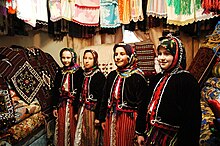
Yoruk girls of Balikesir in traditional dress
In Anatolia in the late Middle Ages, the term “Turkoman” was gradually supplanted by the term “Ottomans”. The Ottoman ruling class identified themselves as Ottomans until the 19th century. In the late 19th century, as the Ottomans adopted European ideas of nationalism, they preferred to return to a more common term “Turk” instead of “Turkoman”, whereas previously “Turk” was used to exclusively refer to Anatolian peasants.
The use of “Turkoman” as an ethnonym for the Turks living in Iranian Azerbaijan disappeared from common use after the 17th and 18th centuries. It continued to be used interchangeably with other ethno-historical terms for the Turkic people of the area, including Turk, Tatar, Ajam, well into the early 20th century. In the early 21st century, “Turkonan” remains as the self-name for the semi-nomadic tribes of the Terekime, a sub-ethnic group of the Azerbaijani people.
In the early 21st century, the ethnonyms “Turkoman” and “Turkmen” are still used by the Turkmens of Turkmenistan, who have sizeable groups in Iran, Afghanistan, Russia, Uzbekistan, Tajikistan and Pakistan, as well as Iraqi and Syrian Turkmens, descendants of the Oghuz Turks who mostly adhere to a Turkish heritage and identity. Most Iraqi and Syrian Turkmens are the descendants of Ottoman soldiers, traders, and civil servants who were taken into Iraq from Anatolia during the rule of the Ottoman Empire. Turks of Israel and Lebanon, and Turkish sub-ethnic groups of Yoruks and Karapapaks (sub-ethnic group of Azerbaijanis) are also referred to as Turkmens.