
Bastar is a district in the state of Chhattisgarh in Central India. Jagdalpur is the district headquarters. Bastar is bounded on the northwest by Narayanpur District, on the north by Kondagaon District, on the east by Nabarangpur and Koraput Districts of Odisha State, on the south and southwest by Dantewada and Sukma. The district possesses a unique blend of tribal and Odia culture.
Bastar and Dantewada districts were formerly part of the princely state of Bastar. Bastar was founded in the early 14th century, by Annama Deva, the brother of Kakatiya King Pratapa Rudra Deva of Warangal in Telangana. After India achieved independence in 1947, the princely states of Bastar and Kanker acceded to the Government of India, and were merged to form Bastar district of Madhya Pradesh. The district, which had an area of 39,114 km², was one of the largest in India when formed.
In 1999, the district was divided into the present-day districts of Bastar, Dantewada, and Kanker. In 2000, Bastar was one of the 16 Madhya Pradesh districts that formed a part of the new state of Chhattisgarh. In 2012, it was divided again to form Kondgaon district. These four districts are part of Bastar Division.
Bastar is known for its traditional Dussehra festival. The Chitrakoot and Teerathgarh waterfalls are situated close to Jagdalpur.
The district is a part of the Red Corridor. Gondi and Halbi are the two main languages, while Chhattisgarhi and Hindi are also spoken. It has been a tourist attraction for decades for its rich diversity of flora and fauna.
Administration
Administratively, the district is divided into four tehsils, Jagdalpur, and Bastar. The district has one municipality, Jagdalpur. Jagdalpur, the administrative headquarters, is a city with a population of about 150,000. Transport railway stations- 11 ; RTc deposits – 03; Airports- jagdalpur.
Demographics
According to the 2011 census, Bastar District had a population of 1,413,199 before its split into Kondagaon and Bastar, after the split having a population of 834,873. This gives it a ranking of 348th in India (out of a total of 640). The district has a population density of 140 inhabitants per square kilometre (360/sq mi) . Its population growth rate over the decade 2001-2011 was 17.83%. Bastar has a sex ratio of 1024 females for every 1000 males, and a literacy rate of 54.94%.
In 1981, Bastar had a population of 1,842,854 with 1,249,197 of the residents being members of scheduled tribes. This represented about 70% of the population. However, these figures are for the pre-1999 Bastar District, which had the same boundaries as the modern Bastar Division. Till date, 70% of those in the district are tribals. After the splitting of Kondagaon district, the district’s population is 834873. Scheduled Castes and Scheduled Tribes make up 1.67% and 63.05% of the population respectively.
Languages
At the time of the 2011 Census of India, 38.39% of the population in the district spoke Halbi, 26.82% Bhatri, 14.55% Gondi, 10.75% Hindi, 2.99% Duruwa, and 2.62% Chhattisgarhi as their first language.
Gondi is the major language spoken in this district. Halbi is a major link language and is spoken by most of the people in Bastar. Halbi and Bhatri, which falls within the Odia language group but only shares about 20% lexical similarity with Odia, is spoken by about 10,000.
Economy
Agriculture

Farmers preparing a fence
Rice is grown predominantly during kharif season as the rain fed crop across a 2.38.9 million hectare area. However, the productivity of this crop is low, with only 08.53 qt/ha. The irrigated area (1.67%) and fertilizer use (4.6 kg/ha.) in the Bastar district is less than in other places of Chhattisgarh, and is insufficient to supply nutrients to the crop.
The pattern of livelihood in Bastar continues to be dictated by tradition. Even today, agricultural practices are traditional. Use of wooden ploughs is common while the number of iron ploughs is negligible. The same is true of bullock carts. The number of tractors is negligible while the bullock carts are all pervasive.
The usage of traditional agricultural implements has lowered the production of agriculture. The kharif crops grown here are paddy, urad, arhar, jowar and maize. The rabi crops include til, alsi, moong, mustard and gram. Forest-related work, including collection and sale of forest produce, supplements the meagre agricultural income of the population.
Most people do not find employment all year round. The cycle of floods and droughts makes livelihoods extremely vulnerable. People are often forced to seek help from moneylenders in times of crisis, which usually means a life of continued indebtedness. The absence of alternate employment opportunities leads to rampant poverty in the area. In the Bastar plateau, irrigation coverage is only 1.2 percent.
Exceptionally fortunate in its water resources, the region has good rainfall and rapid runoff due to the undulating terrain. There is potential for rainwater harvesting in the district.
Forest produce
Forests play an important role in the lives of the people, providing food and livelihood by way of minor forest produce and employment as casual labour in the Forest department. They provide for consumer needs such fuel, firewood, medicines, food, beverages, and housing materials, among others.
Manufacturers
These are traditional occupation-based producers. These include weavers, blacksmiths, carpenters, chattai (woven mats of bamboo or other grasses) weavers and tailors, bamboo craftsmen, and potters. They operate in the cottage or household sectors, in tiny units, which may be family-owned and rented. They may also employ some workers. Some people have taken to modern manufacturing, operating electrical repair or lathe shops. These are located in the big villages or along main roads. Nowdays in bastar everyone is involved in social media so everyone know about the business ideas. When nagarnar steel plant established in bastar then local peoples are get works and now many peoples of bastar are employed.
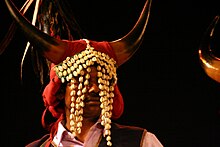
Bison Horn Maria Tribal
Culture

Duruwa man playing a flute
Bastar is well known for its tribal population, which comprises around 63% of the total.[8] The major tribes of the Bastar region are the Gond, Abhuj Maria, Bhatra. Bhatra are divided into subcastes San Bhatra, Pit Bhatra, Amnit Bhatra Amnit Hold Highest Status, Halba, Dhurvaa, Muria, and Bison Horn Maria. The Maria are known for their unique Ghotul system. Gonds are also the largest tribal group of central India in terms of population.
The tribes of Bastar region are known for their unique and distinctive tribal culture and heritage. Each tribal group in Bastar has their own distinct culture and enjoys their own unique traditional living styles. Each tribe has developed its own dialects and differs from other tribes in their costumes, eating habits, customs, and traditions. They may even worship different gods and goddesses.
A large number of Bastar tribals still live in deep forests and avoid mingling with outsiders in order to protect their own unique culture. The tribes of Bastar are also known for their colorful festivals and arts and crafts. The main festival of the area is the Bastar Dusshera.[citation needed] The tribals of Bastar were among the earliest to work with metal and have expertise in making figurines of tribal gods, votive animals, oil lamps, and animal carts[citation needed].
Arts and crafts
An area where handicraft is most widely practiced in Bastar is Kondagaon. Vessels, jewellery, images of the local deities, and some decorative works of art are made through a process called the lost wax technique, which is quite simple and happens to be perfect for tribal settings.
The Bastar district specializes in the preparation of items from Dhokra and unique woodcraft styles. The artifacts prepared from Dhokra technique of this art use beeswas, cow dung, paddy husk and red soil in the preparation. In addition to being used for contouring, wax wires are also used to touch up artifacts for a more polished finish.
The Dhokra and Bell Metal Handicraft are exported all over the world, and some of the handicraft items are purchased by tourists as souvenirs.[citation needed]
Politics
Bastar is part of Bastar Lok Sabha constituency, whose MP is Deepak Baij from the Indian National Congress. Bastar has three assembly constituencies: Bastar, Jagdalpur and Chitrakot. Bastar and Chitrakot are reserved for Scheduled Tribes. The MLAs for these constituencies are Lakheshwar Baghel, Rekhchand Jain and Rajman Venjam respectively, all from the Indian National Congress.