
East Siang is an administrative district in the state of Arunachal Pradesh in India.
History
In 1989 territory was transferred from West Siang district to East Siang. A decade later, in 1999, the district was bifurcated to make Upper Siang district. East Siang district was first settled by Dibu-marang clans and was later driven away by some padam clan( subtribe of adi) . Later padam clans accompanied it’s close ally pasi and settled near padam mone and balek respectively.Later , due to epidemic (considered as spiritual ) in the mone areas padams had to retreat.
Geography
The district headquarters are located at Pasighat. East Siang district occupies an area of 4,005 square kilometres (1,546 sq mi), comparatively equivalent to Indonesia’s Nias Island.
Divisions
There are 5 Arunachal Pradesh Legislative Assembly constituencies located in this district: Panging, Nari-Koyu, Pasighat West, Pasighat East, and Mebo. All of these are part of Arunachal East Lok Sabha constituency.
Demographics
| Year | Pop. | ±% p.a. |
|---|---|---|
| 1961 | 32,421 | — |
| 1971 | 33,138 | +0.22% |
| 1981 | 55,170 | +5.23% |
| 1991 | 71,864 | +2.68% |
| 2001 | 87,397 | +1.98% |
| 2011 | 99,214 | +1.28% |
| source: | ||
According to the 2011 census East Siang district has a population of 99,214, roughly equal to the nation of Kiribati. This gives it a ranking of 615th in India (out of a total of 640). The district has a population density of 27 inhabitants per square kilometre (70/sq mi) . Its population growth rate over the decade 2001–2011 was 13.3%. East Siang has a sex ratio of 962 females for every 1000 males, and a literacy rate of 73.54%.
Religion
Various tribal groups of the Adi people live in various parts of the district. The local people traditionally follow Donyi-Polo, although a sizeable minority have converted to Christianity.
Religion in East Siang district (2011)
Languages
Predominant Language spoken in pasighat is Adi language of the Sino-Tibetan tongue with approximately 140 000 speakers, written in Latin scripts; and Galo, an endangered language with 30 000 speakers, also in the Sino-Tibetan language family.
Flora and fauna
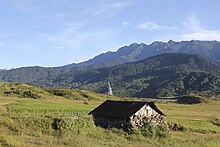
East siaing dietrict
In 1978 East Siang district became home to the D’Ering Memorial (Lali) Wildlife Sanctuary, which has an area of 190 km2 (73.4 sq mi).