
El Alamein is a town in the northern Matrouh Governorate of Egypt. Located on the Arab’s Gulf, Mediterranean Sea, it lies 106 kilometres (66 mi) west of Alexandria and 240 kilometres (149 mi) northwest of Cairo. As of 2007, it had a population of 7,397 inhabitants.
History
 |
This section needs expansion. You can help by adding to it. (June 2021)
|
Tourism
El Alamein war museum
El Alamein has a war museum with artifacts from North African battles.
Military cemeteries
Germany
Visitors can also go to the Italian and German military cemeteries on Tel el-Eisa Hill outside the town. The German cemetery is an ossuary, built in the style of a medieval fortress.
Italy
The Italian cemetery is a mausoleum containing 5,200 tombs. Many tombs bear the soldier’s name with others simply marked IGNOTO, i.e. unknown.
Greek
There is a separate Greek cemetery at El Alamein.
Commonwealth of Nations
There is also a Commonwealth war cemetery, built and maintained by the Commonwealth War Graves Commission, with graves of soldiers from various countries who fought on the Allied side. Buried here are 6,425 identified Commonwealth service personnel, 815 unidentified ones, and 102 of other nationalities; These include four Victoria Cross recipients:
- Private Percival Gratwick, Australian Imperial Force
- Private Arthur Stan Gurney, Australian Imperial Force
- Sergeant William Bill Kibby, Australian Imperial Force
- Private Adam Wakenshaw, Durham Light Infantry
Others buried here include
- Squadron Leader George Barclay, RAF Battle of Britain fighter pilot
- Major Henry Rew, Royal Tank Regiment
This has monuments commemorating Greek, New Zealand, Australian, South African, Indian and Canadian forces. The cemetery entrance is through the Alamein Memorial and there is also a separate Alamein Cremation Memorial to 603 Commonwealth service personnel who died in Egypt and Libya and were cremated in line with their religion.
The names of 213 Canadian airmen appear on the Alamein Memorial in Egypt.
The cemetery was designed by Sir J. Hubert Worthington.
Climate
El Alamein has a hot desert climate, Köppen climate classification BWh, common with most of the Middle East and north Africa. However, like the rest of the northern coast of Egypt, its climate is slightly less hot, compared to the rest of Egypt, because of the prevailing Mediterranean Sea winds.
| hideClimate data for El Alamein | |||||||||||||
|---|---|---|---|---|---|---|---|---|---|---|---|---|---|
| Month | Jan | Feb | Mar | Apr | May | Jun | Jul | Aug | Sep | Oct | Nov | Dec | Year |
| Average high °C (°F) | 17.8 (64.0) |
18.7 (65.7) |
20.3 (68.5) |
23.5 (74.3) |
25.7 (78.3) |
28.8 (83.8) |
29.5 (85.1) |
30.5 (86.9) |
28.7 (83.7) |
27.5 (81.5) |
23.6 (74.5) |
19.7 (67.5) |
24.5 (76.2) |
| Daily mean °C (°F) | 12.4 (54.3) |
13.3 (55.9) |
14.9 (58.8) |
17.7 (63.9) |
20.5 (68.9) |
23.8 (74.8) |
25.2 (77.4) |
25.7 (78.3) |
24.4 (75.9) |
22.1 (71.8) |
18.3 (64.9) |
14.4 (57.9) |
19.4 (66.9) |
| Average low °C (°F) | 7 (45) |
7.9 (46.2) |
9.5 (49.1) |
12 (54) |
15.4 (59.7) |
18.8 (65.8) |
20.9 (69.6) |
21 (70) |
20.1 (68.2) |
16.7 (62.1) |
13 (55) |
9.2 (48.6) |
14.3 (57.8) |
| Average precipitation mm (inches) | 29 (1.1) |
17 (0.7) |
8 (0.3) |
2 (0.1) |
1 (0.0) |
0 (0) |
0 (0) |
0 (0) |
0 (0) |
5 (0.2) |
21 (0.8) |
24 (0.9) |
107 (4.1) |
| Source: climate-data.org | |||||||||||||
World War II
Two important World War II battles were fought in the area:
- At the First Battle of El Alamein (1–27 July 1942), the advance of Axis troops on Alexandria was blunted by the Allies, stopping the German Panzers that were trying to outflank the Allies position.
- At the Second Battle of El Alamein (23 October – 4 November 1942), Allied forces broke the Axis line and forced them all the way back to Tunisia. Winston Churchill, the British Prime Minister at the time, said of this victory: “Now this is not the end, it is not even the beginning of the end. But it is, perhaps, the end of the beginning.” After the war, he wrote: “Before Alamein we never had a victory. After Alamein, we never had a defeat.”
Gallery
-

Cross of Sacrifice, El Alamein Commonwealth cemetery
-

South African Memorial El Alamein Commonwealth cemetery
-
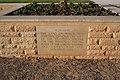
El Alamein Commonwealth cemetery plaque- 1939–1945 The land on which this cemetery stands is the gift of the Egyptian people for the perpetual resting place of the sailors, soldiers and airmen who are honoured here.
-

El Alamein Commonwealth cemetery
-

El Alamein Italian memorial entrance
-

El Alamein German memorial
-
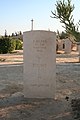
El Alamein Commonwealth cemetery A soldier of the 1939–1945 war known unto God
-

In El Alamein museum
-
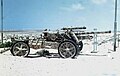
German cannon
-

The list of fallen German soldiers
-

German Memorial
-

British Crusader tank