
Half-mast British, Canadian and Australian English or half-staff American English refers to a flag flying below the summit of a ship mast, a pole on land, or a pole on a building. In many countries this is seen as a symbol of respect, mourning, distress, or, in some cases, a salute. Most English-speaking countries use the term half-mast in all instances. In the United States, this refers officially only to flags flown on ships, with half-staff used on land.
The tradition of flying the flag at half-mast began in the 17th century. According to some sources, the flag is lowered to make room for an “invisible flag of death” flying above. However, there is disagreement about where on a flagpole a flag should be when it is at half-mast. It is often recommended that a flag at half-mast be lowered only as much as the hoist, or width, of the flag. British flag protocol is that a flag should be flown no less than two-thirds of the way up the flagpole, with at least the height of the flag between the top of the flag and the top of the pole. It is common for the phrase to be taken literally and for a flag to be flown only halfway up a flagpole, although some authorities deprecate that practice.
When hoisting a flag that is to be displayed at half-mast, it should be raised to the finial of the pole for an instant, then lowered to half-mast. Likewise, when the flag is lowered at the end of the day, it should be hoisted to the finial for an instant, and then lowered.
Australia

The Australian White Ensign flying at half-mast. In accordance with British tradition, the flag is flying only one flag’s width below the top of the pole.
The flag of Australia is flown half-mast in Australia:
- On the death of the Sovereign – from the time of announcement of the death up to and including the funeral. On the day the accession of the new Sovereign is proclaimed, it is customary to raise the flag to the peak from 11 a.m.;
- On the death of a member of a royal family;
- On the death of the Governor-General or a former Governor-General;
- On the death of the head of state of another country with which Australia has diplomatic relations – the flag would be flown on the day of the funeral;
- On ANZAC day the flag is flown half-mast until noon;
- On Remembrance Day flags are flown at peak till 10:30 am, at half-mast from 10:30 am to 11:03 am, then at peak the remainder of the day;
- On the death of a distinguished Australian citizen. Flags in any locality may be flown at half-mast on the death of a notable local citizen or on the day, or part of the day, of their funeral. Recent examples include the death of naturalist Steve Irwin, actor Heath Ledger, esteemed international opera singer Dame Joan Sutherland, and former Prime Minister Gough Whitlam. In the case of cricketer Phillip Hughes, who died after being struck by a bouncer during a Sheffield Shield cricket match, the Australian flag was flown at half-mast at Cricket NSW headquarters on 27 November 2014 – the day of his death, as well as on the Sydney Harbour Bridge and at Lord’s Cricket Ground in London.
- At times of natural disaster such as bushfires or tragedy. For example, in the days immediately following the Black Saturday bushfires, many flags of all types were flown at half-mast in spontaneous acknowledgement of the enormous loss of life; the then Prime Minister announced that the Australian Flag would be flown at half-mast on 7 February, in remembrance of the victims. On 19 July 2014, the Australian flag flew half-mast across the country in tribute to the lives lost in the Malaysia Airlines Flight 17 incident. On 16 December 2014, flags on all NSW government buildings, including the Sydney Harbour Bridge, flew at half-mast after the 2014 Sydney hostage crisis.
- On the death of international political friends to the country. Recent example includes Womtelo Reverend Baldwin Lonsdale, President of the Republic of Vanuatu.
In Australia and other Commonwealth countries, merchant ships “dip” their ensigns to half-mast when passing an RAN vessel or a ship from the navy of any allied country.
Bangladesh
The flag of Bangladesh flew at half-mast on the national mourning day 15 August, the day in which Father of the nation Bangobandhu Sheikh Mujibor Rahman was murdered with some of his family members by a group of military officers. The national flag is also kept half hoisted on 21 February which is recognised as International Mother’s Language Day to pay homage to the martyrs of Language Movement in 1952 which took place to establish ‘Bangla’ as the state Language of the then East Pakistan (present Bangladesh).
Brazil
The flag of Brazil is flown half-mast when national mourning is declared by the president. This usually happens when a personality dies, or in the occasion of a tragedy.

The Brazilian flag flying at half-mast beside the Mercosul flag in front of the National Congress of Brazil in memory of the victims of the Chapecoense crash on 29 November 2016
Cambodia
The flag of Cambodia flew at half mast upon the death of King-Father Norodom Sihanouk for 7 days, from 15 to 22 October 2012.
Canada
The term half-mast is the official term used in Canada, according to the Rules For Half-Masting the National Flag of Canada. The decision to fly the flag at half-mast on federal buildings rests with the Department of Canadian Heritage. Federally, the national flag of Canada is flown at half-mast to mark the following occasions:
| Occasion or date | Protocol or significance |
|---|---|
| The death of the sovereign | From the time of notification of death until sunset on the day of the funeral or memorial service, but the flag is flown at full-mast on the day which the accession of the new monarch is proclaimed |
| The death of a Governor General or Prime Minister who dies while in office | From the time of notification of death until sunset on the day of the funeral or memorial service |
| The death of any member of the Royal Family, a former Governor General, the sitting Chief Justice of the Supreme Court, sitting Ministers of the Crown, or a former Prime Minister | From the time of notification of death until sunset on the day of the funeral or, if there is to be a memorial service, from the time of notification of death until sunset the following day and from sunrise to sunset on the day of the service |
| The death of a police officer in the line of duty. | The flag could be flown at half-mast from a couple of days to weeks, depending on the ranking of the officer. |
| 28 April of each year | Marking the Day of Mourning for People Killed or Injured in the Workplace (coinciding with World Day for Safety and Health at Work) |
| 23 June of each year | Marking the National Day of Remembrance for Victims of Terrorism |
| Last Sunday in September of each year | Marking Police Officer’s National Memorial Day |
| 11 November of each year | Marking Remembrance Day |
| 6 December of each year | Marking the National Day of Remembrance and Action on Violence Against Women |
Certain events are also marked by flying the national flag at half-mast on the Peace Tower at Parliament Hill. These include:
| Date | Significance |
|---|---|
| 9 April of each year | Marking Vimy Ridge Day |
| Varies | The annual memorial service on Parliament Hill to remember deceased parliamentarians |

The flag of Canada, the flag of Québec, and the flag of the Royal Canadian Sea Cadets are half masted on board Bagotville Cadet Summer Training Centre, following the train detrailment and explosion of Lac Mégantic, Québec.
On occasion discretion can dictate the flying of the national flag at half-mast, not only on the Peace Tower, but on all federal facilities. Some examples include 11 September 2001, 11 September 2002, the 2004 Indian Ocean tsunami, the 2005 Mayerthorpe tragedy, the death of Pope John Paul II, the 2005 London bombings, the death of Smokey Smith, the state funerals of former U.S. presidents Ronald Reagan and Gerald Ford, the death of Jack Layton, and the 2020 Nova Scotia attacks.
There are, however, exceptions to the rules of half-masting in Canada: if Victoria Day or Canada Day fall during a period of half-masting, the flags are to be returned to full-mast for the duration of the day. The national flag on the Peace Tower is also hoisted to full mast if a foreign head of state or head of government is visiting the parliament. These exemptions, though, do not apply to the period of mourning for the death of a Canadian monarch. The Royal Standard of Canada also never flies at half-mast, as it is considered representative of the sovereign, who ascends to the throne automatically upon the death of his or her predecessor. Each province can make its own determination of when to fly the flag at half-mast when provincial leaders or honoured citizens pass away.
To raise a flag in this position, the flag must be flown to the top of the pole first, then brought down halfway before the flag is secured for flying. When such mourning occurs, all flags should be flown at that position or not be flown at all, with the exception of flags permanently attached to poles.
A controversy surfaced in April 2006, when the newly elected Conservative government discontinued the practice, initiated by the previous Liberal government following the Tarnak Farm incident, of flying the flag at half-mast on all government buildings whenever a Canadian soldier was killed in action in Afghanistan. The issue divided veterans’ groups and military families, some of whom supported the return to the original tradition of using Remembrance Day to honour all soldiers killed in action, while others felt it was an appropriate way to honour the fallen and to remind the population of the costs of war. In spite of the federal government’s policy, local authorities have often decided to fly the flag at half-mast to honour fallen soldiers who were from their jurisdiction, including Toronto and Saskatchewan.
On 2 April 2008, the House of Commons voted in favour of a motion calling on the government to reinstate the former policy regarding the half-masting of the flag on federal buildings. The motion, however, was not binding and the Cabinet refused to recommend any revision in policy to the Governor General. At the same time, a federal advisory committee tabled its report on the protocol of flying the national flag at half-mast, recommending that the Peace Tower flag remain at full height on days such as the Police Officers National Memorial Day and the National Day or Remembrance and Action on Violence Against Women, stating that the flag should only be half-masted on Remembrance Day. At last report, the committee’s findings had been forwarded to the House of Commons all-party heritage committee for further study.
China
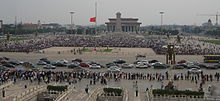
Chinese flag at half-mast to mark to mourn for the victims of the 2008 Sichuan earthquake
The National Flag Law provides for a number of situations on which the flag should be flown at half-mast, and authorizes the State Council to make such executive orders:
- On the death of the President, Premier, Chairman of the Standing Committee of the National People’s Congress, Chairman of the Central Military Commission, Chairman of the Chinese People’s Political Consultative Conference, and those who have made major contributions to the People’s Republic of China, or to world peace or advancement of the mankind. For example, the flag was flown at half-mast after the deaths of Zhou Enlai (1976), Zhu De (1976), Mao Zedong (1976), Soong Ching-ling (1981), Hu Yaobang (1989), Li Xiannian (1992), Deng Xiaoping (1997), Yang Shangkun (1998), Qiao Shi (2015), Wan Li (2015) and Li Peng (2019), as well as death of foreigners such as Joseph Stalin (1953), Patrice Lumumba(1961), Charles de Gaulle(1970) and Norodom Sihanouk (2012).
- When major disasters happen, such as when the flag was flown at half-mast from 19 to 21 May 2008, the three national mourning days for the 2008 Sichuan earthquake, as well as at 4 April 2020 (Qingming Festival) as the national mourning day for the COVID-19 pandemic.
Denmark
Dannebrog is nationally flown at half-mast in Denmark as a sign of mourning. It is performed by raising the flag briefly to the top of the mast and lowering it approximately one-third of the length of the flagpole.
Finland
In Finland, the official term for flying a flag at half-mast is known as suruliputus (mourning by flag(ging)). It is performed by raising the flag briefly to the top of the mast and lowering it approximately one-third of the length of the flagpole, placing the lower hoist corner at half-mast. On wall-mounted and roof-top flagpoles the middle of the flag should fly at the middle of the flagpole. When removing the flag from half-mast, it is briefly hoisted to the finial before lowering.
Traditionally, private residences and apartment houses fly the national flag at half-mast on the day of the death of a resident, when the flag is displayed at half-mast until sunset or 21:00, whichever comes first. Flags are also flown at half-mast on the day of the burial, with the exception that the flag is to be hoisted to the finial after the inhumation takes place.
Flags are also to be flown at half-mast on the days of national mourning. Such days are the deaths of former or current Finnish presidents, as well as significant catastrophic events such as the aftermath of 2004 Indian Ocean earthquake and tsunami, 2011 Norway attacks and significant national events such as the 2004 Konginkangas bus disaster and school shootings of Jokela and Kauhajoki.
Historically, flags were flown at half-mast on the Commemoration Day of Fallen Soldiers which takes place on the third Sunday of May. Originally, flag was raised to the finial in the morning, displayed at half-mast from 10:00 to 14:00, and again raised to the finial for the rest of the day. In 1995, the 50th anniversary of the end of the Second World War, the tradition of flying the flag at half-mast was discontinued and flag is displayed at the finial in a usual manner.
France
The French flag is flown half mast on any Day of Mourning by order of the government (for example after the Charlie Hebdo attack on 7 January 2015, the Paris attacks on 13 November 2015, and the Nice attack on 14 July 2016). Other countries have also flown the French flag at half mast because of this too. (Australia’s Sydney Harbour Bridge flew the French flag at half mast because of the Paris attacks on 13 November 2015).
Some occurrences of the French flag being flown half mast have been controversial, especially after the death of Pope John Paul II in 2005 but also in a lesser measure at the time following the death of Joseph Stalin in March 1953.
Germany

Black ribbons indicate mourning on banners that cannot be lowered to half-mast.
The flag of Germany and the flags of its federal states are flown at half-mast:
- On 27 January, Day of Remembrance for the Victims of National Socialism;
- On National Day of Mourning (33rd Sunday of Ordinary Time).
- On any day of mourning by order of the federal president for all of Germany, or by order of a minister president for a particular state. E.g. upon the death of a current or former ranking politician or person of high esteem, or multiple deaths in accidents or natural disasters.
Greece
According to Law 851/1978, the only day specified on which the Greek flag is flown at half-mast is Good Friday. Also, on other national and public mourning days.
Hong Kong
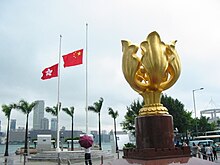
Hong Kong SAR flag flown at half mast
Similar rules as in China apply for Hong Kong. See Flag of Hong Kong for details. Prior to the transfer of sovereignty in 1997, the rules for flying the flag at half-mast were the same as the British ones.
- The HKSAR flag was flown at half-mast on 24–26 August 2010, for the fatalities of the Hong Thai Travel tourists in the 2010 Manila hostage crisis.
- The national flag of the PRC was also flown at half-mast on 26 August in Hong Kong.
- The HKSAR flag was flown at half-mast on 4–6 October 2012, for the Lamma Ferry Accident victims in which 39 people died.
India
The flag of India is flown at half-mast for the death of a President, Vice-President, or Prime Minister, all over India. For the Speaker of the Lok Sabha and the Chief Justice of The Supreme Court of India, it is flown in Delhi and for a Union Cabinet Minister it is flown in Delhi and the state capitals, from where he or she came. For a Minister of State, it is flown only in Delhi. For a Governor, Lt. Governor, or Chief Minister of a state or union territory, it is flown in the concerned state.
If the intimation of the death of any dignitary is received in the afternoon, the flag shall be flown at half-mast on the following day also at the place or places indicated above, provided the funeral has not taken place before sunrise on that day. On the day of the funeral of a dignitary mentioned above, the flag shall be flown at half-mast at the place of the funeral. For example, on 17 March 2019, The Government of India declared a National Day of mourning on 18 March 2019 due to the death of the Chief Minister of Goa, Manohar Parrekar on 17 March 2019. This means, that on 18 March 2019, the Indian National Flag must be at half-mast in the National Capital i.e. New Delhi and in the capital cities of all the 29 states and Union Territories.
In the event of a halfmast day coinciding with the Republic Day, Independence Day, National Week (6 to 13 April), any other particular day of national rejoicing as may be specified by the Government of India, or, in the case of a state, on the anniversary of formation of that state, flags are not permitted to be flown at half-mast except over the building where the body of the deceased is lying until it has been removed and that flag shall be raised to the full-mast position after the body has been removed.
Observances of State mourning on the death of foreign dignitaries are governed by special instructions issued from the Ministry of Home Affairs (Home Ministry) in individual cases. However, in the event of death of either the Head of the State or Head of the Government of a foreign country, the Indian Mission accredited to that country may fly the national flag on the above-mentioned days. India observed a five-day period of National Mourning on the death of Nelson Mandela in 2013. India also declared 29 March 2015 as a day of National Mourning as a mark of respect to the former Prime Minister of Singapore, Lee Kuan Yew.
Indonesia
The flag of Indonesia is flown half-mast for:
- Three days following the death of the President/Vice President (in office or former) of Indonesia throughout the country and on official Indonesian installations abroad.
- Two days following the death of the head of a state institution, minister or minister-level officials. Half mast is only flown limited to the location of the institution which the official is concerned.
- One day following the death of a member of a state institution, regional head and/or the head of the regional people’s representative council. Half mast is only flown limited to the location of the institution which the official is concerned.
The National flag of Indonesia may also be flown half mast:
- On 12 October to remember the 2002 Bali bombings.
- On 26 December to remember the 2004 Indian Ocean earthquake and tsunami in Aceh.
- On 30 September to remember the 30 September Movement.
- On other national days of mourning officially determined by the government.
Iran
The flag of Iran is flown at half-mast on the death of a national figure or mourning days.
- On 21 January 2017 Iran’s flag was flown at half-mast worldwide to respect the victims of the Plasco Building collapse;
- On 10 January 2017 Iran’s flag was flown at half-mast worldwide to respect the death of the national figure and late Chairman of the Expediency Discernment Council Ayatollah Akbar Hashemi Rafsanjani who died on 8 January 2017.
Ireland
The flag of Ireland is flown at half-mast on the death of a national or international figure, that is, former and current Presidents or Taoiseach, on all prominent government buildings equipped with a flag pole. The death of a prominent local figure can also be marked locally by the flag being flown at half-mast. When the national flag is flown at half mast, no other flag should be half-masted. When a balcony in Berkeley, California, collapsed, killing six Irish people, flags were flown at half mast above all state buildings.
In 2016, to commemorate the 100th anniversary of the 1916 Easter Rising, the Irish national flag over the General Post Office in Dublin was lowered to half mast. On Easter Monday 1916, as the rising began, Patrick Pearse stood outside the Post Office and read the Proclamation of the Irish Republic.
Israel
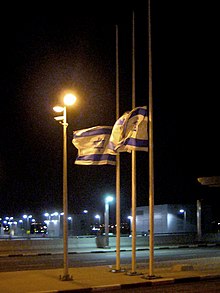
Flags in Israel at half mast on the eve of Yom HaShoah
The flag of Israel is flown at half-mast in Israel:
- On Yom HaShoah, or the Holocaust Remembrance Day;
- On Yom Hazikaron, or Fallen Soldiers and Victims of Terrorism Remembrance Day;
- On other national days of mourning.
Italy
The flag of Italy was flown at half-mast after the 2013 Sardinia floods on 22 November 2013.
Japan
The flag of Japan is flown at half-mast upon the death of the Emperor of Japan, other members of the Imperial Family, or a current or former Prime Minister, and also following national disasters such as the 2011 Tōhoku earthquake and tsunami. In addition to the tradition of half-staff, the national flag topped by black cloth may be flown to designate mourning. See the flag of Japan for more.
Malaysia

Flag of Pahang is flown at half-mast at the Chin Swee Caves Temple as a mark of respect to the late Sultan Ahmad Shah of Pahang. The flag of Malaysia and Selangor are not at half-mast as a result of different mourning periods.
The flag of Malaysia (Jalur Gemilang) is flown at half-mast all over the country:
- On the death of the Yang di-Pertuan Agong (King), for seven days from the day of announcement. All state and territorial flags are also flown at half-mast for seven days, while the national royal standard is flown at half-mast from the day of the announcement until the day of the election and inauguration of the new Yang di-Pertuan Agong;
- On the death of the Raja Permaisuri Agong (Queen), for seven days from the day of announcement. All state and territorial flags are also flown at half-mast for seven days;
- On the death of a state’s Ruler or Governor, as well as the spouse of a Ruler or Governor, from the day of announcement until the day of the funeral. The state flag and state royal standard may be flown at half-mast for a longer period as determined by the state government;
- On the death of the Prime Minister or acting Prime Minister, for three days from the day of announcement; or
- When the Prime Minister’s Department orders to flown the Malaysian flag at half-mast for some days.
As a mark of respect to the passengers and crew who were on board Malaysia Airlines Flight 370 and their family members, some states had their states flag flown at half-mast. Similarly, as a mark of respect to the passengers and crew who were on board Malaysia Airlines Flight 17 and their family members, the national flag was flown at half-mast for three days and also on the national day of mourning, 22 August 2014. The 2015 Sabah earthquake had a mourning day and the flag half-mast on 8 June 2015.
Malta

Flag at half-mast in Żebbuġ, Malta for Good Friday 2014
The flag of Malta is flown at half-mast on government buildings by instruction of the government through the Office of the Prime Minister, for example after 2004 Indian Ocean earthquake and tsunami.
Netherlands

Two flags half-mast at the Martinitoren in Groningen, Netherlands
The flag of the Netherlands is nationally flown at half-mast:
- On remembrance day of the dead (4 May). After the formal 2-minutes of silence at 8 p.m., the flag used to be hoisted upon the playing of the National Anthem. Since 2001, it is allowed to leave the flag at half-mast, even after the two minutes of silence;
- At the death of a member of the royal family;
- By instruction of the Dutch government through the office of the Prime Minister in special situations, such as happened after the crash of Malaysia Airlines Flight 17 in which 193 Dutch citizens died and the 2009 attack on the Dutch royal family on 30 April, Koninginnedag, which resulted in the deaths of seven by-standers.
The royal standard and other flags of the Dutch royal family are never flown at half-mast. Instead, a black pennon may be affixed to the flag in times of mourning.
New Zealand

New Zealand flag at half-mast to mark the death of Sir Edmund Hillary
For both government and public buildings, the flag of New Zealand is flown at half-mast for the following people:
- Monarch of New Zealand from the day of the announcement of their death up to and including the day of the funeral (however, it is flown at full-mast on Proclamation Day, the day when the new sovereign is announced);
- Current and former governors-general and prime ministers of New Zealand on the day of the announcement of their death and the day of their funerals;
- Other members of the Royal Family on the day of their funeral subject to a special command from the Queen or governor-general;
- Commonwealth of Nations Governors-General, Commonwealth prime ministers in office, foreign and Commonwealth heads of state on the day of the funeral;
In addition, it can also be flown at half-mast at the request of the minister for arts, culture and heritage. Examples of this are for the deaths of prominent New Zealanders (e.g. Sir Edmund Hillary and Te Arikinui Dame Te Atairangikaahu, the Maori Queen), and for national tragedies (e.g. the Pike River Mine disaster)
According to the Ministry of Culture and Heritage, the position is always referred to as half-mast. The flag should be at least its own height from the top of the flagpole, though the actual position will depend on the size of the flag and the length of the flagpole.
Northern Cyprus
The flag of Northern Cyprus is flown at half-mast throughout the country every 10 November in memory of Mustafa Kemal Atatürk, founding father of the Republic of Turkey who died on 10 November 1938. At other times, the premiership may issue an order for the flag to be flown at half-mast. Notable dates of half-mast in Northern Cyprus include 7 November 2006 due to the death of Bülent Ecevit, Prime Minister of Turkey at the time of the Turkish Invasion of Cyprus, 14–20 January 2012 due to the death of Rauf Denktaş, founding president of Northern Cyprus, 15–16 May 2014 due to the Soma mine disaster, 22–24 July 2014 due to the 2014 Israel–Gaza conflict, 11–13 October 2015 due to the 2015 Ankara bombings, 29 June 2016 due to the 2016 Atatürk Airport attack and 11 December 2016 due to the December 2016 Istanbul bombings.
Pakistan
The flag of Pakistan is routinely flown at half-mast on following days:
- On 21 April, anniversary of the death of the National Poet, Allama Muhammad Iqbal (1938);
- On 11 September, anniversary of the death of the Father of the Nation Muhammad Ali Jinnah (1948);
- On 16 October, anniversary of the death of the first Prime Minister, Liaquat Ali Khan (1952).
Any other day notified by the Government. For example, on the death of Saudi king King Fahd bin Abdul Aziz, the flag was flown at half-mast for seven days (the flag of Saudi Arabia wasn’t at half-mast because the flag contains the Shahada). Upon the Assassination of Benazir Bhutto, the flag was ordered to be flown at half-mast for three days. On the death of Syedna Mohammed Burhanuddin, spiritual leader of Dawoodi Bohra community, the flag has been ordered by Sindh Chief Minister Qaim Ali Shah, to be flown at half-mast for two days (17 and 18 January) to express solidarity with the bereaved community. In 2014, Prime Minister Nawaz Sharif announced a three-day mourning period from 16 December, including flying the flag at half-mast nationwide and at all Embassies and High Commissions of Pakistan, for the attack on Army Public School in Peshawar.
Philippines
The flag of the Philippines may be flown at half-mast as a sign of mourning. Upon the official announcement of the death of the President or a former president, the flag should be flown at half-mast for ten days. The flag should be flown at half-mast for seven days following the death of the Vice President, the Chief Justice, the President of the Senate or the Speaker of the House of Representatives.
The flag may also be required to fly at half-mast upon the death of other persons to be determined by the National Historical Commission of the Philippines, for a period less than seven days. The flag shall be flown at half-mast on all the buildings and places where the decedent was holding office, on the day of death until the day of interment of an incumbent member of the Supreme Court, the Cabinet, the Senate or the House of Representatives, and such other persons as may be determined by the National Historical Commission. Such other people determined by the National Historical Commission have included Pope John Paul II, and former U.S. President Ronald Reagan.
As per Republic Act No. 229, flags nationwide are flown at half-mast every Rizal Day on 30 December to commemorate the death of national hero José Rizal.
When flown at half-mast, the flag should be first hoisted to the peak for a moment then lowered to the half-mast position. It should be raised to the peak again before it is lowered for the day.
The flag may also be used to cover the caskets of the dead of the military, veterans of previous wars, national artists, and outstanding civilians as determined by the local government. In such cases, the flag must be placed such that the white triangle is at the head and the blue portion covers the right side of the casket. The flag should not be lowered to the grave or allowed to touch the ground, but should be solemnly folded and handed to the heirs of the deceased.
Flags must also be raised to half-mast immediately in any area recovering from natural disasters such as a typhoon or an earthquake.
On June 24, 2021, in several areas in the country, the Flag of the Philippines were raised half-mast within a span of 10 days as a sign of mourning to the 15th Philippine President Benigno “Noynoy” Aquino III
Russia
The flag of Russia is flown at half-mast and (or) topped by black ribbon:
- On 22 June as a reminder of the Nazi invasion of the USSR in 1941.
- On the death of a current or former President of Russia.
- On disasters causing more than 60 killed – across all the country upon Presidential proclamation.
- On disasters causing more than 10 killed – in a suffering region upon proclamation of a Governor.
- On other tragic occasions. For example, national mourning was proclaimed and all the state flags were flown at half-mast after the Polish President’s plane crash near Smolensk, Russia despite the number of casualties being slightly fewer than 100. After the Assassination of Andrei Karlov, the Russian ambassador in Turkey, in December 2016, the Russian flag was flown in half-mast on all Russian embassies in the world.
All the regional flags and the departmental ensigns are flown at half-mast on national or regional mourning days as well as the national flag. Firms and non-governmental organizations, embassies and representatives of international organizations often join the mourning. National or regional mourning usually lasts for one day.
Saudi Arabia
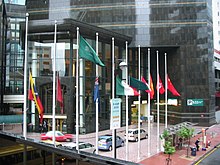
The flag of Saudi Arabia is never flown at half-mast.
The flag of Saudi Arabia is one of the four flags in the world that are never flown at half-mast because it shows the Shahada. The flag of Somaliland, a self-declared state internationally recognized as part of Somalia, also displays the Shahada. The flag of Iraq bears the Takbir once. The flag of Afghanistan displays the Takbir beneath the Shahada on the top. Since all four bear the concept of the unique right of Allah to be worshipped alone, the flags are never lowered to half-mast even as a sign of mourning.