
Indian copper plate inscriptions are historical legal records engraved on copper plates in India.
Donative inscriptions engraved on copper plates, often joined together by a ring with the seal of the donor, was the legal document registering the act of endowment. It was probably necessary to produce them when required to prove ownership/ the claim to the rights. The retrievability of the copper plates was perhaps crucial in the newly settled lands. Detailed information on land tenures and taxation available from these copper plate grants.
History

The Sohgaura copper plate inscription, the earliest known of its kind, 3rd century BCE

The Taxila copper plate, 1st century BCE (British Museum).
Indian copper plate inscriptions (tamarashasana), usually record grants of land or lists of royal lineages carrying the royal seal, a profusion of which have been found in South India. Originally inscriptions were recorded on palm leaves, but when the records were legal documents such as title-deeds they were etched on a cave or temple wall, or more commonly, on copper plates which were then secreted in a safe place such as within the walls or foundation of a temple, or hidden in stone caches in fields. Plates could be used more than once, as when a canceled grant was over-struck with a new inscription. These records were probably in use from the first millennium.
Some of the oldest inscribed copper plates to be found in the Indian subcontinent date to the Mature Harappan era, consisting of up to 34 characters and thought to be used for copper plate printing.
The so-called Sohgaura copper-plate inscription, inscribed in the Brahmi script, and possibly from the 3rd century BCE Maurya Empire, is a precursor to the later copper-plate inscriptions. However, it is actually written on a small plaque of bronze (a copper alloy). The Taxila and the Kalawan copper-plate inscriptions (c. 1st century CE or earlier) are among the earliest known instances of copper plates being used for writing in the Indian subcontinent. However, these are not proper charters, unlike the later copper-plate inscriptions.
The oldest known copper-plate charter from the Indian subcontinent is the Patagandigudem inscription of the 3rd century CE Andhra Ikshvaku king Ehuvala Chamtamula. The oldest known copper-plate charter from northern India is probably the Kalachala grant of Ishvararata, dated to the late fourth century on palaeographic basis.
Some of the earliest authenticated copper plates were issued by the Pallava dynasty kings in the 4th century, and are in Prakrit and Sanskrit. An example of early Sanskrit inscription in which Kannada words are used to describe land boundaries, are the Tumbula inscriptions of Western Ganga Dynasty, which have been dated to 444 according to a 2004 Indian newspaper report. Rare copper plates from the Gupta period have been found in North India. The use of copper plate inscriptions increased and for several centuries they remained the primary source of legal records.
Most copper plate inscriptions record title-deeds of land-grants made to Brahmanas, individually or collectively. The inscriptions followed a standard formula of identifying the royal donor and his lineage, followed by lengthy honorifics of his history, heroic deeds, and his extraordinary personal traits. After this would follow the details of the grant, including the occasion, the recipient, and the penalties involved if the provisions were disregarded or violated. Although the profusion of complimentary language can be misleading, the discovery of copper plate inscriptions have provided a wealth of material for historians
Tirumala Venkateswara Temple have a unique collection of about 3000 copper plates on which the Telugu Sankirtans of Tallapaka Annamacharya and his descendants are inscribed.
Tamil copper-plate inscriptions

Copper plate grant, Thiruvalangadu Temple, Tamil Nadu
Tamil copper-plate inscriptions are engraved copper-plate records of grants of villages, plots of cultivable lands or other privileges to private individuals or public institutions by the members of the various South Indian royal dynasties. The study of these inscriptions has been especially important in reconstructing the history of Tamil Nadu. The grants range in date from the 10th century C.E. to the mid 19th century C.E. A large number of them belong to the Chalukyas, the Cholas and the Vijayanagar kings. These plates are valuable epigraphically as they give us an insight into the social conditions of medieval South India; they also help us fill chronological gaps in the connected history of the ruling dynasties. For example, the Leyden grant (so called as they are preserved in the Museum of Leyden in Holland) of Parantaka Chola and those of Parakesari Uttama Chola are among the most important, although the most useful part, i.e., the genealogical section, of the latter’s plates seems to have been lost.
- Vijaynagar Tamil Copper Plate Inscriptions at the Dharmeshwara Temple, Kondarahalli, Hoskote
-

Plate 1 and Back
-

Plate 2
Unlike the neighbouring states where early inscriptions were written in Sanskrit and Prakrit, the early inscriptions in Tamil Nadu used Tamil along with some Prakrit. Tamil has the extant literature amongst the Dravidian languages, but dating the language and the literature precisely is difficult. Literary works in India were preserved either in palm leaf manuscripts (implying repeated copying and recopying) or through oral transmission, making direct dating impossible. External chronological records and internal linguistic evidence, however, indicate that extant works were probably compiled sometime between the 4th century BCE and the 3rd century CE. Epigraphic attestation of Tamil begins with rock inscriptions from the 3rd century BCE, written in Tamil-Brahmi, an adapted form of the Brahmi script. The earliest extant literary text is the Tolkāppiyam, a work on poetics and grammar which describes the language of the classical period, dated variously between the 5th century BCE and the 2nd century CE.
Copper plates of Kerala
Between the eighth and tenth centuries, rulers on the Malabar Coast awarded various rights and privileges to Nazranies (Saint Thomas Christians) on copper plates, known as Cheppeds, or Royal Grants or Sasanam.
-
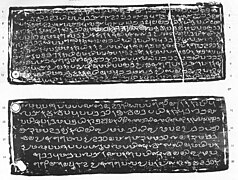
Tharisapalli plates of 849 CE
-

The inscription from the Sasanam
- Iravikorthan Sassanam, awarded by Shri Veera Raghava Perumal (in c. 774 CE)
- Thomas of Cana copper plates, a lost set of copper plates awarded to Knai Thoma and his followers (Knanaya) sometime between the 4th and 9th century.
- Tharissapalli Chepped, awarded in 849 CE by the King of Venadu (Quilon), Ayyan Atikal Tiruvatikal, to Sapir Isho, the leader of Syrian Christians in Malabar Coast in the 5th regnal year of the Chera ruler Sthanu Ravi Varma. It is the first important inscription of Kerala, the date of which has been determined with accuracy. It is engraved on copper plates in vatteluttu and signed by 25 witnesses. Names of fifteen of them are in Kufic, ten in Pahlavi, and four i Hebrew.
- Jewish Copper Plate, awarded by Bhaskara Ravi Varman I Perumal (962-1019 A.D.), is a Sasanam outlining the grant of rights of the Anjuvannam and 72 other properietary rights to local Jewish Chief Ousepp Irabban
Grants
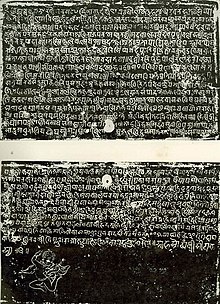
Paramara ruler Siyaka’s Harsola copperplate copper plate of 949 CE
One of the most important sources of history in the Indian subcontinent are the royal records of grants engraved on copper-plates (tamra-shasan or tamra-patra; tamra means copper in Sanskrit and several other Indian languages). Because copper does not rust or decay, they can survive virtually indefinitely.
Collections of archaeological texts from the copper-plates and rock-inscriptions have been compiled and published by the Archaeological Survey of India during the past century.
Approximate dimensions of copper plate is 93⁄4 inch long × 31⁄4 inch high × 1/10 (to 1/16) inch thick.
The earliest known copper-plate, known as the Sohgaura copper-plate, is a Maurya record that mentions famine relief efforts. It is one of the very few pre-Ashoka Brahmi inscriptions in India.