
The Jat people (Hindi pronunciation: ) (also spelled Jattand Jaat) are a traditionally agriculture based community largely in rural parts of Northern India and Pakistan. Originally pastoralistsin the lower Indus river-valley of Sindh, Jats migrated north into the Punjab region in late medieval times, and subsequently into the Delhi Territory, northeastern Rajputana, and the western Gangetic Plain in the 17th and 18th centuries. Of Hindu, Muslim and Sikhfaiths, they are now found mostly in the Indian states of Punjab, Haryana, Rajasthanand Uttar Pradesh and the Pakistani provinces of Sindh and Punjab.
The Jats took up arms against the Mughal Empire during the late 17th and early 18th centuries. The community played an important role in the development of the martial Khalsa panth of Sikhism. The Hindu Jat kingdom reached its zenith under Maharaja Suraj Mal (1707–1763). By the 20th century, the landowning Jats became an influential group in several parts of North India, including Punjab,Western Uttar Pradesh, Rajasthan, Haryana and Delhi. Over the years, several Jats abandoned agriculture in favour of urban jobs, and used their dominant economic and political status to claim higher social status.
Contents
- History
- Hindu Jats
- Sikh Jats
- Demographics
- Republic of India
- Pakistan
- Culture and society
- Military
- Religious beliefs
- Varna status
- Clan system
- In popular culture
- See also
- Footnotes
- References
- Further reading
- External links
History

A Jutt (Jat) Muslim camel-driver from Sind, 1872
The Jats are a paradigmatic example of community- and identity-formation in early modern Indian subcontinent. “Jat” is an elastic label applied to a wide-ranging community from simple landowning peasants to wealthy and influential Zamindars The Jats had their origins in pastoralism in the lower Indus valley of Sindh.At the time of Muhammad bin Qasim’s conquest of Sind in the 8th century, Arab writers described agglomerations of Jats in the arid, the wet, and the mountainous regions of the conquered land. The Arab rulers, though professing a theologically egalitarian religion, the position of Jats or the discriminatory practices against them that had been put in place in the long period of Hindu rule in Sind.Between the eleventh and the sixteenth centuries, Jat herders migrated up along the river valleys, into the Punjab, which had not been cultivated in the first millennium. Many took up tilling in regions such as Western Punjab, where the sakia (water wheel) had been recently introduced.By early Mughal times, in the Punjab, the term “Jat” had become loosely synonymous with “peasant”, and some Jats had come to own land and exert local influence.
According to historians Catherine Asher and Cynthia Talbot,
The Jats also provide an important insight into how religious identities evolved during the precolonial era. Before they settled in the Punjab and other northern regions, the pastoralist Jats had little exposure to any of the mainstream religions. Only after they became more integrated into the agrarian world did the Jats adopt the dominant religion of the people in whose midst they dwelt.
Over time the Jats became primarily Muslim in the western Punjab, Sikh in the eastern Punjab, and Hindu in the areas between Delhi Territory and Agra, with the divisions by faith reflecting the geographical strengths of these religions. During the decline of Mughal rule in the early 18th century, the Indian subcontinent’s hinterland dwellers, many of whom were armed and nomadic, increasingly interacted with settled townspeople and agriculturists. Many new rulers of the 18th century came from such martial and nomadic backgrounds. The effect of this interaction on India’s social organization lasted well into the colonial period. During much of this time, non-elite tillers and pastoralists, such as the Jats or Ahirs, were part of a social spectrum that blended only indistinctly into the elite landowning classes at one end, and the menial or ritually polluting classes at the other. During the heyday of Mughal rule, Jats had recognized rights. According to Barbara D. Metcalf and Thomas R. Metcalf:
Upstart warriors, Marathas, Jats, and the like, as coherent social groups with military and governing ideals, were themselves a product of the Mughal context, which recognized them and provided them with military and governing experience. Their successes were a part of the Mughal success.
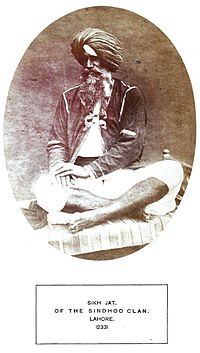
Jat Sikh of the “Sindhoo” clan, Lahore, 1872
As the Mughal empire now faltered, there were a series of rural rebellions in North India.Although these had sometimes been characterized as “peasant rebellions”, others, such as Muzaffar Alam, have pointed out that small local landholders, or zemindars, often led these uprisings. The Sikh and Jat rebellions were led by such small local zemindars, who had close association and family connections with each other and with the peasants under them, and who were often armed.
These communities of rising peasant-warriors were not well-established Indian castes, but rather quite new, without fixed status categories, and with the ability to absorb older peasant castes, sundry warlords, and nomadic groups on the fringes of settled agriculture. The Mughal Empire, even at the zenith of its power, functioned by devolving authority and never had direct control over its rural grandees. It was these zemindars who gained most from these rebellions, increasing the land under their control. The triumphant even attained the ranks of minor princes, such as the Jat ruler Badan Singh of the princely state of Bharatpur.
Hindu Jats
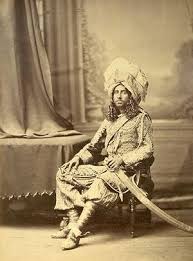
The Hindu Jat Maharaja of Bharatpur, 1882
In 1669, the Hindu Jats, under the leadership of Gokula, rebelled against the Mughal emperor Aurangzeb in Mathura. The community came to predominate south and east of Delhi after 1710. According to historian Christopher Bayly
Men characterised by early eighteenth century Mughal records as plunderers and bandits preying on the imperial lines of communications had by the end of the century spawned a range of petty states linked by marriage alliance and religious practice.
The Jats had moved into the Gangetic Plain in two large migrations, in the seventeenth and eighteenth centuries respectively.They were not a caste in the usual Hindu sense, for example, in which Bhumihars of the eastern Gangetic plain were; rather they were an umbrella group of peasant-warriors. According to Christopher Bayly:
This was a society where Brahmins were few and male Jats married into the whole range of lower agricultural and entrepreneurial castes. A kind of tribal nationalism animated them rather than a nice calculation of caste differences expressed within the context of Brahminical Hindu state.
By the mid-eighteenth century, the ruler of the recently established Jat kingdom of Bharatpur, Raja Surajmal, felt sanguine enough about durability to build a garden palace at nearby Dig (Deeg). Although, the palace, Gopal Bhavan, was named for Lord Krishna, its domes, arches, and garden were evocative of Mughal architecture, a reflection ultimately of how much these new rulers—aspiring dynasts all—were products of the Mughal epoch. In another nod to the Mughal legacy, in the 1750s, Surajmal removed his own Jat brethren from positions of power and replaced them with a contingent of Mughal revenue officials from Delhi who proceeded to implement the Mughal scheme of collecting land-rent.
According to historian, Eric Stokes,
When the power of the Bharatpur raja was riding high, fighting clans of Jats encroached into the Karnal/Panipat, Mathura, Agra, and Aligarh districts, usually at the expense of Rajput groups. But such a political umbrella was too fragile and short-lived for substantial displacement to be effected.
-
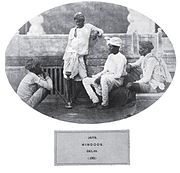
Jats in the Delhi Territory in 1868.
-

Jat girl from Aligarh, Uttar Pradesh, India, 1868.
-

Ethnographic photograph of Jat zemindars (land owners) in Rajasthan, playing pachisi, 1874.
-

The durbar of the teenage Hindu Jat ruler of Bharatpur, a princely state in Rajasthan, early 1860s.
Sikh Jats

The Sikh Jat Maharaja of Patiala, 1898
According to censuses of the British Raj period, most Sikh Jats were converted from Hindu Jats. Writing about the Jats of Punjab, the Sikh author, Khushwant Singhopined that their attitude never allowed themselves to be absorbed in the Brahminic fold :
The Jat’s spirit of freedom and equality refused to submit to Brahmanical Hinduism and in its turn drew the censure of the privileged Brahmins…. The upper caste Hindu’s denigration of the Jat did not in the least lower the Jat in his own eyes nor elevate the Brahmin or the Kshatriya in the Jat’s estimation. On the contrary, he assumed a somewhat condescending attitude towards the Brahmin, whom he considered little more than a soothsayer or a beggar, or the Kshatriya, who disdained earning an honest living and was proud of being a mercenary.
In Punjab, the states of Patiala, Faridkot, Jind, and Nabha were ruled by the Sikh Jats.
Demographics
According to anthropologist Sunil K. Khanna, Jat population is estimated to be around 30 million (or 3 crore) in South Asia in 2010. This estimation is based on statistics of the last caste census and the population growth of the region. The last caste census was conducted in 1931, which estimated Jats to be 8 million, mostly concentrated in India and Pakistan. Deryck O. Lodrick estimates Jat population to be over 33 million (around 12 million and over 21 million in India and Pakistan, respectively) in South Asia in 2009 while noting the unavailability of precise statistics in this regard. His estimation is based on a late 1980s population projection of Jats and the population growth of India and Pakistan. He also notes that some estimates put their total population in South Asia at approximately 43 million in 2009. His religion-wise break-up of Jats is as follows: 47% Hindus, 33% Muslims, and 20% Sikhs.
Republic of India

Chaudhary Charan Singh, the first Jat Prime Minister of India, accompanied by his wife, on his way to address the nation at the Red Fort, Delhi, Independence Day, 15 August 1979.
In India, multiple 21st-century estimates put Jats’ population share at 20–25% in Haryana state and at 20–35% in Punjab state. In Rajasthan, Delhi, and Uttar Pradesh, they constitute around 9%, 5%, and 1.2% respectively of the total population.
In the 20th century and more recently, Jats have dominated as the political class in Haryana and Punjab. Some Jat people have become notable political leaders, including the sixth Prime Minister of India, Charan Singh.
Consolidation of economic gains and participation in the electoral process are two visible outcomes of the post-independence situation. Through this participation they have been able to significantly influence the politics of North India. Economic differentiation, migration and mobility could be clearly noticed amongst the Jat people.
Jats are classified as Other Backward Class (OBC) in seven of India’s thirty-six States and UTs, namely Rajasthan, Himachal Pradesh, Delhi, Uttarakhand, Uttar Pradesh, Madhya Pradesh and Chhattisgarh. However, only the Jats of Rajasthan– excluding those of Bharatpur district and Dholpur district – are entitled to reservation of central government jobs under the OBC reservation. In 2016, the Jats of Haryana organized massive protests demanding to be classified as OBC in order to obtain such affirmative action benefits.
Pakistan
Many Jat Muslim people live in Pakistan and have dominant roles in public life in the Pakistani Punjab and Pakistan in general. Jat communities also exist in Pakistani-administered Kashmir, in Sindh, particularly the Indus delta and among Seraiki-speaking communities in southern Pakistani Punjab, the Kachhi region of Balochistan and the Dera Ismail Khan District of the North West Frontier Province.
In Pakistan also, Jat people have become notable political leaders, like Hina Rabbani Khar.
Culture and society
Military

14th Murrays Jat Lancers (Risaldar Major) by AC Lovett (1862–1919).jpg
Many Jat people serve in the Indian Army, including the Jat Regiment, Sikh Regiment, Rajputana Rifles and the Grenadiers, where they have won many of the highest military awards for gallantry and bravery. Jat people also serve in the Pakistan Army especially in the Punjab Regiment.
The Jat people were designated by officials of the British Raj as a “martial race”, which meant that they were one of the groups whom the British favoured for recruitment to the British Indian Army. The Jats participated in both World War I and World War II, as a part of the British Indian Army. In the period subsequent to 1881, when the British reversed their prior anti-Sikh policies, it was necessary to profess Sikhism in order to be recruited to the army because the administration believed Hindus to be inferior for military purposes.
The Indian Army admitted in 2013 that the 150-strong Presidential Bodyguard comprises only people who are Hindu Jats, Jat Sikhs and Hindu Rajputs. Refuting claims of discrimination, it said that this was for “functional” reasons rather than selection based on caste or religion.
Religious beliefs
Deryck O. Lodrick estimates religion-wise break-up of Jats as follows: 47% Hindus, 33% Muslims, and 20% Sikhs.
Jats pray to their dead ancestors, a practice which is called Jathera.
Varna status
There are conflicting scholarly views regarding the varna status of Jats in Hinduism. Some sources state that Jats are regarded as Kshatriyas, while others assign Vaishya or Shudra varna to them. According to Santokh S. Anant, Jats, Rajputs, and Thakurs are at the top of the caste hierarchy in most of the north Indian villages, surpassing Brahmins. Assigning Vaishya varna to Jats, he notes that they perform the dual duties of Kshatriyas and Vaishyas in the Punjab region. According to Indera P. Singh, Brahmins demoted the varna status of Jats from Kshatriya to Sat Shudra (clean Shudra) in the Vedic period for challenging the authority of Brahmins. According to Irfan Habib, Jats were a “pastoral Chandala-like tribe” in Sindh during the 8th century. Their 11th-century status of Shudra varna changed to Vaishya varna by the 17th century, with some of them aspiring to improve it further after their 17th-century rebellion against the Mughals. Some scholars point out widow remarriage as the main cause for Jats being placed at a lower position than Rajputs within the Kshatriya varna.
The Rajputs refused to accept Jat claims to Kshatriya status during the later years of the British Raj and this disagreement frequently resulted in violent incidents between the two communities. The claim at that time of Kshatriya status was being made by the Arya Samaj, which was popular in the Jat community. The Arya Samaj saw it as a means to counter the colonial belief that the Jats were not of Aryan descent but of Indo-Scythian origin.
Clan system
The Jat people are subdivided into numerous clans, some of which overlap with other groups. Hindu and Sikh Jats practice clan exogamy.
In popular culture
Jatt are part of Punjabi culture and are often portrayed in Indian and Pakistani films and songs.
- Maula Jatt
- The Legend of Maula Jatt
- A Flying Jatt
- Jatt & Juliet
- Jatt & Juliet 2
- Jatt James Bond
- Badla Jatti Da
- Jatts In Golmaal