
Krapina (Croatian pronunciation: ; Hungarian: Korpona) is a town in northern Croatia and the administrative centre of Krapina-Zagorje County with a population of 4,482 (2011) and a total municipality population of 12,480 (2011). Krapina is located in the hilly Zagorje region of Croatia, approximately 55 km (34 mi) away from both Zagreb and Varaždin.
Population
The following settlements comprise the Krapina municipality:
- Bobovje, population 510
- Doliće, population 436
- Donja Šemnica, population 912
- Gornja Pačetina, population 404
- Krapina, population 4,471
- Lazi Krapinski, population 79
- Lepajci, population 391
- Mihaljekov Jarek, population 469
- Podgora Krapinska, population 565
- Polje Krapinsko, population 666
- Pretkovec, population 66
- Pristava Krapinska, population 214
- Strahinje, population 328
- Straža Krapinska, population 42
- Škarićevo, population 707
- Šušelj Brijeg, population 4
- Tkalci, population 432
- Trški Vrh, population 399
- Velika Ves, population 727
- Vidovec Krapinski, population 215
- Vidovec Petrovski, population 101
- Zagora, population 94
- Žutnica, population 248
| population |
5457
|
6060
|
6435
|
7007
|
7538
|
8141
|
7884
|
8224
|
9222
|
9473
|
10384
|
11533
|
12540
|
12938
|
12950
|
12480
|
11553
|
| 1857 | 1869 | 1880 | 1890 | 1900 | 1910 | 1921 | 1931 | 1948 | 1953 | 1961 | 1971 | 1981 | 1991 | 2001 | 2011 | 2021 |
History
Krapina has been known since 1193. It has always been a favorite site for castles and country houses of Croatian and Hungarian rulers.
In the first half of the 15th century, it was an important center of the Counts of Celje, who additionally fortified the town and expanded the nearby castle. Later, it came in the possession of the Keglević family.
In the late 19th and early 20th century, Krapina was a district capital in the Varaždin County of the Kingdom of Croatia-Slavonia.
Prehistoric site
In 1899, on a hill called Hušnjakovo near modern Krapina, the archaeologist and paleontologist Dragutin Gorjanović-Kramberger found over eight hundred fossil remains belonging to Neanderthals.

Proposed Neandertal jewelry: white-tailed eagle claw with striations at the Neanderthal site of Krapina, Croatia, circa 130,000 BP.
The half-cave in Krapina was soon listed among the world’s science localities as a rich fossil finding site, where the largest and richest collection of the Neanderthal man had ever been found.
At the site where the Neanderthal remains were discovered there is now a state-of-the-art Neanderthal museum which also includes an extensive section on evolution, making it one of the most interesting evolutionary museums in Europe. It is surrounded by a park with many statues of Neanderthals and the game they hunted, a bear, a moose and a beaver set in the actual locations.
Culture
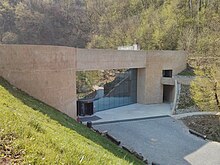
Krapina Neanderthal Museum
Krapina is home to the yearly Festival kajkavske popevke (The festival of kajkavian song) sung in the local Kajkavian language.
There is also a nearby municipality of Krapinske Toplice (Krapina spa) with numerous thermal springs and spa tourist infrastructure. Krapina is also the birthplace of the linguist and language reformer Ljudevit Gaj. His home is now a museum where visitors can learn about his life and work.
Since 1997, Franciscan monastery and St. Catherine’s church in Krapina are hosts of the Krapinafest, annual contemporary Christian music festival.
Transportation
Krapina has a train station on R106 railway corridor of regional significance (Zabok-Krapina-Đurmanec-Hromec-border with Slovenia) and a bus station which also serves as a hub for the bus company “Presečki d.o.o.” – the company connects Krapina with numerous of towns across the county and region with lines such as Krapina-Zagreb, Krapina-Macelj, Krapina-Đurmanec, Krapina-Hum na Sutli, Krapina-Jesenje, etc.