
This is a list of religious populations by number of adherents and countries.
Adherents in 2020

Prevailing religious population by country
There may be 2 billion atheists around the world.
| Religion | Adherents | Percentage |
|---|---|---|
| Christianity | 2.382 billion | 31.11% |
| Islam | 1.907 billion | 24.9% |
| Secular/Nonreligious/Agnostic/Atheist | 1.193 billion | 15.58% |
| Hinduism | 1.161 billion | 15.16% |
| Buddhism | 506 million | 5.06% |
| Chinese traditional religion | 394 million | 5% |
| Ethnic religions excluding some in separate categories | 300 million | 3% |
| African traditional religions | 100 million | 1.2% |
| Sikhism | 26 million | 0.30% |
| Mormonism | >16,7 million | >0,21% |
| Judaism | 14.7 million | 0.18% |
| Spiritism | 14.5 million | 0.18% |
| Baháʼí | 5.0 million | 0.07% |
| Jainism | 4.2 million | 0.05% |
| Shinto | 4.0 million | 0.05% |
| Cao Dai | 4.0 million | 0.05% |
| Zoroastrianism | 2.6 million | 0.03% |
| Tenrikyo | 2.0 million | 0.02% |
| Animism | 1.9 million | 0.02% |
| Druze | 1.2 million | 0.015% |
| Neo-Paganism | 1.0 million | 0.01% |
| Unitarian Universalism | 0.8 million | 0.01% |
| Rastafari | 0.6 million | 0.007% |
| total | 7.79 billion | 100% |
Notes
- ^ These figures may incorporate populations of secular/nominal adherents as well as syncretist worshipers, although the concept of syncretism is disputed by some.
- ^ Nonreligious includes agnostic, atheist, secular humanist, and people answering ‘none’ or no religious preference. Half of this group is theistic but nonreligious. According to a 2012 study by Gallup International “59% of the world said that they think of themselves as religious person, 23% think of themselves as not religious whereas 13% think of themselves as convinced atheists”.
- ^ Chinese traditional religion is described as “the common religion of the majority Chinese culture: a combination of Confucianism, Buddhism, and Taoism, as well as the traditional non-scriptural/local practices and beliefs.”
By proportion
Christians
Countries and territories with the greatest proportion of Christians from Christianity by country (as of 2010):
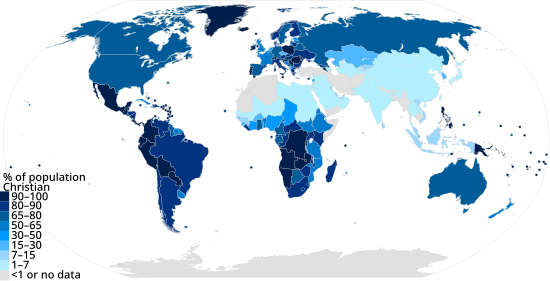
Christian population by country, June 2014.
 Vatican City 100% (100% Roman Catholic)
 Pitcairn Islands 100% (100% Seventh-day Adventist)
 Samoa ~99% (mostly Protestant)
 Romania 99% (mostly Romanian Orthodox)
 East Timor 99.6% (mostly Roman Catholic)
 Armenia 98.5% (96% Armenian Apostolic)
 American Samoa 98.3% (mostly Protestant)
 Malta 98.1% (mostly Roman Catholic)
 Venezuela 98% (71% Roman Catholic)
 Greece 98% (95% Greek Orthodox)
 Marshall Islands 97.2% (mostly Protestant)
 Tonga 97.2% (mostly Protestant)
 San Marino 97% (~97% Roman Catholic)
 Paraguay 96.9% (mostly Roman Catholic)
 El Salvador 96.4% (mostly Roman Catholic)
 Kiribati 96% (mostly Protestant)
 Federated States of Micronesia ~96% (mostly Protestant)
 Barbados 95.1% (mostly Protestant)
 Papua New Guinea 94.8% (mostly Protestant)
 Mexico 94.6% (mostly Roman Catholic)
 Peru 94.51% (mostly Roman Catholic)
Muslims
Countries with the greatest proportion of Muslims from Islam by country (as of 2010) (figures excluding foreign workers in parenthesis):
Data is based on the Pew Forum on Religion and Public Life

Muslim population by country, 2014.
 Afghanistan 99.7% (mostly Sunni, 20% Shi’a)
 Tunisia 99.5% (mostly Sunni)
 Iran 99.4% (mostly Shi’a)
 Azerbaijan 99.2% (70-80% Shi’a)
 Yemen 99.1% (40-45% Shi’a)
  Mauritania 99.1%
 Morocco 99%
 Iraq 99% (70-75% Shi’a)
 Niger 99% (mostly Sunni)
 Somalia 99% (mostly Sunni)
 Maldives 98.4% (mostly Sunni)
 Comoros 98.3% (mostly Sunni)
 Algeria 98%
 Saudi Arabia ~97% (10-15% Shi’a)
 Djibouti 96.9% (mostly Sunni)
 Libya 96.6% (Mostly Sunni)
 Pakistan 96.4%
 Egypt 90% (Mostly Sunni)
 Bangladesh 89.6% (Mostly Sunni)
 Turkey 89.5% (Mostly Sunni)
 Indonesia 87.2% (Mostly Sunni)
 Sierra Leone 78.00% (mostly Sunni)
 Bosnia and Herzegovina 77.9% (Mostly Sunni)
 Kuwait 74.6% (20-25% Shi’a)
 Bahrain 73.7% (Mostly Shi’a)
 Sudan 71.3% (mostly Sunni)
 Malaysia 61.3% (mostly Sunni)
Irreligious and atheist
Countries with the greatest proportion of people without religion (including agnostics and atheists) from Irreligion by country (as of 2020):
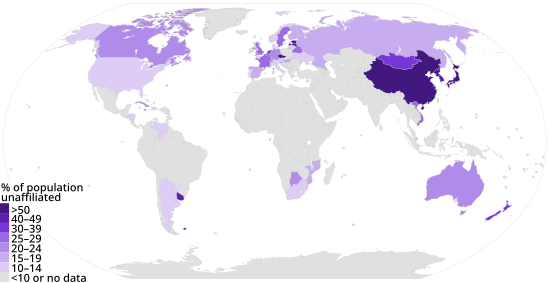
Nonreligious population by country, 2010.
 Czech Republic (78.4%)
 North Korea (71.3%)
 Estonia (60.2%)
 Japan (60%)
 Hong Kong (54.7%)
 China (51.8%)
 South Korea (46.6%)
 Latvia (45.3%)
 Netherlands (44.3%)
 Uruguay (41.5%)
 New Zealand (39.6%)
 Mongolia (36.5%)
 France (31.9%)
 United Kingdom (31.2%)
 Belgium (31%)
 Spain (30.3%)
 Vietnam (29.9%)
 Sweden (29%)
 Australia (28.6%)
 Belarus (28.6%)
 Luxembourg (26.7%)
 Germany (26.3%)
 Cuba (23.2%)
 Switzerland (22.8%)
 Finland (20.8%)
 Hungary (20%)
 Slovenia (18.8%)
 United States (18.6%)
 Botswana (17.5%)
Remarks: Ranked by mean estimate which is in brackets. Irreligious includes agnostic, atheist, secular believer, and people having no formal religious adherence. It does not necessarily mean that members of this group don’t belong to any religion. Some religions have harmonized with local cultures and can be seen as a cultural background rather than a formal religion. Additionally, the practice of officially associating a family or household with a religious institute while not formally practicing the affiliated religion is common in many countries. Thus, over half of this group is theistic and/or influenced by religious principles, but nonreligious/non-practicing and not true atheists or agnostics. See Spiritual but not religious.
Hindus
Countries with the greatest proportion of Hindus from Hinduism by country (as of 2010):

Hindu population by country, 2012.
 Nepal 81.3%
 India 79.8%
 Mauritius 48.54%
 Fiji 27.9%
 Bhutan 25%
 Guyana 24.8%
 Suriname 22.3%
 Trinidad and Tobago 18.2%
 United Arab Emirates 15%
 Sri Lanka 12.6%
- Kuwait 12%
- Bangladesh 9.6%
- Bahrain 8.1%
- Réunion 6.7%
- Malaysia 6.3%
 Singapore 5.1%
 Oman 3%
 Seychelles 2.1%
- New Zealand 2.0%
- Pakistan 1.8%
- Indonesia 1.7%
- United Kingdom 1.7%
- United States 0.7%
Buddhists
Countries with the greatest proportion of Buddhists from Buddhism by country (as of 2010):

Buddhist population by country, 2012.
 Cambodia 96.9%
 Thailand 93.2%
 Myanmar 80.1%
- Bhutan 74.70%
- Sri Lanka 69.3%
 Laos 66.0%
- Mongolia 55.1%
- Japan 36.2%
 Taiwan 35.1%
- Singapore 33.2%
- South Korea 22.9%
- Malaysia 19.8%
- China 18.2%
 Macau 17.3%
- Vietnam 16.4%
- Hong Kong 13.2%
- Nepal 10.3%
Taoists/Confucianists/Chinese traditional religionists
As a spiritual practice, Taoism has made fewer inroads in the West than Buddhism and Hinduism. Despite the popularity of its great classics the I Ching and the Tao Te Ching, the specific practices of Taoism have not been promulgated in America with much success; these religions are not ubiquitous worldwide in the way that adherents of bigger world religions are, and they remain primarily an ethnic religion. Nonetheless, Taoist ideas and symbols such as Taijitu have become popular throughout the world through Tai Chi Chuan, Qigong, and various martial arts.
- Taiwan 33–80%
- China 30%
- Hong Kong 28%
- Macau 13.9%
- Singapore 8.5%
- Malaysia 2.6%
- South Korea 0.2–1%
- Vietnam
 Philippines 0.01–0.05%
- Indonesia 0.05%
The Chinese traditional religion has 184,000 believers in Latin America, 250,000 believers in Europe, and 839,000 believers in North America as of 1998.
Ethnic and indigenous
All of the below come from the U.S. Department of State 2009 International Religious Freedom Report, based on the highest estimate of people identified as indigenous or followers of indigenous religions that have been well-defined. Due to the syncretic nature of these religions, the following numbers may not reflect the actual number of practitioners.
 Haiti 50%
 Guinea-Bissau 50%
 Cameroon 40%
 Togo 33%
 Côte d’Ivoire 25%
- Sudan 25%
 Benin 23%
 Burundi 20%
 Burkina Faso 15%
 South Africa 15%
 Democratic Republic of the Congo 12%
 Central African Republic 10%
 Gabon 10%
 Lesotho 10%
 Nigeria 10%
- Sierra Leone 10%
 Kenya 9%
 Palau 9%
 Ghana 8.5%
 Guinea 5%
Sikhism
Countries with the greatest proportion of Sikhs:
- India 1.9%
- United Kingdom 1.2%
 Canada 1.4%
- Malaysia 0.5%
- New Zealand 0.42%
- Fiji 0.3%
- Singapore 0.3%
- United States 0.2%
- Australia 0.1%
 Italy 0.1%
The Sikh homeland is the Punjab state, in India, where today Sikhs make up approximately 61% of the population. This is the only place where Sikhs are in the majority. Sikhs have emigrated to countries all over the world – especially to English-speaking and East Asian nations. In doing so they have retained, to an unusually high degree, their distinctive cultural and religious identity. Sikhs are not ubiquitous worldwide in the way that adherents of larger world religions are, and they remain primarily an ethnic religion. But they can be found in many international cities and have become an especially strong religious presence in the United Kingdom and Canada.
Spiritism
- Cuba 10.3%
 Jamaica 10.2%
 Brazil 4.8%
- Suriname 3.6%
- Haiti 2.7%
 Dominican Republic 2.2%
 The Bahamas 1.9%
 Nicaragua 1.5%
- Trinidad and Tobago 1.4%
- Guyana 1.3%
- Venezuela 1.1%
 Colombia 1.0%
 Belize 1.0%
 Honduras 0.9%
 Puerto Rico 0.7%
 Panama 0.5%
 Iceland 0.5%
- Guadeloupe 0.4%
 Argentina 0.2%
 Guatemala 0.2%
Note that all these estimates come from a single source. However, this source gives a relative indication of the size of the Spiritist communities within each country.
Judaism
Countries with the greatest proportion of Jews (as of 2017):
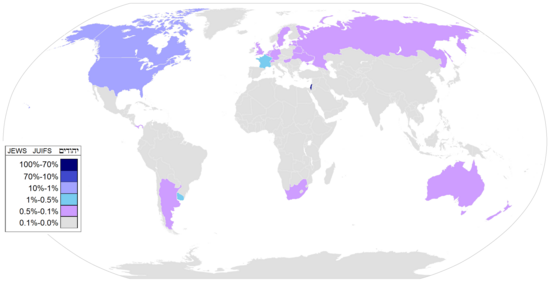
Jewish population by country, 2016.
 Israel 73.6%
 Gibraltar 2.0%
- United States 1.76%
- Canada 1.07%
- France 0.7%
- Hungary 0.485%
- Uruguay 0.483%
- Australia 0.47%
- United Kingdom 0.44%
- Argentina 0.41%
 U.S. Virgin Islands 0.36%
- Belgium 0.259%
- Panama 0.250%
- Latvia 0.24%
- Switzerland 0.22%
- Netherlands 0.17%
- New Zealand 0.16%
- Estonia 0.154%
 Bermuda 0.154%
- Sweden 0.152%
- Germany 0.14%
- South Africa 0.124%
 Ukraine 0.124%
 Russia 0.122%
 Denmark 0.112%
Jainism
 |
This section does not cite any sources. (August 2014) (Learn how and when to remove this template message)
|
- India 0.3%
- Suriname 0.3%
- Fiji 0.2%
- Kenya 0.2%
- Nepal 0.1%
By population
Christians
Largest Christian populations (as of 2011):
- United States 229,157,250 (details)
- Brazil 169,213,130
- Russia 114,198,444
- Mexico 106,204,560
- Nigeria 80,510,000
- Philippines 78,790,000
- China 67,070,000
- Democratic Republic of the Congo 63,150,000
- Italy 55,832,000
 Ethiopia 51,477,950
- Germany 50,752,580
- Colombia 44,502,000
- Ukraine 41,973,000
- South Africa 40,243,000
- France 39,560,000
- Spain 38,568,000
 Poland 36,526,000
- Kenya 33,625,790
- Argentina 33,497,100
- United Kingdom 33,200,417
 Uganda 29,943,000
- India 28,436,000
- Venezuela 28,340,790
- Peru 27,365,100
- Indonesia 24,123,000
Hindus
Largest Hindu populations (as of 2020):
- India 1,120,000,000
- Nepal 28,600,000
- Bangladesh 14,274,430
- Indonesia 4,640,000-10,000,000
- Pakistan 3,990,000
- Sri Lanka 3,090,000
- United States 2,510,000
- Malaysia 1,940,000
- United Arab Emirates 1,239,610
- United Kingdom 1,030,000
- South Africa 749,870
- Mauritius 665,820
- Myanmar 890,000
- Canada 610,000
- South Africa 540,000
- Saudi Arabia 440,000
- Australia 410,000
 Tanzania 403,570
- Singapore 380,000
 Qatar 360,000
- Kuwait 330,000
- Trinidad and Tobago 310,000
- Fiji 270,000
- Guyana 200,000
- Yemen 200,000
- Bhutan 190,000
- Suriname 120,785
- Germany 120,000
Muslims
Largest Muslim populations (as of 2017):
- Indonesia 225,000,000
- Pakistan 203,000,000
- India 182,000,000
- Bangladesh 142,937,800
- Nigeria 90,000,000
- Iran 73,238,340
- Egypt 70,056,000
- Turkey 70,036,838
- Algeria 36,092,810
- Morocco 31,351,800
- Afghanistan 30,112,680
- Sudan 30,064,180
- Iraq 29,767,300
- Ethiopia 28,120,050
- Saudi Arabia 26,624,560
 Uzbekistan 25,628,240
- Russia 25,000,000
- Yemen 23,836,523
- China 20,095,870
 Syria 19,601,750
- Malaysia 17,085,402
Buddhists
Largest Buddhist populations
- China 244,130,000
- Thailand 64,420,000
- Japan 45,820,000
- Myanmar 38,410,000
- Sri Lanka 14,450,000
- Vietnam 14,380,000
- Cambodia 13,690,000
- South Korea 10,500,000
- India 9,250,000
- Malaysia 5,010,000
- United States 3,800,023
- Indonesia 1,710,000
Sikhs
Largest Sikh populations
- India 22,892,600
- United Kingdom 853,000
- Canada 620,200
- United States 500,010
- Malaysia 120,000
- Bangladesh 100,000
- Australia 72,300
- Italy 70,000
- Thailand 70,000
- Myanmar 70,000
- United Arab Emirates 50,000
- Pakistan 50,000
- Germany 40,000
- Mauritius 37,700
- Kenya 20,000
- Kuwait 20,000
- Philippines 20,000
- New Zealand 17,400
- Indonesia 15,000
- Singapore 14,500
Jews
Largest Jewish populations (as of 2017):
- Israel 6,451,000
- United States 5,700,000
- France 456,000
- Canada 390,000
- United Kingdom 289,500
- Argentina 180,500
- Russia 176,000
- Germany 116,500
- Australia 113,200
- Brazil 93,800
- South Africa 69,300
- Ukraine 53,000
- Hungary 47,500
- Mexico 40,000
- Netherlands 29,800
- Belgium 29,300
- Italy 27,300
- Switzerland 18,700
 Chile 18,300
- Uruguay 16,900
- Turkey 15,300
- Sweden 15,000
- Spain 11,800
- Belarus 10,000
- Panama 10,000
Baháʼís
Largest Baháʼí populations (as of 2010) in countries with a national population ≥200,000:
- India 1,897,651
- United States 512,864
- Kenya 422,782
- Vietnam 388,802
- Congo, Democratic Republic of the 282,916
- Philippines 275,069
- Iran 251,127
 Zambia 241,112
- South Africa 238,532
 Bolivia 215,359
- Tanzania 190,419
- Venezuela 169,811
- Uganda 95,098
 Chad 94,499
- Pakistan 87,259
- Myanmar 78,915
- Colombia 70,504
- Malaysia 67,549
- Thailand 65,096
- Papua New Guinea 59,898
Jainism
As of 2005:
- India 5,146,697
- United States 79,459
- Kenya 68,848
- United Kingdom 35,000
- Canada 12,101
- Tanzania 9,002
- Nepal 6,800
- Uganda 2,663
- Myanmar 2,398
- Malaysia 2,052
- South Africa 1,918
- Fiji 1,573
- Japan 1,535
- Belgium 1,500
- Australia 1,449
- Suriname 1,217
 Ireland 1,000
- Réunion 981
- Yemen 229